
You are using an out of date browser. It may not display this or other websites correctly.
You should upgrade or use an alternative browser.
You should upgrade or use an alternative browser.
Kit Wrenches, Auto Kit and others
- Thread starter disston
- Start date


four.cycle
Well-known member
^ You mean the open-ends were the only ones marked with the brand? Or... .???
Very similar, except these have a slightly different holder clip:


Very similar, except these have a slightly different holder clip:
The last one, I promise. Sold by Western Auto, Westline.

That is a paper label. I'm afraid to clean it. I may try some day with mild soap and water.


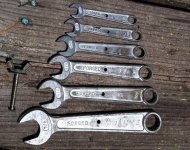
Not all of my pictures come out very good but I think the idea comes across. I've had some of these sets for a few years. The Auto-Kit set goes for $25 or more if complete and in good condition. The other double open end sets are usually less. There was a double box end set a few months ago, forget by who, that went for over $30. Of course I didn't get it.
My prices I mention here are the prices I have been willing to pay and what I have found these kits for. They of course may sometimes go for more too.
A very interesting feature of the Auto-Kit is the the box end and the open end on each wrench do not match. So if you have a doubled nut on something to be so it doesn't come loose you would have two wrenches with the same size that can be used together.
I hope some others have a fancy for these sets and will post some more. I'm sure there are other sets. Right now I think I'm full up on the things.
Charlie
That is a paper label. I'm afraid to clean it. I may try some day with mild soap and water.
Not all of my pictures come out very good but I think the idea comes across. I've had some of these sets for a few years. The Auto-Kit set goes for $25 or more if complete and in good condition. The other double open end sets are usually less. There was a double box end set a few months ago, forget by who, that went for over $30. Of course I didn't get it.
My prices I mention here are the prices I have been willing to pay and what I have found these kits for. They of course may sometimes go for more too.
A very interesting feature of the Auto-Kit is the the box end and the open end on each wrench do not match. So if you have a doubled nut on something to be so it doesn't come loose you would have two wrenches with the same size that can be used together.
I hope some others have a fancy for these sets and will post some more. I'm sure there are other sets. Right now I think I'm full up on the things.
Charlie
All of these wrench kits are made with drop forged tools and good quality at least from that standpoint. The ones from Bridgeport I hold a little dearer just because of the name I guess. I'm thinking the Auto-Kit was first but I don't know if that is a fact. I think this is an example of items sold at the checkout counter, what today is called an "Impulse Buy".
I'm going to wipe tese down with some light oil and put them away. But maybe I'll take a pic of the Indestro set nailed to a wall. Now that I know how the rack works thanks to Four.Cycle. Thanks to all the rest too. The knowledge on this site about tools is tremendous.
Charlie
I'm going to wipe tese down with some light oil and put them away. But maybe I'll take a pic of the Indestro set nailed to a wall. Now that I know how the rack works thanks to Four.Cycle. Thanks to all the rest too. The knowledge on this site about tools is tremendous.
Charlie
Last edited:
four.cycle
Well-known member
^ And don't try to "clean" that label. Nothing you can do is going to make it "better". the most radical thing I'd even think of attempting would be a damp paper towel, and even then I'd be real careful.
There were all kinds of similar "kits" made up of stamped steel wrenches, like that "Aetna" set I posted above. Indestro made them in a number of configurations. There were also all kinds of "kits" made that were either fastenened together with a screw and nut (or permanently fastened together at a central pivot point with a rivet) made for early ignition systems and magnetos.
As to "who was first" on the forged style, Alloy-Artifacts says Danielson patented their "Auto Kit" set in 1937.
The oldest documentation I have for a forged Indestro set is in the 1938 Jensen-Byrd Hardware catalog. (I cannot find a similar forged set in the 1935 Indestro catalog.)
It might be reasonable to assume they both came out with the item about the same time, or within a couple years of each other.
There were all kinds of similar "kits" made up of stamped steel wrenches, like that "Aetna" set I posted above. Indestro made them in a number of configurations. There were also all kinds of "kits" made that were either fastenened together with a screw and nut (or permanently fastened together at a central pivot point with a rivet) made for early ignition systems and magnetos.
As to "who was first" on the forged style, Alloy-Artifacts says Danielson patented their "Auto Kit" set in 1937.
The oldest documentation I have for a forged Indestro set is in the 1938 Jensen-Byrd Hardware catalog. (I cannot find a similar forged set in the 1935 Indestro catalog.)
It might be reasonable to assume they both came out with the item about the same time, or within a couple years of each other.
Private Lugnutz
Well-known member
I found a couple pre-war vintage hand-crank valve grinders today at one of my early bird flea markets. (Photo posted in Garage Sale thread: http://www.garagejournal.com/forum/showpost.php?p=6354604&postcount=1124) One of them was a Duro. What does that have to do with this thread? Look what I saw pictured with the grinder when I went to the 1939 catalog to find it...

four.cycle
Well-known member
^ Yes, those are the stamped, not forged type wrenches, which were made by all kinds of outfits much earlier than the forged "Auto-Kit" type Danielson made or the type made by Indestro.
The early ignition/magneto wrenches were stamped (as opposed to forged), and they were available much earlier, like these Gilfillan sets that date from between 1915-1921:
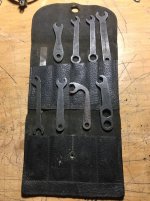
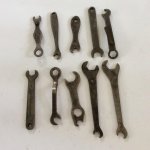
Indestro showed stamped wrench sets in their 1935 catalog:
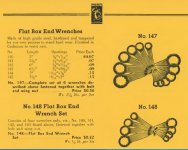
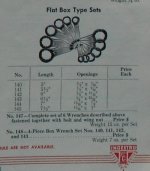
The early ignition/magneto wrenches were stamped (as opposed to forged), and they were available much earlier, like these Gilfillan sets that date from between 1915-1921:
Indestro showed stamped wrench sets in their 1935 catalog:
Last edited:
Private Lugnutz
Well-known member
Yes, definitely the pressed steel type. I have a few that go in the toolkit for my bike (BSA WDM20). I just thought it was interesting, shown loose, without the set and center clip, and more suggestive of their general purpose.
four.cycle
Well-known member
^ Those were sold in "kits" that were held together with a screw and nut (as opposed to a "clip"), like these "nut and tap wrench sets" shown in the 1935 Indestro catalog. I've seen them referred to as "script wrenches" (presumably because the Indestro name is stamped on them in "script" writing.)
Some of the ignition/magneto wrench sets I've seen listed on Ebay are permanently attached at a center pivot point with a rivet.
Just speculation on my part, but I'd think that Duro / Indestro weren't the only people stamping out wrenches of this sort - I see all kinds of these listed individually on Ebay that have become orphaned from the sets they originally belonged to.
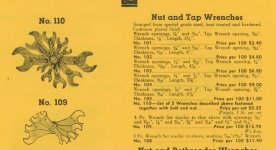
Some of the ignition/magneto wrench sets I've seen listed on Ebay are permanently attached at a center pivot point with a rivet.
Just speculation on my part, but I'd think that Duro / Indestro weren't the only people stamping out wrenches of this sort - I see all kinds of these listed individually on Ebay that have become orphaned from the sets they originally belonged to.
Private Lugnutz
Well-known member
Yes. Poor choice of words on my part. Kit wrenches, shown loose, without the other wrenches that go in the kit, and without whatever held them together through that hole in the middle. Hahaha.^ Those were sold in "kits" that were held together with a screw and nut (as opposed to a "clip")
Private Lugnutz
Well-known member
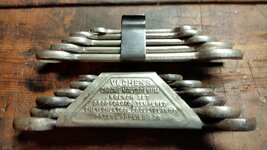
I was inspired enough by this thread to dig a couple wrench kits out. A pre-war 6-wrench Vlchek, and a post-war 5-wrench BHM.


The BHM set is their No. 25N with a plated finish. The wrenches have ‘FORGED STEEL’ and ‘U.S.A.’ on the depressed panels on the top side along with the fractional sizes, and the metric sizes on the depressed panels on the flip side.


Here it is in the 1953 catalog:

Charlie (disston) posted a photo of his kit upthread, which is No. 53, with a blued finish. Different holder.
Link to his kit here: http://www.garagejournal.com/forum/showpost.php?p=6352651&postcount=39
The Vlchek kit is a “FITZ-ALL” in the tin hinged container. This is kit No. 2045 with the rust proof “Velco” (cadmium-plated) finish. (The pin through the closure on the back is not original.) The wrenches have the sizes on the jaw faces and ‘DROP FORGED’ on the shank, and the ‘Vlchek Chrome Molybdenum’ branding and an ISN-based model numbers (1723, 1725B, 1027, 1729, 1031, and 1033B) on the jaw faces and ‘MADE IN U.S.A.’ on the shank on the flip side.


Here it is in the 1936 catalog:

The BHM set is their No. 25N with a plated finish. The wrenches have ‘FORGED STEEL’ and ‘U.S.A.’ on the depressed panels on the top side along with the fractional sizes, and the metric sizes on the depressed panels on the flip side.
Here it is in the 1953 catalog:
Charlie (disston) posted a photo of his kit upthread, which is No. 53, with a blued finish. Different holder.
Link to his kit here: http://www.garagejournal.com/forum/showpost.php?p=6352651&postcount=39
The Vlchek kit is a “FITZ-ALL” in the tin hinged container. This is kit No. 2045 with the rust proof “Velco” (cadmium-plated) finish. (The pin through the closure on the back is not original.) The wrenches have the sizes on the jaw faces and ‘DROP FORGED’ on the shank, and the ‘Vlchek Chrome Molybdenum’ branding and an ISN-based model numbers (1723, 1725B, 1027, 1729, 1031, and 1033B) on the jaw faces and ‘MADE IN U.S.A.’ on the shank on the flip side.
Here it is in the 1936 catalog:
Last edited:
four.cycle
Well-known member
Private Lugnutz said:"Kit wrenches, shown loose, without..."
 Don't mind me.. it's just my pedanticism getting the best of me
Those are pretty fabulous - love the holder on the Vlchek set. Does that just "snap" together? (I'm assuming the pin is just the hinge mechanism, correct?)
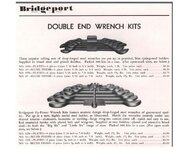
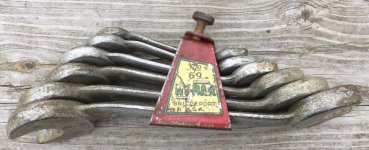
I posted a Bridgeport "Hy-Power" set just above (post #40) that has the SAE sizes stamped on one side and metric on the other, kind of like yours but clearly much older. I wonder how many other makers were doing that; marking both SAE and metric on the same wrench? Or was it exclusively a Bridgeport thing?
Private Lugnutz
Well-known member
No offense taken.
No. It actually hinges at the bottom, and that open frame drops down to open the holder.four.cycle said:Does that just "snap" together? (I'm assuming the pin is just the hinge mechanism, correct?)

I have discovered that the pin is original. I thought it was too crude to be an original latch, and I was thrown off by a reference in the catalogs to these holders “locking,” therefore expecting something different in a latch, but the DATAMP website has a photo of a set just like mine showing the same exact crudely bent pin latch. Click on the link and then go to Page 2.
http://www.datamp.org/patents/displayPatent.php?number=1,877,466&type=
Vlchek did make a holder that actually had "FITZ-ALL" embossed into the sheet metal holder where mine says "CHROME MOLYBDENUM". Here’s an ad from a 1930 Popular Mechanics magazine. You can just make out the FITZ-ALL on the holder at the bottom or the pyramid.

They had a few of these sheet metal holder sets with mysterious names (Star, Norivell, and Checker), with those names embossed in the holder. I was assuming mine is from later in the 1930’s when they perhaps dropped those novelty names. The 1936 catalog only includes the “FITZ-ALL,” as shown in my post above, not the other sets, but it doesn’t show the front of the holder. The 1941 catalog advertises generic wrench sets, and the image shows a holder with “CHECKER” embossed in it. My holder is stamped with the patent (1,808,190) on the bottom, which dates to June 2, 1931. Strangely, they had an improved design patent (1,877,466) granted Sep 19, 1932, throwing my conclusions about the date of my kit into question. It can’t be older than 1931. Whether it’s contemporary to the named sets or later, I don’t know.
Frankly, I don't recall ever seeing it on another wrench prior to the modern era, in person or in a catalog or advertisement. I have a 1946 Cleveland Twist Drill reamer set that is marked with fractional and metric sizes on the reamers and the box, and the unit of measure is articulated the same exact way ("m/m"). And when I saw it I had the same double-taking anachronistic reaction I had when I first realized that Bridgeport was doing it: way ahead of its time.four.cycle said:I posted a Bridgeport "Hy-Power" set just above (post #40) that has the SAE sizes stamped on one side and metric on the other, kind of like yours but clearly much older. I wonder how many other makers were doing that; marking both SAE and metric on the same wrench? Or was it exclusively a Bridgeport thing?
Last edited:
four.cycle
Well-known member
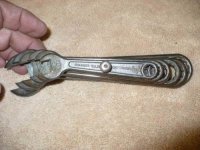
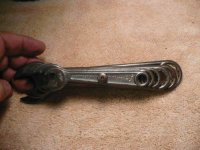
This was just listed on Ebay today. Shows the original tapered screw and knurled round nut that holds the wrench set together.
J.P. Danielson 6-piece "Auto Kit 100" SAE wrench set
with the original tapered screw and knurled nut
(photos Ebay)


just a note for the curious:
That 6-pc Danielson "Auto Kit" wrench set sold for $40.00 (incl. shippning) on 03/08
http://www.ebay.com/itm/6-Pcs-Vinta...=item5b34811e49:g:SUoAAOSwTuJYv2t4&rmvSB=true
J.P. Danielson 6-piece "Auto Kit 100" SAE wrench set
with the original tapered screw and knurled nut
(photos Ebay)
just a note for the curious:
That 6-pc Danielson "Auto Kit" wrench set sold for $40.00 (incl. shippning) on 03/08
http://www.ebay.com/itm/6-Pcs-Vinta...=item5b34811e49:g:SUoAAOSwTuJYv2t4&rmvSB=true
Last edited:
honza.vosalik
Well-known member

Farmer J.
Well-known member
I came across this Ford wrench today at a garage sale. Couldn't resist.
Nice wrench!
Looks like a spark plug wrench from a model N tractor. The open end is for removing the plug. The plugs come apart for cleaning, and you put the plug into the hexagonal hole cast into the side of the radiator frame to hold it, then use the wrench ring end to unscrew the middle bit of the plug so it's easy to clean the electrodes.
d42jeep
Well-known member
I was inspired enough by this thread to dig a couple wrench kits out. A pre-war 6-wrench Vlchek, and a post-war 5-wrench BHM.
The BHM set is their No. 25N with a plated finish. The wrenches have ‘FORGED STEEL’ and ‘U.S.A.’ on the depressed panels on the top side along with the fractional sizes, and the metric sizes on the depressed panels on the flip side.
Here it is in the 1953 catalog:
Lugz,
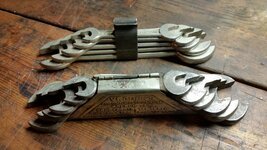
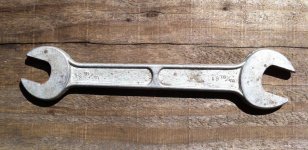
If you hadn't posted your BHM set I would never have picked up this BHM DOE
wrench at a Berkeley estate sale yesterday because I wouldn't have known what it was.
-Don




Last edited:
four.cycle
Well-known member
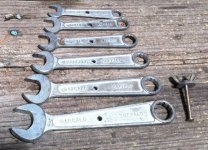
The same style wrench was also made by Barcalo Buffalo - came across these on Ebay a couple days ago"


Who knew?
Who knew?
d42jeep
Well-known member
four.cycle
Well-known member
gah!
well, I guess we can all tell who's actually paying attention here, right?
had to scroll all the way back to the beginning to find them.
wonder if anybody else made a similar wrench?
coincidentally, there have been a bunch of them listed on Ebay just recently. (or maybe I just wasn't paying much attention to them before.)
well, I guess we can all tell who's actually paying attention here, right?
had to scroll all the way back to the beginning to find them.
wonder if anybody else made a similar wrench?
coincidentally, there have been a bunch of them listed on Ebay just recently. (or maybe I just wasn't paying much attention to them before.)
Username already in use
Well-known member
Private Lugnutz
Well-known member
That's a great find and a really sweet set with a fairly intact label!
Steel A Rod
Active member
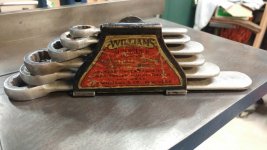


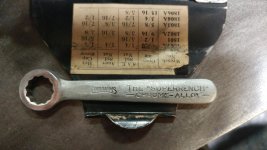
Picked these up a couple of days ago. Looks like most of the wrenches were never used.
^^^^^^^^^^^^
That is TOOO sweet.

Sawdustmaker
Well-known member
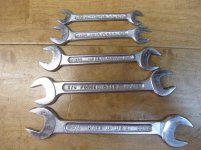
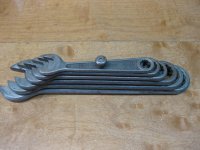
Here is my Auto Kit set. Belonged to my dad. Probably from the 1930's or 40's. The other set is one my mom gave me when I got my first car. It originally had a clip that held them together, but the thread striped of the thumb screw and it is now long gone. This set has no company name on it, but each wrench has one letter. In order from largest wrench to smallest the letters are: W N X L C
Attachments

I really like the Bridgeport set.
Someday I'll find a box end set I can afford but a single end box end set? Who wood a thought?
Tools from your parents are super cool. I have a small Craftsman set of pliers my parents gave me for Christmas one year. They are not something I owned or would of bought for myself. I use them all the time.
Someday I'll find a box end set I can afford but a single end box end set? Who wood a thought?
Tools from your parents are super cool. I have a small Craftsman set of pliers my parents gave me for Christmas one year. They are not something I owned or would of bought for myself. I use them all the time.
The right hand set looks like it was made by Lectrolite, circa early 1950s to about 1962. Unbranded TruFit wrenches, same ones that came in the same time-period Dunlap (later just plain "Sears") kits. You should find an "LC" mark somewhere on them, but I have seen examples without those initials too.Here is my Auto Kit set. Belonged to my dad. Probably from the 1930's or 40's. The other set is one my mom gave me when I got my first car. It originally had a clip that held them together, but the thread striped of the thumb screw and it is now long gone. This set has no company name on it, but each wrench has one letter. In order from largest wrench to smallest the letters are: W N X L C
Last edited:
Private Lugnutz
Well-known member
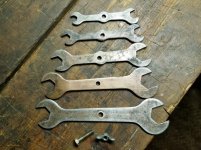
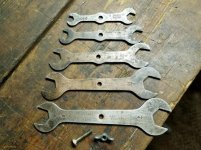
As first reported in the 2018 Garage Sale thread, I picked up this auto kit style set of wrenches this morning. I am hoping our resident auto kit style wrench set expert, four.cycle, can held sort this kit out. The biggest wrench on the bottom is stamped [FRANKLIN], which I never heard of. They were grimy when I found them, and when I cleaned them up I discovered a copper coating finish on all of them, which must be what the "RUST PROOFED" is referring to. The "HARD C.R. STEEL" is a reference to their manufacturing process - not forged or cast, but stamped out of cold rolled (or pressed) steel.
Attachments


Last edited:
northwoods
Well-known member
Mine too--woth the little bolt. ;-).
Private Lugnutz
Well-known member
I posted this in the Indestro thread but because that thread is on the General Discussion board, not the Vintage board, I am going to re-post it here.
I picked up an auto-kit style Indestro Wrench Set No. 900-4C at the flea market today. As far as I have been able to determine, it dates to the late 1940's or early 1950's. There is a No. 900-4C set specified exactly like mine on page 50 of the 1949 Indestro catalog. The figure is not showing a clip, only a screw and a wingnut, but all these sets, including the No. 900-4C are shown with clips on page 47 of the 1958 Indestro catalog. Even though these combination wrenches have individual model numbers in the catalog, they are not marked with those numbers. They are branded, marked with the sizes, 'DROP FORGED SELECT STEEL', and the COO on the flip side. These wrenches are not plated. They appear to have some kind of zinc wash on them.
I picked up an auto-kit style Indestro Wrench Set No. 900-4C at the flea market today. As far as I have been able to determine, it dates to the late 1940's or early 1950's. There is a No. 900-4C set specified exactly like mine on page 50 of the 1949 Indestro catalog. The figure is not showing a clip, only a screw and a wingnut, but all these sets, including the No. 900-4C are shown with clips on page 47 of the 1958 Indestro catalog. Even though these combination wrenches have individual model numbers in the catalog, they are not marked with those numbers. They are branded, marked with the sizes, 'DROP FORGED SELECT STEEL', and the COO on the flip side. These wrenches are not plated. They appear to have some kind of zinc wash on them.
Attachments


Private Lugnutz
Well-known member
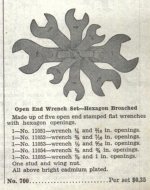
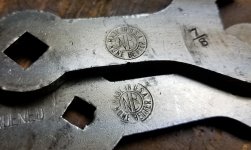
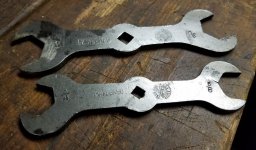
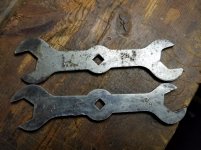
I saw these at my flea market and I was astonished that they were branded with the NONE BETTER logo and not Indestro when I picked them up to inspect them closer. I guess it should come as no surprise, since New Britain was a giant and made everything that Duro/Indestro did and then some, but I didn't know they made these. First seen for me. But an excerpt from the NONE BETTER section of a 1937 W. Bingham catalog (See Pic 3) that 4.c shared with me shows them. New Britain apparently dropped them by 1940, as they don't appear in that factory catalog.
Looks like I have the two (2) largest wrenches - 11055 and 11054. I am missing three (3) wrenches - 11053, 11052, and 11051. I have no expectations of ever finding them, but it will be exciting if I do!
Looks like I have the two (2) largest wrenches - 11055 and 11054. I am missing three (3) wrenches - 11053, 11052, and 11051. I have no expectations of ever finding them, but it will be exciting if I do!
Attachments
four.cycle
Well-known member
^ Is that 5/8" end split open on the gullet? I would not have thought those would do that, considering how thick they are.
Do you think there's any possibility those came off the same production line as Indestro? Perhaps in either Chicago or somewhere in Connecticut?
Do you think there's any possibility those came off the same production line as Indestro? Perhaps in either Chicago or somewhere in Connecticut?
Private Lugnutz
Well-known member
Yes on the split gullet; Possibly but I don't think so on Indestro as OEM. The 1 x 7/8 wrenches are fairly close in profile, but the 5/8 x 3/4 wrenches are not.
Attachments



Oldtuleguy
Well-known member
- Joined
- Nov 4, 2017
- Messages
- 10,486
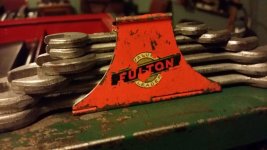
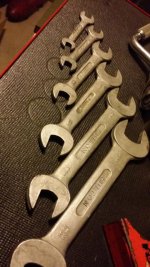
d42jeep
Well-known member

What did I miss? $221 ??
https://www.ebay.com/itm/Vintage-Au...p6EPlJU6SY%3D&orig_cvip=true&nordt=true&rt=nc
https://www.ebay.com/itm/Vintage-Au...p6EPlJU6SY%3D&orig_cvip=true&nordt=true&rt=nc
Private Lugnutz
Well-known member

 I have no clue. It's a complete set, and in nice condition, but "Batman" JPD's are not rare as far as I know! Common, in fact. I usually don't even pick them up when I see them at the fleas! Maybe the bidders know something we don't. Let's see what 4.c and others think.