To avoid these ads, REGISTER NOW!

Pebble Plomb Production Dates

Private Lugnutz

Well-known member
Joined
Mar 30, 2012
Messages
30,508
Location
The Authentic Jersey Shore
Can anyone point me to the rationale/justification for the common convention of dating the majority of Plomb's pebbled finish tools (i.e., wrenches, socket drive tool handles, etc) to post-WWII?

This is not a naiive question. To be even more direct, and to forestall someone from answering with links to the Van Natta, Alloy Artifacts, Bartlett Street, and Tools Archive sites, I am fully aware of those sites, fully versed in the 1940's catalogs hosted on those sites, and what they say about "pebble" tools production. Why those tools are dated to post-war is not explained and, in my opinion, not at all self-evident from the catalogs.

So, can anyone point me to the rationale?
 
To avoid these ads, REGISTER NOW!

Ole Slewfoot

Well-known member
Joined
Feb 22, 2016
Messages
5,098
Location
Freedom, CA
Prior to the pebble style, the tools have dates?
They are not shown in earlier catalogs.
They span the split between Made In USA and MFD USA
They carry over into Proto production.
They are chromed.

I see these points as backing the theory
 
OP
P

Private Lugnutz

Well-known member
Joined
Mar 30, 2012
Messages
30,508
Location
The Authentic Jersey Shore
Thanks for your reply, Slew. I will take them one by one. This kind of dialogue will help me think through my understanding.

Prior to the pebble style, the tools have dates?
True, but not all tools from the wartime period are dated.

They are not shown in earlier catalogs.
This is very disputable, or at least ambiguous, and actually forms the basis of my questioning.

They span the split between Made In USA and MFD USA
This is true, but would also be true if the pebble style were late war.

They are chromed.
This is not true. Not all pebble tools are chromed. I own a few that are not, and have seen others that are not.
 

Username already in use

Well-known member
Joined
Sep 4, 2015
Messages
2,177
Location
Ohio
I've been wondering the same thing actually. The early Pebble style ratchets are marked 'Made in USA' and are NOT chrome plated. This leads me to believe that they are at least late war manufacture.

I'm gonna grab some popcorn and see how this shakes out!

Edit:
Not the best example out there, but here is my unplated 1/2" drive #5449 ratchet marked 'Made In'

attachment.php
 

Attachments

  • Plomb 5449 ratchet.jpg
    Plomb 5449 ratchet.jpg
    98.3 KB · Views: 451
Last edited:

Provincial

Well-known member
Joined
Sep 21, 2011
Messages
6,856
Location
Near Salem, OR
Does anyone know if Plomb had government contracts cancelled late in WWII? If so, Plomb could have started on post-war designs before the end of the war.

Were there shortages of materials for non-defense projects late in the war? If not, Plomb could have started making new forging dies earlier. If alloy steel was still being rationed, it would have been hard for them to make the new dies.

I have a 3/4 pebble ratchet that is not chrome. I wonder if early post-war production wasn't chromed due to shortages during the conversion to peace-time production?

It seems odd that a company so involved in defense production would retool to a decorative and more complicated design when they had established and reputation for utilitarian tools. The pebble design had to have been motivated by civilian marketing, since the government couldn't care less about the esthetics of wrenches.
 
OP
P

Private Lugnutz

Well-known member
Joined
Mar 30, 2012
Messages
30,508
Location
The Authentic Jersey Shore
Does anyone know if Plomb had government contracts cancelled late in WWII?
They did not. Their biggest contracts ($3.197M and $4.203M) were in 1942, and they had four (4) fairly hefty follow-ons in 1943 and 1944. But they were awarded a contract for "Wrenches" from the USAAF in February 1945 (worth $165,000) and April 1945 (worth $160,000), which were not terminated until August 1945 and January 1946 respectively. I suspect that these would've been the contracts that produced pebbled handle tools, if they were made during WWII.

Were there shortages of materials for non-defense projects late in the war? If not, Plomb could have started making new forging dies earlier. If alloy steel was still being rationed, it would have been hard for them to make the new dies.
Alloy restrictions were successively reduced starting in late 1944 and revoked by April 1945. Limitation orders limiting production for commercial sales inventories (the footprints of which can be seen sprinked throughout many wartime catalogs, including Plomb) were revoked in May 1945.

It seems odd that a company so involved in defense production would retool to a decorative and more complicated design when they had established and reputation for utilitarian tools. The pebble design had to have been motivated by civilian marketing, since the government couldn't care less about the esthetics of wrenches.
Actually, the pebbled background was first used on the handles of pliers in the late 1930's and its purpose was utilitarian: as a gripping surface. While we think of it as aesthetically pleasing on the shanks of wrenches and drive tool handles, I believe a dual-purpose goes back to the original purpose. Plomb was constantly experimenting with dual-purpose designs, and was no stranger to converging aesthetic and functional features: consider the entire "Name-Nurl" concept on pliers handles, for example.
 
OP
P

Private Lugnutz

Well-known member
Joined
Mar 30, 2012
Messages
30,508
Location
The Authentic Jersey Shore
The early Pebble style ratchets are marked 'Made in USA' and are NOT chrome plated. This leads me to believe that they are at least late war manufacture.
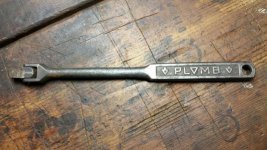
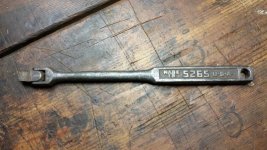
Not just the ratchets! Here is a Plomb pebble 5265 hinge handle I own. It's these tools, in conjunction with them showing up illustratively in catalogs replete with wartime War Production Board (WPB) references, that are at the crux of my question.
 

Attachments

  • 20170512_174300.jpg
    20170512_174300.jpg
    67.7 KB · Views: 98
  • 20170512_174247.jpg
    20170512_174247.jpg
    70.1 KB · Views: 104

Carla

MEMBER EMERITUS
Joined
Nov 27, 2010
Messages
672
Prior to the pebble style, the tools have dates?
They are not shown in earlier catalogs.
They span the split between Made In USA and MFD USA
They carry over into Proto production.
They are chromed.

I see these points as backing the theory

At least some of the 'pre-pebble era' dated Plombs were chrome-plated.

I have here a small basic 1/2 drive set, called '5400X Challenger' in the 1940 catalogue, in which the tooling is nicely polished and chrome-plated. The pieces are marked '39A' and '39B', presumably indicating January and February of 1939 production dates. (this was a lucky flea market find from 20-ish years ago....still 'as new', except, apparently, for one usage......one socket had some black greasy grime in it, the others were pristine.)

The aesthetic quality of finish on that set is quite noticeably better than the finish of the generality of post-war chromed Plomb tooling......maybe more careful polishing, maybe thicker plating??

I've a stray 1216 wrench, marked '2A', presumably January of 1942 production, which was nicely polished and chrome-plated.

(this could lead one to guess that the Plomb works had planned to offer chrome-finish wrenches as a regular line, and had them in production by December of '41, or a little earlier, and some chrome-finish wrench production was still running by Feb. of '42, til they were told 'no more chrome-plated tools, for the duration'????)

cheers

Carla
 
OP
P

Private Lugnutz

Well-known member
Joined
Mar 30, 2012
Messages
30,508
Location
The Authentic Jersey Shore
Yes. Chromium was put under govt control in mid 1941, during the Emergency period, prior to the declaration of war. So was nickel, vanadium, and molybdenum. The controls grew successively more severe until January 1942, when the govt had to ban vanadium altogether, restricted molybdenum and chromium content in steel that made pre-war recipes impossible (prompting consortium-invented "New Emergency" steels, essentially AISI 8600/8700 triple alloys), and ban nickel and chrome plating. There was a grace period until Nov 1942 for pre-war steel that was already at a mfgr's warehouse. But there was no grace period for plating. That was revoked in mid 1945. If you search on "alloy restrictions" or "War Production Board" you may find other threads where I have discussed this in more elaborate detail here. I'm out, on my phone, or I'd try to find them for you.
 

Rileysan

Well-known member
Joined
Sep 11, 2015
Messages
4,298
Location
Milwaukie, Oregon
Not just the ratchets! Here is a Plomb pebble 5265 hinge handle I own. It's these tools, in conjunction with them showing up illustratively in catalogs replete with wartime War Production Board (WPB) references, that are at the crux of my question.

Playing devil's advocate here -

1) Are there records of Plomb tools being sold/shipped to the military without the WF part numbers?

2) How certain can you be that a tool without chrome plating was manufactured that way?

I have several Long-C Craftsman wrenches (double box-ends to be precise) that are in various conditions ranging from fully chrome plated to peeling chrome plating to no chrome plating. Those wrenches that are peeling could easily be cleaned of their chrome plating and be passed off as having been manufactured that way.

Brian
 

d42jeep

Well-known member
Joined
Oct 22, 2014
Messages
16,510
Location
Northern California
Lugz,
I checked the Plomb ratchets I've unintentionally gathered and I have a 1/4" drive that's unplated and has the less well finished look we normally associate with wartime tools. It is marked "Made in USA" as opposed to the "Mfg USA" on the chrome 3/8" and 1/2" drive ratchets. The finish more resembles the Wright Field ratchets I added for comparison.
-DonIMG_4118.jpgIMG_3239.jpgIMG_3251.jpg
 
Last edited:

Rileysan

Well-known member
Joined
Sep 11, 2015
Messages
4,298
Location
Milwaukie, Oregon
Lugz,
I checked the Plomb ratchets I've unintentionally gathered and I have a 1/4" drive that's unplated and has the less well finished look we normally associate with wartime tools. It is marked "Made in USA" as opposed to the "Mfg USA" on the chrome 3/8" and 1/2" drive ratchets. The finish more resembles the Wright Field ratchets I added for comparison.
-Don

Did you see the WF-38 Proto ratchet in the Plomb thread? The Proto name wasn't used during WWII, was it?

http://www.garagejournal.com/forum/showpost.php?p=6486506&postcount=2323

Taking that example, who's to say that Wright Field tools weren't manufactured after the war? That is, how many years did Pendleton Tool manufacture tools with the Wright Field model numbers? If production of Wright Field continued into the 1950s, as that Proto ratchet implies, then there's no good argument for the production of pebble wrenches for WWII.

Brian
 
Last edited:

stormking

Well-known member
Joined
Jan 27, 2011
Messages
401
Have you ever seen a "war finish" pebble? I have not in the hundreds of examples I own or have seen. That doesn't mean they don't exist.
Just a hypothesis, even if Plomb had planned on introducing the pebble design earlier in the 1940's; once the war started they would not have tooled up until the outcome wasn't in doubt. An interesting topic for sure and one that I hope the definitive answer shows up some day.
 
OP
P

Private Lugnutz

Well-known member
Joined
Mar 30, 2012
Messages
30,508
Location
The Authentic Jersey Shore
1) Are there records of Plomb tools being sold/shipped to the military without the WF part numbers?
Not all Plomb tools sold to the military during WWII were "Wright Field" tools. That is a common fallacy. Besides their contracts with the US Army Air Corps (its headquarters was Wright Field, OH, hence the abbreviated contract designation), Plomb also had contracts with the US Ordnance Dept, the Navy, and the Treasury Dept (those tools were acquired for the Federal Standard Stock Catalog system, and could've went to any federal agencies). None of those other tools had "WF" marked on them.

2) How certain can you be that a tool without chrome plating was manufactured that way?
100%. I have handled thousands of pre-war, wartime, and post-war tools. A tool with a natural steel finish is unmistakable from a tool that has shed its plating. I'm not saying it cant happen. (In fact, I have used muriatic acid to remove plating from a tool, and that surface did not look like a natural steel finish.) But, passing one off is different than un-plated pebble Plomb drive tools showing up in all over the country in numbers. That would require an enterprise (of shamming) in scale and scope that I am not cynical enough to give a second thought to, frankly.
 
OP
P

Private Lugnutz

Well-known member
Joined
Mar 30, 2012
Messages
30,508
Location
The Authentic Jersey Shore
I checked the Plomb ratchets I've unintentionally gathered and I have a 1/4" drive that's unplated and has the less well finished look we normally associate with wartime tools. It is marked "Made in USA" as opposed to the "Mfg USA" on the chrome 3/8" and 1/2" drive ratchets. The finish more resembles the Wright Field ratchets I added for comparison.
Thanks, Don. Agreed.
 
OP
P

Private Lugnutz

Well-known member
Joined
Mar 30, 2012
Messages
30,508
Location
The Authentic Jersey Shore
Did you see the WF-38 Proto ratchet in the Plomb thread? The Proto name wasn't used during WWII, was it?

Taking that example, who's to say that Wright Field tools weren't manufactured after the war? That is, how many years did Pendleton Tool manufacture tools with the Wright Field model numbers? If production of Wright Field continued into the 1950s, as that Proto ratchet implies, then there's no good argument for the production of pebble wrenches for WWII.

I have not seen the particular ratchet you are referring to, Brian, but they have popped up before, and they have been discussed before. My position on these Proto WF tools is the use of old dies. The last "Wright Field" contract on record was terminated in January 1946. Production for the US Army Air Corps (part of the US Army Air Forces), as the contract agency associated with the "Wright Field" contracts, could not have occurred after 1947, when the US Army Air Forces became a separate service known as the US Air Force. I suppose it's possible that the US Air Force contracted with Proto, and Proto continued to use the legacy "WF" marking to designate those tools. I just think it's unlikely, and there's no record of it.
 
OP
P

Private Lugnutz

Well-known member
Joined
Mar 30, 2012
Messages
30,508
Location
The Authentic Jersey Shore
The start of all this for me was Twertsy recently publishing a “new” Plomb catalog on his site (http://toolarchives.com/node/3347). The catalog – No. 19, generously provided by a GJ member, has never been seen in the public domain before to my knowledge. It is listed in the catalog section of the Van Natta Brothers Plomb History page (http://www.vannattabros.com/plomb/plombtool.html), but it is not listed in the Alloy Artifacts reference library (http://alloy-artifacts.org/plomb-gallery.html#history). It is not dated, and is not accompanied by a dated Price List. In my opinion, it dates to 1942 into early 1943. (There will be much more on that in the discussion below).

Reviewing it prompted me to do a long-threatened deep dive into all the 1940’s era Plomb catalogs, due to inklings, misgivings, and confusion I have always had about the way these catalogs are interpreted, dated, and used to date vintage Plomb tools.

As I said upthread, I am challenging the seemingly unanimous conventional wisdom that the majority of so-called “pebble finish” drive tools are post-WWII.

As far as I can tell, this commonly accepted milestone is supported by three major sources in the collecting community:

Section 8 of the Van Natta Brothers “Plomb History” site states that the pebbled finish was “adapted to a major portion of the Plomb line as soon as War Production permitted circa 1945.” (In my interpretation, “circa 1945” is a vague reference to the end of the war, and “War Production” is an incomplete reference to the War Production Board. But I’m not completely sure I understand the reference - and I don’t think the guys behind the Van Natta site fully do, either, since a pebbled finish would not have been restricted by the WPB during the war, as long as it did not require a separate die in the forging process. Plating with certain precious metals, e.g., nickel and chromium, was the only finish restriction.) Regardless of the sketchiness of the statement, the implication seems to assert that pebbled finishes on a majority of the tools was a post-war convention.

Page 1 of the Plomb section on Alloy Artifacts agrees, stating, “After the end of the war Plomb changed many of its tools to include a ‘pebbled’ background on the flat forged areas,” and Alloy Artifacts dates all examples of its so-called “Pebble Period” tools to 1945 or later.

A timeline posted on the Tools Archive (http://toolarchives.com/?q=Plomb-Company-timeline) seems to agree with Van Natta and Alloy Artifacts, noting that pebbled grips first appeared on pliers in the 1930’s, and going so far as to pinpoint the appearance of the pebbled background on the majority of tools to an exact date: 9-30-1945. (I am waiting on an answer from Todd on his reference source for this date, which he is trying to backtrack.)

My challenge is politely interrogative. That is to say, it is phrased in questions. I can only see one logical answer. But I could be wrong. And I would gladly be proven wrong. I will present my substantiated reasons and I would welcome any substantiated arguments in return.
 
OP
P

Private Lugnutz

Well-known member
Joined
Mar 30, 2012
Messages
30,508
Location
The Authentic Jersey Shore
First, some essential background information.

I have conducted extensive research on War Production Board (WPB) M (Material) and L (Limitation) Orders that affected the steel composition, finish, and availability of all steel hand tools from all Mfgrs between January 1942 and April 1945. With a colleague, I have found all the most important M and L Orders, including the L-216 that many period catalogs, including Plomb, make reference to. We have enough material, quite literally, for a book on this subject. For the purposes of this inquiry, these two bullets will suffice:

- All the major M Orders (for brevity – eliminating all vanadium in steel, and severely restricting chromium and molybdenum) were in effect from January 1942 to August 1945.

- Limitation Order L-216, which is the focus of my analysis with respect to Plomb pebble finish tools, was in effect from May 1943 to May 1945.

The issue I have is that none of the resources (Van Natta, AA, etc) make any mention of the wartime restrictions in their comments on the catalogs and the dating of the catalogs. Without a rationale for how they're dating the catalogs, and therefore the tools they are using the catalogs to date, I have no idea if they understand what they are and when they were enforced.

Here is a sort of table summarizing the catalogs involved in my argument, with notes on markings in the illustrations, and the indications, or not, as the case may be, of wartime WPB restrictions (and providing a link to the respective catalog for those who want to follow along and check and/or argue with my analysis):

Catalog # – Dated? – Markings – Significant Notes

#18-A - not dated, Price Lists dated August 1940 and October 1941 - v PLVMB v USA - No War Production Board (WPB) indications
http://bartlettstreet.com/toolcatalogs/
http://www.toolarchives.com/node/2018

#19 - not dated, no Price List - v PLVMB v USA - No WPB indications
http://www.toolarchives.com/node/3347

#19-A - not dated, Price List dated January 1944 - v PLVMB v USA - Price List has references to wartime WPB steel and finish restrictions and Limitation Order L-216, but catalog itself has no WPB warnings or redlines
http://www.toolarchives.com/node/2019

#19-R REPRINT - not dated, no Price List - v PLVMB v USA on ‘Pebble’ backgrounds - Catalog is full of wartime WPB steel, finish, availability warnings, and redlines
http://bartlettstreet.com/toolcatalogs/

#19-R FOURTH PRINTING – not dated, Price List - P-4805 dated March 1948 - v PLVMB v USA markings on ‘Pebble’ backgrounds – Catalog is full of wartime WPB temporarily discontinued notices and redlines
http://www.toolarchives.com/node/2020
 
Last edited:
To avoid these ads, REGISTER NOW!
OP
P

Private Lugnutz

Well-known member
Joined
Mar 30, 2012
Messages
30,508
Location
The Authentic Jersey Shore
A longer narrative on what that all means, in my interpretation:

#18-A was published before the war (at least as early as August 15, 1940), and therefore, well before WPB restrictions took effect.

Due to the lack of wartime WPB warnings about composition, finishes, and availability and the lack of redlines (strikethroughs) in the #19-A catalog itself, it seems logical to conclude that it was also printed before WPB restrictions took effect. Since it has an “-A’ suffix, we can conclude that it succeeded catalog #19. The notes on Page 1 of the January 1, 1944 Price List that accompanies the catalog confirms this, saying “This price list applies to Plomb Tool catalog No. 19 and No. 19-A.” They were apparently published in close succession, otherwise this note would’ve only had to refer to #19-A.

Instead of the approach they took in the #19-R catalogs (adding wartime WPB warnings in red, redline strike-throughs, etc, in the catalog itself, with a secondary typesetting – i.e., after the original typesetting was created), it looks like they handled the WPB regulations in the Price List, with this note, “Due to government regulations, finish or steel analysis is subject to change without notice,” and the “0” symbol next to the items accompanied in the price list by the WB Order L-216 footnote at the bottom of every page.

I believe catalog #19-A should be interpreted as no later than (NLT) January 1, 1944, the date on the Price List. But the late date of that price list tends to have a misguided connotation on the catalog itself. Catalog #19-A was obviously being used prior to that, and since there is evidence that it was Plomb’s very first attempt to deal with the WPB regulations, and does not contain any WPB indications in the catalog itself, only in the price list that accompanied it, it had to have been first printed prior to May 1943, when Limitation Order L-216 was first issued by the WPB.

We don’t know exactly when Catalog #18-A was first published, but we know it was printed as early as August 1940 (the date of the earliest Price List found with it) and as late as October 1941 (the date of the latest Price List found with it). That puts catalog #19 in the 1942 to March 1943 timeframe, and the first printing of #19-A no later than April 1943, to at least January 1944 (last known price list).

Catalog #19-R, including the implied first, second, and third printings which are not in the public domain as far as I know, as well as the FOURTH PRINTING and REPRINT, was clearly published after catalog #19-A, as early as but no earlier than February 1944. Catalog #19-R is the first Plomb catalog to include the WPB markings. In fact, the "R" in 19-R may actually stand for REGULATIONS, with modifications due to the govt regulations. It's certainly not sequential from -A. There aren't any 19-B through -Q catalogs. But all of that is conjecture and only academic to my argument.

Take note that Price List P-4805, dated March 1948, and found with Catalog 19-R FOURTH PRINTING, says that it “applies to catalogs 19, 19A, and 19R.” It also says that the catalog page numbers “apply to catalog No. 19R First Printing,” which indicates that it was first prepared for and synchronized with that catalog, and was applied retroactively to those using 19 and 19-A, where the tools may appear on different pages.

That analysis, in and of itself, changes the constructs used to date these catalogs on all three (3) Plomb catalog source sites: Van Natta, Alloy Artifacts, and the Tool Archives.

That analysis also forms the baseline for reviewing the #19-R REPRINT and #19-R FOURTH PRINTING catalogs, which give ample reasons to question the “pebble finish” start date.
 
Last edited:
OP
P

Private Lugnutz

Well-known member
Joined
Mar 30, 2012
Messages
30,508
Location
The Authentic Jersey Shore
The government regulation warning about steel, finish, and availability on the first page of #19-R REPRINT and #19-R FOURTH PRINTING, the many redlines (strikethroughs) and temporarily discontinued notices found throughout the catalogs are consistent with WPB M (material ) and L (limitation) orders and what we see in wartime dated catalogs from other Mfgrs (such as Williams, SK, Cornwell, and others).

Williams stapled an insert into their catalog referring directly the WPB Limitation Order L-216 and used redline strikethroughs to show which items were not available.

1945catalog_Notice_zps449f0e37.jpg


Sherman-Klove addressed WPB Limitation Order L-216 in the foreword to their 1943 “War Issue” catalog, and used redline strikethroughs and footnotes to show which items were not available.

194320SK20War20Issue20Catalog20foreword_zpszzhifqsx.jpg


Here’s how Black & Decker handled it:

20160612_101212_zpsp47jjxbh.jpg
 
OP
P

Private Lugnutz

Well-known member
Joined
Mar 30, 2012
Messages
30,508
Location
The Authentic Jersey Shore
In this process of looking deeper at the Plomb 1940’s catalogs for the purpose of re-examining the “pebble finish” production start date, I ended up having a different view of the dates of these catalogs, as described in narrative form above. I developed this chart to articulate a summarized comparison of my dates with those of Van Natta, AA, and The Tool Archives.

Plomb20Catalog20Dates20Table_zpsj66lzcdm.jpg
 
Last edited:
OP
P

Private Lugnutz

Well-known member
Joined
Mar 30, 2012
Messages
30,508
Location
The Authentic Jersey Shore
All this leads to my questions:

If “pebble” tools are post-war, how and why would they be included in the only Plomb catalogs (#19-R FOURTH PRINTING and #19-R REPRINT) that include Plomb notices about red toolboxes being painted green, War Production Board warnings about steel, finishes, the availability of certain sizes, and the restriction on shipping entire sets, and Plomb redlines striking L-216 limited tools from the catalog?

Note that Catalog #19-R REPRINT includes a Utica-made adjustable crescent-type wrench (see page 56), the same wrench that is used in the wartime Catalogs #19 and #19-A. Plomb purchased J.P. Danielson on 11-30-1946 and was reportedly buying Plomb-branded adjustable wrenches from J.P. Danielson prior to that acquisition. If #19-R REPRINT was a catalog printed in 1947, the adjustable wrench would be J.P. Danielson made.

Note that Cataog #19-R REPRINT also includes a reference to “US Army Air Forces specifications” for the flare nut wrench (see page 52), the same reference that is used in the wartime Catalogs #19 and #19-A. That designation (USAAF) became defunct in September 1947, when the US Air Force was established as a separate service from the US Army.

If Plomb replaced the illustrations of wrenches and drive tools on those particular pages in #18-A, #19, and #19-A with illustrations of wrenches and drive tools with pebbled handles, keeping the other typesetting on those pages, after the war was over, as someone suggested to me when vetting this in private, why would they go through the trouble of doing that but keep the obsolete (and potentially confusing) WPB warnings and redlines? Why would they do that but keep the image of an adjustable wrench made by a former supplier? Why would they do that but keep the obsolete references to the US Army Air Force?

The only logical explanation I have is that Plomb introduced the pebbled wrenches and drive tools when the WPB restrictions were still in effect, when they were still alerting customers that their boxes would be painted green, not red as the catalog indicates, when they were still using Utica as an adjustable wrench source, and they were still citing US Army Air Forces specifications for their flare nut wrench.

Note that the adjustable wrench in catalog #19-R FOURTH PRINTING is J.P. Danielson made (see page 63B). It looks like at some point after acquiring J.P. Danielson in late 1946, Plomb printed #19-R for the fourth time, re-using type-settings first used in the implied first, second, and third editions, as well as the #19-R REPRINT, all published during WWII, and they finally inserted a new page (note the “B” in the page 63B page number) in the #19-R FOURTH PRINTING to replace the Utica wrench image with the J.P. Danielson wrench image.
---------------------------------------------------------------------------------

Again, I invite any arguments or alternative explanations that would help resolve the dilemma in another logical way from this.
 
Last edited:

d42jeep

Well-known member
Joined
Oct 22, 2014
Messages
16,510
Location
Northern California
As always, you make a very compelling argument. I searched through some of my older pictures and found a couple more examples of unplated pebbles. The ratchet is 3/8" drive and marked "Made in USA"
-DonIMG_4135.JPGIMG_4137.JPGIMG_4138.JPG
 
Last edited:

tym

Well-known member
Joined
Mar 5, 2016
Messages
2,429
Location
MA
Thank you for this scholarship, Lugz. Quite an interesting and informative read!
 

Ole Slewfoot

Well-known member
Joined
Feb 22, 2016
Messages
5,098
Location
Freedom, CA
Indeed.

I'm not sure how much we can trust the pictures. For example in catalog 19 the Heavy Metal Box :rocker: is clearly shown with two latches and a lock hasp on pg 50, but in the toolbox section, the earlier style with no lock hasp(maybe a mil requirement?) is shown on page 27.

As they are drawing up the new catalog, the artist sends a floor sweeper down to inventory to grab an 8' adjustable. the good lad runs down, reaches ito a bin of 2200, and grabs one....was it Danielson or Utica? Were they both producing simultaneously?

What is the car shown in the opening pages? that gives us a photographic 'not earlier than' date.

I have a few tools with a good amount of variation, and some of it is year on changes, but some may be the same tool being produced at multiple facilities?

WRT plating, how long after the ban ends does it take to set that up, and how long to even decide to do so? Which tools do you start with?
 
Last edited:
OP
P

Private Lugnutz

Well-known member
Joined
Mar 30, 2012
Messages
30,508
Location
The Authentic Jersey Shore
Thanks, Don. You're welcome, tym.

All good probing questions, Slew, but none that can explain why pebbled tools show up in catalogs with wartime restrictions.

Someone PM’d me and said they were having a hard time following the explanation by bouncing back and forth between GJ and the catalog links, and they asked if I wouldn’t mind providing examples right here in the thread.

I’ll do so, and you can tell me if you still cling to the pebble=post-war notion.

Here are some pertinent scans of pages 29, 30, and 31 (the 1/4-inch midget section) from Plomb Catalog #19-A, which I date from no later than April 1943, one month before the WPB issued Limitation Order L-216, to at least January 1944, the date of a price list found in the catalog.

Plomb%20Cat%20Analysis%20Ex_19A%20pg%2029_zpsmjngk8sy.jpg


Plomb%20Cat%20Analysis%20Ex_19A%20pg%2031_zpszlvp5uzj.jpg


Plomb%20Cat%20Analysis%20Ex_19A%20pg%2030_zpszmvunohj.jpg


Notice that the tools are not pebbled and there are no redlines (strikethroughs) or any direct references to wartime restrictions or limitations.

Here are some scans of page 4 of the Price List that came with the same catalog. It is dated January 1, 1944 at the top. And at the bottom there is a reference to WPB Limitation Order L-216. I am including a closeup of that reference and the part of the price list with the Midget drive tool part numbers.

Plomb%20Cat%20Analysis%20Ex_19A%20Price%20List_zpslgfo42ux.jpg


Plomb%20Cat%20Analysis%20Ex_19A%20Price%20List%20Zooms_zpsbq98fmhm.jpg


Notice the symbol next to part number 4716, the midget drive socket with a 12-point 1/2” opening. But notice also that many part numbers have already been removed from the price list, no doubt in price lists that accompanied this catalog well before January 1, 1944. Missing from the list is 4751, the miniratchet, and 4768, the flexible hinge handle. Also missing from the price list are 4736, the 9/16” deep socket, and all the special attachments between 4740 and 4747.

This shows that Catalog #19-A was printed before the WPB Limitation Order L-216 was issued and the way Plomb handled it in the Price Lists they published with their catalogs, removing parts that were restricted by L-216, and at later junctures, footnoting updates to L-216 rather than redoing their whole price list.

Here are some pertinent scans of pages 24 and 25 covering the same section (1/4-inch midget drive tool) from Plomb Catalog #19-R. Notice that several tools are redlined (strikethroughs), and there is a reference to Plomb not being able to ship entire sets (forbidden by L-216). Notice that the ratchet and hinged handle are pebbled.

Plomb%20Cat%20Analysis%20Ex_19R%20pg%2024_zpsqivqlswd.jpg


Plomb%20Cat%20Analysis%20Ex_19R%20pg%2025_zpsfi0uvije.jpg


Now, if you go back to the January 1, 1944 Price List, you’ll see that the tools that are struck through in red on these pages of catalog #19-R are the exact same tools that were either removed from or footnoted at the bottom of the Price List found in Catalog #19-A.

In #19-R, Plomb obviously progressed to a more direct way of dealing with the L-216 limitations. Notice that the typesetting is not the same. The tools and the tables and the graphics are similar, but not the same and not in the same place as they were in #19-A. This is a new catalog. With pebbled tools! But it is articulating the exact same wartime government limitations.

Again, if pebbled tools were not introduced until after the war, why are they shown in a Plomb catalog articulating wartime WPB L-216 limitations inside a Plomb catalog for the first time? If the image of the pebbled ratchet and breaker are replacing the image of the earlier pre-pebbled ratchet and breaker, where is the catalog with these pages with this layout showing the pre-pebbled ratchet and breaker? And if this page was printed after the war was over (and well after WPB Limitation Order L-216 was revoked), why would Plomb not replace the tables showing obsolete government limitations?

The bottom line is I think the entire community has ignored these markings, uncertain of what they really were and meant.

Unless someone can explain why these pebbled tools would be in a wholly different Plomb catalog showing wartime restrictions for the very first time in any Plomb catalog, I can only conclude that pebble tools were introduced before the end of the war, despite what the rest of the Plomb collecting community has concluded for many years.

And examples of pebbled MADE IN USA tools with a natural steel finish do seem to confirm it.
 
Last edited:

Rileysan

Well-known member
Joined
Sep 11, 2015
Messages
4,298
Location
Milwaukie, Oregon
Now, if you go back to the January 1, 1944 Price List, you’ll see that the tools that are struck through in red are the exact same tools that were either removed from or footnoted at the bottom of the Price List found in Catalog #19-A.


Again, if pebbled tools were not introduced until after the war, why are they shown in a Plomb catalog articulating wartime WPB L-216 limitations inside a Plomb catalog for the first time?

The bottom line is I think the entire community has ignored these markings, uncertain of what they really were and meant.

Unless someone can explain why these pebbled tools would be in a wholly different Plomb catalog showing wartime restrictions for the very first time in any Plomb catalog, I can only conclude that pebble tools were introduced before the end of the war, despite what the rest of the Plomb collecting community has concluded for many years.

And examples of pebbled MADE IN USA tools with a natural steel finish do seem to confirm it.
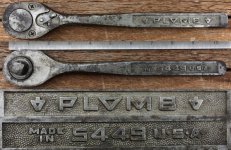

It could simply mean that pebble tools were developed prior to (or during) the war but because of the restrictions, they were not able to produce them. The catalog references and strikes seem little more than a teaser to me ...

Brian
 
OP
P

Private Lugnutz

Well-known member
Joined
Mar 30, 2012
Messages
30,508
Location
The Authentic Jersey Shore
Could mean? There's no ambiguity on these pages, Brian. Redline strike throughs and "Temporarily Discontinued" annotations require no interpretation. The WPB Limitation Order L-216 was very precise. Items that are struck through in Catalog #19-R were not permitted to be produced, and were therefore not available to commercial customers. That's why they were removed from the Price List (and therefore, unavailable for purchase) attached to the earlier Catalog #19-A. Items that are not struck through in #19-R (and which were included on the Price List in #19-A) were not affected by L-216, were permitted to be produced, and were available for sale. The 4749 ratchet and the 4766 hinge handle were in that category. No limitations. Available for sale. They are both shown, with knurled round handles, on page 30 in #19-A, and they are both listed in the Price List. They are both shown, with flat pebbled handles, on page 25 in #19-R, and they are not struck through with redlines in the parts list table on the same page.
 
Last edited:

twertsy

Well-known member
Joined
Jan 5, 2014
Messages
6,726
Location
Reedville, VA
I have not seen the particular ratchet you are referring to, Brian, but they have popped up before, and they have been discussed before. My position on these Proto WF tools is the use of old dies. The last "Wright Field" contract on record was terminated in January 1946. Production for the US Army Air Corps (part of the US Army Air Forces), as the contract agency associated with the "Wright Field" contracts, could not have occurred after 1947, when the US Army Air Forces became a separate service known as the US Air Force. I suppose it's possible that the US Air Force contracted with Proto, and Proto continued to use the legacy "WF" marking to designate those tools. I just think it's unlikely, and there's no record of it.
That makes absolutely zero sense. To wit; in order to produce a Proto marked tool they would have had to have produced at least one new die for the Proto marked side. You're suggesting they used an old die for the WF side and a new one for the Proto side?

Sent from my VS990 using Tapatalk
 
OP
P

Private Lugnutz

Well-known member
Joined
Mar 30, 2012
Messages
30,508
Location
The Authentic Jersey Shore
For the flip side, yes. I wish I could find the thread I talked this out on with lbgradwell. But I'm not stuck on the theory. And to be perfectly clear, that topic is completely tangential to this topic.

Regardless of why those Proto pebble ratchets have a "WF" mark, they have no bearing whatsoever on an indisputably Plomb catalog with indisputably wartime WPB markings and Plomb ratchets with indisputably pebble handles. That's not theory.

Does what I have presented here dispute a longstanding status quo? Absolutely. But the Van Natta site offers no back up for their conclusions. The implication is that they used the catalogs. If so, they're ignoring or are unaware of the date of those redlines and discontinued notices, which are no later than May 1945. Ditto AA, which has even fewer catalogs, and offers far less explanatory back up. Yet everyone takes it for gospel.

To your credit, The Tools Archive has always taken the substantive, bottoms up, 'show your homework' approach, making catalogs, other historical documents accessible and part of your studies. Which you know I admire.

I am eager to see the backup for the 9/30/45 pebble start date on your timeline. Perhaps it will provide a substantive explanation for how pebbled tools can show up on printed pages with wartime restriction markings.
 

twertsy

Well-known member
Joined
Jan 5, 2014
Messages
6,726
Location
Reedville, VA
For the flip side, yes. I wish I could find the thread I talked this out on with lbgradwell. But I'm not stuck on the theory. And to be perfectly clear, that topic is completely tangential to this topic.

Regardless of why those Proto pebble ratchets have a "WF" mark, they have no bearing whatsoever on an indisputably Plomb catalog with indisputably wartime WPB markings and Plomb ratchets with indisputably pebble handles. That's not theory.

Does what I have presented here dispute a longstanding status quo? Absolutely. But the Van Natta site offers no back up for their conclusions. The implication is that they used the catalogs. If so, they're ignoring or are unaware of the date of those redlines and discontinued notices, which are no later than May 1945. Ditto AA, which has even fewer catalogs, and offers far less explanatory back up. Yet everyone takes it for gospel.

To your credit, The Tools Archive has always taken the substantive, bottoms up, 'show your homework' approach, making catalogs, other historical documents accessible and part of your studies. Which you know I admire.

I am eager to see the backup for the 9/30/45 pebble start date on your timeline. Perhaps it will provide a substantive explanation for how pebbled tools can show up on printed pages with wartime restriction markings.
Yes, as I said, I've contacted the source of that date and awaiting his research results. There's no arguing your research but if for no other reason than practicality, I still believe the pebbles are post war only. Too much of a tooling rework for wartime IMO.

Sent from my VS990 using Tapatalk
 

d42jeep

Well-known member
Joined
Oct 22, 2014
Messages
16,510
Location
Northern California
If you compare Plomb with Willys, another company that was a little busy during the war, they were very concerned with their positioning in a postwar retail market. Their advertising changed as the war wound down to making their upcoming civilian Jeeps appealing to returning GIs and the agriculture industry. Plomb had gone through a tremendous wartime expansion and I'm sure that they made plans to maintain their position in the postwar marketplace. I'm sure that it would have been likely that their designers would have been working on the postwar designs as the war wound down and the goverment's demand for their products diminished. Willys was producing CJ prototypes at around the same time. If the dies were in place in anticipation of tremendous postwar demand, there would have been no reason not to start turning out the new design while still following the restrictions regarding plating. Just my opinion.
-Don
 

twertsy

Well-known member
Joined
Jan 5, 2014
Messages
6,726
Location
Reedville, VA
If you compare Plomb with Willys, another company that was a little busy during the war, they were very concerned with their positioning in a postwar retail market. Their advertising changed as the war wound down to making their upcoming civilian Jeeps appealing to returning GIs and the agriculture industry. Plomb had gone through a tremendous wartime expansion and I'm sure that they made plans to maintain their position in the postwar marketplace. I'm sure that it would have been likely that their designers would have been working on the postwar designs as the war wound down and the goverment's demand for their products diminished. Willys was producing CJ prototypes at around the same time. If the dies were in place in anticipation of tremendous postwar demand, there would have been no reason not to start turning out the new design while still following the restrictions regarding plating. Just my opinion.
-Don
Good point Don.

Sent from my VS990 using Tapatalk
 
OP
P

Private Lugnutz

Well-known member
Joined
Mar 30, 2012
Messages
30,508
Location
The Authentic Jersey Shore
The whole purpose of L-216 was to optimize production (in terms of tonnage, and in terms of specific tools) for the war. That's why all those special 1/4-inch drive attachments were scratched. They were not included on the permitted list of 1/4-drive tools. The miniratchet was scratched because no mfgr was allowed to make two types or styles of the same tool. Ditto the flexible hinge handle. 4751 was redundant in function to 4749. 4768 was redundant to 4766. These are all directly traceable to L-216 Schedule II. The US Govt did not want steel devoted to something they deemed non-essential. The same thing can be seen in the other areas of the same catalog (other drive sizes, other wrenches, etc), and in other Mfgrs catalogs. SK took the same approach as Plomb (redlines). Other Mfgrs handled it differently. For example, Snap-On did not publish a new catalog until 1944, and they essentially took the one blanket notice upfront and see your jobber approach.

Nothing about L-216 would prevent Plomb from abandoning a ratchet and breaker with a round knurled handle and replacing them with a ratchet and a breaker with a flat pebbled handle.

Going back to Snap-On, note that they were not even producing 1/4-inch drive tools at the time L-216 was issued. They added them to their production line in 1944 and to their December 1944 Catalog Q. The ratchet, introduced in 1943, was based on the 9/32-inch drive design with a replaceable plug. Everything else required new dies.

This wartime Pebble Plomb revelation seems like a shock to the system at first, but it probably only amounts to 9 months maybe a year or so earlier than the conventional wisdom, and would only apply to the natural steel examples.
 
OP
P

Private Lugnutz

Well-known member
Joined
Mar 30, 2012
Messages
30,508
Location
The Authentic Jersey Shore
By the way, I have repeatedly referred to the revoked date (May 1945) for the L-216, but some of the amendments to it were even earlier. An amendment that removed the restriction preventing Mfgrs from shipping entire sets came on December 8, 1944. That proves that the Catalog #19-R REPRINT I am using above dates to at least as early as November 1944 since it still includes their added redline notice that they couldn't ship complete sets directly from the factory. And that pushes Pebble Plomb back to at least November 1944.

Edit: I acknowledged Roger Milam, a WPB research partner residing in the UK before, and I will here again. This revelation would not be possible without him.
 
Last edited:

Carla

MEMBER EMERITUS
Joined
Nov 27, 2010
Messages
672
The whole purpose of L-216 was to optimize production (in terms of tonnage, and in terms of specific tools) for the war. That's why all those special 1/4-inch drive attachments were scratched. They were not included on the permitted list of 1/4-drive tools. The miniratchet was scratched because no mfgr was allowed to make two types or styles of the same tool. Ditto the flexible hinge handle. 4751 was redundant in function to 4749. 4768 was redundant to 4766. These are all directly traceable to L-216 Schedule II. The US Govt did not want steel devoted to something they deemed non-essential. The same thing can be seen in the other areas of the same catalog (other drive sizes, other wrenches, etc), and in other Mfgrs catalogs. SK took the same approach as Plomb (redlines). Other Mfgrs handled it differently. For example, Snap-On did not publish a new catalog until 1944, and they essentially took the one blanket notice upfront and see your jobber approach.

Nothing about L-216 would prevent Plomb from abandoning a ratchet and breaker with a round knurled handle and replacing them with a ratchet and a breaker with a flat pebbled handle.

Going back to Snap-On, note that they were not even producing 1/4-inch drive tools at the time L-216 was issued. They added them to their production line in 1944 and to their December 1944 Catalog Q. The ratchet, introduced in 1943, was based on the 9/32-inch drive design with a replaceable plug. Everything else required new dies.

This wartime Pebble Plomb revelation seems like a shock to the system at first, but it probably only amounts to 9 months maybe a year or so earlier than the conventional wisdom, and would only apply to the natural steel examples.

Hello, Lugz,

I've a little 1/4 drive set, or partial set, here, another flea market find, which would appear to support your comments. It was found amongst some other 'estate sale' items which appeared to have come from long-term storage.

These tools appear to have never been actually used, and were preserved in 'as new' condition. The little 4749 ratchet is plain, or 'natural', steel, with the 'Made In USA' marking, and has a somewhat lesser quality of polish on the surfaces.

The sockets with it have date codes of AC (also marked 'War Finish') AC (without the 'War Finish' marking), BC, and CC.

It would be plausible, I suppose, to visualise a supply house clerk making up a set for civilian sale sometime late in the war, with a freshly arrived ratchet, and 'reaching into the bins' at random for the little sockets, coming up with ones which had been there awhile.

Other drive tools with this set are a mix of finishes, tho.....the 4785 T-handle has the 'stacked' style 'made in' lettering, a FB date code, and is 'prewar nice finish' chrome-plated. The 4769 handle, and 4761 extension, are unplated plain steel, and have a surprisingly rough finish.

cheers

Carla
 
OP
P

Private Lugnutz

Well-known member
Joined
Mar 30, 2012
Messages
30,508
Location
The Authentic Jersey Shore
Hi Carla,

I'd love to see some photos of your set.

I have collected a few partial Plomb midget sets that seemed fairly intact, in their crinkle green box, with all the sockets and drive tools having a natural steel finish. The ratchet and hinged head had the knurled and round handle, as in the early wartime catalogs. And as you may have seen above, I have collected some orphan Plomb drive tools with a natural steel finish and a flat pebbled handle. But I have never seen a partial set with a ratchet or a hinge handle with a natural steel finish and pebbled grips.

EDIT:

...a somewhat lesser quality of polish on the surfaces.

See note e (2) below from Limitation Order L-216.

L-216%20Finishes_zps1nxhls5x.jpg
 
Last edited:

Provincial

Well-known member
Joined
Sep 21, 2011
Messages
6,856
Location
Near Salem, OR
One should be aware that the VanNatta site is a hosting for Ed Boudinot's old site. I understand that Ed could no longer maintain his site due to terminal cancer and the VanNatta's volunteered to put it on the site they maintain for their own purposes.

It appears that there has been little or nothing added to that site since 11/27/2005. There has been a lot of interest in Plomb tools since then, with more catalogs and other documentation turning up and entering the public domain.

I don't think it is fair to criticize the VanNatta site for accuracy at this date. It is valuable as a snapshot of dedicated amateur historians doing their best to preserve the history Plomb and the wonderful tools they manufactured. These were pioneers in researching Plomb and their work was done before the internet was as widely used as it is now. The wonder is how much information they were able to collect and display, not that they may have been wrong about some details of obscure production dates. My hat is off to Ed Boudinot and his compatriots!
 
To avoid these ads, REGISTER NOW!
Top Bottom