Thanks, Don. You're welcome, tym.
All good probing questions, Slew, but none that can explain why pebbled tools show up in catalogs with wartime restrictions.
Someone PM’d me and said they were having a hard time following the explanation by bouncing back and forth between GJ and the catalog links, and they asked if I wouldn’t mind providing examples right here in the thread.
I’ll do so, and you can tell me if you still cling to the pebble=post-war notion.
Here are some pertinent scans of pages 29, 30, and 31 (the 1/4-inch midget section) from Plomb Catalog #19-A, which I date from no later than April 1943, one month before the WPB issued Limitation Order L-216, to at least January 1944, the date of a price list found in the catalog.
Notice that the tools are not pebbled and there are no redlines (strikethroughs) or any direct references to wartime restrictions or limitations.
Here are some scans of page 4 of the Price List that came with the same catalog. It is dated January 1, 1944 at the top. And at the bottom there is a reference to WPB Limitation Order L-216. I am including a closeup of that reference and the part of the price list with the Midget drive tool part numbers.
Notice the symbol next to part number 4716, the midget drive socket with a 12-point 1/2” opening. But notice also that many part numbers have already been removed from the price list, no doubt in price lists that accompanied this catalog well before January 1, 1944. Missing from the list is 4751, the miniratchet, and 4768, the flexible hinge handle. Also missing from the price list are 4736, the 9/16” deep socket, and all the special attachments between 4740 and 4747.
This shows that Catalog #19-A was printed before the WPB Limitation Order L-216 was issued and the way Plomb handled it in the Price Lists they published with their catalogs, removing parts that were restricted by L-216, and at later junctures, footnoting updates to L-216 rather than redoing their whole price list.
Here are some pertinent scans of pages 24 and 25 covering the same section (1/4-inch midget drive tool) from Plomb Catalog #19-R. Notice that several tools are redlined (strikethroughs), and there is a reference to Plomb not being able to ship entire sets (forbidden by L-216). Notice that the ratchet and hinged handle are pebbled.
Now, if you go back to the January 1, 1944 Price List, you’ll see that the tools that are struck through in red on these pages of catalog #19-R are the
exact same tools that were either removed from or footnoted at the bottom of the Price List found in Catalog #19-A.
In #19-R, Plomb obviously progressed to a more direct way of dealing with the L-216 limitations. Notice that the typesetting is not the same. The tools and the tables and the graphics are similar, but not the same and not in the same place as they were in #19-A. This is a new catalog. With pebbled tools! But it is articulating
the exact same wartime government limitations.
Again, if pebbled tools were not introduced until after the war, why are they shown in a Plomb catalog articulating wartime WPB L-216 limitations inside a Plomb catalog
for the first time? If the image of the pebbled ratchet and breaker are replacing the image of the earlier pre-pebbled ratchet and breaker, where is the catalog with these pages with this layout showing the pre-pebbled ratchet and breaker? And if this page was printed after the war was over (and well after WPB Limitation Order L-216 was revoked), why would Plomb not replace the tables showing
obsolete government limitations?
The bottom line is I think the entire community has ignored these markings, uncertain of what they really were and meant.
Unless someone can explain why these pebbled tools would be in a wholly different Plomb catalog showing wartime restrictions for the very first time in any Plomb catalog, I can only conclude that pebble tools were introduced before the end of the war, despite what the rest of the Plomb collecting community has concluded for many years.
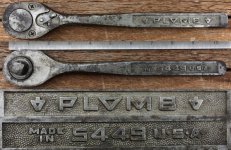
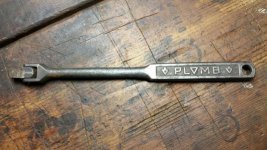
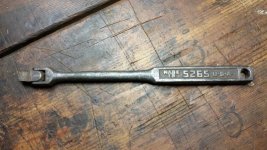
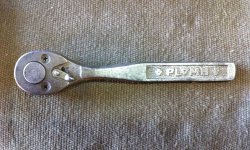
And examples of pebbled MADE IN USA tools with a natural steel finish do seem to confirm it.






 is clearly shown with two latches and a lock hasp on pg 50, but in the toolbox section, the earlier style with no lock hasp(maybe a mil requirement?) is shown on page 27.


