To avoid these ads, REGISTER NOW!

The Vise History Thread

twertsy

Well-known member
Joined
Jan 5, 2014
Messages
6,725
Location
Reedville, VA
We have "The Vises of Garage Journal," a monumentally huge thread dedicated to those who chase down and procure all manner of vises. We have the Vise Information Thread, where folks knowledgeable on such things document model numbers, weights, jaw sizes, etc. We have the Vise Repair Thread dedicated to the repair and maintenance of the vises we find. We don't however have a vise history thread, which frankly I'm much more interested in. Hopefully, some of you are as well.

In this thread I will document the stories of VERY early American vise inventors, focusing specifically on those vises I can find evidence that they were actually produced (not just a pretty picture). These vises would be exceedingly rare to find and, given the story were told correctly, could bring ridiculous prices when offered for sale.

I'm going to start with a pretty cool story about Mr. Charles B. Clark and his 1858 Vise patent No. 19622. As near as I can tell, Mr. Clark was born in 1834. In the 1855 census he is listed as a book keeper. His father, Benjamin, was a chair and table maker so he may well have been keeping dad's books in 1855.

Mr. Jeff Joslin of DATAMP and OWWM and I have been collaborating on research lately and it just so happens I stumbled on some information about this vise a couple weeks ago. There's nothing really spectacular about the design, which appears to be an early "quick-acting" variation. What makes it unique in my mind is that the book "A History of American Manufactures, from 1608 to 1860, Volume 2" notes that this invention was manufactured by none other than W. T. Nicholson. Yes, the very same man that started Nicholson File only 3 years after this patent.

If you found this vise, you may well be able to claim ownership of the "Only known vise made by W. T. Nicholson of rasp and file fame." Surely one of these gems sits in a dusty old barn or shop, probably in or around Oneida, NY.
 

Attachments

  • clarkpatent19622.jpg
    clarkpatent19622.jpg
    35.3 KB · Views: 134
Last edited:
To avoid these ads, REGISTER NOW!

MShaw

Well-known member
Joined
Mar 2, 2015
Messages
1,013
Location
York, Pa.
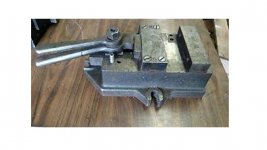
I see you have the Hartford Special Machinery Co. in your archives. They made a very nice cam actuated production milling vice. When I started in machining in the Hartford Ct. area in 1965 that was the only style of vise we used in production.

The bottom lever opened and closed the vice and the top lever was a short stroke cam that locked the vise.
 

Attachments

  • vise.jpg
    vise.jpg
    90.1 KB · Views: 183
OP
T

twertsy

Well-known member
Joined
Jan 5, 2014
Messages
6,725
Location
Reedville, VA
I see you have the Hartford Special Machinery Co. in your archives. They made a very nice cam actuated production milling vice. When I started in machining in the Hartford Ct. area in 1965 that was the only style of vise we used in production.

The bottom lever opened and closed the vice and the top lever was a short stroke cam that locked the vise.

That sucker looks made for speed work.
 

MShaw

Well-known member
Joined
Mar 2, 2015
Messages
1,013
Location
York, Pa.
And very solid. The jaw on the handle side is stationary and the movable jaw is pulled by the bar that the levers are mounted on. I set up jobs with special jaws extending 4" above the top of the standard jaws and took substantial climb milling cuts with no rigidity issues.
 
OP
T

twertsy

Well-known member
Joined
Jan 5, 2014
Messages
6,725
Location
Reedville, VA
The next vise I will spotlight is said to be the first vise ever produced having a steel jaw, by Enoch D. McCord of Sandy Hill, NY. Unfortunately, the patent document was destroyed in the fire of 1836, but we have found a couple sources that describe the vise in great detail. The patent header describes the invention as "Vice, Stock & Hand" and the patent was awarded on October 1, 1831.

A newspaper article from the 12/31/1831 edition of the Vermont Courier of Woodstock, Vermont confirms production of this vise noting it is ".....furnished at any quantity by the works of Mr. Melville C. Dibble, Sandy Hill, NY." The article also states the vise can be purchased at Craft, Hart & Pitcher's of Woodstock, Vermont and can be seen in use at the shops of Eaton & Gilbert's, Charles Veazie's, and Starbuck & Company.

This same article provides a detailed description of the vise as follows:
"All parts of the machine are cast iron, except the steel faces of the jaw, and the wrought iron threads of the screw. The great improvement, in point of principle, however, is that part of the construction by which the strain of the screw is constantly horizontal. By this means, much power is saved, and the wear of the machine is diminished. An important advantage, in point of economy, results from the casting of the vise; if any part breaks, that part can be replaced without incurring the charge of an entire new machine.

A further description of this vise can be found in an 1831 edition of Genesee Farmer. I should also note that this publication eludes to an earlier expose on the McCord vise indicating there may actually be a picture. Regardless, this article describes the vise as follows: "It unites an eminent degree of lightness, durability and power. Its strength results from the screw always acting horizontally, and both parts, the entering and receiving screw being perfectly parallel, whatever be the distance of the jaws of the vise. This enables the whole length of the thread of the screw to act uniformly and equally. The manner of its construction also gives the advantage of fixing it into its block much more firmly and solidly." This article also states "the agent passed through this city this morning with several tons of vises for the New York market."

Another newspaper article from 2/23/1831 discusses the vise, noting it has been under review for "18 months" and documents production of the vise by the "Sandy Hill Vice Company." This company is said in this article to be run by Enoch D. McCord and Melville C. Dibble.

Indications are that Mr. Dibble possibly manufactured something in Detroit in the mid 1830's. In 1842, soon after Mr. McCord passed away, we find newspapers from Detroit declaring the bankruptcy of the "firm of M. C. Dibble & E. D. McCord manufacturing vices at Sandy Hill, NY"
 
Last edited:

woody 73

Well-known member
Joined
Apr 14, 2009
Messages
11,540
Location
The Great State Up North
twertsy Hi,

My apologies for not calling you, I have been under the weather as they say.

I always wondered why no stories about all the vise makers out there (on the GJ), oh sure lots of pictures but never any Histories.

You are doing a great thing keep up the good work.:beer:
 
OP
T

twertsy

Well-known member
Joined
Jan 5, 2014
Messages
6,725
Location
Reedville, VA
No problem Woody, we'll catch up here soon.........

Today's spotlight vise maker is Archibald LaMont of Pittsburgh / Allegheny Town, PA

Archibald LaMont - Pittsburgh, PA - 1830 - 1840s. Here is an article explaining his vises, a write-up by the Franklin Institute and their award of First Premium for his vise. Archibald's biography can be found in "A Century and a half of Pittsburgh and her people." His biography notes that he never secured letters of patents on the vise he invented. However, every advertisement we have found, most being from local hardware stores, market his product as "LaMont's Patent Vices." The Pittsburgh Gazette of 3/30/1837 notes that the company of Wallingford & Co. (2nd St.) is selling "Lamont's patent solid box vices." The 2/22/1831 edition of the Pittsburgh Weekly Gazette also notes the sale of "Lamont's patent vices" by Cochran & Irwin at No. 26 Wood St. The 6/19/1832 edition of the Pittsburgh Weekly Gazette carries an article noting the virtual completion of the manufactory A. LaMont & Co. in Allegheney Town. Every description of the LaMont vise indicates it being of the post leg design.

Beyond vises, A. LaMont & Co. manufactured large screws for presses, mills, rolling mills, etc. Interestingly, the bottom of the article carries a warning to not infringe upon the patent rights of the subscribers, contradicting his biography which stated he never received patents for his vises. This contradiction may lead to a conclusion that someone other than Archibald actually patented the design, and Archibald simply manufactured them. Archibald LaMont did receive a patent for dies and taps, which may or may not apply. It should be noted that Mr. Lamont's vises were celebrated as differing from imported models in that the screw receiver is cut from the 1 piece box, while imported receivers are brazed in. This may be where the patent comes into play.
Lemont, Archibald on January 29, 1830
#X005803 dies and taps Pittsburg, PA
 

CRSINMICH

Well-known member
Joined
Aug 15, 2015
Messages
2,394
Location
Southeastern Michigan
twertsy: I'll throw this in for what it's worth. It's the earliest vise patent I ever ran across. Thanks for starting this thread.
 

Attachments

  • 1837 Linus Dean vise patent drawing2.jpg
    1837 Linus Dean vise patent drawing2.jpg
    40.5 KB · Views: 82
  • 1837 Linus Dean vise patent document.jpg
    1837 Linus Dean vise patent document.jpg
    163.3 KB · Views: 77

CRSINMICH

Well-known member
Joined
Aug 15, 2015
Messages
2,394
Location
Southeastern Michigan
One more thing: Here's a snippet from an 1853 Massachusetts Business Directory.
 

Attachments

  • 1853 Massachusetts Business Directory.jpg
    1853 Massachusetts Business Directory.jpg
    62 KB · Views: 52
OP
T

twertsy

Well-known member
Joined
Jan 5, 2014
Messages
6,725
Location
Reedville, VA
twertsy: I'll throw this in for what it's worth. It's the earliest vise patent I ever ran across. Thanks for starting this thread.

twertsy:
Thanks for starting this thread. I share your interests.
(Subscribed)

One more thing: Here's a snippet from an 1853 Massachusetts Business Directory.

Thanks Guys. You should review these two pages on my site. I have documented every patent ever for Vises. I've got your above patents/makers covered. :beer:

The first link represents the earliest known vise patents/makers:

http://toolarchives.com/node/3526

This link is stories and research on vise patenters / manufacturers regardless of whether or not they had a patent.

http://toolarchives.com/node/3922
 
OP
T

twertsy

Well-known member
Joined
Jan 5, 2014
Messages
6,725
Location
Reedville, VA
Today's post will highlight multiple early New England vise (and vice) makers. Until approximately 1850, the United States used the English spelling of Vice. It's a good tidbit of information if you're researching very early American Vice/Vise makers.

I recently found several editions of "Mechanics Association" exhibitions, reviews and awards from the 1800s. If I ever get to Boston, the MA Historical Society has all of the Boston Mechanics Association event reports going back to 1795 I think, with pictures! In the meantime, we can say FOR CERTAIN that the below names and companies either manufactured or had examples made of at least one vise.

The following exhibitors - Awards are listed in the 1844 Mechanic's Exhibition in Boston, MA:
- Mark Fisher​ - Newport, ME - One Parallel Vice **NOTE** In 1847, Mr. Fisher and William Martin Jr. invented a method for welding cast iron to malleable iron or steel. In April of 1852, he teamed up with John H. Norris of Trenton, NJ to patent an improvement in a method of welding cast iron to steel. In 1854, the two invented a machine for polishing anvils. This team formed Fisher & Norris in 1851.
- N. S. Raymond​ - Utica, N. Y. - One Eccentric Vice. A convenient article for workers in wood.

The following exhibitors - Awards are listed in the 1849 Mechanic's Exhibition in Salem, MA:
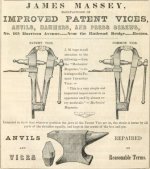
​​ - James Massey​ - Boston - One Anvil and 3 Blacksmith's Vices - Diploma

**NOTE** See attached 1849 Boston City Directory Advertisement

The following exhibitors - Awards are listed in the 1850 Mechanic's Exhibition in Boston:
- ​​John Woolley​ - Boston - Three Bench Vices: One large Blacksmith Vice; One Finishing Vice. Well made and substantial articles, very credible to the workman.
- James Massey​ - Boston - Two improved vices. Well made and much improved on the common form. The shoulder of the Female Screw is so curved as to avoid the unfavorable action of a square shoulder where the jaws are widely opened. The shoulder on the Male Screw is formed in the segment of a sphere, and it bears on a corresponding surface. The action of this vice is easy and natural, and there is no tendency to bend or injure the screw or its box, when tightly screwed on large masses, as in the common form of vice. Two Anvils. - Diploma
​ - M. Fisher, and William Martin Jr.​ - Newport, ME - One Stand of Parallel Chain Vices. This article has received the highest commendation from mechanics, and is fast coming into use. It is considered in all respects a superior article, and a decided improvement over the common vice. - Silver Medal **NOTE** See above Note on Mark Fisher
​ - Josiah Cowles​ - Belchertown - A Wooden Vice. So arranged with gearing, as to keep the moveable jaw parallel with the stationary jaw. A good article. - Diploma.
- Prouty & Mears​ - Boston - One Vice - Silver Medal (We suspect however the medal was for various plow designs)

The following exhibitors - Awards are listed in the 1853 Mechanic's Exhibition in Boston:
​​ - James Massey​ - Boston - Vises & Anvils. These appear to be good and substantial articles

The following exhibitors - Awards are listed in the 1860 Mechanic's Exhibition in Boston:
​​ - James Massey​ - Boston - Improved Vises, 4 Anvils Excellent specimens, one large vise particularly well finished
- William H. Woolley​ - Boston - Vise, Well made wrought iron vise
- Spence & Company​ - Boston - Improved Bench Vise. A new modification of a parallel vise, which may answer well for small work
- ​A. J. Wilkinson & Company, Boston for W. T. Nicholson, Providence, R. I.​ - Vises, Levels, Egg Beater, etc. - Diploma **NOTE** This is likely the Clark Patent Vise highlighted in post #1 in this thread.

The following exhibitors - Awards are listed in the 1869 Mechanic's Exhibition in Boston:
- Henry M. Johnson​ - Boston - Vises - Well Made
​ - James Massey​ - Boston - Vises and Anvils - Well Made
- L. B. Hunt​ - Hyde Park - Union Vises - Well Manufactured
​ - F. L. Walker​ - Boston - 2 Cabinet Bench Vises - Diploma (At least 2 F. L. Walker patents were used on Parker Vises)
​ - George Stone - Boston - Parallel and Adjustable Vise - Bronze Medal
- Joseph H. Lewis​ - West Duxbury - Vise Patented 5/12/1869 - Diploma
- New England Vise Company​ - Fitchburg - Iron Vises - Good Articles

Some more information on select inventors/makers:

John Woolley - Salutation St., Boston, MA 1842 - 1879 - John Woolley is listed in the 1842 Boston City Directory as a vice maker. Mr. Woolley is listed in the 1844 "4th Exhibition of the Massachusetts Charitable Mechanics Association" as having on display 4 new vices. ​Also listed as "Visemaker" in the Boston City Directory in 1855, 1860, 1862, 1864, 1865, 1869, 1882, 1883. ​William H. Woolley is listed in the 1861 & 1862 Boston City Directory as a "Visemaker." Benjamin F. Woolley ​is listed at 37 Salutation St. in the 1869, 1889, 1890, 1892 Boston City Directory as a "Visemaker."

Update: We found John Woolley listed as a Vice Maker in the Universal British Directory of 1793. We found record of a ship arriving in Boston Harbor in 1836 indicating this to be when John M. Woolley (22 yrs. old) arrived. In the ship's manifest he is listed as a laborer.

We only find 2 patents for John Woolley:
​Patent March 16, 1831 - Edging Machine for turning the edges of tin, copper or sheet-iron
Patent #4,184 - Cooking Stove

James Massey - Plymouth St., Boston, MA 1849 - 1875 - In the 1849 Boston Directory, Mr. Massey is listed as a maker of anvils, vises and hammers. Listed as "Visemaker" in the Boston City Directory in 1870, 1880. Mr. Massey is listed in the 1850 (5th) (See Image 3 Below) and 1865 (10th) "Exhibition of the Massachusetts Charitable Mechanics Association" as having on display vises and anvils.

New England Vise Company - Incorporated March 14, 1873 in West Acton, MA. They are also listed in an 1869 exhibition roll call. According to this report, the company was organized on January 25, 1868 by John Sherman Hoar in order to produce his patented "off shot" vise design. See this Acton local blog about the man and his company. Here is another link from the local blog showing a very clean example of Mr. Hoars "off shot" vise. A newspaper article from November of 1868 notes the company employs 20 men in the manufacturing of vises.
According to the Acton Historical Blog referred to above, John Sherman Hoar had two Partners in his patent, Charles Hastings and Nathaniel Cutler. Also according to the referenced blog, they sold the company to a concern in Fitchburg in 1870. This link to the Fitchburg Directory of 1878 may provide a clue as to which company took over for Hoar's patent vise production, C. S. Tolman.
According to this state report, the company was dissolved in 1892.
John Sherman Hoar Patent #55,656
Improvement / Reissue of 55,656 - Patent RE2606
John Sherman Hoar Patent #61,429
John Sherman Hoar Patent #65,081

Joseph H. Lewis​ -
Patent #65,097 - Vise
Patent #89,671 - Vise

Josiah Cowles
Patent #5,458 - Bench Vise
 

Attachments

  • Massey1849BostonDir.jpg
    Massey1849BostonDir.jpg
    80 KB · Views: 62
Last edited:
OP
T

twertsy

Well-known member
Joined
Jan 5, 2014
Messages
6,725
Location
Reedville, VA
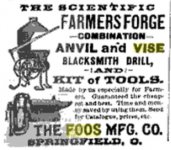
Today we make our way to Springfield, Ohio and the Foos Manufacturing Company. This company was started ca. September, 1885 to manufacture corn grinders and forges. However, by 1886 ads begin appearing in national magazines for not only the grinder, but a combined anvil, vise and drill.

The Foos family, Gustavus S. (father), Robert H. & William F. (sons) broke away from the firm of Evans & Foos Manufacturing Co. in 1885, although that company continued on as A. C. Evans & Co. According to a short A. C. Evans biography, Evans & Foos was established in 1876. It should be noted that Mr. Evans' father manufactured steam engines and threshers for about 25 years before that in Piqua, OH. Despite this timeline, I found advertisements as early as March, 1884 for the Foos Mfg. Co. Blower Forge (No vise).

I have not been able to find a patent against which this vise was produced but I did find this "Anvil Vise" on Ebay that, although oriented differently, comes pretty close to the picture in the advertisement.

Foos Mfg. is listed as a manufacturer of Anvils in Poor's Manufacturers Directory in 1893.

In 1911, the Foos Manufacturing Company was succeeded by the Bauer Brothers Company.
 

Attachments

  • foos.jpg
    foos.jpg
    66.4 KB · Views: 55
OP
T

twertsy

Well-known member
Joined
Jan 5, 2014
Messages
6,725
Location
Reedville, VA
Today's ancient vise maker is Abiezer Jameson of Trenton, NJ.

Abiezer Jameson - A. Jameson Company (owner) // The Bricksburg Manufacturing Company (Superintendent) - Mr. Jameson had 4 vise patents, #56,057, #66,712, #66,965, and #77,289. Appears to have operated as a "casting" company in the early 1860s per tax records. Also, Patent #69,361 by J. Howard Murray was assigned to Abiezer Jameson and T. S. Murray.

On 3/27/1868, Mr. Jameson and colleagues founded the American Roofing, Paving & Manufacturing Company. Many of Jameson's patents in the late 1860's through the 1870's had to do with the addition of fibrous material to felt roofing, paper for paper bags, etc. On February 16, 1870, the name of this company was changed to The Bricksburg Manufacturing Company.

An advertisement in the 2/1875 edition of Scientific American, placed by Millers Falls Co., notes that they sell vises made by the Bricksburg Manufacturing Company.

Announced in The Technologist, June of 1873, Smith & Garvin (makers of Drill Presses & Milling Machines) moved from New York to the Bricksburg Manufacturing plant, apparently as a tenant.

We have yet to discover the exact date, but between 1875 and 1880 the factory of Bricksburg Mfg. was foreclosed on and taken over by Kimball & Davis in 1880.

Note: we do find mention of "Abraham Jameson" as president of Bricksburg in 1870. Could be a mistake or another Jameson.
 
Last edited:
OP
T

twertsy

Well-known member
Joined
Jan 5, 2014
Messages
6,725
Location
Reedville, VA
Today's Vise Maker is Morris Wilcox of Norwalk, OH.

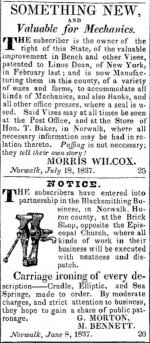
Morris Wilcox - Norwalk, OH - 1837 - According to the Huron Reflector (newspaper) of 7/25/1837, Mr. Wilcox is manufacturing vises against Patent #127 - Vise, Mode of constructing bench and other vises - Linus Dean - the article states the vises are being sold at the store of Hon. T. Baker in Norwalk. This article persists from July of 1837 to October of 1938, then I lose track of Mr. Wilcox.

A couple notes:
- CRSINMICH posted the patent above in post #9;
- The lower part of the attached picture/article is not the same entity, and as far as I know has nothing to do with Mr. Wilcox, but I included it because it had a picture of a vise.

Morris Wilcox is a pretty common name, and the following information may or may not be pertinent to the vise maker:
- I found an 1835 land purchase by Morris Wilcox (from Utica, NY) of 135 acres in Bucyrus, OH. (40 or so miles from Norwalk)
- There are many indicators that there was a connection between Morris Wilcox and Utica / Oneida, NY but I've yet to find that trail definitively. This begins to make sense when we consider the patentee, Linus Dean, was from Utica, NY.

Here is an article by the Franklin Institute regarding the Vise and patent.

It appears Linus Dean went on to manufacture ornamental steel and iron products, and even had more patents in that realm. Here's an 1852 article about his factory. The 1869 Utica Business Directory also lists Mr. Dean as Proprietor of the Utica Ornamental Iron Works.
 

Attachments

  • wilcox.jpg
    wilcox.jpg
    85.3 KB · Views: 53
Last edited:

drivesitfar

Well-known member
Joined
Oct 23, 2013
Messages
35,997
Location
Pacific Northwest
Twertsy: I'm still hoping to use your website and help you add more information if I might happen to know something you and the others haven't found, but i've got maybe another year or two of ORGANIZING before i get some time to post more than just GJ.

that said I appreciate you starting this thread that should cover or UNcover a lot of the mysteries or histories of a lot of the old vise companies.

thanks and looking forward to learning more about such a simple well made and well used tool.

cheers

ALL: thanks for your additions too!!
 
OP
T

twertsy

Well-known member
Joined
Jan 5, 2014
Messages
6,725
Location
Reedville, VA
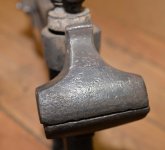
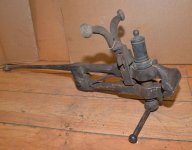
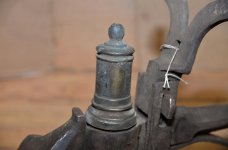
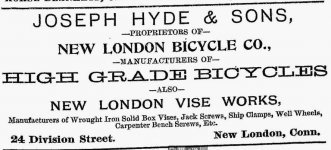
Today's entry attempts to follow the Hyde family. This entity is listed under many names, and is very difficult to follow:

Joseph Hyde & Sons
New London Vise Works
Hyde Vise Works

The first picture below is an advertisement from an 1838 Hartford, CT newspaper. The second picture is from the 1898 New London City Directory. The rest of the pics are from a recent ebay sale of a New London Vise works post leg vise.

New London, CT -
Link to an 1897 Receipt on Toolmera.com - This receipt notes that the proprietors are Joseph Hyde, Sons & Co.

See Image 1 Below where we find an advertisement from the 3/20/1838 edition of the Hartford Courant for Hyde & Sons Vices.

Based on the 1880 census, Joseph Hyde (age 54) is listed as a blacksmith, as is his son Joseph Jr. (age 31). However, Joseph Jr.'s brothers Joshua (age 29), Samuel (age 23) and George (age 14) are all listed as "Vice Makers." In the 1870 census Joseph, Joseph Jr. and Joshua are all listed as "Vice Makers."

Just when we think we've gotten somewhere, the records throw a curve. The 1884 City Directory for New London lists the following (typed below exactly as seen)
Joseph Hyde, vise maker, h Chappell
Joseph Hyde Jr., vise maker, rear of Woodbridge
Joseph Hyde Sr., vise maker, rear of Woodbridge
Joshua Hyde, vise maker, bds Chappell
Joshua Hyde, blacksmith, h Fort Neck
Joshua Hyde, vise maker, bds r Woodbridge
Samuel Hyde, vise maker, bds r Woodbridge
Samuel Hyde, galvanizer, bds 158 Bank
Samuel Hyde Jr., blacksmith, h Fort Neck
William H. Hyde, vise maker, bds Chappell

It would appear to us that we possibly have 3 distinct families/operations making vises in New London, all named Hyde, and mostly having the same names! The family records do seem to support this theory since we find numerous records but they all seem like they are different families/households.

In the 1892 New London City Directory the New London Vise Works is listed as makers of Ship Clamps.

In the 1905 New London City Directory, the following information can be found:
- Robert Chamberlain is listed as an Engineer at Joseph Hyde & Sons;
- Joseph Jr., Samuel and Joshua Hyde are listed as Proprietors of "N. L. Vise Works";
- New London Vise Works (J. Hyde & Sons) are listed as manufacturers of:
- Jack Screws
- Machinists & Machinery
- Vises

We find references to this company, albeit scarce, up to 1925. They appeared to specialize (in terms of vises) in exclusively Post Leg Vises.

Joseph Hyde's obituary confirms that, along with his father and brothers, he founded the company. Mr. Hyde passed away 5/25/1932 at the age of 81. He was an English immigrant.

We are looking into the question as to whether the vise patents of John Lee and Isaac C. Tate, or perhaps Sidney Hubbell were manufactured by this company.

Here is a price list from the December, 1890 edition of Iron Age. The Iron Age advertisement mentions Hyde's Patent Vise on multiple occasions. It's interesting to note the various styles of vises represented in this list. As far as I can tell, we've only ever had post vises come up as examples.

Here is another old advertisement for a foot operated blacksmith's vise.

We also found British Patent #1361, 5/14/1857 by William and Joshua Hyde, vice makers in Dudley, Worcester, England for "Improvements in the construction of vices."
 

Attachments

  • nlvw4.jpg
    nlvw4.jpg
    78.9 KB · Views: 45
  • nlvw5.jpg
    nlvw5.jpg
    129.3 KB · Views: 37
  • nlvw6.jpg
    nlvw6.jpg
    88.2 KB · Views: 36
  • nlvw1.jpg
    nlvw1.jpg
    60.8 KB · Views: 37
  • nlvw.jpg
    nlvw.jpg
    35.1 KB · Views: 38
  • hyde1898.jpg
    hyde1898.jpg
    123.6 KB · Views: 41
  • hyde_and_Sons.jpg
    hyde_and_Sons.jpg
    44.3 KB · Views: 44
Last edited:
OP
T

twertsy

Well-known member
Joined
Jan 5, 2014
Messages
6,725
Location
Reedville, VA
In my quest to discover the earliest American vise maker(s), this morning I ran across this poem entitled "On the Death of a Blacksmith." I thought some of you might enjoy the read.

This is from the 5/2/1803 edition of "The Gleason" in Wilkes Barre, PA.
 

Attachments

  • smithpoem.jpg
    smithpoem.jpg
    127.4 KB · Views: 67
OP
T

twertsy

Well-known member
Joined
Jan 5, 2014
Messages
6,725
Location
Reedville, VA
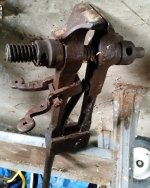
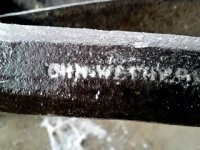
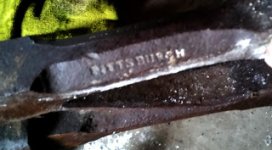
Today's vise maker is John Wetherell of Pittsburgh, PA. Information about Mr. Wetherell's life is scarce.

John Wetherell - corner of Anderson & Robinson Sts. Allegheny, PA - Listed in newspapers as "manufacturer of solid box and brazed box vises" in 1852.
1839 John Wetherell Patent #1,132 - Vise
Link to one of Wetherell's vises currently for sale.

Link to Vise uploaded on ToolArchives
 

Attachments

  • wetherell.jpg
    wetherell.jpg
    89.4 KB · Views: 40
  • wetherellstamp.jpg
    wetherellstamp.jpg
    28.5 KB · Views: 34
  • wetherellstamp2.jpg
    wetherellstamp2.jpg
    20.2 KB · Views: 36
Last edited:
To avoid these ads, REGISTER NOW!

drivesitfar

Well-known member
Joined
Oct 23, 2013
Messages
35,997
Location
Pacific Northwest
Twertsy: did you understand the "DEATH OF A BLACKSMITH" on your first reading?

I think i need a Google translator cause not sure it's in ENGLISH. :dunno: :bounce:

did you find that old blacksmith vise and buy it and post up more pictures if you can cause it looks like it's in pretty decent shape once you replace the missing handle.

thanks again for digging up all this great VISE STUFF!! :thumbup::thumbup::thumbup:
 
OP
T

twertsy

Well-known member
Joined
Jan 5, 2014
Messages
6,725
Location
Reedville, VA
Twertsy: did you understand the "DEATH OF A BLACKSMITH" on your first reading?

I think i need a Google translator cause not sure it's in ENGLISH. :dunno: :bounce:

did you find that old blacksmith vise and buy it and post up more pictures if you can cause it looks like it's in pretty decent shape once you replace the missing handle.

thanks again for digging up all this great VISE STUFF!! :thumbup::thumbup::thumbup:

I didn't buy it, but I posted a link here and in the Vises of GJ thread. To my surprise, nobody even commented on what I believe is the oldest "manufacturer attributable" American made vise (so far) in existence. Surprised there wasn't more interest??
 

chrisnazzy

Well-known member
Joined
Apr 20, 2013
Messages
1,671
Location
Arizona
Me too! I've been subscribed and reading this thread also. Thanks Twertsy for all the hard work you put into bringing us these history lessons.

Sent from my SM-G930P using Tapatalk
 
OP
T

twertsy

Well-known member
Joined
Jan 5, 2014
Messages
6,725
Location
Reedville, VA
I appreciate it gents. I really enjoy digging into the research.

Another story tomorrow.

Sent from my VS990 using Tapatalk
 
Last edited:

KMScott

Well-known member
Joined
Feb 14, 2012
Messages
4,632
Location
Daufuskie Island, South Carolina
I am anxious to see if you find the person that came up with the method of brazing the hard jaw inserts during the casting process, or was this a second operation. Maybe you covered this in a earlier post. **NOTE** In 1847, Mr. Fisher and William Martin Jr. invented a method for welding cast iron to malleable iron or steel. In April of 1852, he teamed up with John H. Norris of Trenton, NJ to patent an improvement in a method of welding cast iron to steel. Just was not clear to me on what they was welding. Keep up the excellent work Todd. I am subscribed and enjoy your work.
 
OP
T

twertsy

Well-known member
Joined
Jan 5, 2014
Messages
6,725
Location
Reedville, VA
I am anxious to see if you find the person that came up with the method of brazing the hard jaw inserts during the casting process, or was this a second operation. Maybe you covered this in a earlier post. **NOTE** In 1847, Mr. Fisher and William Martin Jr. invented a method for welding cast iron to malleable iron or steel. In April of 1852, he teamed up with John H. Norris of Trenton, NJ to patent an improvement in a method of welding cast iron to steel. Just was not clear to me on what they was welding. Keep up the excellent work Todd. I am subscribed and enjoy your work.
You know Kevin, I didn't open those patents......perhaps they elaborate? An early Fisher vise should tell you?

Sent from my VS990 using Tapatalk
 
OP
T

twertsy

Well-known member
Joined
Jan 5, 2014
Messages
6,725
Location
Reedville, VA
Today we go to Buffalo, NY, in about 1847.

Isaac Hickman - 1849 Buffalo Directory at 110 East Swan St. // 1855 - N. Division St., Buffalo, NY - Isaac Hickman immigrated from Devonshire, England in 1847 to Buffalo, NY. From 1847 to 1849 he operated a "vise & tool shop." In 1849 he moved to Marshall, MI for only a year, returning to Buffalo and staying there until 1868. In 1869, he took a government job in CA as Master Mechanic at Mare's Island Navy Yard.

Arthur Hickman - Carroll St., Buffalo, NY - 1849 - 1863 - Buffalo City Directory Listings - As far as we can discern, Arthur was born during the brief Michigan move so we are not sure why he is listed in the given timeframe as a vise maker. Our only conclusion is that there are 2 Arthur Hickmans in Buffalo during this timeframe.

Isaac, Arthur and other Hickmans in the Buffalo area​ - The 1854 Buffalo city directory lists both Arthur and Isaac as "Vice Makers." Isaac only is listed in the 1849 directory as a Vice Maker, Arthur is listed as a Blacksmith. There is also a Joseph Hickman listed as a Blacksmith in 1849. In 1850, 1851 and 1852, only Arthur is listed. In the 1864 Buffalo Directory, Ambrose, Arthur and Thomas Hickman are all listed as Blacksmiths.

I was unable to locate any examples of their vises.
 
OP
T

twertsy

Well-known member
Joined
Jan 5, 2014
Messages
6,725
Location
Reedville, VA
Today's inventor is Jeremiah Peck, who's vise was manufactured by J. S. Griffing in Hartford, CT.

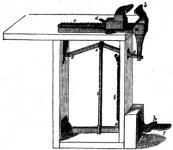
12/20/1843 - 3,384 - Bench-Vise, Jeremiah Peck, Waterbury, CT // According to this note, made by J. S. Griffing of New Haven, CT // The linked article also notes the vise is sold by Quincy & Delapiere of NY, Geo. H. Gray & Co. of Boston, Curtis & Hand of Philadelphia, and Way & Brothers of Hartford, CT. The Franklin Institute Journal from 1848 (Pages 133/134) contains a comprehensive write-up on the vise, as well as a picture. Note that this article also lists Mr. L. (Leonard) Pardee as a co-inventor. We found an invention (Patent #5713) but it does not seem to match. However, given the original patent drawing showing a bench vise operated by a wheel attached to the main screw, when compared with that shown in the Franklin Institute representation, Mr. Pardee's contribution was likely integration of the the table and treadle to operate the vise. By 1855, Leonard Pardee is listed as a Manufacturer, L. P. & Co., who manufacturers sashes and blinds.
 

Attachments

  • peckvise.jpg
    peckvise.jpg
    36.9 KB · Views: 57
Last edited:
OP
T

twertsy

Well-known member
Joined
Jan 5, 2014
Messages
6,725
Location
Reedville, VA
Today's early vise (vice) makers come from the archives of the "Annual Report of the American Institute of the City of New York," 1842-1860 editions. This was an annual exhibition in New York of new and useful mechanics related inventions. Given the context, we know that at least one of each of these vises were manufactured in order to show at the event.

Alfred & George W. Brady​ (A. & G. W. Brady) - New York, NY - The Annual Report of the American Institute of the City of New York of 1847 awards this company a "Diploma" for vices. They also received a diploma for vices in 1844. The pair are listed in the 1845 City Directory as "Founders."

Benjamin Beecher​ - NYC (7 Wall St.) - Mr. Beecher received a Diploma for "best cast iron vices" in the 1843/44 edition of the Annual Report of the American Institute​ for NYC.

John Goldie - Plymouth St., Boston, MA 1852 // 1880 census reports Joseph Goldie in New London, CT as a "vise maker."
The 1883, 1885, and 1887 New London City Directory lists Joseph W. Goldie, Joseph Goldie Jr., and William H. Goldie as "Vise Maker"
In the 1843/44 edition of the Annual Report of the American Institute​, Joseph Goldie Jr. of 133 Attorney-Street, NYC received a diploma for "well finished miniature anvils & vices." In the same edition on the previous page, Joseph Goldie, of the same address, was awarded a Silver Medal for vices.
In the 1848 edition of the Annual Report of the American Institute, Joseph Goldie received a Silver Medal for "anvil and vice."

​Alex. Stiven​ - NYC (58 & 60 Vesey St.) - Listed in the 1848 edition of the Annual Report of the American Institute as receiving a silver medal for "a parallel vice." He also received a Silver Medal in 1850. A description and picture of Stiven's vise can be found in the 5/13/1848 edition of Scientific American.

H. B. Chaffee ​- NYC (Corner of 29th St. & 11th Ave) - Listed in the 1858 edition of the Annual Report of the American Institute as receiving a Diploma for "best parallel vice."

​Horace B. Chaffee Patent #15,170 - Vise 6/24/1856

C. C. Chapman - Philadelphia - In the 1848 edition of the Annual Report of the American Institute, C. C. Chapman received a Gold Medal for a "flexible jawed vice."
 
Last edited:
OP
T

twertsy

Well-known member
Joined
Jan 5, 2014
Messages
6,725
Location
Reedville, VA
typo..... 19 vs. 18

I see that Bill Gates got a Diploma for Manure and Hay forks.

Myself am trying to figure out how Shephard got vises into his pies.


Interesting work Twertsy

akasrick
GOTCHA! Fixed.

Sent from my VS990 using Tapatalk
 

drivesitfar

Well-known member
Joined
Oct 23, 2013
Messages
35,997
Location
Pacific Northwest
Twertsy: i'm not sure if you are starting at oldest and making your way up through the 1800's into the 1900's or just putting out information as you find it. do you have a method to your research?

since a majority of your posts are about blacksmith vise makers so far (as far as I can tell) I can see why you don't have a lot of posts other than yours. while a lot of us love the information not too many of us own or know much about these great old vises. I actually started a thread called Blacksmith vises 101 to see how much interest there was and it rarely gets many posts or views and I started it maybe 2 or 3 years ago.

just curious if you still have the information on Fulton cause he seemed to have his hand on several vise companies and I think I read in some old newspaper article in the early 1900's that he married a MASSEY and that name is on several vises too. was Massey a sister, ex wife or wondering how she was related (if she was) to the Massey that had a vise company?

thanks again for all your time and for posting all this good information that really isn't that easy to find.
 
OP
T

twertsy

Well-known member
Joined
Jan 5, 2014
Messages
6,725
Location
Reedville, VA
Twertsy: i'm not sure if you are starting at oldest and making your way up through the 1800's into the 1900's or just putting out information as you find it. do you have a method to your research?

since a majority of your posts are about blacksmith vise makers so far (as far as I can tell) I can see why you don't have a lot of posts other than yours. while a lot of us love the information not too many of us own or know much about these great old vises. I actually started a thread called Blacksmith vises 101 to see how much interest there was and it rarely gets many posts or views and I started it maybe 2 or 3 years ago.

just curious if you still have the information on Fulton cause he seemed to have his hand on several vise companies and I think I read in some old newspaper article in the early 1900's that he married a MASSEY and that name is on several vises too. was Massey a sister, ex wife or wondering how she was related (if she was) to the Massey that had a vise company?

thanks again for all your time and for posting all this good information that really isn't that easy to find.

No method to the madness really, I just post it as I find it. For most of these makers, we can assume the vises discussed are post leg style, but really have no way of knowing, until I find a picture, drawing or somebody digs up an example.

I started this thread because I had a ton of research notes piled up, and on TA, so I thought it would be informative. Further, I thought that given the amount of collectors of vises, they may want to know that some of these very early patents / designs were actually produced, and are likely very rare and therefore, potentially valuable. I've never seen nor heard of anyone having a LaMont or McCord vise, but since one of those two was likely the first American vise maker, it'd be a hell of a find IMO.

EDIT: The Stivens vise (link to an article and picture above) was a normal bench vise ca. 1848.
 
Last edited:
To avoid these ads, REGISTER NOW!
Top Bottom