To avoid these ads, REGISTER NOW!

Rebuilding a Do-All V-36 band saw

To avoid these ads, REGISTER NOW!
OP
A

A_Pmech

Well-known member
Joined
May 8, 2007
Messages
8,002
Location
IL
awesome updates you will love those lock line coolent hoses


It's good stuff! I already like it on the saw. Lots better than the bendy tube stuff with the internal wire in it. Far more customizable too.

I should have bought the assembly pliers though. It isn't quite like assembling legos. :spit:
 
OP
A

A_Pmech

Well-known member
Joined
May 8, 2007
Messages
8,002
Location
IL
Finishing the Blade Welder

This evening I decided to spend a little while and make a new machine screw for the grinding wheel holder on the blade welder. I destroyed the old one removing it from the arbor. I could have spent an hour or so flipping though fastener catalogs looking for one, or I could just make the thing and get it over with. I chose the latter.

I began by center drilling some 4130 scrap I had floating around:

580.jpg


Then, I roughed out the shape:

581.jpg


Here's the finished blank:

582.jpg


Because this screw has a 1/4 -20 LEFT hand thread, I had to reverse the leadscrew and thread from the headstock towards the tailstock:

583.jpg


The final threading pass:

584.jpg


Testing it's fit to the grinding wheel arbor:

585.jpg


Parting off:

586.jpg


Finished!

587.jpg


588.jpg
 
OP
A

A_Pmech

Well-known member
Joined
May 8, 2007
Messages
8,002
Location
IL
Somebody asked me a while back if a big lathe could make small parts. I forgot to post this photo last night, but it should answer the question. :)

The screw is circled in red:

589.jpg
 

KenS

Well-known member
Joined
Oct 21, 2007
Messages
726
How did you mill the slot in the screwhead?

(And you probably should have made a couple spares while you were set up!)
 
OP
A

A_Pmech

Well-known member
Joined
May 8, 2007
Messages
8,002
Location
IL
How did you mill the slot in the screwhead?

(And you probably should have made a couple spares while you were set up!)

Hi Ken,

I slotted the screw freehand with a Dremel. The until the mill is up and running, I have no easy way to run a slitting saw slow enough the cut steel.
 

allessence

Member
Joined
Nov 20, 2009
Messages
18
A few more things arrived in the mail today to wrap up some details:

A new grinding wheel for the blade welder and 1/4" Loc-Line for the chip blower are the highlights.

:)

575.jpg

The loc-line works great. It does move around a bit with each burst of air but nothing to bad. Maybe 1/4" total, 1/8" either side of center.

I used 18" complete length including fittings and more than likely will add 2 more segments in to get 20" total length.

I bought 2 kits figuring this will give me extra nozzles.

Cold the segments are nearly impossible by hand to get together.

Heated up they go together pretty easy. At first I was thinking I should have bought the assembly pliers as well, but was fine once I warmed them up.

Hot tap water works great.
 

allessence

Member
Joined
Nov 20, 2009
Messages
18
I've been thinking of adding a light over Betzy's welder also, Really is pretty dark in the shop and aligning the blades can be taxing when you are doing multiple holes.

In your search for bulbs did you find any of the 110V small light fixtures like the one you have on your welder?

By the way, that is one Beautiful machine. How long did it take you to figure out all the funcitons????
 
OP
A

A_Pmech

Well-known member
Joined
May 8, 2007
Messages
8,002
Location
IL
Jennifer,

Great minds must think alike! :D

I had a lot of trouble getting it together until I held it in front of the heater for a few seconds. I still popped my fingers a couple times though!

I ended up using 18" as well, but I may extend that slightly once I see how it works in practice. I'll take a photo the next time I'm out there. At the moment I have the medium nozzle installed, but I may change that to one of the wide nozzles they sell.

You might look into one of the small halogen light fixtures they sell at Lowes or similar and adapt it to your requirements. They run on 12V with a transformer and are pretty small. Some have "bendy stalks" to position the lamp head where you want it. The only downside is they get fairly hot.

I still haven't figured out all the uses for all the functions. I think of new ways to use them every time I make something!
 
OP
A

A_Pmech

Well-known member
Joined
May 8, 2007
Messages
8,002
Location
IL
Data Plate Update

The past few nights I've been working on drawing new camera-ready artwork for the data plates. Here's how it's done:

1) The old data plate is scanned into the computer:

590.jpg


2) The new artwork is overlaid on the old design:

591.jpg


3) The old design is removed from the frame:

592.jpg


4) The result is scaled and printed:

593.jpg


I'm about halfway though the various data plates. I need to make a field trip to pick up some chemicals to make the etchant bath. I think I'm going to use .040" 3003 aluminum for the plates as it's readily available locally and inexpensive.
 

wyndycity

Well-known member
Joined
Dec 28, 2008
Messages
286
Location
Chicago
I like how you strayed from the original and centered "Fast" between the arrowhead and the mounting hole...hardly noticeable to most but still, it makes the plate look more balanced.
 

Steve in Mi

Well-known member
Joined
Mar 13, 2007
Messages
1,042
Location
Mid Michigan
Aluminum placards are very nice for 'showroom correct' but you already have the artwork necessary for a decal that will convey the message. Get a few sheets of decal paper for your printer and have at it or have vinyl cut. Or not.


If you mount the decal/vinyl to a styled aluminum backer this then can be clear-coated before mounting on the saw.
 
Last edited:

Stuart in MN

Well-known member
Joined
Sep 8, 2005
Messages
23,052
Location
Minneapolis
I like how you strayed from the original and centered "Fast" between the arrowhead and the mounting hole...hardly noticeable to most but still, it makes the plate look more balanced.

I think that's probably more a function of the available fonts on the computer being slightly different than what was used on the original badge.
 

Mickey O

Well-known member
Joined
Oct 25, 2009
Messages
6,153
Location
Chicago, IL
Glad too see another update, this and the '30's auto shop are some of my favorite ongoing threads, coincidentally two guys from Illinois, must be something in the water. I'd say that saw should go in the Smithsonian when completed but I'd rather see it used. I actually have a few of those left-handed thread 1/4-20 flat heads somewhere but you made one faster than I could find them.
 

Mickey O

Well-known member
Joined
Oct 25, 2009
Messages
6,153
Location
Chicago, IL
Aluminum placards are very nice for 'showroom correct' but you already have the artwork necessary for a decal that will convey the message. Get a few sheets of decal paper for your printer and have at it or have vinyl cut. Or not.

I think he's etching that right into a piece of aluminum.
 

cdrewferd

Well-known member
Joined
Apr 5, 2006
Messages
402
Location
Westminster, CO
Utterly amazing. I've been in awe of some shops on here, but what you are doing is inspiring. I've thought about getting a small mill, then I see the size you have and don't know if I'll ever get there.

Awesome build.
 
OP
A

A_Pmech

Well-known member
Joined
May 8, 2007
Messages
8,002
Location
IL
That is so neat. :)

Do you happen to have any books you'd recommend on the subject?

Hi Jennifer,

Not really, as I am re-inventing the process. I'll be showing how it's done though.

wyndycity said:
I like how you strayed from the original and centered "Fast" between the arrowhead and the mounting hole...hardly noticeable to most but still, it makes the plate look more balanced.

I fiddled with that for a few minutes before settling on balancing it out. The old artwork would have been made by paste-up and I've found a number of minor "errors". Of course, using a computer implies a level of precision which isn't necessarily reproducible or required, it's interesting to see where they layout matches and where it needed a little tweaking. Today's modern illustration programs make tweaking things very easy.

Steve in MI said:
Aluminum placards are very nice for 'showroom correct' but you already have the artwork necessary for a decal that will convey the message. Get a few sheets of decal paper for your printer and have at it or have vinyl cut. Or not.

If you mount the decal/vinyl to a styled aluminum backer this then can be clear-coated before mounting on the saw.

I can't skip the fun part! :)

Mickey O said:
Glad too see another update, this and the '30's auto shop are some of my favorite ongoing threads, coincidentally two guys from Illinois, must be something in the water. I'd say that saw should go in the Smithsonian when completed but I'd rather see it used. I actually have a few of those left-handed thread 1/4-20 flat heads somewhere but you made one faster than I could find them.

Thanks!

It's definitely going to get used. I thought about looking for some, but I doubt I could have found one in the time it took me to make it.

cdrewferd said:
Utterly amazing. I've been in awe of some shops on here, but what you are doing is inspiring. I've thought about getting a small mill, then I see the size you have and don't know if I'll ever get there.

Awesome build.

Thanks!

You can do it! :thumbup:
 

crashbumper

Well-known member
Joined
Feb 8, 2009
Messages
602
Location
Gilbert, AZ
A_PMech, great job, as I have said before!

Do you have any plans on releasing the finished artwork as a creative commons type license for others to use in their restoration?


For anyone interested in the etching process, here is an article I saved a few years ago which details it for brass nameplates.

Making Antique Brass Nameplates
 
Last edited:
To avoid these ads, REGISTER NOW!
OP
A

A_Pmech

Well-known member
Joined
May 8, 2007
Messages
8,002
Location
IL
A_PMech, great job, as I have said before!

Do you have any plans on releasing the finished artwork as a creative commons type license for others to use in their restoration?

For anyone interested in the etching process, here is an article I saved a few years ago which details it for brass nameplates.

Making Antique Brass Nameplates

Thanks, Crash

I hadn't thought about that, but it's an interesting idea. :thumbup:

I believe I have all the chemicals I need now, so I should have something to show soon.
 

allessence

Member
Joined
Nov 20, 2009
Messages
18
I've read that with the proper shielding one could take metals and etch them, but some of the stuff I have seen I had thought were roll imprinted.

Maybe they weren't. Maybe etched instead.
 
OP
A

A_Pmech

Well-known member
Joined
May 8, 2007
Messages
8,002
Location
IL
Here's the first test of the etching process:

594.jpg


I have some tweaking to do to bracket the exposure, but it's close.

I used a black metallic paint to fill the field.

:beer:
 
Last edited:
OP
A

A_Pmech

Well-known member
Joined
May 8, 2007
Messages
8,002
Location
IL
Here's the new and the old together:

595.jpg


On the original data plate the lettering is raised only about .0015" over the field. On the new plates, the lettering will be raised .007" over the field, giving the plate some depth and a tactile feel.

I have also discovered the cause of the overexposure which caused the small E to come out as a solid.

:thumbup:
 
OP
A

A_Pmech

Well-known member
Joined
May 8, 2007
Messages
8,002
Location
IL
Once again, nice!

Why are the mounting holes slightly different sizes?

Thanks!

I missed that when I proofed the artwork. The ID of the left donut is a little larger than the right. That's OK, as the center is only there to guide the drill for installing a drive screw. The head of the drive screw will cover about area of the donut pad.

Speaking of which, I need to order some drive screws!
 
OP
A

A_Pmech

Well-known member
Joined
May 8, 2007
Messages
8,002
Location
IL
The past couple of days I've had some time to make a few more data plates. Here's how the etching process works:

In the darkroom under a safelight the exposure time of the photoresist must be first be bracketed with transmission step wedge:

597.jpg


After bracketing the exposure, an aluminum plate blank is laminated with photo resist and a 1:1 negative is placed over the resist, emulsion side down for exposure:

598.jpg


Then the UV exposure lamp is turned on for a set exposure. The UV light causes the resist to harden upon exposure. Areas shaded by the dark negative are not exposed to UV light and therefore don't harden.

After exposure the resist is developed and the unhardened resist is washed away, leaving this. The resist is now "safe" and the lights can now be turned back on.

599.jpg


The developed plate blank is then masked off with electrical tape so that only the areas to be etched are exposed to the etchant. A timer helps to control the depth of the etching:

600.jpg


Here, you can see the etching solution starting to "bite":

601.jpg


Here's the plate after a couple minutes in the bath. You can see the resist is fully developed with nice, sharp lines:

602.jpg


Fully etched and rinsed:

603.jpg


Here the resist has been stripped and the plate is ready to be cut out and painted:
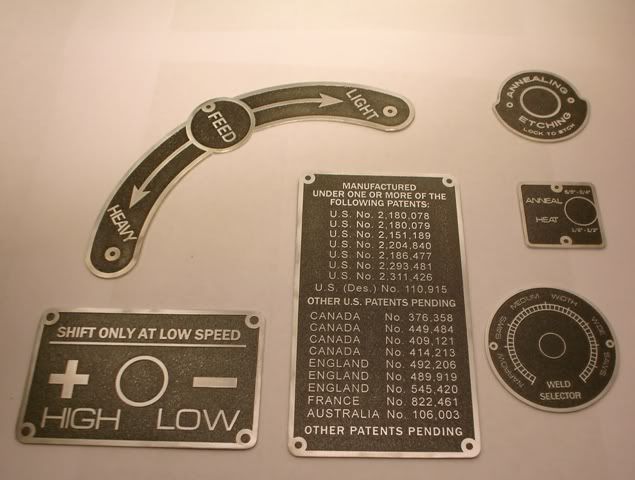
604.jpg
 
Last edited:

mjozefow

Well-known member
Joined
Apr 9, 2009
Messages
2,111
Location
Lafayette, IN
This is far above and beyond what most would do. And that is why it is such an incredible restoration to follow. Good work John.

Have you aver considered getting into aircraft restoration? I'd feel safe in any old plane restored to this level of detail.
 

Medwards

Well-known member
Joined
Jun 10, 2009
Messages
76
Location
TN
Here the resist has been stripped and the plate is ready to be cut out and painted:
If you only had a nice running bandsaw to cut these out with, you would be set. :D

When I bought my lathe it needed work, so I stripped everything but the headstock from the machine. I had to ream some bronze bushings for the apron while it was apart and only the a lathe would do. I was able to rig some stuff together and turn the input on the headstock with my drill. It was just enough power to ream the bushings. Having a machine make it's own spare parts is a pretty gratifying experience.
 
OP
A

A_Pmech

Well-known member
Joined
May 8, 2007
Messages
8,002
Location
IL
More data plates!

605.jpg


I solved my exposure problem as can be seen in this close-up. The commas and periods are twelve thousandths of an inch wide. The tails of the commas are .007" wide.

606.jpg


If anyone needs photo-engraved data plates / placards, I'm available...

:bounce:
 
Last edited:
OP
A

A_Pmech

Well-known member
Joined
May 8, 2007
Messages
8,002
Location
IL
This is far above and beyond what most would do. And that is why it is such an incredible restoration to follow. Good work John.

Have you aver considered getting into aircraft restoration? I'd feel safe in any old plane restored to this level of detail.

Thanks Mitch!

I have rebuilt aircraft before as part of my duties as an airplane mechanic. However, I've never had the pleasure of rebuilding an historic aircraft. Yet...

Thank you for your vote of confidence! :)

Medwards said:
If you only had a nice running bandsaw to cut these out with, you would be set.

When I bought my lathe it needed work, so I stripped everything but the headstock from the machine. I had to ream some bronze bushings for the apron while it was apart and only the a lathe would do. I was able to rig some stuff together and turn the input on the headstock with my drill. It was just enough power to ream the bushings. Having a machine make it's own spare parts is a pretty gratifying experience.

True! I sat down with some shears and cut them out instead. :)

Making spare parts certainly is gratifying and it's one of the big reasons why I love machining!

It sounds like you're in the process of going though the drive electrics. Are you going to retain the existing Monarch drive or go VFD?

:beer:
 
Last edited:

Medwards

Well-known member
Joined
Jun 10, 2009
Messages
76
Location
TN
I have an old Clausing Colchester. I did a rebuild of the apron and feed gearbox when I bought it over a year ago. Luckily it came with most all the spare parts I needed I just had to make a new crossfeed screw and some bushings.

Wow!! Those data plates look fantastic. I read this the other day. "A craftsman is someone who builds things better than anyone else thinks they need to be. When everyone else thinks it's good enough, a craftsman still looks for ways to perfect it further." You are truly a craftsman.
 

Steve from Socal

Well-known member
Joined
Jan 27, 2009
Messages
3,491
Location
Hutchinson Ks.
John,

The data plates are fantastic!!! The patent plate is amazing. For what its worth many of the plates on my saw and the later ones are silk screens.

Steve
 

chad pickens

Well-known member
Joined
Jan 11, 2006
Messages
230
Location
Bloomington , In
A_Pmech
Ive been away for a while and you've been BUSY, It looks wonderful. I got my metalmaster finished and am in heaven theres nothing like a Good OLD piece of machinery. My hats off to you I dont think it would be possible to do a better job :beer:
 
OP
A

A_Pmech

Well-known member
Joined
May 8, 2007
Messages
8,002
Location
IL
I have an old Clausing Colchester. I did a rebuild of the apron and feed gearbox when I bought it over a year ago. Luckily it came with most all the spare parts I needed I just had to make a new crossfeed screw and some bushings.

Wow!! Those data plates look fantastic. I read this the other day. "A craftsman is someone who builds things better than anyone else thinks they need to be. When everyone else thinks it's good enough, a craftsman still looks for ways to perfect it further." You are truly a craftsman.

Ahh! I remember now. I had your machine pictured as a 10EE in my head, it has some shapes in common with the Monarch. It sounds like you bought it as a project in need of some skilled help. It's fun making stuff useful again.

Thank you, Medwards. :bow:

Steve in Socal said:
John,

The data plates are fantastic!!! The patent plate is amazing. For what its worth many of the plates on my saw and the later ones are silk screens.

Steve

Thanks!

I was wondering about that. I kinda figured they had gone to silk screening at some stage in the 60's - 70's like a lot of other manufacturers.

Chad Pickens said:
A_Pmech
Ive been away for a while and you've been BUSY, It looks wonderful. I got my metalmaster finished and am in heaven theres nothing like a Good OLD piece of machinery. My hats off to you I dont think it would be possible to do a better job

Chad!!!

I was wondering where you went! Hope all is well on your end?

Glad to hear you have yours running! I'm still plugging away but I'll be done soon. The V-36's are nice machines, for certain.

I don't know if you've been following the thread, but it turns out my V-36 was also very likely in the Army or the Air Force. I found an AAFES wrapper in the base of the machine, along with a dead mouse, a vintage peanut brittle and a whole bunch of other junk.

As an aside, Do-All just recently uploaded the correct operator's manual for the V-36, which can be found here:

http://www.doallsawing.com/downloads/product_support/IV__ML_ V-16_ V-26_ V-36_ V-60.pdf
 

Mickey O

Well-known member
Joined
Oct 25, 2009
Messages
6,153
Location
Chicago, IL
Incredible job on the data plates! You wouldn't believe what I ran across the other day, that is unless I took pictures, and I did (sorry they're real crappy, I don't know how to get them from the phone to the PC so I took pics of the phone). I told them to look up garage journal if they need any info or parts made for it.


DoAll.jpg
 
Last edited:
To avoid these ads, REGISTER NOW!
Top Bottom