To avoid these ads, REGISTER NOW!

Voltage Drop and Wire Size - Detached Barn Project

Bert_

Well-known member
Joined
Dec 24, 2016
Messages
9,699
Location
NW Iowa
Inline splice will be harder to tuck in the box than if both wires entered from the same side.

Most of the time I would go with the insulated splice vs taping it. Main reason for that is my time to tape it is more expensive than the insulated splice. If I was doing it for myself I would use the splice reducer or a split bolt and tape it with rubber then electrical tape.

Have to ask why you're running 1/0 ground. Normally #6 would suffice but since your phase wires are upsized the ground does need to be at least a #3. Still quite a bit smaller than 1/0.
 
To avoid these ads, REGISTER NOW!
OP
L

larry4406

Well-known member
Joined
Jan 27, 2006
Messages
19,039
Location
Northern Virginia
Inline splice will be harder to tuck in the box than if both wires entered from the same side.

Most of the time I would go with the insulated splice vs taping it. Main reason for that is my time to tape it is more expensive than the insulated splice. If I was doing it for myself I would use the splice reducer or a split bolt and tape it with rubber then electrical tape.

Have to ask why you're running 1/0 ground. Normally #6 would suffice but since your phase wires are upsized the ground does need to be at least a #3. Still quite a bit smaller than 1/0.

Bert - thanks for sticking with me!

Typo on the 1/0 ground! I will correct that. Back when I was thinking aluminum MHF I was heading down the path of 2/0-2/0-2/0-1 as that was the product offering. So I should change the ground to #3 aluminum with 2/0 AL XHHW phase wires?

The insulated splices seem easier to me and in the grand scheme of things, not a huge cost penalty and seems more idiot proof (not that I am one unless you talk to my wife ;)) and a neater installation.

The inline splice my thought was that I could push the excess SER back up to the attic while pulling the excess XHHW down towards the pedestal and doing the pedestal splice last. I was thinking this would keep excess wire out of the junction box knowing there was slack on the attic side. I have never worked with 2/0 AL so maybe I am fooling myself.

If I use the same side insulated splices, then I think I need to arc sideways into the junction box vs straight thru. I agree this will be easier to splice. This will increase the amount of wires in the junction box and make it more congested. Trying to keep it neat and not to draw attention to a crowded junction box as you pointed out prior. Maybe I am over thinking this. Concept sketches attached.

Thanks again for your help.
 

Attachments

  • House Junction Box Zoom - Inline Splice.jpg
    House Junction Box Zoom - Inline Splice.jpg
    83.6 KB · Views: 23
  • House Junction Box Zoom - Same Side Splices.jpg
    House Junction Box Zoom - Same Side Splices.jpg
    86.6 KB · Views: 21
OP
L

larry4406

Well-known member
Joined
Jan 27, 2006
Messages
19,039
Location
Northern Virginia
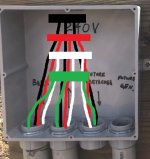
The splices at the 240V pedestal junction I am thinking would look like this.

I was thinking to vertically stagger the insulated connectors so as to improve fastener access and make for a neater installation. The stagger is exaggerated, I would keep the wires as long as possible.

The feed from the house panel would be in the middle, the port to the barn on the left, and the port on the right to the future detached garage (not used at present).
 

Attachments

  • 240V Pedestal Junction.jpg
    240V Pedestal Junction.jpg
    67.3 KB · Views: 15
  • 240V Pedestal Junction Labeling.jpg
    240V Pedestal Junction Labeling.jpg
    51.7 KB · Views: 11
  • Polaris 3-Way Multi-Tap.jpg
    Polaris 3-Way Multi-Tap.jpg
    55 KB · Views: 8

pattenp

Well-known member
Joined
Jun 4, 2008
Messages
10,175
Location
Virginia - USA
Be mindful that code requires a certain length of wire to be in the box for splicing. You need to have a minimum of 6" of length from where the conductor enters the box.
 
OP
L

larry4406

Well-known member
Joined
Jan 27, 2006
Messages
19,039
Location
Northern Virginia
Be mindful that code requires a certain length of wire to be in the box for splicing. You need to have a minimum of 6" of length from where the conductor enters the box.

Good info! I think that then means the SER/XHHW splice at the house needs to be the side by side arced type I illustrated since the box is 12x12.

Vacuumed pull strings and pulled mule tape today. Used shop vacuum to blow thru conduit and no water. Then crumpled a sheet of newspaper, tied string, then crumpled it into a ball. Sucked thru like a charm. Paper dry. Tied off mule tape, pulled tape back thru and the string length was my measurement. Laid string on ground and wheeled it off. Measured both cuts from barn to pedestal and pedestal to house junction. Added some fat.

Now need to confirm the minimum #3 aluminum ground and then go get supplies. What’s interesting is that it appears the ground is 1awg in all the 2/0 AL SER products I can find on line. I have a left over spool of #2 AL XHHW compact which I’m thinking should work for the ground; I just need to confirm the footage.

Still need to install the junction box on the back side of panel, stub pipes to attic, then measure the SER.
 

pattenp

Well-known member
Joined
Jun 4, 2008
Messages
10,175
Location
Virginia - USA
The code section for the oversized circuit for voltage drop says the EGC also needs to be increased in size in proportion to the current carrying conductors. Since #1Al is what's needed for 100A, the percent increase in size to #2/0Al is the amount the EGC is to be increased. So #6Al EGC is needed for up to 100A needs an increase in size of X% which is where the #3Al is called for, assuming Bert did the math.
 
Last edited:
OP
L

larry4406

Well-known member
Joined
Jan 27, 2006
Messages
19,039
Location
Northern Virginia
The code section for the oversized circuit for voltage drop says the EGC also needs to be increased in size in proportion to the current carrying conductors. Since #1Al is what's needed for 100A, the percent increase in size to #2/0Al is the amount the EGC is to be increased. So #6Al EGC is needed for up to 100A needs an increase in size of X% which is where the #3Al is called for, assuming Bert did the math.

I'm no sparky but I will give it a try! Please check me.

#1 = 83.6927 kcmil
2/0 = 133.0765 kcmil

Percent increase = 100* (133.0765 - 83.6927)/83.6927 = 59.0%

So normally 100A would be #6 Al ground (NEC Table 250.122).

#6 = 26.2514 kcmil

Upsizing = 1.59*(26.2514) = 47.7400 kcmil

#4 = 41.7413 kcmil
#3 = 52.6348 kcmil

So I round up to #3 and confirm Bert's recommendation.

As I already have a #2 AL XHHW (66.3713 kcmil) its ok (over kill). Any problem using this with (3) 2/0 AL XHHW in a 2" conduit?

Is my understanding and calc's proper? I am a rusty ME not an EE.

Thanks again!
 

Bert_

Well-known member
Joined
Dec 24, 2016
Messages
9,699
Location
NW Iowa
I'm no sparky but I will give it a try! Please check me.

#1 = 83.6927 kcmil
2/0 = 133.0765 kcmil

Percent increase = 100* (133.0765 - 83.6927)/83.6927 = 59.0%

So normally 100A would be #6 Al ground (NEC Table 250.122).

#6 = 26.2514 kcmil

Upsizing = 1.59*(26.2514) = 47.7400 kcmil

#4 = 41.7413 kcmil
#3 = 52.6348 kcmil

So I round up to #3 and confirm Bert's recommendation.

As I already have a #2 AL XHHW (66.3713 kcmil) its ok (over kill). Any problem using this with (3) 2/0 AL XHHW in a 2" conduit?

Is my understanding and calc's proper? I am a rusty ME not an EE.

Thanks again!

Looks good.

(3) 2/0 and (1) #2 xhhw is no problem. Your allowed (6) 2/0's in 2" PVC, plenty of room with your plans.
 
OP
L

larry4406

Well-known member
Joined
Jan 27, 2006
Messages
19,039
Location
Northern Virginia
3-way Lighting Circuit with Intermediate Outlets

I am still trying to figure out the lighting circuit and intermediate outlets.

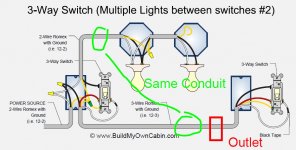
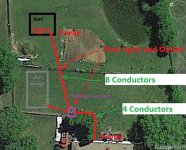
Power source is at the barn. There will be a 3-way switch at the barn and a barn light. 75' away via 1" conduit I will have a post light and an outlet. The 1" conduit then continues for 65' reaching a second post light and an outlet. From there, the 1" conduit runs 100' to the house for the 3-way switch. Outlets always hot.

The attached wiring diagram is the closest that I can come up with. The lighting and 3-way wiring would all be in the same conduit plus additional wires for the outlet.

Counting conductors:
3-way - R, B1, B2 , G (schematic shows the white made black)
Lights - B, W, G
Outlet (not shown) - B, W, G
Net = R, B1, B2, B3, B4, W1, W2, G (8 conductors)

I plan on using THHN/THWN stranded wire, likely 12 awg. This link indicates that the 1" conduit could accommodate up to 25 of these conductors so I am good at 8 conductors. http://www.elliottelectric.com/Stat.../ElectricalTables/Conduit_Fill_Table_PVC.aspx

My understanding is that NEC does not allow phase markings for #6 and smaller wires (my initial plan was to just buy a spool of black wire). Is it ok to just get R, B, W, and G and differentiate the 4-blacks and 2-whites via labels? I see these labels are offered.
 

Attachments

  • 3-way Switching of Intermediate Lights with Intermediate Outlets.jpg
    3-way Switching of Intermediate Lights with Intermediate Outlets.jpg
    116.9 KB · Views: 23
  • Aerial View - Post Lights and Outlets.jpg
    Aerial View - Post Lights and Outlets.jpg
    90.9 KB · Views: 22
  • Ideal Wire Labels.jpg
    Ideal Wire Labels.jpg
    68.1 KB · Views: 23
To avoid these ads, REGISTER NOW!
OP
L

larry4406

Well-known member
Joined
Jan 27, 2006
Messages
19,039
Location
Northern Virginia
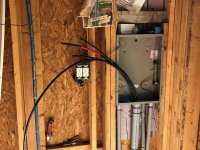
Big day yesterday, pulled the wire through the conduits.

Tied the mule tape to the ground wire using the knot shown in the first picture, then electric taped the bundle together. Used the Klein spray foam lube. Had 4 guys which helped greatly.

One step closer...
 

Attachments

  • Barn Panel.jpg
    Barn Panel.jpg
    155.2 KB · Views: 36
  • Pedestal Junction.jpg
    Pedestal Junction.jpg
    146.6 KB · Views: 40
  • House Junction.jpg
    House Junction.jpg
    133.7 KB · Views: 41
  • Wire Pull.jpg
    Wire Pull.jpg
    143.3 KB · Views: 39
  • Cable Pulling Lock Stitch Knots.jpg
    Cable Pulling Lock Stitch Knots.jpg
    41.9 KB · Views: 40
OP
L

larry4406

Well-known member
Joined
Jan 27, 2006
Messages
19,039
Location
Northern Virginia
Pulled the SER from the house junction up into the attic. Still need to run it thru the attic over to the panel.

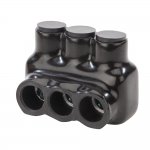
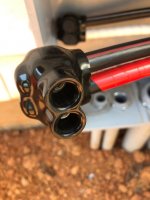
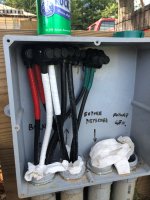
Used the "Polaris Type" connectors and made terminations at the house junction box and pedestal junction box. Those connectors are sweet!

In retro spec, at the pedestal junction, I should have purchased and used 4-port connectors for the neutral and ground instead of 3-port. This would have simplified the future 4-wire generator installation as I would then need to only pull 2 conductors (L1 and L2) for the back feed breaker with interlock. Ground is ground and the neutral would fed the out buildings when on the grid and would be used by the generator when off grid. Easy enough to change later.

I also terminated the feed to the barn panel as well (no pictures). Remaining work to be done is go back up into the attic, finish pulling the SER over to the panel and make terminations to the main panel (will need to rearrange some breakers). Maybe later today will be the day that the barn finally gets power.
 

Attachments

  • Polaris Type Connector.JPG
    Polaris Type Connector.JPG
    90.7 KB · Views: 45
  • House Junctions Terminated.JPG
    House Junctions Terminated.JPG
    120.9 KB · Views: 52
  • Pedestal Junctions Terminated.JPG
    Pedestal Junctions Terminated.JPG
    138.4 KB · Views: 54
OP
L

larry4406

Well-known member
Joined
Jan 27, 2006
Messages
19,039
Location
Northern Virginia
Yesterday pulled the SER thru the attic and connected it to the main panel. Had to add lugs for the neutral and ground to connect them to the bar.

Barn is finally on the grid!

Thanks again to all for the help with this! Now on to other aspects of this project.

PS - the 2/0 AL did fit the CH 100A breakers.
 

Norcal

Well-known member
Joined
Mar 16, 2008
Messages
13,752
Re: 3-way Lighting Circuit with Intermediate Outlets

I am still trying to figure out the lighting circuit and intermediate outlets.

Power source is at the barn. There will be a 3-way switch at the barn and a barn light. 75' away via 1" conduit I will have a post light and an outlet. The 1" conduit then continues for 65' reaching a second post light and an outlet. From there, the 1" conduit runs 100' to the house for the 3-way switch. Outlets always hot.

The attached wiring diagram is the closest that I can come up with. The lighting and 3-way wiring would all be in the same conduit plus additional wires for the outlet.

Counting conductors:
3-way - R, B1, B2 , G (schematic shows the white made black)
Lights - B, W, G
Outlet (not shown) - B, W, G
Net = R, B1, B2, B3, B4, W1, W2, G (8 conductors)

I plan on using THHN/THWN stranded wire, likely 12 awg. This link indicates that the 1" conduit could accommodate up to 25 of these conductors so I am good at 8 conductors. http://www.elliottelectric.com/Stat.../ElectricalTables/Conduit_Fill_Table_PVC.aspx

My understanding is that NEC does not allow phase markings for #6 and smaller wires (my initial plan was to just buy a spool of black wire). Is it ok to just get R, B, W, and G and differentiate the 4-blacks and 2-whites via labels? I see these labels are offered.


Only 6 AWG & smaller white & green insulation need to be colored throughout, I see no reason why the black ungrounded conductors can't be field marked as needed.
 
OP
L

larry4406

Well-known member
Joined
Jan 27, 2006
Messages
19,039
Location
Northern Virginia
Re: 3-way Lighting Circuit with Intermediate Outlets

Only 6 AWG & smaller white & green insulation need to be colored throughout, I see no reason why the black ungrounded conductors can't be field marked as needed.

Thank you!

So I could eliminate Red and use black and label it as well? Trying to cut down on buying so many colors as I will likely never use them again. Would rather just buy black, white, and green.
 
Last edited:

brewchief

Well-known member
Joined
Sep 20, 2008
Messages
2,370
Location
Michigan
Pulled the SER from the house junction up into the attic. Still need to run it thru the attic over to the panel.


Used the "Polaris Type" connectors and made terminations at the house junction box and pedestal junction box. Those connectors are sweet!


In retro spec, at the pedestal junction, I should have purchased and used 4-port connectors for the neutral and ground instead of 3-port. This would have simplified the future 4-wire generator installation as I would then need to only pull 2 conductors (L1 and L2) for the back feed breaker with interlock. Ground is ground and the neutral would fed the out buildings when on the grid and would be used by the generator when off grid. Easy enough to change later.


I also terminated the feed to the barn panel as well (no pictures). Remaining work to be done is go back up into the attic, finish pulling the SER over to the panel and make terminations to the main panel (will need to rearrange some breakers). Maybe later today will be the day that the barn finally gets power.
Maybe I'm missing something on how you're going to wire the generator but AFAIK all conductors for a circuit must be run in the same conduit, you can't use the neutral and ground from a different circuit.

Sent from my SM-G965U using Tapatalk
 
OP
L

larry4406

Well-known member
Joined
Jan 27, 2006
Messages
19,039
Location
Northern Virginia
Maybe I'm missing something on how you're going to wire the generator but AFAIK all conductors for a circuit must be run in the same conduit, you can't use the neutral and ground from a different circuit.

Sent from my SM-G965U using Tapatalk

Interesting... Thanks for looking into this!

I literally have 2 parallel 2" conduits - one for my barn feed (now has 4 XHHW wires in it, L1, L2, G, N) and one for my future generator feed (empty). Both conduits start at the main panel and terminate at the same pedestal junction box.

My recent thought was that the Polaris Type connectors in essence have created remote ground and neutral bars at the pedestal junction. Continuing with this train of thought, then the generator would just need its L1 and L2 run in the empty conduit back to the main panel and use the N and G that are present at the pedestal junction. New separate N and G would literally land on the bar in the main panel next to the ones I just installed.

The two conduits were used for ease of subsequent generator pull (vs trying to pull thru a conduit with existing conductors, or remove and repull all).

This conduit fill chart looks like I could have put six 2/0 conductors in a 2". So had I done this, then the N and G would be in the same conduit as the generator conductors and the barn conductors. On MWBC's aren't the neutrals and grounds shared?
http://www.elliottelectric.com/Stat.../ElectricalTables/Conduit_Fill_Table_PVC.aspx

I am not a sparkie nor EE. Conceptually this seems to work to me. However if this is truly verboten (and I would like to confirm, understand why, and do the right thing!), then I can simply use the empty 2" generator conduit for its own dedicated 4-wire feed back to the panel. As a minimum, the separate ground return seems redundant as its right there.
 

Attachments

  • Pedestal Junctions Terminated.JPG
    Pedestal Junctions Terminated.JPG
    138.4 KB · Views: 20
To avoid these ads, REGISTER NOW!
Top Bottom