To avoid these ads, REGISTER NOW!

the Nepros brand hand tool thread

Dave455

Well-known member
Joined
Mar 19, 2013
Messages
5,800
Location
Sussex, England
I see Nepros has added a bunch of sizes to there 1/4 drive hex bit lineup.

Also stubby length and longer ones.

Hopefully they will add some ball end wobble hex in the future.

Any recommendations for quality ball drivers?

Yes, although high on quality, and offering quite a variety of styles, the Nepros range hasn’t always had a huge range of sizes.

It’s improving all the time though, and I think the increase in 1/4 drive hex bits reflects the fact that most folks attack these cap screws with their 1/4 drive now. I don’t even have regular hex keys in my road box anymore!

In case nobody noticed, they have introduced a load of 1/4 drive SAE sizes as well. My gut feeling is that the aerospace industry is driving this move. I’m already seeing Nepros ratchets in the hands of aircraft engineers, and those guys tend to be very conservative in their tastes!
 
To avoid these ads, REGISTER NOW!

giants

Banned
Joined
Feb 15, 2019
Messages
605
Location
California
Thanks for your comments. I was wondering why SAE remain popular. For aerospace, I would think that 3/4" drives are the main size. What drive sizes are common and for what types of planes/satellites?
 

toddmorr

Well-known member
Joined
May 4, 2017
Messages
649
Location
Potomac, Maryland
Can you or someone enlighten me as to the Japanese rationale with sticking with an apparently 1970's technology?

i'm not privy to their engineering/product discussions but would speculate they've made a very deliberate decision to produce lower tooth count ratchets because that design makes it easier to achieve really low back drag. And thus they've differentiated themselves from the masses. Not a bad strategy at all. No one else has backdrag that comes close. Couple that with a slightly lower handle length on the Zeal ratchets and you have a coherent product offering. Much better (and likely higher profit) than just repackaging another taiwan ratchet, as good as those might be.

having worked and lived in Japan off and on for years I can tell you the Japanese are quite good at this---studying the heck out of a marketplace, dissecting it until the cows come home, introducing a product to fill a space, and then patiently selling the product until profits come.
 

giants

Banned
Joined
Feb 15, 2019
Messages
605
Location
California
i'm not privy to their engineering/product discussions but would speculate they've made a very deliberate decision to produce lower tooth count ratchets because that design makes it easier to achieve really low back drag. And thus they've differentiated themselves from the masses. Not a bad strategy at all. No one else has backdrag that comes close. Couple that with a slightly lower handle length on the Zeal ratchets and you have a coherent product offering. Much better (and likely higher profit) than just repackaging another taiwan ratchet, as good as those might be.

having worked and lived in Japan off and on for years I can tell you the Japanese are quite good at this---studying the heck out of a marketplace, dissecting it until the cows come home, introducing a product to fill a space, and then patiently selling the product until profits come.

Thanks. I understand everything, except the concept and downside of backdrag. Please bear with me and explain what it is and why it's a problem. Thanks
 

neilsen100

Member
Joined
Oct 20, 2019
Messages
5
Location
Utah
Thanks. I understand everything, except the concept and downside of backdrag. Please bear with me and explain what it is and why it's a problem. Thanks

Backdrag is the force it takes to overcome the ratcheting mechanism while turning the ratchet opposite the direction of force. Said differently, if the ratchet is set to the "on" position, which would turn a fastener clockwise, backdrag is the amount of force it takes to turn the ratchet handle counterclockwise and overcome the spring to make it to the next "click."

The greater the back drag, the more likely the reverse motion of the ratchet causes the fastener to back rotate instead of the ratchet ratcheting to the next position. It is also suggested that greater backdrag can increase fatigue over the course of consistent usage.

Nepros has wonderfully low backdrag. Regardless of the technical points listed above and their potential merits, I prefer lower backdrag personally.
 

giants

Banned
Joined
Feb 15, 2019
Messages
605
Location
California
Nepros has wonderfully low backdrag. Regardless of the technical points listed above and their potential merits, I prefer lower backdrag personally.

Thank you for clarifying.

What brands and models and tooth count of of low backdrag ratchets do you have? Does the Nepros offer a particular advantage(s) over other low backdrag ratchets?
 

superautobacs

Well-known member
Joined
Oct 31, 2008
Messages
3,997
Location
Vancouver, BC
Giants,

As far as backdrag goes, Ko-ken, whether it be their standard or Zeal, is lighter, regardless of drive size (1/4 3/8/ 1/2).
The backdrag on Nepros' 90-tooth mechanism is pretty standard. It's not light nor heavy...as vague as that may sound. It is consistent though! I played with around 20 or so 90-tooth ratchets at a store, which included 1/4 and 3/8 drive ratchets. Each one of them were flawless. Consistent all the way through in feel.

I feel like you're trying to decide on a ratchet to purchase. What drive size and length are you looking for? Do you care for push-release head? Flex or non-flex? Automotive work or something else?
 

giants

Banned
Joined
Feb 15, 2019
Messages
605
Location
California
superautobacs, thanks.

I'm looking for 3/8" ratchets.

I just bought an old US SK 3/8" 40-tooth with knurled handle; I wanted to test out at home on my car what the lack of a quick release and having a knurled were like in an actual situation. I hate non-quick release. Lubed the detent ball on it and still can't pull out standard size socket by hand; instead, I jam a flathead screwdriver between the ratchet and socket to release the socket. Is that a SK flaw, being it's an old ratchet, or typical of non-quick release and I'm just strong enough or doing it wrong?

Also, do you mean the Nepros' 90-tooth has the same backdrag as other 90-tooth brands, or less?

I prefer to start threading bolts by hand, rather than using ratchet, to reduce the risk of cross-threading (maybe that's a novice problem?).

Would the low backdrag make it easier to initiate threading a fastener?

I have to thread by hand, because my current ratchet won't reverse, counter-rotate for me to keep ratcheting at the beginning; it won't reverse until there's resistance on the bolt/thread connection. Would low back drag ratchet solve that problem, ie rotate before the fastener catches on the threads?
 
Last edited:

jmhinkle

Well-known member
Joined
Feb 6, 2019
Messages
452
Location
Portland, OR
Honestly, I think you'd be happy with the Tekton ratchets. I also only like quick release heads because of greasy car work. Tekton makes every ratchet with QR option. I just compared my Tekton and Nepros again to see how they feel. They have the same amount of back drag to me which is pretty low in my opinion. They are both 90T mechanisms and the Tekton has been tested as one of the strongest ratchets out there. The Nepros feels a little smoother/nicer in the ratchet mechanism and is a little quieter as well. It also looks like a polished work of art, but there are no faults in the finish or action of the Tekton. Price is what keeps me loving the Tekton stuff. It's on par with the top stuff quality wise and the lower price point and cash back system from their website makes them topnotch in my opinion unless you absolutely have buckets of cash to burn and want to show off the Nepros name. I never once feel bad for grabbing my Tekton and using it. My Nepros is always gets the "should I use this here?"
 

giants

Banned
Joined
Feb 15, 2019
Messages
605
Location
California
Honestly, I think you'd be happy with the Tekton ratchets. I also only like quick release heads because of greasy car work. Tekton makes every ratchet with QR option. I just compared my Tekton and Nepros again to see how they feel. They have the same amount of back drag to me which is pretty low in my opinion. They are both 90T mechanisms and the Tekton has been tested as one of the strongest ratchets out there. The Nepros feels a little smoother/nicer in the ratchet mechanism and is a little quieter as well. It also looks like a polished work of art, but there are no faults in the finish or action of the Tekton. Price is what keeps me loving the Tekton stuff. It's on par with the top stuff quality wise and the lower price point and cash back system from their website makes them topnotch in my opinion unless you absolutely have buckets of cash to burn and want to show off the Nepros name. I never once feel bad for grabbing my Tekton and using it. My Nepros is always gets the "should I use this here?"

Thanks. Do you think that this Tekton has backdrag similar to the Koken and KTC 20-30ish tooth ratchets?
 

superautobacs

Well-known member
Joined
Oct 31, 2008
Messages
3,997
Location
Vancouver, BC
superautobacs, thanks.

I'm looking for 3/8" ratchets.

I just bought an old US SK 3/8" 40-tooth with knurled handle; I wanted to test out at home on my car what the lack of a quick release and having a knurled were like in an actual situation. I hate non-quick release. Lubed the detent ball on it and still can't pull out standard size socket by hand; instead, I jam a flathead screwdriver between the ratchet and socket to release the socket. Is that a SK flaw, being it's an old ratchet, or typical of non-quick release and I'm just strong enough or doing it wrong?

Also, do you mean the Nepros' 90-tooth has the same backdrag as other 90-tooth brands, or less?

I prefer to start threading bolts by hand, rather than using ratchet, to reduce the risk of cross-threading (maybe that's a novice problem?).

Would the low backdrag make it easier to initiate threading a fastener?

I have to thread by hand, because my current ratchet won't reverse, counter-rotate for me to keep ratcheting at the beginning; it won't reverse until there's resistance on the bolt/thread connection. Would low back drag ratchet solve that problem, ie rotate before the fastener catches on the threads?

Without having your socket(s) and ratchet to hold here, I can't comment on whether the issue is dimensional clearance or the ball on the anvil (or both).

Regarding backdrag feel on the 90-tooth Nepros...
I'm comparing it to 3/8 drive Snap-on's Dual-80, Mac Axis 90-tooth, Matco Eighty8, and Carlyle 90-tooth. In 3/8 drive, the Nepros feels normal. I feel the 3/8 drive Dual-80 and Axis ratchets can be lighter feeling. I say "can be", because I find that they are inconsistent. That's why in the previous post, I noted the consistency is there with Nepros (same with Ko-ken).


I have no issues with push-release ratchets, but If a choice was available between a push-release or not, I'd go with the non push-release. In certain situations, the push-release ratchet just adds frustration to the already difficult task at hand.

For the threading process, a lower backdrag ratchet is always going to be more user friendly, whether you're threading on or backing out a fastener.

It's good practice to start the threading process using your fingers, yes.
Don't underestimate the utility of your finger tips. When the friction between fastener and thread is low enough, your fingers are much more adept at working those fasteners on/off as you twirl your finger tips. Of course, that doesn't apply to all situations, so that's where your low backdrag ratchet comes into play, and you may even consider attaching a quick spinner to help aid in your fastening process.

What length 3/8 drive are you looking for? Maybe try a same length as your SK for a more direct comparison?
 

superautobacs

Well-known member
Joined
Oct 31, 2008
Messages
3,997
Location
Vancouver, BC
Thanks. Do you think that this Tekton has backdrag similar to the Koken and KTC 20-30ish tooth ratchets?

As Jmhinkel stated, maybe Tekton might be a good idea.

I don't own a Tekton ratchet, but I do have a KTC standard ratchet (36-tooth) and the backdrag is heavy in comparison to the Nepros 90. I wouldn't recommend it given the choices available today.
 

giants

Banned
Joined
Feb 15, 2019
Messages
605
Location
California
Without having your socket(s) and ratchet to hold here, I can't comment on whether the issue is dimensional clearance or the ball on the anvil (or both).

Regarding backdrag feel on the 90-tooth Nepros...
I'm comparing it to 3/8 drive Snap-on's Dual-80, Mac Axis 90-tooth, Matco Eighty8, and Carlyle 90-tooth. In 3/8 drive, the Nepros feels normal. I feel the 3/8 drive Dual-80 and Axis ratchets can be lighter feeling. I say "can be", because I find that they are inconsistent. That's why in the previous post, I noted the consistency is there with Nepros (same with Ko-ken).


I have no issues with push-release ratchets, but If a choice was available between a push-release or not, I'd go with the non push-release. In certain situations, the push-release ratchet just adds frustration to the already difficult task at hand.

For the threading process, a lower backdrag ratchet is always going to be more user friendly, whether you're threading on or backing out a fastener.

It's good practice to start the threading process using your fingers, yes.
Don't underestimate the utility of your finger tips. When the friction between fastener and thread is low enough, your fingers are much more adept at working those fasteners on/off as you twirl your finger tips. Of course, that doesn't apply to all situations, so that's where your low backdrag ratchet comes into play, and you may even consider attaching a quick spinner to help aid in your fastening process.

What length 3/8 drive are you looking for? Maybe try a same length as your SK for a more direct comparison?

Thanks. Standard length ratchet, beginner's version that would be representative and last me for a while until I get up to speed and sophisticated. Kinda like I'd like to buy a Cessa trainer propeller plane to try out flying and possibly return for refund (or not care if the price is really good) rather than buy into a 6th generation fighter (unless I can find the figher at a Cessan price).

From there, I can evaluate strengths and weaknesses and needs for my particular applications.
 

jmhinkle

Well-known member
Joined
Feb 6, 2019
Messages
452
Location
Portland, OR
Thanks. Do you think that this Tekton has backdrag similar to the Koken and KTC 20-30ish tooth ratchets?

I've never owned a koken ratchet as I don't like low tooth count ratchets. I've whittled my collection down to 72t or more as that's what I prefer. I think the back drag is low personally, but I'm not a back drag snob like some people. For me the ratchet acton itself had to be light, smooth and low angle.
 

Salmanslim

Member
Joined
Jul 26, 2018
Messages
24
Location
Sacramento
9701947725607794a9f37bb7264d99e9.jpg

This was taken from koken’s catalogue and explains what low backdrag is.


Sent from my iPhone using Garage Journal
 

Attachments

  • 9701947725607794a9f37bb7264d99e9.jpg
    9701947725607794a9f37bb7264d99e9.jpg
    608.1 KB · Views: 15

superautobacs

Well-known member
Joined
Oct 31, 2008
Messages
3,997
Location
Vancouver, BC
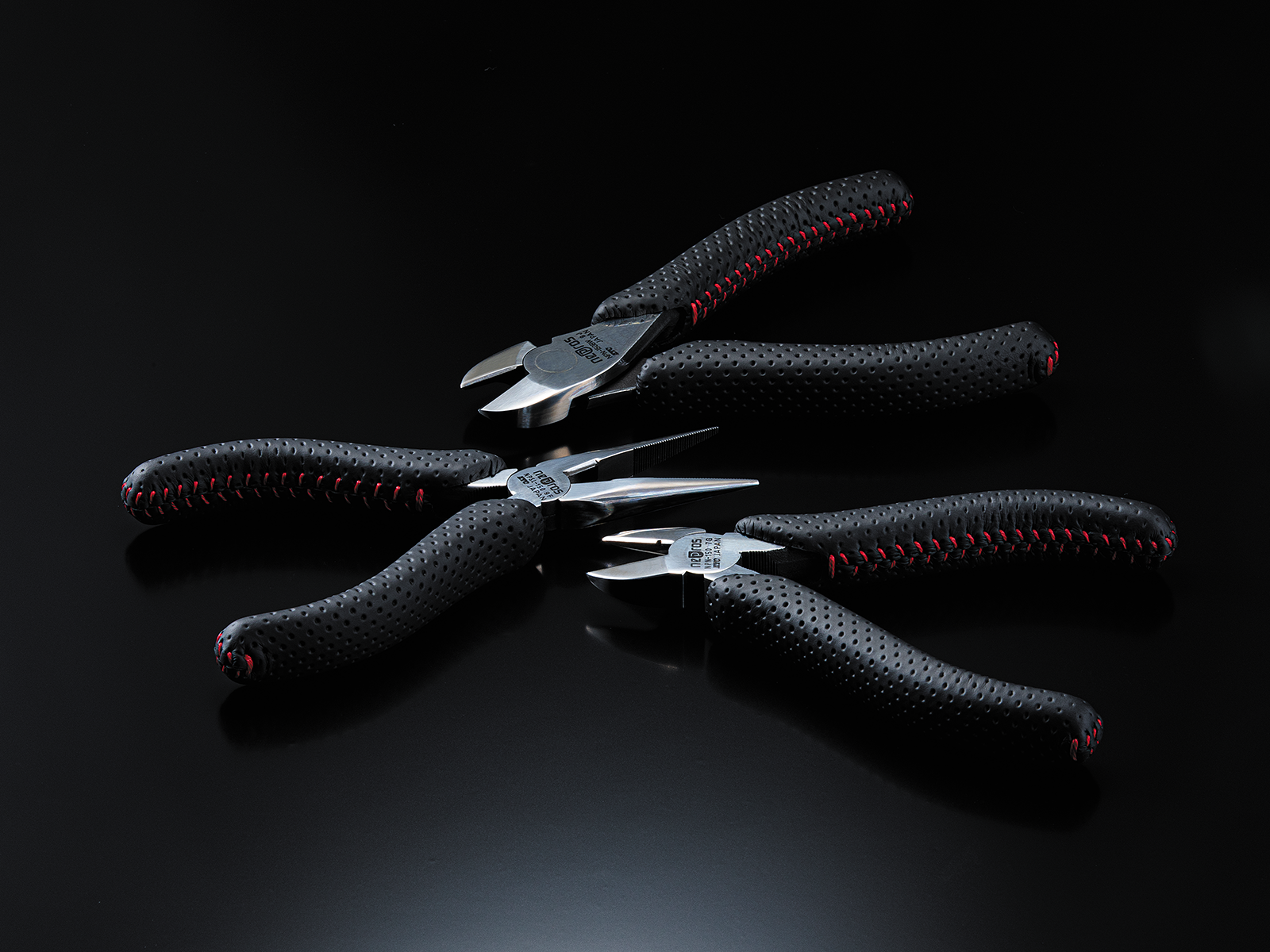
Something I handled recently:

<a data-flickr-embed="true" href="https://www.flickr.com/photos/ccassan/49093945602/in/datetaken-public/" title="Nepros' Custom Leather Wrapped and Stitched Pliers"><img src="https://live.staticflickr.com/65535/49093945602_8af540b230_c.jpg" width="450" height="800" alt="Nepros' Custom Leather Wrapped and Stitched Pliers"></a><script async src="//embedr.flickr.com/assets/client-code.js" charset="utf-8"></script>


<a data-flickr-embed="true" href="https://www.flickr.com/photos/ccassan/49093945587/in/datetaken-public/" title="Nepros' Custom Leather Wrapped and Stitched Pliers"><img src="https://live.staticflickr.com/65535/49093945587_53daa27930_c.jpg" width="450" height="800" alt="Nepros' Custom Leather Wrapped and Stitched Pliers"></a><script async src="//embedr.flickr.com/assets/client-code.js" charset="utf-8"></script>
 

Dave455

Well-known member
Joined
Mar 19, 2013
Messages
5,800
Location
Sussex, England
Thanks for your comments. I was wondering why SAE remain popular. For aerospace, I would think that 3/4" drives are the main size. What drive sizes are common and for what types of planes/satellites?

SAE (or to be more correct, Unified) are pretty much the world standard for anything aerospace. Even Airbus, being essentially an Anglo / French manufacturer, use them (the Brit’s won that argument) despite having the specs in metric (the French won that one)! It’s the only way to be, you can go to any airfield anywhere in the world, and the guys will have SAE tools!

Most of the fasteners are small. If you work on light aircraft you probably use 1/4 drive 90% of the time. On bigger aircraft you are probably using 1/4 drive and 3/8 drive, but seldom anything bigger. There are very few bolt heads bigger then about 5/8. Anything much bigger probably needs a specialist tool!

U.S. made aircraft are all inch/unified size threads, but with a selection of 12 point bolts / splines / oddballs (such as HTS) as desired.

British aircraft are generally standard inch / unified provided they post date unification, but engines / avionics can use BA sizes. Older stuff, from Tiger Moths to the Comet, are BSF / BSW. I could show you examples of BSW threads on my A330 though!

The tools an an aircraft engineer needs are actually quite limited. Most guys have a regular tool chest, and a much smaller hand held box for ‘line maintenance’, that they can do about 90% of jobs with. All the specialist tools are held by the company. A firm my father worked for operated a wide variety of types, with an even wider variety of engines. The stores looked something like the end scene from ‘Raiders of the Lost Ark’, except there were rows of shadowed boards with all the tools for each type, and also each engine. There was stuff dating back to the war!

The only time I saw round a satellite factory, conditions were sterile and we were not allowed into the assembly lines. The fasteners were minuscule, everything was torqued to a spec, and the torque drivers were wirelessly connected to the QC system, which recorded the torque applied to every bolt!
 
Last edited:

giants

Banned
Joined
Feb 15, 2019
Messages
605
Location
California
SAE (or to be more correct, Unified) are pretty much the world standard for anything aerospace.

Thanks.

Do you know why SAE/Unified won out?

Why do they call it Unified?

I (barely) understand that British Standard and BSW have different ways of measuring fastener sizes, eg SAE 5/8" is different from BSW. Can you give insights as to how British Standard and BSW determine fastener sizes?
 

pizza

Well-known member
Joined
Dec 4, 2019
Messages
1,739
Location
Midwest, USA
i was very excited to receive my first nepros tools. i got a couple of screwdrivers with plastic grips, the ND1P2-2 (Phillips No. 2) and ND1M2-6 (Slotted 1x6.3mm)

they seem nice overall, but i wonder if my expectations were too high or if their QC is slipping?

i emailed these thoughts to info AT nepros.net, but my message bounced. i then tried contacting them through the form on their site but haven't heard back yet.

figured i'd share my impressions here also:

Dear KTC,

I must say that I am not entirely satisfied with the quality of the screwdrivers I received today.

Regarding the ND1P2-2:
  • The end of the chroming near the tip is imperfect. It is rough and non-uniform. I admit this is a very minor issue.
  • The plastic of the handle arrived rough in a spot like it has been dropped or scraped on something.

Regarding the ND1M2-6:
  • There are voids in the plastic handle between the components or something, or perhaps the fit against the metal has a gap. Because of this, every time you touch/use/squeeze the handle, it makes a creaking or cracking noise. It is loud and noticeable, and it makes the tool feel cheap. This is my main complaint. If the handle did not make noises like this, I would not have emailed you.

From the images and videos I've seen online, your tools have earned an almost legendary reputation for attention to detail and quality control, especially the chroming and plastic molding. Almost like jewelry or something. I admit that my expectations were high. Were they too high? Like I said, the issues with the ND1P2-2 are minor, but the issue with the creaking handle noise in the ND1M2-6 makes me question the quality control.

I appreciate that you allow tool returns within 30 days, but I don't know it's worth it for me to pay for replacement shipping. Still, I wanted to let you know my thoughts on your otherwise very nice tools.

Best regards,
pizza

i'd share pics and video clips, but alas, can't do it due to post count. oh well. i'll share them later if anyone is curious.

also, i'm not here to hate on nepros. even with these issues, i think they're pretty sweet, and i look forward to trying more of their tools in the future.
 

Dave455

Well-known member
Joined
Mar 19, 2013
Messages
5,800
Location
Sussex, England
Thanks.

Do you know why SAE/Unified won out?

Why do they call it Unified?

I (barely) understand that British Standard and BSW have different ways of measuring fastener sizes, eg SAE 5/8" is different from BSW. Can you give insights as to how British Standard and BSW determine fastener sizes?

For many years, Britain and the U.S. used their own systems.

The British Whitworth system was the oldest, using a thread angle of 55 degrees. The U.S. system used a thread angle of 60 degrees, but otherwise the systems were similar, and both used bolts with dimensions in fractions of an inch. A 5/8 fastener is a 5/8 in both systems, though the thread pitch, as well as the angle, may differ.

The major area of difference was the bolt heads. British bolt heads, in the original system, were simply twice the bolt diameter, measured across the points. The U.S. system used bolt heads of specified sizes, measured ‘across flats’.

Both systems offered coarse and fine threads, BSW being comparable to American ‘National Coarse’, and BSF to ‘National Fine’.

BSW is British Standard Whitworth and BSF is British Standard Fine. Both might be referred to as ‘British Standard’, as would the wrenches, which fit both!

After the war, with the possibility, of both countries having to fight another major war, (Canada too) it was thought preferable that we all standardised on the same system. That was ‘Unified’. It was decided that a 60 degree thread would be standardised, as that angle is easier to construct geometrically, and with the benefit of a century of engineering knowledge, probably better.

In practice, this wasn’t a big change for the U.S. as most thread pitches stayed the same. A few vanished though, such as the larger sizes in the ‘numbered’ series, and some thread pitches changed. On many products produced in the U.K. in this era (late 50’s) you will see the ‘Unified’ symbol of 3 interlocking rings to denote it’s made with Unified threads.

As for aircraft, in the 50’s and 60’s the only major aircraft producers in the western world were the U.K. the U.S. and Canada. They had all just decided to use the Unified system, so that was that!
 
To avoid these ads, REGISTER NOW!

nichocha33

Well-known member
Joined
Dec 31, 2010
Messages
180
Something I handled recently:

<a data-flickr-embed="true" href="https://www.flickr.com/photos/ccassan/49093945602/in/datetaken-public/" title="Nepros' Custom Leather Wrapped and Stitched Pliers"><img src="https://live.staticflickr.com/65535/49093945602_8af540b230_c.jpg" width="450" height="800" alt="Nepros' Custom Leather Wrapped and Stitched Pliers"></a><script async src="//embedr.flickr.com/assets/client-code.js" charset="utf-8"></script>


<a data-flickr-embed="true" href="https://www.flickr.com/photos/ccassan/49093945587/in/datetaken-public/" title="Nepros' Custom Leather Wrapped and Stitched Pliers"><img src="https://live.staticflickr.com/65535/49093945587_53daa27930_c.jpg" width="450" height="800" alt="Nepros' Custom Leather Wrapped and Stitched Pliers"></a><script async src="//embedr.flickr.com/assets/client-code.js" charset="utf-8"></script>


Part number?


Sent from my iPhone using The Garage Journal mobile app
 

superautobacs

Well-known member
Joined
Oct 31, 2008
Messages
3,997
Location
Vancouver, BC

:thumbup:


npsl-150k~npn-150k_image.png


Those things look so sweet. But like everything Nepros, too nice to actually use.

I have no remorse using their bread-and-butter items. Not that I have any of them, but I'd dare use their leather or urushi series doing automotive work. Although it would be interesting to see a photo of say the leather wrapped pliers after years of use....just to see how it would patina and conform to the user's hands.
 
Last edited:

Ruxpin

Well-known member
Joined
Mar 1, 2016
Messages
124
Location
England
For many years, Britain and the U.S. used their own systems.

The British Whitworth system was the oldest, using a thread angle of 55 degrees. The U.S. system used a thread angle of 60 degrees, but otherwise the systems were similar, and both used bolts with dimensions in fractions of an inch. A 5/8 fastener is a 5/8 in both systems, though the thread pitch, as well as the angle, may differ.

The major area of difference was the bolt heads. British bolt heads, in the original system, were simply twice the bolt diameter, measured across the points. The U.S. system used bolt heads of specified sizes, measured ‘across flats’.

Both systems offered coarse and fine threads, BSW being comparable to American ‘National Coarse’, and BSF to ‘National Fine’.

BSW is British Standard Whitworth and BSF is British Standard Fine. Both might be referred to as ‘British Standard’, as would the wrenches, which fit both!

After the war, with the possibility, of both countries having to fight another major war, (Canada too) it was thought preferable that we all standardised on the same system. That was ‘Unified’. It was decided that a 60 degree thread would be standardised, as that angle is easier to construct geometrically, and with the benefit of a century of engineering knowledge, probably better.

In practice, this wasn’t a big change for the U.S. as most thread pitches stayed the same. A few vanished though, such as the larger sizes in the ‘numbered’ series, and some thread pitches changed. On many products produced in the U.K. in this era (late 50’s) you will see the ‘Unified’ symbol of 3 interlocking rings to denote it’s made with Unified threads.

As for aircraft, in the 50’s and 60’s the only major aircraft producers in the western world were the U.K. the U.S. and Canada. They had all just decided to use the Unified system, so that was that!

Excellent info thanks Dave.

I was aware of the high level changes with British / US systems but not the details, e.g. 50 degree thread, 60 degree thread.


To keep this post somewhat on topic...
I'm probably going to order a 90 tooth 1/4 ratchet (NBR290) to complement my leather handled 3/8" ratchet during clean builds and repair work.

0315161-nbr290.png

It would be nice (read: good for my OCD tendancies) if KTC produced a matching leather handled 1/4" ratchet but the NBR290 looks a fine alternative.

I'd also like one of the 3/8" breaker bars with leather grip (NBS3K) but in a leather colour which matches the ratchet's grip, but presume the client base for that would be absolutely miniscule!

130-nbs3k.png
 

Dave455

Well-known member
Joined
Mar 19, 2013
Messages
5,800
Location
Sussex, England
Excellent info thanks Dave.

I was aware of the high level changes with British / US systems but not the details, e.g. 50 degree thread, 60 degree thread.


To keep this post somewhat on topic...
I'm probably going to order a 90 tooth 1/4 ratchet (NBR290) to complement my leather handled 3/8" ratchet during clean builds and repair work.

Always happy to help! A lot of folks in the U.K. are familiar with all the different systems, because they have to be!

If I was buying again, and was going to buy tools for ‘clean’ work (which is an excellent idea) I would seriously consider Nepros. They excel at making beautifully precise 1/4 drive tools, all the modern styles of ratchet are available, but personally I love their steel handle ratchets.
 

Salmanslim

Member
Joined
Jul 26, 2018
Messages
24
Location
Sacramento
Just got my second order of nepros, as usual i am very pleased.


Sent from my iPhone using Garage Journal
 

Attachments

  • IMG_6213.jpg
    IMG_6213.jpg
    126.5 KB · Views: 286
  • IMG_6219.jpg
    IMG_6219.jpg
    147.3 KB · Views: 310
Last edited:

ricleh

Well-known member
Joined
Nov 2, 2007
Messages
1,447
Location
Sacramento, CA
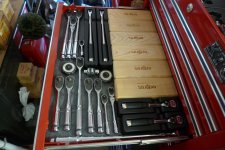
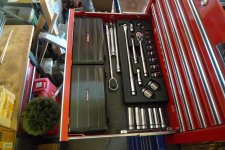
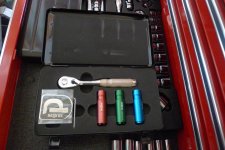
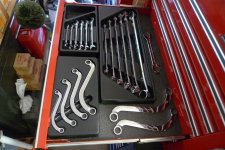
Reposting some pictures that Photobucket killed a long time ago. Some of my Nepros with a few other Japanese tool brands also.
 

Attachments

  • L1010902.jpg
    L1010902.jpg
    159.3 KB · Views: 158
  • L1010903.jpg
    L1010903.jpg
    154.5 KB · Views: 153
  • L1010901.jpg
    L1010901.jpg
    159.2 KB · Views: 142
  • L1010900.jpg
    L1010900.jpg
    155.5 KB · Views: 150
  • L1010899.jpg
    L1010899.jpg
    151.2 KB · Views: 165
  • L1010898.jpg
    L1010898.jpg
    153.1 KB · Views: 174
  • L1010897.jpg
    L1010897.jpg
    152.8 KB · Views: 167

ricleh

Well-known member
Joined
Nov 2, 2007
Messages
1,447
Location
Sacramento, CA
Some more pictures.
 

Attachments

  • L1010908.jpg
    L1010908.jpg
    154 KB · Views: 100
  • L1010909.jpg
    L1010909.jpg
    152.4 KB · Views: 102
  • L1010907.jpg
    L1010907.jpg
    150.7 KB · Views: 96
  • L1010910.jpg
    L1010910.jpg
    155 KB · Views: 104
  • L1010906.jpg
    L1010906.jpg
    150.7 KB · Views: 101
  • L1010904.jpg
    L1010904.jpg
    155.5 KB · Views: 98
  • L1010905.jpg
    L1010905.jpg
    147.7 KB · Views: 108

M6erfan

Well-known member
Joined
Dec 6, 2014
Messages
10,170
Location
'Merica!
Wow @ricleh, you don't mess around! As much as I love Nepros they are just too nice for me to use.

How is the build quality on those KTC boxes?

Their scrapers are my absolute favorites.
 

pizza

Well-known member
Joined
Dec 4, 2019
Messages
1,739
Location
Midwest, USA
nepros tool haul:

niFEAPq.jpg


cVMlLHs.jpg


i had the screwdrivers already, and my impression of them is that they're really very nice. however, i have some minor criticisms that i feel detract from their top-notch-ness:

i talked about this a little before, but i don't like their multi-component handle process. there are voids between the components, and this results in a popping/creaking sound when you use the screwdriver or squeeze the handle in any way. i complained to nepros about this, and they actually replaced it on their dime, but the replacement is basically the same.

also, i don't like the aesthetics of their badge on the handle.
there's a molded recess, and then in there they put one of those rubberized, beveled stickers with the reflective backing. to me, this seems like a toy. i can dig my fingernail into it and move the badge sticker around in there. i wonder how long before it falls out. i associate these kinds of badges with toys and other cheap products.

xvx8YfB.jpg


the new stuff:

NBR390F 3/8"sq. 90-Tooth Gear Flex-Head Ratchet
NTB315BA 3/8"sq. Socket Set (15pcs.) 6pt. SAE
YG-N29BK Suede cap

all in all pretty **** stuff, and i'm happy to use it.
but i think i'll probably continue to round out my ratchet and socket tools with more koken gear, particularly stuff from the zeal line. i need some extensions and stuff.
 
Last edited:

threewood

Well-known member
Joined
Sep 9, 2014
Messages
419
Location
Yuma, AZ
Got my Nepros reduced head 90 and my wobble extensions yesterday. WOW! Very pretty and smooth. Back drag is very light. Ratchet action is crisp. It is very small compared to regular head ratchets. Also, the wobble extensions can be fixed or wobble depending how far on the socket is attached. I really like this brand. I'm going to order a few more to try.
 

Attachments

  • nepros2.jpg
    nepros2.jpg
    76.8 KB · Views: 71
  • nepros3.jpg
    nepros3.jpg
    44.9 KB · Views: 78
  • nepros4.jpg
    nepros4.jpg
    143.3 KB · Views: 88
  • nepros5.jpg
    nepros5.jpg
    88.3 KB · Views: 75
  • nepros1.jpg
    nepros1.jpg
    78.3 KB · Views: 67
  • nepros6.jpg
    nepros6.jpg
    79.2 KB · Views: 60

pizza

Well-known member
Joined
Dec 4, 2019
Messages
1,739
Location
Midwest, USA
nice ratchet :D

if i understand correctly, the 3/8" reduced head ratchets are 3/8" square anvil kits in their 1/4" ratchet bodies?
 

FuzzyTiger

Well-known member
Joined
Aug 17, 2020
Messages
429
Location
Canada
nice ratchet :D

if i understand correctly, the 3/8" reduced head ratchets are 3/8" square anvil kits in their 1/4" ratchet bodies?

It really does look like that but actually no.

The 3/8" ratchet from Nepros is 30mm wide, 15mm tall for the head.

The 1/4" ratchet is 22mm wide, 11mm tall

The 1/2" are 39.5mm wide, 19mm tall

Different bodies for each of them and they are all mind bogglingly small for their size categories. The 3/8" is quite a bit smaller than most 1/4" ratchets I've seen from other companies... I haven't held their 1/4" but its on my shopping list. The 3/8" extended length flex head is first for me then I'll get their 1/4's.
 
To avoid these ads, REGISTER NOW!
Top Bottom