To avoid these ads, REGISTER NOW!

tile flooring?

rmousir

Well-known member
Joined
Jan 31, 2009
Messages
116
Hey All,

I saw Jack Olsen's garage and it is awesome! I was wondering how hard it would be to do the tile work that he did in his garage? Is that going to stand up to welding? What about dropping stuff? I think it is a cool way to go but don't know if it is really practical. I use floor jacks and lots of other auto stuff. Will it stand up?
 
To avoid these ads, REGISTER NOW!

TONE

Well-known member
Joined
Jun 5, 2006
Messages
1,866
Jacks garage/floor is great and it seems to work very well for him.

Me though, no, I would have cracked tile everywhere. I like the looks very much but I would be terrified to work in his garage.

I think it all depends on what you use the space for.

Same goes for paint on the walls, lighting, etc
 
To avoid these ads, REGISTER NOW!

Jack Olsen

Super Moderator
Staff member
Joined
Mar 22, 2009
Messages
6,678
Location
Los Angeles
I'm no expert on tile. But I think some people think all ceramic tile is like the stuff in their bathrooms. By the hardness/friction/H20-content ratings, the stuff in my garage is commercial grade and meets California code for public spaces like shopping malls. I think its durability owes a lot to how it's installed, also. Air gaps mean cracks. I double buttered everything.

05+Tile1204948474.jpg


I've jacked up cars on it, dropped tools -- no serious issues yet from normal use.

Jacked1268892394.jpg


Jacked21268892402.jpg


PoorMansLift.jpg


The garage is clean in most of the pictures I post online. But it gets a pretty serious workout in between cleanings. These are the 760-pound cabinets I installed. I had to bring them in, cut off their feet, and get them positioned on the tiles. No problems from that at all.

Moving041263936354.jpg


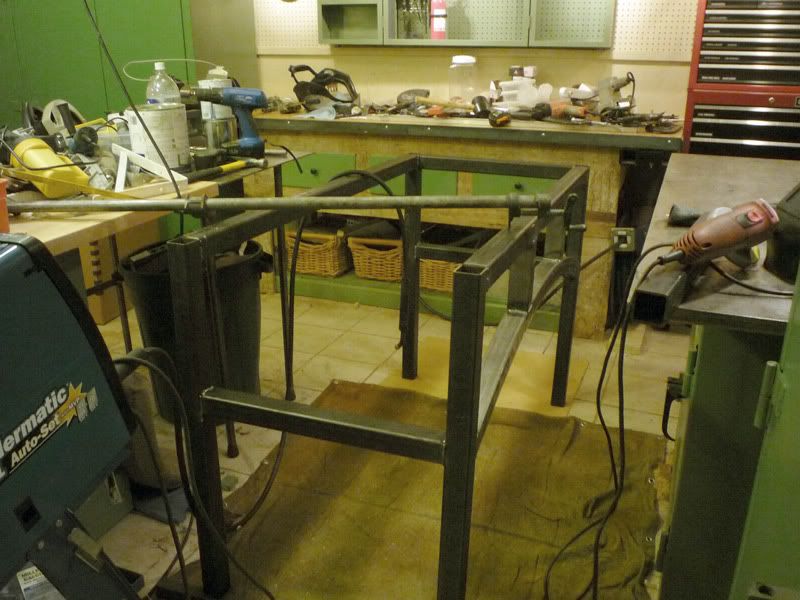
And these pictures will show that this is not a shop where Tone would have to be terrified he was going to break something.

Messy21268892419.jpg


The tiles do get damaged by weld spatter -- which burns tiny spots in the glazing. Now I set a welding tarp down under where I'm welding.

05BoxingItUp.jpg


The one thing that did do some damage (a while back) was when I dropped this vise:

Compliance+Station1254984045.jpg


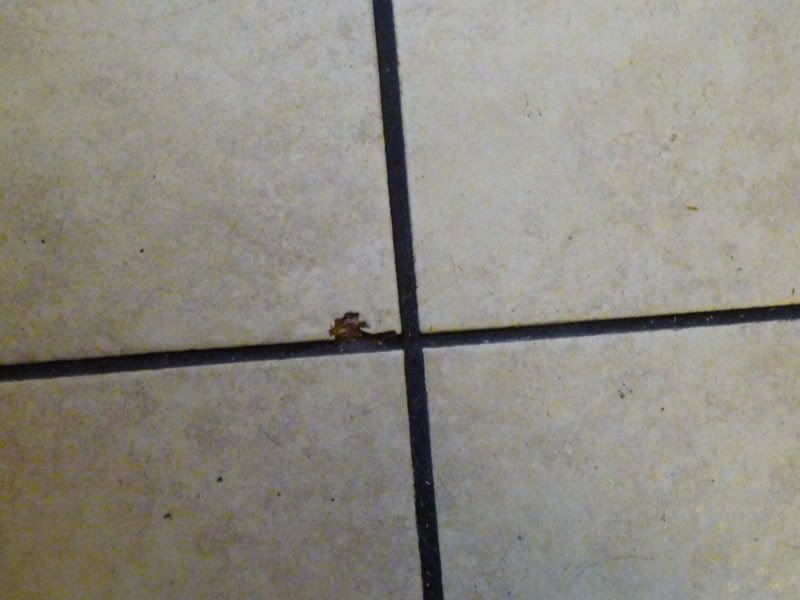
It's a 65-pound forged 10-inch vise that fell onto the tiles from its 37" bench top. It didn't crack the tile, but it chipped away the glazing on a corner of one.

TileChip.jpg


Can it be broken? Yes. Take a hammer to one and you can break it. But it's also pretty simple to take a broken tile out to replace it.

Here's the pretty shot:

11267553245.jpg


My slab was poured in 1925 and has been through 85 years of California earthquakes. It is NOT flat. It's also not vapor sealed, so enamel was not an option for me. The tile has worked out great, so far -- and at 68 cents a square foot, it was also pretty cheap.
 
Last edited:

Kevro

Well-known member
Joined
Jan 20, 2010
Messages
108
Location
Chester County, PA
Hey Jack, how slippery is your tile when it's wet? On a scale of 1 to 10, with 10 being "like ice - be extremely careful" and 1 being "like a concrete sidewalk - no worries at all". And for a frame of reference, what is its wet CoF? It looks great, btw - your garage is an inspiration. :)
 

Jack Olsen

Super Moderator
Staff member
Joined
Mar 22, 2009
Messages
6,678
Location
Los Angeles
Tiles come with three ratings from the manufacturer.

First off, there's a P.E.I. (Porcelain Enamel Institute) Wear Rating:

Group I - Tiles suitable only for residential/commercial walls. Not suitable and/or recommended for foot traffic

Group II - Tiles suited to general light residential traffic, except kitchens, entrance halls, and other areas subjected to continuous foot traffic.

Group III - Tiles suited for all residential and light commercial areas such as offices, reception areas and boutiques.

Group IV - Tiles suited for residential, medium commercial and light institutional applications such as restaurants, hotels, hospital lobbies and corridors.

Group V - Tiles suitable for heavy traffic both residential and heavy commercial applications such airports, malls and subways.


Then there's a Water Absorption Rating:

1. Non-vitreous Tiles - absorb 7% or more of its body weight in water. They are suited for indoor use only and considered to be non-frost resistant.

2. Semi-vitreous Tiles - absorb between 3% to 7% of its body weight in water. They are suited for indoor use only and considered to be non-frost resistant.

3. Vitreous Tiles - absorb between 0.5% to 3% of its body weight in water. They are suited for both interior and exterior applications (covered and/or non-heated rooms not exposed to standing water) and considered to be frost resistant.

4. Impervious Tiles - are the strongest. They absorb between 0 and 0.5% of their weight in water.


Finally, there's COF (coefficient of friction), with a rating for both wet and dry. This is how slippery the tile gets when it's wet. I don't know what the typical range is for ceramic tiles.


My cheapo tiles have a PEI rating of 'IV' (residential, medium commercial and light institutional applications). Obviously, 'V' would be the absolute ideal for a garage.

My water absorption rate is 3-7%, which means the tiles are not frost-resistant or frost-proof, and wouldn't cut it in an exterior application in a part of the country with sub-freezing temps. But then, I would guess Home Depot probably sells more appropriate tiles in parts of the country where it does freeze.

My coefficient of friction is 0.60, wet or dry. I haven't found much on the internet on this, aside from the fact the City of Los Angeles building code requires that level surfaces have a COF of not less than 0.60 and ramps no less than 0.80 when tested. I guess that would mean I'm just slip-resistant enough to be used in the local shopping mall.
 

Kevro

Well-known member
Joined
Jan 20, 2010
Messages
108
Location
Chester County, PA
Thanks, Jack. I'm considering some tile that is .72 CoF wet, but is more expensive than .60 tile that's available at HD. Just trying to decide if the ~15% higher cost would be worth the ~12% increase in safety.

And sorry for the threadjack. Tile is an excellent floor for a working garage, provided it's installed correctly, which basically means 100% coverage of the thinset, to fully support the tile. Thinset doesn't just hold a tile down - it's primary purpose is to hold it UP. And the longer it cures, the stronger it gets. :)
 
To avoid these ads, REGISTER NOW!
Top Bottom