What is the reason for a water jet over a laser? I looked into purchasing a multi-head water jet and starting a small business around it, but after talking to several people about it, I determined a laser or CNC plasma would be a easier machine to maintain and cheaper to operate.
Loaded question...even more loaded answer.
Back ground. I have been around Sheet Metal Lasers since 1979. We had a 500 Watt Laser on a Strippitt Turret Press. It was slow and very expensive to maintain. We didn't turn it on unless we need to.
As time went on more and more Machine Tool Suppliers started building Laser. Now they are the norm, probably more Laser installs going on today verses Turrets.
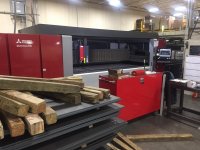
Currently my brother and I own 6 Lasers. 3 CO2 Amada 1212 Pulsars, 1 Mitsubishi CO2 4000 Watt and 2 Mitsubishi 8000 Watt Fibers. The support for these machines to keep them cutting is regular maintenance and lots of Assist Gas (Oxygen, Nitrogen and very rarely Shop Air).
The consumables are the Lenses and Nozzles. Lenses range anywhere from $1200 to 1500 each on the Co2's and 20K plus on the Fibers.
Entry pricing on the CO2's is cheap if you buy used. A good CO2 (no Chinese junk) new is in the $300K plus. Fiber is $600K plus. Again I am talking production machines that a build to run 24-7 and last a good long time with proper care.
The support systems you need cost money. Liquid Nitrogen and Liquid Oxygen in bulk. We have a 9000 Gallon Liquid Nitrogen Tank with a Pressure Builder (Trifecta System) and a 6000 Gallon Liquid Oxygen Tank. They are filled about once a week each. Do the math on 6 packs, 12 packs or Dura Cylinders you will spend more time changing tanks than yo will cutting.
Oxygen cutting is typically low pressure thus normally Liquid Cylinders will make enough pressure.
Nitrogen on the other hand requires way more pressure. Up to 400 psi thus you need a pressure building system to maintain high pressure. Get all 6 machines calling for HP Nitrogen and we have issues.
CO2 Lasers need to have the Vacuum Pump and Blower changed out about every 15000 hours. This is very costly. Optics need to be tweaked constantly by someone who knows what they are doing or you cut goes to hell in a hurry. Fibers are more forgiving, less optics to deal with but when you need to change a Lens you send the old head out for a rebuild. Typically they have an exchange program.
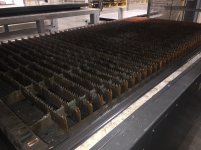
Slats: Your best bet is to invest in Copper Slats. We save 4 hours per bed (1 machine = 2 beds) per week by running Copper (that's 24 hours a week). The slag comes off easy and the Copper will out last the steel slats by 18 months. A set of steel slats may only last a week if you are cutting a lot of heavy plate. Not to mention you can scrap the Copper out and recapture 1/3 of your investment if you clean the slats before turning them in.
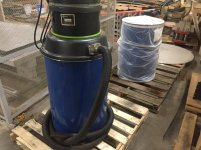
Lasers are limited on Materials. They will only cut what is in the wave length of the Beam. So metals on a metal laser are perfect. Start introducing other materials and you may have problems. Not to mention dust collector issues like fires. Cut plastic on a Metal Laser and sooner or later you will have a fire. Ask me how I know. Burnt 3 Dust Collectors to the ground in my tenure. Next person to cut Plastic, Wood or Copper in one of our Lasers will be looking for a job...and I am serious.
Laser Speed: Yep they are fast...never anywhere close to what the Manufactures state but they are fast. A laser needs to speed up and slow down for corners thus they never really hit full IPM. Take .118 CRS. We will program at 800 IMP on the internal features and 1200 on the externals and the real average speed is about 180-200 IPM with all the pierce time and travel time.
Thin materials cut way faster in a Fiber but once you hit 3/16 it is a wash with the CO2 until you get up to 1/2+ where the power becomes the driver of speed.
Our FMS Laser Systems are made for Lights out production and unmanned production during the day so the Set-ups and Operator can focus on programming and scheduling.
Our Amada Lasers are used for short run production and mainly prototype. They are programmed by Engineering and the Set-up loads the Program and Material and runs. We also do a lot of Combo Jobs on the Amadas. We may pre punch a blank and then finish it in the Laser. Or Laser first then punch. Or back and forth several times. We dabble in some pretty crazy stuff that requires thinking way outside the box.
Water Jet:
Slow on thin materials but close on thick for speed. No need for Nitrogen or Oxygen. You just need clean water (less than 250 PPM dissolved solids) and clean Garnet.
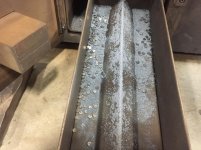
Consumables: Water Filters, Final Filters, Mixing Tubes (MT), MT Nuts and Garnet.
The entry point for a Water Jet can be as low as $40K on a new machine but a good machine is going to be around $150K without a Garnet removal system.
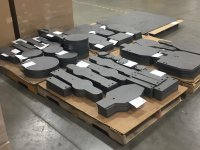
Versatility: A Water Jet can cut almost anything. Just remember the water takes the least path of resistance. So if you are cutting wood you will have issue with the grain. I have cut plastic, concrete, steel (all kinds) and there is no heat effected zone form the cut. A bonus when having to tap or c'snk holes after Laser.
For me it was entry level price and not having to deal with Liquid Oxy or Nitrogen. If you don't use it everyday they will bleed off which is a waste of money.
I could go on for another hour...but the Wife is calling saying my Ice Cream is served...LOL...
Water Jet or Laser? I would love to have a Laser at home...who knows...maybe someday. For now the Water Jet is the best solution for me.
If you are in the neighborhood let me know. I'll walk you through both facilities and you can see for yourself the pluses and minuses. I do value both!!!