OP
Private Lugnutz
Well-known member
"Made" is probably an overstatement given that it's an old door, but thanks.This dog ramp you made is fantastic!

Snerk. Thanks for that 1st hand anecdotal confirmation, OR.Mostly.
Thanks. And the answer was had in even shorter order than you probably suspected! Without even lifting my mouse-clicking finger.Nice kit, Lugz! I suspect you'll have an answer to that question in short order...

Very pertinent? INDISPENABLE!Here is a rather long but very pertinent YouTube video about a 1944 USN pilots’ survival kit.

Shifty, you just saved the Curator countless hours or futzing around with Google. Thanks, brother. Ironically, the segment on the emergency fishing kit was completely tangential to his survival kit, which came with a different, smaller kit.
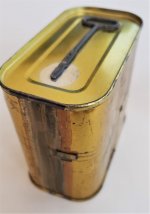
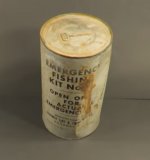
To save people time, the video Shiftless linked contains a segment in the middle (exact running time is 34:30 to 42:30) where the collector and narrator opens, live, for the first time ever since 1943, a NOS Navy Emergency Fishing Kit in a can. The can has a little key with a slot taped to the top, and it is uses to grab a strip and roll it, stripping the top off the can. Inside the can is...
...the Lugzsonian's emergency fishing kit roll-up!
So, here's what the Curator needs...
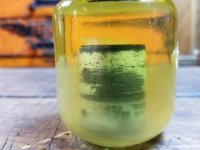
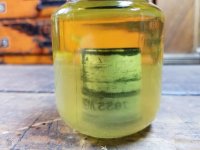
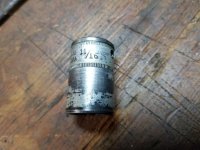
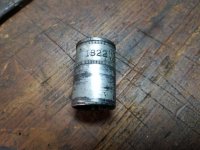
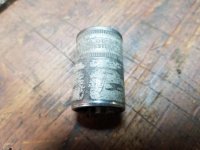
(1) The can!
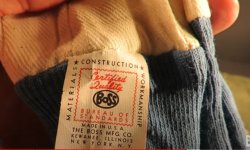
(2) White fabric lightweight work gloves type gloves with a blue cuff and a fabric label, reading Boss Mfg Co, Kewanee, Illinois, NY, NY.
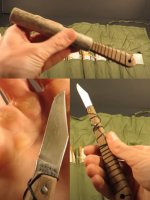
(3) The buoyant knife has a flat, lightweight wooden handle (of course) and a very short fillet style blade, only two rivets. The knife is almost all wooden handle. The handle has a leather shoelace type lanyard permanently attached to the pommel, to wrap around your wrist. Made by Imperial, Providence, R.I.
(4) The Pork Rind strips (12 of them) were in a cellophane bag, a commercial product. The top of the bag had a cardboard material for product labeling. Day's Dry Pack. Day Bait Company. No. 70. Port Huron, Michigan. Since the Curator has the original strips, this might be a repro. Any old bag with a fake cardboard label made on a computer, printed, and attached.
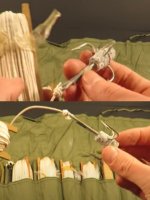
(5) What the narrator calls a "treble hook" is actually Rig No. 5, the Grapple. (He did a terrific job, but he would've been better served by opening and reading the Instructions before making the video.) No branding, but the Curator thinks any vintage common grapple will do.
(6) The whetstone. It was lashed to Rig No. 4 - Hook, Line & Sinker. The Curator was wondering why that wooden rig was made with a recess. Now he knows why. That's where the whetstone was kept. The Curator's deductive powers are slipping.
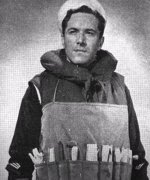
In addition to the contents, the Curator learned what the lines attached to the top of the roll-up are for. To tie the roll-up around one's neck and wear it like a shop apron as one traipses around the island avoiding the head-hunters!
Last edited: