“THIS IS MY BENDPAK” – MAKING THIS LIFT MINE (Part 3 of ?)…
AN AIR ACCUMULATOR BOTTLE FOR THE LOCKS (COMPRESSORLESS OPERATION) - continued
I’ll offer up a bit more detail on the air bottle system and some explanation on how it works.
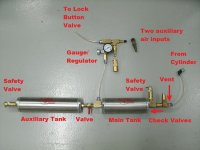
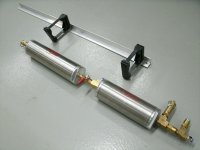
Here are the parts all laid out so it might more sense to you. Air can enter the system from one of four points, the retracting hydraulic cylinder, two different auxiliary inputs (direct hose connection or air chuck), and a vent (or breather) if the system ever draws vacuum with the extending cylinder. Arrows show where two of the three check valves are installed. The third check valve is where the male quick-disconnect fitting is installed.
When raising the lift, the compressed air is stored in the short bottle, or if desired, in both bottles when the ball valve is opened. The long bottle on the left works somewhat as a reserve. If raising the lift to full height, I will open up the valve allowing both bottles to get charged. At full height, I close the valve to the reserve bottle and save that compressed air for (maybe weeks) later.
The gauge/regulator is mounted up by the lock button valve. I could use this to regulate the air down to 30 psi or so, but instead I have it opened full to show pressure in the bottle(s). The lock circuit is fine for up to 120 psi and the safety valves are set for that.
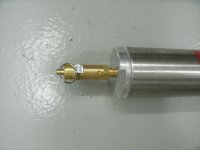
Here’s a closer look at the end connected to the lift cylinder. I just attached the clear hose and fitting to help visualize the system better.

Connections between the air bottles. The valve serves to isolate the reverse bottle.

Safety valve for the reserve bottle. Although this may not be entirely needed, it could protect against an overpressure situation when the bottle is isolated from the rest of the system and there is a big ambient temperature change. I had an extra valve so I installed it instead of a pipe plug.
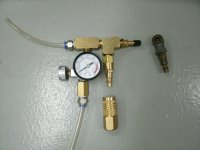
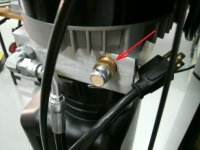
A close-up shot of the gauge/regulator and aux air inputs. The female quick-disconnect and air chuck are there for demonstration purposes only. The clear hose in the top left would feed to lock release button.
 Some final notes on the system:
- It will be typical for me to have a car stored at the highest height. If you are starting with no pressure (0 psi) because it had all leaked out, I found you can cycle the lift between the top lock and full up positions (up and down roughly 4” each time) three cycles to generate enough pressure to release the locks. This only takes a few seconds to do.
- If ascending from the ground, you will see the pressure start building very gradually until the runways are about a foot from full up. Then the pressure spikes rather quickly. I wasn’t expecting this, but it makes perfect sense now that I think about it. I like to fill the reserve bottle when I’m doing a full height lift.
- Before I added the reserve bottle, a full height lift easily over-pressurized the system and much air was lost (or wasted) when the safety valve popped open. And when the safety valve pops open, about half of the system pressure is lost instantly.
- The reserve bottle valve is easy to reach while standing by the Hydraulic power unit. I put a little decal on the runway so I knew exactly where to find it. In fact, when the decal gets about eye level, it serves as a great reminder me to open the valve and capture the maximum air possible. With the lift on the ground, my runways sit just high enough that I can still reach under to open or close the valve.

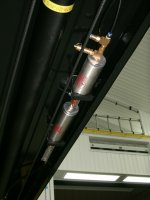
 . Here’s a worm’s eye view.





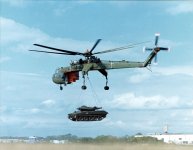
 good ole skycraft
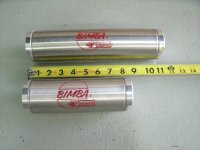
 . They are really nothing more than air tanks or "non-repairable reservoirs" as they call them. They are well built, however. I probably mislead you by calling them accumulators, because they are nothing like the hydraulics one we use at work either. But thanks for your suggestion.

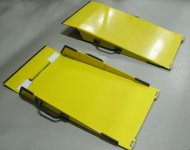
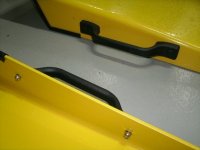
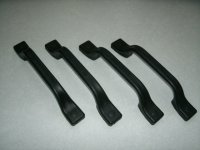
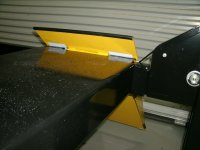

 . If I see something that will make a product easier to use, I do something about it.



 If it is all that you two have said it is, I don't know how JC can work down the street from it and not spend all his time there. Convenience like that could get expensive!












 Let's just say the compressor installation involves a 7-day timer and at least one solenoid valve