IT’S TIME TO TIDY UP THE WIRING TO THE CRANE HOIST…
There are many ways to get power cleanly out to a trolley-mounted electric hoist. Festoon systems, cord reels, and cable carriers come to mind. Originally I had purchased some little festoon rollers to drape the cable along the I-beam, but decided against them. Instead, I will be using a section of flexible cable carrier to contain the hoist cable as well as the cord for the hoist-mounted halogen spotlight. I’m mainly choosing it because of its clean looks.
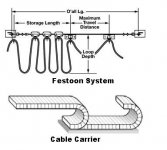
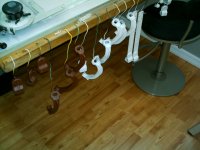
A cable carrier is basically a tube with links similar to a chain which can only bend in one direction. The one I have has hinging sides so you don’t have to feed the wire through. This will make it real easy to add more cables later if needed. A festoon system and cable carrier are shown in the next picture. The two extreme positions of the carrier version are shown to give you some idea how it travels.
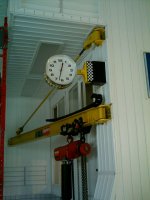
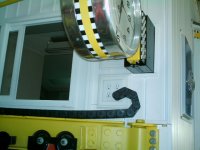
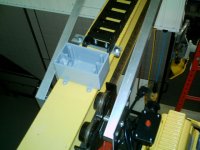
Here are some shots of the actual black carrier section lying in the approximate position on top of the I-beam. Cords will need to run from the wall (near the clock) out to the middle of the beam (above the “DAYTON” decal) where they will enter into the carrier. After running through the carrier, the cords will exit at the top hook and some brackets will connect from there to the hoist trolley. These ~20” brackets will be designed to match the angle of the crane tie rod (I’m kind of particular that way). Note that the carrier has a slight bow to it. It’s molded this way so the weight of the power cords inside straighten the carrier out when it‘s in the unsupported position (not resting on the I-beam).


There are many ways to get power cleanly out to a trolley-mounted electric hoist. Festoon systems, cord reels, and cable carriers come to mind. Originally I had purchased some little festoon rollers to drape the cable along the I-beam, but decided against them. Instead, I will be using a section of flexible cable carrier to contain the hoist cable as well as the cord for the hoist-mounted halogen spotlight. I’m mainly choosing it because of its clean looks.
A cable carrier is basically a tube with links similar to a chain which can only bend in one direction. The one I have has hinging sides so you don’t have to feed the wire through. This will make it real easy to add more cables later if needed. A festoon system and cable carrier are shown in the next picture. The two extreme positions of the carrier version are shown to give you some idea how it travels.
Here are some shots of the actual black carrier section lying in the approximate position on top of the I-beam. Cords will need to run from the wall (near the clock) out to the middle of the beam (above the “DAYTON” decal) where they will enter into the carrier. After running through the carrier, the cords will exit at the top hook and some brackets will connect from there to the hoist trolley. These ~20” brackets will be designed to match the angle of the crane tie rod (I’m kind of particular that way). Note that the carrier has a slight bow to it. It’s molded this way so the weight of the power cords inside straighten the carrier out when it‘s in the unsupported position (not resting on the I-beam).
Last edited:



 Maybe that memory IS starting to go!


 . The money for it has been sitting in an account for about 1.5 years now and it has taken EXTREME self control to resist buying it. Even though it has the ability to roll around easily on casters, I foresee it getting in the way when the ceiling is being worked on. I can’t just move it outside like the cars when it’s time to move the scaffold. I also considered buying it a while back and setting it up temporarily in the side bay to allow stacking the cars (actually not a bad idea to get both cars out of the way), but I think it will just be too much of a distraction and then the ceiling would never get done. Plus tearing it down and moving it later, although feasible, didn’t sound too appealing and getting the extra wide version makes it even tougher to squeeze it between the columns. A prior discussion about that can be found here:






 ).
).



 As the title suggests, I was counting my lucky stars because after the fireworks had stopped, I noticed fuel dribbling off the bottom of the tank. Sure enough, it had blown about 6 pinholes in the tank but somehow it didn’t ignite. I’m still not sure what it touched since the electrical parts are about 2” below the tank mount surface.