To avoid these ads, REGISTER NOW!

Above 1200 Sq/FT The ASYLUM - Happy 40th Birthday to Me! (Est. 2005)

Wokspaces above 1200 squarefeet.
OP
S

shopnut

Well-known member
Joined
Feb 22, 2006
Messages
4,237
Location
Florida
AN AUTO DRAINING WATER SEPARATOR FOR THE STACK…

Now that I have seen roughly how much water the STACK aftercooler pulls out of the air, I decided an auto drain on the upstream water separator was a must. I tried my other auto float drain there (with a simple bowl swap) and the float just got hammered from the pulsations in the pump outlet line. It was LOUD and couldn’t be used as is.

Luckily, not only does this particular water separator have a float to drain when full, but it also has a drain at the bottom to purge the bowl when the pressure drops to zero. PERFECT! In this location, the unloader valve conveniently drops the pump-to-tank line down to zero pressure every time the tank reaches its max setting (shutoff setting).

Knowing this was going to work out, I found another water separator on ebay for $25 (plus $12 shipping) and it came with a bonus 1/2” regulator. I will swipe the auto drain bowl from this new one and use it to replace the simple manual drain metal bowl shown earlier in the video.

3024-CH-60G-Compressor-755.JPG

My quick solution involved just securing the float so it couldn’t rattle in there, in effect, overriding the float feature. A spring did a fine job at holding the float in a down position.

3025-CH-60G-Compressor-756.JPG

Here’s a look down into the bowl.

3026-CH-60G-Compressor-758.JPG

And here it is assembled.

3027-CH-60G-Compressor-760.JPG

A little water spits out after every 95-125psi pump cycle. I will connect a hose to the bowl and collect it down in a larger reservoir.

Here is a cross section for reference. The extra spring sits on top of the float, item 2.

attachment.php
 
Last edited:
To avoid these ads, REGISTER NOW!
OP
S

shopnut

Well-known member
Joined
Feb 22, 2006
Messages
4,237
Location
Florida
MEASURING THE COMPRESSOR NOISE…

I said earlier that the noise of the stock compressor wasn’t that terrible and that I would wait to see how bad it was inside the cabinet before determining if extra measures were needed. I’m finally at that point.

Since I had some 1/2” thick foam board leftover from another project, I decided to cut some panels to fit between the framing before I installed the tileboard. I honestly don’t know if it helps or hurts (because I didn't measure it without it), but it’s in there now.

3028-CH-60G-Compressor-745.JPG

Here are the readings from my cell phone Sound Meter app. All panels were on and doors were closed for the testing.

Without compressor running. Ambient shop noise = 68 dB

3029-CH-60G-Compressor-773.jpg

Standing 5 feet away from the cabinet, directly in front of the doors - 82 dB

3030-CH-60G-Compressor-771.jpg

Standing 15 feet away from the cabinet, directly in front of the doors – 79 dB. This is probably more typical of what I will generally hear.

3031-CH-60G-Compressor-772.jpg

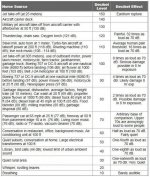
Just as reference, here are some charts I lifted from the internet as a guideline.

3032-Sound-Chart-01.jpg 3033-Sound-Chart-02.JPG

I think the 79 dB is fine for now with my limited use. Its sort of a nice deep sound now. There’s certainly room for improvement though, and I will tackle it as time goes on. The intake filter is still a huge source of noise and this is one area I will target first. If I hold my hand partially over the intake port for a second, the overall noise of the system gets cut in half (maybe more). I have a hunch that some kind of foam-lined tube where the air enters will quiet it down nicely. I’ll have to be careful it’s not something that can get sucked into the inlet, or there will be big trouble.

Sealing around the doors also seems like low hanging fruit for noise reduction of the sound emitting from the pump and motor.
 
Last edited:

nine4gmc

Well-known member
Joined
Mar 24, 2012
Messages
14,357
Location
Dallas
As for foam lined tube, I was thinking about this a couple months ago and figured I would make a "glasspack" muffler intake for my compressor. Long tube inside another tube with holes in it and wrapped in fiberglass insulation. Screen mesh to prevent insulation from being sucked into the compressor. Now you have me wanting to check my DB's tomorrow...:headscrat
 

Wingnut65

Well-known member
Joined
Apr 21, 2010
Messages
3,170
Location
Tampa Bay, FL
Nice call on the insul board and sound check. But, this will probably be the only time ever that you will be listening to see how loud the compressor is.

When (and that may be a long when) you get the Chevelle on the rack and have pneumatic tools pulling parts off, the sound of the compressor won't even be a thought in your mind.
 
OP
S

shopnut

Well-known member
Joined
Feb 22, 2006
Messages
4,237
Location
Florida
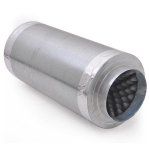
nine4gmc - If you Google “Duct Silencer” you will find these commercially available units:

3034-Duct-Silencer-Example-01.jpg

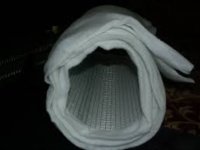
Google “Duct Silencer DIY” and you will find variants people have made. I just stocked up on the fiberglass packing material for motorcycle silencers to be used on my RZ500. But maybe it will get used here on the compressor first make a homemade one like you describe :dunno: (Who wants a 4 cylinder 2-stroke engine quieted down anyway! :))

3035-Duct-Silencer-Example-02.JPG

Of course, there is always the labyrinth approach like Vernmotor used on his cabinet ventilation system, which seems like an effective way to do it too. Something like this:

3036-Duct-Silencer-Example-03.jpg

I have sort of an odd shaped area by the air intake filter to fit something in, so I’m not sure what I will end up with yet.

Wingnut65 – I’m still dreaming of those glorious days to come… Impact wrenches whizzing, air ratchets rapping, DA sanders spinning, and media cabinets blasting. Of course the reality is, there will also be a nice blend of busted knuckles bleeding, box-end wrenches flying, and curses filling the air. :)
 
OP
S

shopnut

Well-known member
Joined
Feb 22, 2006
Messages
4,237
Location
Florida
FINISHING UP THE DETAILS ON THE COMPRESSOR…

Since the compressor seems to be running great, the rest of the work is superficial.

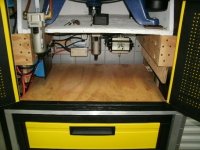
I’ve been meaning to paint the removable plywood shelf black since I installed it, but better late than never. It comes out with 5 screws to allow better access to all the valves if major servicing is required.

3037-CH-60G-Compressor-782.JPG 3038-CH-60G-Compressor-786.JPG 3039-CH-60G-Compressor-788.JPG

Next, it was on to the exterior of the cabinet. After finishing up the remainder of the black corner trim, I replaced the white vinyl that was removed so many months ago. Of course, a little modification was needed before it would fit back on.

3040-CH-60G-Compressor-790.JPG 3041-CH-60G-Compressor-793.JPG 3042-CH-60G-Compressor-797.JPG

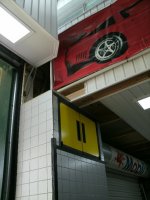
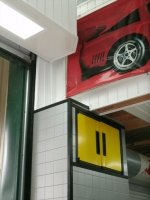
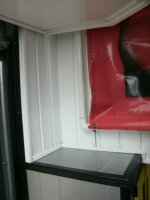
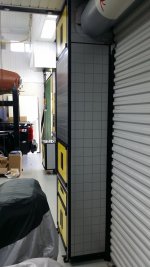
On the other side of the cabinet, I had to trim the tileboard out to clear the roll-up door drum. Eventually, there will be a checkered flag banner to hide the door drum and match the large “stripe” I have going around the perimeter of the shop.

3043-CH-60G-Compressor-800.JPG
 
Last edited:
OP
S

shopnut

Well-known member
Joined
Feb 22, 2006
Messages
4,237
Location
Florida
REPLACING THE LIGHT BAR…

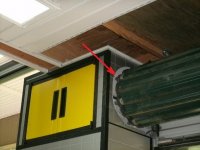
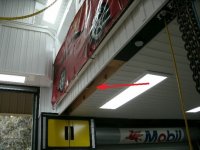
The original light bar that extended over to the wall had to be removed to make room above the compressor. This recess where it was located became the exit point for the hot air out the cabinet ceiling.

3044-CH-60G-Compressor-802.JPG

After a quick cut of the black plywood board, it was ready to go back up. Let there be light! The light closest to the cabinet ended up a little closer to the doors than I would have preferred, but it serves as a great light for inside the cabinet since it swivels.

3045-CH-60G-Compressor-855.JPG

JUST SO SOMETHING DOESN’T GET INTO THE VENTILATION FAN…

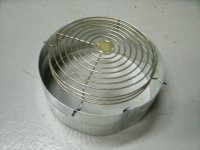
I had this 8” wire grill in my spare parts bin and figured the ventilation fan outlet was the perfect place for it. I added some heat shrink to the four tabs so they wouldn’t rattle in the matching holes I drilled in the short section of duct I cut for it.

3046-CH-60G-Compressor-903.JPG

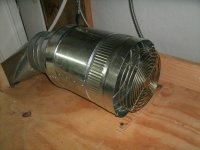
All in place up in the storage loft above the compressor. Although the duct joints fit very tightly, I added a small strip of wood to keep it from wandering around.

3047-CH-60G-Compressor-907.JPG

SOME WIRE INSIDE THE INTAKE HOSE…

I doubt there is enough vacuum on the pump suction port to do it, but I thought it would be a good idea to add a spring inside the hose elbow to keep it from collapsing. It’s the same idea as what they use on the lower suction line of an automotive cooling system.

3048-CH-60G-Compressor-910.JPG

FOAM IN THE HOLLOW DOORS…

The doors on the compressor cabinet are hollow for the pegboard system and it seemed like a good idea to add some noise absorbing foam inside them. Once reinstalled, however, I really couldn’t say if it made a difference. I probably should have fired up the sound meter just to check, but I didn’t get around to it during this visit.

3049-CH-60G-Compressor-912.JPG 3050-CH-60G-Compressor-913.JPG
 
Last edited:

Wingnut65

Well-known member
Joined
Apr 21, 2010
Messages
3,170
Location
Tampa Bay, FL
Great work on all the little details. Most of which only you would know they are there.

Another couple weeks and the compressor project might be getting close to being Done! Maybe...
 
OP
S

shopnut

Well-known member
Joined
Feb 22, 2006
Messages
4,237
Location
Florida
E12-535iTurbo - I hope all my slaving away in the Asylum has made your leisure time just that much more enjoyable! Drink a cold one for me :beer:

Wingnut65 - Thanks! I can honestly say, the compressor install is all but behind me - just a little testing to do yet. Although, I'm sure there will be a couple of tweaks here and there as time goes on, but there always are!
 
OP
S

shopnut

Well-known member
Joined
Feb 22, 2006
Messages
4,237
Location
Florida
FINAL AIR COMPRESSOR PICTURES (Part 1 of 2)…

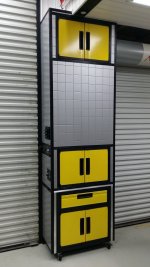
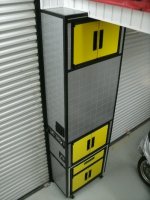
This project took waaaay too long (don’t they all?), but at least I’m happy with the functionality of the system and I think the looks blend in nicely with the rest of the shop.

I like the following picture, but I just wish I would have wiped my sweaty paw prints off of the tileboard panel before snapping it. ;) That kind of stuff doesn’t show up on the little 2” camera screen.

3051-CH-60G-Compressor-804.JPG

Some overall shots – 10 feet of air compressor goodness!

3052-CH-60G-Compressor-875.jpg 3053-CH-60G-Compressor-840.JPG 3054-CH-60G-Compressor-878.jpg

Here’s one from the upstairs office looking through the bay window.

3055-CH-60G-Compressor-807.JPG

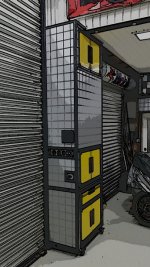
And a goofy picture with the camera set on “Cartoon” mode.

3056-CH-60G-Compressor-892-(Cartoon).jpg

While up in the manlift, I turned around and thought this would make a cool cartoon picture as well.

3057-Overall-Interior-01-Cartoon.jpg
 
Last edited:
OP
S

shopnut

Well-known member
Joined
Feb 22, 2006
Messages
4,237
Location
Florida
FINAL AIR COMPRESSOR PICTURES (Part 2 of 2)…

Here are some details.

Top and bottom access doors open.

3058-CH-60G-Compressor-821.JPG

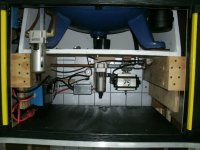
Bottom doors gain access to the air intake filter, 2 water separators, air actuated ball valve, contactor box, and tank auto-drain system.

3059-CH-60G-Compressor-824.JPG

Top doors give access for pump oil checks and changes.

3060-CH-60G-Compressor-827.JPG

Base cabinet rolls out for access to the future water collection bottle and offers additional access to the valves and piping.

3061-CH-60G-Compressor-832.JPG

Lower cabinet stores all my air tools, compressor supplies, and spare parts. My red 5 gallon portable tank stores in the area above.

3062-CH-60G-Compressor-932.JPG

Close-up of the finished control panel. Main switch is located below while the STACK aftercooler air intake is above.

3063-CH-60G-Compressor-858.JPG

Control panel from left to right: Regulator, Pressure gauge (shop air), Hour meter, Pressure gauge (tank), Indicator Lights for pump ON and shop air ON, Timer for shop air ball valve.

3064-CH-60G-Compressor-860.JPG

There will be little tidbits to update as time goes on, but I need to get going on the rest of the ASYLUM build. I'm finally ready to get rid of my smaller 30 gallon compressor and it's being swapped for a small portable one I can keep down in the garden shed. A buddy of mine has been waiting patiently for it!
 
Last edited:

ODIS

Well-known member
Joined
Apr 30, 2012
Messages
2,110
Location
Pacific Northwest
Just so cool! Perhaps dry ice cool!

You are appreciated for all of your skills and for your zeal for sharing what is accomplished in your shop!

With warm regards,

Ody.
 

Wingnut65

Well-known member
Joined
Apr 21, 2010
Messages
3,170
Location
Tampa Bay, FL
FINAL AIR COMPRESSOR PICTURES (Part 2 of 2)…

:spit: Yeah, Right...


And a goofy picture with the camera set on “Cartoon” mode.

attachment.php

So that is what it has come to? The Compressor Cabinet build has been so influential on you that it has started its own animated series? Or is it just comic books?

No, seriously, that is really a cool idea. Cameras and phones have so many creative features, but we mostly stick to the automatic mode! Probably in an effort to make picture taking idiot-proof. But then we manage to get blurry automatic pictures...


And thanks for posting every detail, every thought and every idea that may have been thought in this project. Those ideas have sparked conversations and ideas for others to take and run with. :thumbup:


There will be little tidbits to update as time goes on, but I need to get going on the rest of the ASYLUM build.

Alright! Lets Go! :3gears:
 
OP
S

shopnut

Well-known member
Joined
Feb 22, 2006
Messages
4,237
Location
Florida
ODIS - Thanks so much. As I always say - If people keep reading, I’ll keep writing. Plus I’m sure it will be fun to go back and reread all this someday. Certainly, more than a few “What the heck was I thinking?!?” moments will occur during the walk down memory lane. :)

akdiesel - Thanks. Now all I can hope for is that the used compressor I bought doesn’t take a dump next week :). That would ****.

BlackSheepSpeedShop - Thanks. I’m sure anyone that spent all the time on it like I did would come out with something twice as nice.

Wingnut65 - I can tell you right now, there will be just a few more pictures yet – hehehhe.

Maybe I should start a comic book for all the antics performed in/on the Asylum. It could be named “Asylum Shop Shenanigans” – no wait, I’m not real fond of the acronym that might come from that :)

I think the next big project is going to be building the big wall cabinet adjacent to the apartment – maybe I should leave room for some sports jerseys to be displayed? :) It’s really the last big frontier left in the Asylum. First though, I better zip through my Task List to make sure I’m not forgetting anything else of higher priority.
 
OP
S

shopnut

Well-known member
Joined
Feb 22, 2006
Messages
4,237
Location
Florida
Bravo as usual Shopnut. You are always an inspiration!!
Thanks! I'm sure there are many who grow tired of all my boring dribble. But, if there's a couple folks that get inspired to improve a corner of their shop because of what they see here, then I am a happy man.
 
OP
S

shopnut

Well-known member
Joined
Feb 22, 2006
Messages
4,237
Location
Florida
AIR COMPRESSOR PERFORMANCE TESTING…

I just wouldn’t be able to sleep until I gathered some performance data on the finished air compressor system ;).

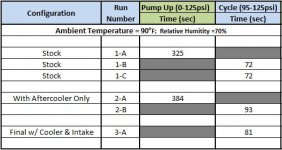
I had a hunch the extra restriction in the pump-to-tank lines would degrade the flow some amount, so I base-lined the stock compressor before making any changes. I did this by recording cycle times required to pressurize the tank from 0-125 and 95 to 125 PSI. Longer cycle times would indicate a lower CFM flow to the tank.

My preliminary testing (Runs 1 thru 3) produced the following data. I used my infrared temp gun to get a few temperatures here and there, but I found it hard to get a reading on the small pipes so I didn’t include it.

3065-Compressor-Testing-01.JPG

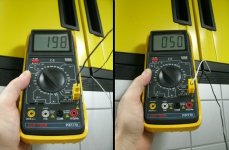
I decided to conduct a slightly more sophisticated test and pulled out my K-type thermocouples. Unfortunately, I only have a couple probes, so I had to conduct 2 separate tests to gather all the data. Please note temperatures shown on the meter were in degrees Celsius. A chart at the end converts this to degrees Fahrenheit.

For the fourth set of tests (4-A thru 4-D), I measured the compressed air temperature flowing through the STACK aftercooler. I attached the probes on the pump outlet and tank inlet pipes with hose clamps.

3066-CH-60G-Compressor-917.JPG

Here are temperatures (in Celsius) recorded at the end of the full pump-up cycle, which equate to a temp drop of 148C or 266F. Honestly, it seemed like too high of a differential to believe.

3067-CH-60G-Compressor-925 combined.jpg

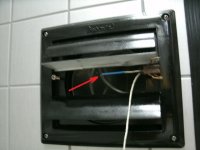
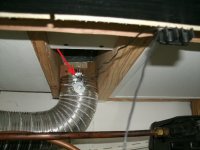
For the fifth set of tests (5-A thru 5-D), I measured the rise in the cooling air being pushed up through the STACK aftercooler. Probes were placed in the air flow as shown.

3068-CH-60G-Compressor-938.JPG 3069-CH-60G-Compressor-936.JPG

Here are temperatures (in Celsius) recorded at the end of another full pump-up cycle, which equate to a temp rise of 30C or 54F.

3070-CH-60G-Compressor-944 combined.jpg

Here is a summary chart of all values recorded.

3071-Compressor-Testing-02.JPG

SO WHAT DOES ALL THIS MEAN?

Raw data doesn't means much unless you draw some conclusions from it.

If you consider the pump-up time as a general indicator of performance (longer pump time = lower CFM flow), the STACK aftercooler added a whopping 59 seconds (384 minus 325 sec) to the full cycle time, which equates to an 18% increase in time and an equal reduction in performance. I was a very disappointed after seeing these numbers.

What’s really interesting, however, is what happened when the larger Solberg air intake filter was added to the system. Most of that lost performance was gained back! The final configuration with STACK and intake filter installed added only 10 seconds (335 minus 325 sec) to the full pump-up time, which equates to only a 3% increase in time and an equal reduction in performance – virtually the same as stock. Now THAT I can live with!

For those wanting a simple performance increase from their compressor, you might consider installing a high flow filter on your pump. Mine apparently was gasping for air, even with a new, clean element installed. I suspect I would have gained roughly 10% performance from that simple modification alone on my system for a mere $25.

I was amazed at the temperature reductions seen through the STACK aftercooler. I had heard other members mention 200F temp reductions, but I was skeptical of those claims. I’m sorry for having any doubts. I’m seeing 260F temperature drops and above through the aftercooler. I actually doubted my own values at first, but considering the 40-50F temperature rise in the STACK cooling air, it’s really not so hard to believe. The compressed air flowing at 10 CFM is being cooled 260 degrees F by ambient air flowing at 200 CFM and being warmed 50 degrees F. I’m sure there’s a heat transfer equation that would prove this is completely feasible, but I can’t find my textbook at the moment. Perhaps someone would like to take a stab at it?

So the bottom line is this – I’m removing nearly all of the moisture from the compressed air for no appreciable loss in performance. Mission accomplished!
 
To avoid these ads, REGISTER NOW!

Bob Heine

ALLIANCE MEMBER
Joined
Oct 24, 2009
Messages
10,703
Location
Boca Raton, Florida
If you consider the pump-up time as a general indicator of performance (longer pump time = lower CFM flow), the STACK aftercooler added a whopping 59 seconds (384 minus 325 sec) to the full cycle time, which equates to an 18% increase in time and an equal reduction in performance. I was a very disappointed after seeing these numbers.

What’s really interesting, however, is what happened when the larger Solberg air intake filter was added to the system. Most of that lost performance was gained back! The final configuration with STACK and intake filter installed added only 10 seconds (335 minus 325 sec) to the full pump-up time, which equates to only a 3% increase in time and an equal reduction in performance – virtually the same as stock. Now THAT I can live with!
As a retired technical writer I can only spell thermodynamics but I think your cycle time with the new filter and aftercooler might be an overall improvement in performance. Heating the air going into the tank should increase the pressure in the tank all by itself. Getting to the same pressure with cooled air means more air has been pumped into the tank, which may account for part or all of those 10 seconds.

In any event you now have an excellent source of dry compressed air in the Asylum and the "dry" aspect is done without refrigeration or kitty litter canisters. Well done sir!!!
 

akdiesel

Well-known member
Joined
Aug 8, 2008
Messages
2,617
Location
Wasilla, AK
shopnut

Your original reason for all this was for dry air, correct? It seems you have accomplished that goal. What Bob has said makes since for the dense air.
To help keep the pump from cycling more than needed, double check the lines for leaks as well, but I am sure you have thought of that too.
 
OP
S

shopnut

Well-known member
Joined
Feb 22, 2006
Messages
4,237
Location
Florida
Bob Heine - You are a very smart and observant man, figuring that out from the twisted and convoluted bits of information I share here. I've been taking notes along the way and was compiling them to post in the near future. This is an excerpt from it on the topic I'll share a little early because it was brought up:

********************************
CON’s:
3. Reduced Compressor Performance. The price of the PRO’s comes in the form of reduced flow. The reduced flow is undoubtedly due to the increased flow restriction in the long length of the coiled pipe and the water separator. Testing shows the modifications I’ve made to the pump-to-tank circuit taxes the system about 18%. This is a pretty big price to pay for dry air. Luckily, I was able to gain most of the performance back with the pump air intake modifications.

Since I’m not a heavy compressed air user, however, between the pump and tank is not a bad place to lose the energy. You see, even though the pump runs just a bit longer for the tank to hit the 125 psi max, it will be filled with cooler, denser air that will remain at 125 psi until I use it. Before adding the STACK, I noticed the hot tank would show 125 psi right after cycling. A short time later after it cooled off, pressure dropped to 120 or 115 psi and then level off. In essence, each tank full of cold air should do more work for me at the output hoses than hot would. Well, that is my theory, anyways.

********************************

So it appears I'm not the only one with this theory. What I didn't think about, however, is how this relates to overall performance. At this point, it would be easy to measure when the new system hits 115 or 120 psi for more of a direct comparison to the old stock system. From all my testing, it seems that last 5 or 10 psi tends to take the longest time. I will report back shortly with my findings.

akdiesel - Yes, moisture removal was the sole purpose of installing the aftercooler. But as Bob is pointing out, there is quite possibly a big side benefit to adding the STACK.

No, I have not leak tested things yet. But I introduced many more potential leak points in the system with all the crazy stuff I added, and the tank bleeding down about 20psi over a couple weeks is evidence I have one or more somewhere.

Leaks in the STACK system would equate to longer pump-up times, but that line drops to zero thanks to the unloader valve once 125psi is reached, so a leak there wouldn't account for the tank leaking down over a long period of time. The tank leak(s) could be anywhere in the lines leading up to the shutoff ball valve, valve actuation lines, pressure gauge lines, or tank drain circuit.

It hasn't been a big enough nuisance yet, but I will track it down with some soapy water soon. Hopefully it doesn't require major disassembly of anything - I honestly hate NPT fittings when it comes repairing leaks.
 

E12-535iTurbo

Well-known member
Joined
Feb 27, 2014
Messages
492
Location
The Netherlands
Nice results and feedback. I think that the flow resistance of your cooling setup has won't have an 18% influence on the pump cycle time. The flow numbers of the water removers I've been looking at are all exceeding most pump flow numbers multiple times. And I'd guess that would be the biggest restriction in your setup.

Up to some level you can use the ideal gas law to calculate the influence of temperature on the pump cycle time. A practical way to determine the influence is to check the tank pressure at the time the pump shuts down and after a while when the tank air is cooled down to ambient conditions. I read you already did this 115psi/125psi=an influence of 8%. If your tank air is already at ambient with the stack. You'll get 8% more air in the tank. So cycle time should increase with 8%.

Then there is the matter of water removal. There is a **** load of calculations you can do with this but in short you're removing an amount of volume in the form of watervapour. If you take the percentage of the relative humidity and multiply it with number you find at a given temperature (degC) in this graph: http://upload.wikimedia.org/wikipedia/commons/9/91/Dewpoint.jpg You'll have an estimate of the actual volume you're removing. In your case at 70%rhum @ 85degF you could remove somewhere at the border of 2% of volume. This is directly related to the pump cycle time!

Cheers, Jan
 
OP
S

shopnut

Well-known member
Joined
Feb 22, 2006
Messages
4,237
Location
Florida
Nice results and feedback. I think that the flow resistance of your cooling setup has won't have an 18% influence on the pump cycle time. The flow numbers of the water removers I've been looking at are all exceeding most pump flow numbers multiple times. And I'd guess that would be the biggest restriction in your setup.

Up to some level you can use the ideal gas law to calculate the influence of temperature on the pump cycle time. A practical way to determine the influence is to check the tank pressure at the time the pump shuts down and after a while when the tank air is cooled down to ambient conditions. I read you already did this 115psi/125psi=an influence of 8%. If your tank air is already at ambient with the stack. You'll get 8% more air in the tank. So cycle time should increase with 8%.

Then there is the matter of water removal. There is a **** load of calculations you can do with this but in short you're removing an amount of volume in the form of watervapour. If you take the percentage of the relative humidity and multiply it with number you find at a given temperature (degC) in this graph: http://upload.wikimedia.org/wikipedia/commons/9/91/Dewpoint.jpg You'll have an estimate of the actual volume you're removing. In your case at 70%rhum @ 85degF you could remove somewhere at the border of 2% of volume. This is directly related to the pump cycle time!

Cheers, Jan

I see the same thing with my water separator. I found this chart of the flow characteristics for my SMC AF40 unit. The P1=0.7 MPa is probably the appropriate curve to use for the elevated pressures in the pump line. Pressure drop at my flowrate (10cfm = 283 l/min) is nearly zero. I’m even surprised that I’m seeing water swirl out of the air in the bowl, being so far below its rated flow.

3072-SMC-AF40-Pressure-Chart.JPG

Wow, 8% more air in the tank with it being cooler. For a 60 gallon (227 liters) tank, that equates to about 5 gallons (18 liters) which is a significant amount.

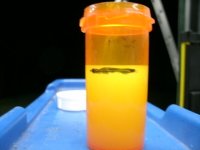
Here is the amount of water it pulled out during a 0-125psi full pump cycle. That line on the pill bottle represents 1 ounce (the amount of weed killer that I add to 1 gallon of water).

3073-CH-60G-Compressor-931.JPG

I think the air is pretty dry by the time it makes it to the tank so maybe I’m getting nearly that full 2% you mention. I have yet to see any water spit out of the drain system and I’ve even taken apart the small inline filter leading to it just to check – dry as a bone!

Well, it’s comforting to know the STACK could actually be adding 10% to the performance rather than causing a reduction. I would have been completely happy with equal performance as long as the water was removed.

Thanks for taking the time to help with this!
 

Wingnut65

Well-known member
Joined
Apr 21, 2010
Messages
3,170
Location
Tampa Bay, FL
Congrats on the analysis to confirm success... Temperature drop in the air lines! Temperature increase in the exhaust vent line! Moisture removed from the air! And electronics to make it all work and stop automatically! Way to go! :thumbup:
 

akdiesel

Well-known member
Joined
Aug 8, 2008
Messages
2,617
Location
Wasilla, AK
shopnut

Nice results.
You may want to try another test. Run an impact gun or some high flow air tool for a length of time and see if your collect any water in your line. You might have to wait an hour or so after running it for that duration to see if any water collects in your air line traps.
 
OP
S

shopnut

Well-known member
Joined
Feb 22, 2006
Messages
4,237
Location
Florida
Wingnut65 - Thanks. Once in a great while, the plan comes together. I'm so stoked with the results. I would have never guessed it was possible. Of course, I'm still at the stage where I switch off the breaker in the main panel because I'm not 100% confident in my wiring job :wtf:. Give me another month or two until the main feed doesn't get disconnected when I'm away for a week. I think it took about 2 months before I stopped worrying about the front control panel (light panel) starting the place on fire. ;)

akdiesel - Thanks. Not exactly the highest flow, but all my testing was done with a locked open air nozzle located about 25 feet from the tank. It took a minute or two to drop the tank from 125 to 95 psi, but it seemed like forever when I was waiting to move to the next test cycle. I kept thinking there would be some fraction of the water in the second separator (downstream of the tank) like what I saw originally before the STACK was installed, but nothing accumulated. I'll check the downstream traps on the next trip out though. Maybe the last 5 or 10 degrees that the air drops in the lines might be releasing a little moisture :dunno: Good idea.
 
OP
S

shopnut

Well-known member
Joined
Feb 22, 2006
Messages
4,237
Location
Florida
SOME COMMENTS ON THE COMPRESSOR “STACK” SYSTEM…

Before I forget all this stuff, I decided to share some additional thoughts on the STACK aftercooler system. Here is what I observed:

PRO’s:
1. Reduced moisture in air.
This is paramount for me and it seems to do a great job at it. And removing it BEFORE the tank may prolong its life. On a typical day, its extracting about an ounce of water for every pump up cycle.

2. Reduced Compressor Temperature. I’m talking about overall system temps. Before the STACK was installed, the tank, the motor, the pump, pressure switch, basically EVERYTHING would get very hot. The STACK pulls the heat out early in the circuit before it can saturate the tank and anything connected to it with extra heat and immediately blows it out of the enclosure. The pump and motor still get hot because of what they are doing, but their cool mounting bracket and tank below help to pull heat from them quicker. Also, if the tank now isn’t a vital part of cooling the system, I didn’t need to worry about cooling it with the cabinet ventilation system – the coolest possible air routes directly to the pump housing.

CON’s:
3. Reduced Compressor Performance.
(EDIT: I hate to even list this as a CON because as others have pointed out, CFM performance may actually have increased with the STACK aftercooler in place, considering all the factors. Go back and read some of the most recent replies to see the discussion on this topic if interested. I will leave this text as I originally wrote it until it can be proven, however)

The price of the PRO’s comes in the form of reduced flow. The reduced flow is undoubtedly due to the increased flow restriction in the long length of the coiled pipe and the water separator. Testing shows the modifications I’ve made to the pump-to-tank circuit taxes the system about 18%. This is a pretty big price to pay for dry air. Luckily, I was able to gain most of the performance back with the pump air intake modifications.

Since I’m not a heavy compressed air user, however, between the pump and tank is not a bad place to lose the energy. You see, even though the pump runs a bit longer for the tank to hit the 125 psi max, it will be filled with cooler, denser air that will remain at 125 psi until I use it. Before adding the STACK, I noticed the hot tank would show 125 psi right after cycling. A short time later after it cooled off, pressure would drop to 120 or 115 psi and then leveled off. In essence, each tank full of cold air should do more work for me at the output hoses than hot would. Well, that is my theory, anyways.

4. Longer Hiss from Unloader Valve. This really isn’t an issue for me since the compressor is enclosed in a cabinet, but I thought it was worth mentioning for those that don’t plan on enclosing theirs. Before the mods, just a quick pop of air was heard from the pressure switch, now it is a long 10 second hiss.

This escaping air also represents some wasted energy. For my setup, the pressurized air that bleeds off equals about 0.2 gallons, so I guess it’s nothing to be too concerned with.

Some other general comments.
* Before I got the STACK up and running, I had many doubts about it actually working, so I brainstormed all kinds I other aftercooler methods as alternatives. I will pull them together soon and show them to give you some ideas as you build yours.
* Many people install an aftercooler on the belt guard and use the existing cooling airflow to the pump to also cool the compressed air. This is fine if your compressor was designed for the extra heat load. But for my inexpensive unit, I didn’t want to tax the system by preheating the pump cooling air. It seems like that could lead to shorter pump life. And the testing showed very high pump temperatures already.
* I mounted the STACK so it would move with the compressor and I wouldn’t have to deal with flex lines. This, however, exposes the entire STACK to a higher vibration level. Hopefully the soft copper will deal with the vibration okay over the years.
* Make sure you do not have spots in your piping that could catch water, unless it is a designated trap point with a valve or similar installed for draining. The STACK has a spiraling coil that continuously flows downhill to the water separator where it can be drained.
* An aftercooler installed between the pump and tank is a great idea for helping to prolong the life of the tank. The water is being removed before it ever reaches it.
* An aftercooler installed between the pump and tank also offers the largest temperature differential between the hot compressed air and cool ambient air. This will increase the heat transfer rate.
* The STACK uses the counterflow method of heat exchanger. What this means is the hot compressed air enters one end while the cooling air enters the other. This maximizes temperature differential between the hot and cold air throughout the entire length, and thus improves efficiency.
* I’m still not sure exact how much of the water being removed can be attributed condensation in the STACK coil and how much is being spun out in the water separator. I guess it doesn’t really matter. The important thing is that the STACK cools the air enough that the separator can be used in the first place because it was a 140F max operating temp. Without the stack, the internal parts of the separator would have been cooked.
* Hot air wants to rise right? So use that to your advantage. Cool air drawn in by the STACK gets heated as it blows up through the duct. This is the direction it naturally wants to go.

I’m sure there are some other points worth mentioning, but my fingers are tired from typing.
 
Last edited:
OP
S

shopnut

Well-known member
Joined
Feb 22, 2006
Messages
4,237
Location
Florida
THE COMPRESSOR REALLY LEFT IT’S MARK ON ME…

I’ve tried to put the “ShopNut touch” on this compressor installation, but unfortunately the compressor decided to return the favor. I laid my arm on the pump outlet tube while working on something above it – SURPRISE!

It’s a good reminder just how hot compressed air can get and why you don't want anything flammable coming in contact with the hot compressor parts.

3074-CH-60G-Compressor-900.JPG

No worries – I’LL LIVE! :)

SPARE PARTS FOR THIS ONE-OFF BUILD…

When I’m finished with one of these custom builds, I buy spares of the unique purchased parts that were used. For this build, some include the 6” duct fan and the throttle cable. Sure there will always be booster fans available, but I wanted to make sure I had an extra one with exactly the same length and performance. I did a local search at the big box stores and didn’t find a duplicate for the throttle cable. An ebay search turned up an NOS cable exact like the 20 year old one I used. Although it seems pretty tough, I feel there is a possibility of the plastic handle snapping off, like if I sideswipe it with the manlift :wtf:

3075-CH-60G-Compressor-761.JPG

Of course, now I need to store them for the next 20 years! ;)
 
Last edited:
OP
S

shopnut

Well-known member
Joined
Feb 22, 2006
Messages
4,237
Location
Florida
THIS MESS HAS GOTTEN OUT OF HAND…

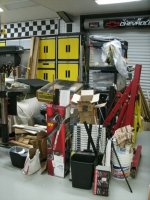
Recent projects of the light control panel, jib crane, 4-post lift installation, and finally the compressor cabinet build have left this place a complete mess. Here is one mound of junk that has accumulated. Underneath there somewhere are two spare V8 engines (BB and SB Chevy’s)!

3076-Clutter-05.JPG

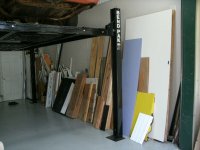
And here is the wall adjacent to the apartment. This will be the site for one the next (and one of the last!) big projects – a wall full of cabinets!

3077-South-Wall-Cabinet-002.JPG

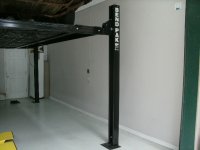
I started the cleanup over at this wall and after some sorting and tossing, I managed to see the wall again. Hey – that’s where my 220VAC lift outlet is!!!

3078-South-Wall-Cabinet-004.JPG

I'm still trying to figure out exactly what to do on this wall.
 
Last edited:

E12-535iTurbo

Well-known member
Joined
Feb 27, 2014
Messages
492
Location
The Netherlands
You might have mentioned it before but must have missed it. What will you be working on when your dream garage is done? What kind of amazing projects will you be completing here?
 
OP
S

shopnut

Well-known member
Joined
Feb 22, 2006
Messages
4,237
Location
Florida
E12-535iTurbo – If (and it’s a big IF!!!!) I ever get done with this place, there are 3 motorcycles that need some minor attention to get them running again. The Corvette also just needs a couple minor things, but luckily it’s currently drivable. The Chevelle is drivable as well, but it needs EVERYTHING redone on it to become the car I want it to be. If it didn’t have sentimental value as my first car, I would probably be seeking out another that didn’t need quite so much work.

Besides the vehicles, I enjoy tearing apart just about anything and restoring it. I’m actually looking forward to restoring my manlift soon. I will probably seek out some used machine tools (a benchtop milling machine is top on the list) in the near future to rebuild and have available for the various projects around here.

Be looking for a "Toys of the ASYLUM" to appear in the Free Parking section in the near future (and by near future, I'm talking a year or so :))

akdiesel – Haha. Yeah, I bet you are nose deep in it right about now. Honestly, having someone beat me in a clutter competition is one game I don’t mind losing. :) Good luck with all your projects. If you need a hand, I'm looking for an excuse to visit Alaska (actually, I'm considering a bike ride up there next summer)

tinbender66 – Don’t get your hopes up too high there fella. The Chevelle will probably not be "bad ***" in the eyes of many, but I promise it will have some cool features/gizmos that might make it very unique to a few. That's kinda my style. I just hope I can make it through the grunt work at the beginning of the project – the poor girl has seen way too many Wisconsin winters in her earlier life.
 

akdiesel

Well-known member
Joined
Aug 8, 2008
Messages
2,617
Location
Wasilla, AK
shopnut

Sometimes a messy shop means productivity, and you have proven that with your work.
I would be more than happy to have your help, but it would not be right to have someone on vacation, work. You are still welcome here even if I don't put you to work though.
There have been lots of bike riders up here and all the way to Prudhoe Bay.
 
OP
S

shopnut

Well-known member
Joined
Feb 22, 2006
Messages
4,237
Location
Florida
shopnut

Sometimes a messy shop means productivity, and you have proven that with your work.
I would be more than happy to have your help, but it would not be right to have someone on vacation, work. You are still welcome here even if I don't put you to work though.
There have been lots of bike riders up here and all the way to Prudhoe Bay.

I'll let you know if I'm ever up that way - would love to meet up with you again and talk shop (literally! :)).
 
OP
S

shopnut

Well-known member
Joined
Feb 22, 2006
Messages
4,237
Location
Florida
SAY “GOODBYE” TO THE 3-TIER SCAFFOLD…

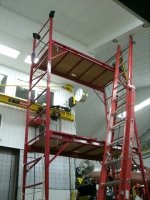
This rig has served me well over the years and I’ve spent many hours working up on top of it. But with the purchase of the manlift, it hasn’t been used in about a year and it’s time to tear her down. I will keep one tier up for a job I have planned in the side bay, but the other 2 will get stored, somewhat long-term, up in the front loft. And the 24' extension ladder will finally become an integral part of the library ladder system.

3079-Scaffold-03.JPG

MINOR MAINTENANCE ON THE MANLIFT…

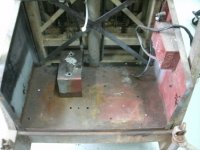
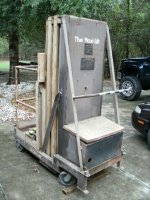
Before taking the scaffold apart, however, I thought I better do a little maintenance on the old manlift to make sure she keeps going up and down. I lubed up all the mast slides with the recommended petroleum jelly. The 10 lift chains were doused until dripping wet with light weight oil, and the hydraulic pump reservoir was drained and replaced with the recommended oil – Mobil DTE 25.

I looked for a drain plug and couldn’t find one so I figured they had intended for the tank to simply be unbolted and removed to drain the oil. But to do this on the machine would make an awful mess. So out came the whole power unit. It was a little rusty from battery acid, but the compartment cleaned up okay.

3080-Cotterman-Manlift-170.JPG

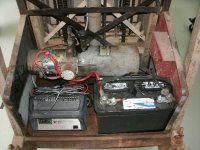
Much to my surprise, the drain oil was really not all that dirty, although it have that brownish look of motor oil. The hydraulic oil that went back in was clear in color. Here the hydraulic unit was put back in place.

3081-Cotterman-Manlift-175.JPG

And finally the battery and charger where re-installed.

3082-Cotterman-Manlift-176.JPG

I’m still looking forward to the day I can paint this old girl to match the ASYLUM colors, but now isn’t that day. Right now, I just need to keep her running.

3083-Cotterman-Manlift-001.JPG 3084-Cotterman-Manlift-160.JPG
 
Last edited:
OP
S

shopnut

Well-known member
Joined
Feb 22, 2006
Messages
4,237
Location
Florida
TASK LIST UPDATE…

It's been a long time (over a year!) since I updated my Task List and I must say, I'm proud of all the things that have been accomplished since the last one. If you've been following along for a while, you know these things don't always get completed in monster leaps. For me, it's the steady marching along over the years that will get me to my final goal.

Since the last update, the front porch was totally finished off, including some kick-**** yard lights that illuminate the entire property. And with the porch project came a new storage loft in front of the apartment to match the lumber loft on the opposite side. This appears as a single line item in the list, but it was a pretty major task.

The first auto lift was installed and I'm loving the extra space it provides. It turned out to be one of the easiest projects and now I want another. The light control panel was built and installed and it puts a smile on my face every time I turn a light on. The jib crane finally matches what I originally envisioned with its new cable carrier to tidy up the cords and onboard spot light and cord reel. The air compressor was installed and is now functional, but I have a few things left to do to finish the entire system.

Link to prior Task List (Reply#2240)
Link to next Task List (Reply#4087)

ASYLUM Task List:

Crane
* **DONE** Install cable carrier system for power cabling to hoist (mounted; needs power cords routed)
* **DONE** Install hoist-mounted spotlight (controlled with wall switch) (needs power cord routed to it)
* **DONE** Install crane-mounted power cable reel
* Final leveling of crane beam

West Wall (Wall with 3 roll-up doors)
* **DONE** Design/build power drive system for doors
* **DONE** Add lights to indicate that doors are locked
* **DONE** Install hose reel in permanent position
* **DONE** Install industrial cord reel in permanent position
* **DONE** Add fairlead panel at bottom of center box.
* Finish wall section in corner by mandoor.

Front Porch
* **DONE** Install exterior siding on porch (above doors)
* **DONE** Straighten edge trim on roof above porch
* **DONE** Build side storage loft in front of apartment

South Wall (adjacent to apartment)
* Design/Build shallow storage cabinet covering entire wall

Library Ladder
* **DONE** Paint brackets/hangers
* **DONE** Install L-Brackets inside walls (north) (front) (south)
* **DONE** Install hangers (north) (front) (south)
* **DONE** Bend and test fit rail sections
* **DONE** Build ladder trolley and try on rail system
* **DONE** Remove rails
* **DONE** Paint remaining rails yellow
* **DONE** Re-install rail
* **DONE** Add lateral support rods and tighten entire rail.
* Paint ladder trolley
* Modify ladder to store in retracted position

Electrical
* **DONE** Rearrange circuit breakers in main panel
* **DONE** Route final wiring to main bay lights (8X) (north) (south)
* **DONE** Add “WEST WALL” GFI circuit for front wall outlets
* **DONE** Add “MAIN LTS#2” light circuit for front fluorescent fixtures (4X) and front storage loft fluorescent fixtures (4X).
* **DONE** Design/build front control panel (AFCP)
* **DONE** Add wiring to AFCP for side porch lights (switch currently over by shop man-door)
* **DONE** Add 3-way circuit for front yard lights (switched in apt and by shop man-door)
* **DONE** Install large yard lights and 3-way circuit
* **DONE** Add dedicated 220VAC circuit over to Air Compressor
* STARTED Add branch on “Night Lights” circuit to front of shop for illuminating ASYLUM sign. (MC cable routed across shop and breaker added) (check - need to splice into J-box)
* STARTED Replace T12 fluorescent fixtures in side bay (2 of 8 replaced)

Auto Lifts
* **DONE** Determine which Bend-Pak HD9 model suits my car storage needs
* **DONE** Determine where to buy it from
* **DONE** Pickup and install lift
* Install rope-light loop for general undercarriage illumination
* Determine which lift model suits my car renovation needs (MAX-JAX?)
* Determine where to buy it from
* Pickup and install lift

Air Compressor Cabinet
* **DONE** Build shelf to get it off floor
* **DONE** Integrate rolling cabinet below
* **DONE** Add automatic dual path drain system
* **DONE** Add air actuated shutoff valve for shop loop
* **DONE** Add STACK aftercooler and water separator
* **DONE** Add 220V timer for automatic pump shutoff when away
* **DONE** Add 110V 12-hour timer for shutoff valve
* **DONE** Add second downstream water separator
* **DONE** Build enclosure
* **DONE** Add high flow air intake filter/silencer
* **DONE** Add cabinet ventilation fan
* **DONE** Add baffles to direct cooling air up to pump/motor
* **DONE** Add sound deadening material to cabinet

Man-Lift Upgrades
* **DONE** Replace battery
* **DONE** Repair outrigger jacks
* **DONE** Straighten rear swivel casters and lube all four casters
* **DONE** Replace cylinder breather line
* **DONE** Replace hydraulic fluid
* Replace lift hose
* Permanently mount battery charger
* Add spring retractable reel for charger cord
* Add integral storage
* And ladder for emergencies
* Add timer for charging circuit
* Add voltmeter as “fuel gauge”
* Paint (Chassis - Black) (Mast - Silver) (Basket - Yellow)

MISC Project List:
* **DONE** Replace punctured ceiling panel by front loft
* Install final large diameter air line loop around main bay (through side bay)
* Add air line drops for auto lift and hose reels
* Build doors for front loft (Decide if actually needed ???)
* Rolling workbench – Add table support props and paint to match
* Install parking meters in front of exterior columns for collision avoidance.
* Lathe Cart – Build heavy duty version to dock in window nook
* Portable Air Tank – Convert spare 30gal compressor tank (with wheels) to function like one of those portable carry-around tanks.
* Design/Build C.U.P.O.L.A.
* Chevelle – Replace fuel line tubing
* Chevelle – Replace transmission cooler line tubing
* Chevelle – Replace heater core
* Corvette – Fix clogged A/C expansion valve (again!)

.
 
Last edited:
To avoid these ads, REGISTER NOW!
Top Bottom