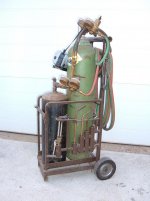
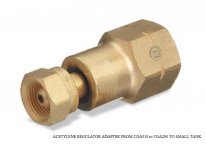
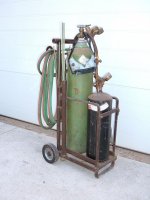
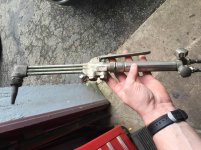
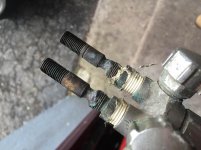
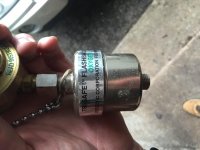
My uncle is a retired iron worker and gave me some of his extra stuff. The rest I picked up elsewhere. He also told me about propane, but because I have two b tanks and he had all the stuff for acetylene I figured just to stay with it. I'm not a welder/fabricator so I may never use it for cutting, or I may need it in a few weeks. Whatever and whenever the time comes, atleast I'll have something and I'll be able to get it done. I'm not going to spend big bucks on a propane setup when I really don't need it. It will mostly be used for heating stuck/frozen fasteners and stuff like that, but still have the option to cut if needed. I'm not going to be cutting 4" thick steel plates or anything like that. Nuts, bolts, fasteners, etc.
For heating or cutting, the current 'trend' is to use oxy-fuel, more specifically oxy-propane. Because of the expense and 'hassle' of acetylene mostly. Oxy-acetylene works just fine for cutting and heating, but oxy-propane works 90% or better as well, with less 'hassle' or expense (for the fuel anyway).
For oxy-fuel welding though, oxy-acetylene is still the way to go. The oxy-acetylene flame characteristics (and flame/burning chemistry) work pretty well for welding.
Also note that different tips need to be used with oxy-propane as opposed to oxy-acetylene (different fuel characteristics means different tips need to be used).
Most 'recent' torch handles can be used with the different fuels, just the tips need to be different.
Also note that if using a fuel gas other than acetylene, you
need to use "T" hose. The 'standard "R" or "RM" hoses are safe to use with acetylene, but degrade if used with other fuels (like propane, or natural gas, or propylene, etc).
Right from Victor:
Hose
The gas hose transports low pressure gases (maximum 200 PSIG (1400 kPa)) from the regulators to the cutting or welding torch. Proper care and maintenance of the hose assists the operator in maintaining a safe, efficient shop or work area.
Hose Construction
Industrial gas hose used in the U.S. is generally color-coded for gas service identification. The oxygen hose is normally green and the fuel hose is red. The colors are subject to change in countries other than the U.S. The hose walls are constructed of continuous layers of rubber or neoprene material over a braided inner section. The hose is marked to indicate its grade. All
approved domestically fabricated type VD grade “RM” and “T” hoses are flame retardant and have an oil resistant cover. Grade “R” hose does not have an oil resistant cover. Grade “T” and “RM” hose will burn, but will not support a flame if the heat source is removed. Grade “T” hose is recommended for all fuel gases. Grade “R” and “RM” hose is for use with acetylene only.
WARNING
Grade “R” and “RM” hose are for use with acetylene only. These hoses have
rubber linings that are degraded by petroleum-based fuel gases. Grade “T” hose is recommended for all fuel gases. It should be used with petroleum-based fuel gases since it has a neoprene inner liner that is compatible with these gases.
But my real question is why do people advertise regulators as working with victor or smith type setups? It would make sense if a victor Reg worked better with victor torch/tips or something, but this is not true, right?
Any regulator can work with any tip. The job of the regulator is to "regulate" the high pressure from the source cylinder (oxygen or fuel, whether acetylene or propane) down to a lower 'usable' pressure for the tips and to keep that pressure (and thus flow rate) consistent in use as the source cylinder pressure changes.
Cylinder pressure for the oxygen can be 2000-2400 psi when the cylinder is full, and cutting or welding or heating usage pressure out of the regulator to the torch might be 5-100 psi for most 'common' tips (some 'big' industrial-type tips might have oxygen usage pressures up to maybe 200 psi, but that is 'BIG' tips for a place like a steel foundry).
Acetylene or propane cylinder pressure might be 400 psi or so, and the usage pressure out of the regulator to the torch might be 1-15 psi for acetylene (
NEVER over 15 psi output pressure for acetylene.
NEVER! ) and maybe sometimes a little bit higher fuel pressure with propane.
The pressure out of the regulators is what is being controlled, and that output pressure going through a fixed orifice (the tip in the torch, whether a welding tip or a heating tip or a multi-flame heating tip, aka 'rosebud' tip) determines the gas flow rate. The gas flow rate determines how much "heat" is being produced by the tip. Not the "flame temperature" (the flame temperature for oxy-acetylene is approximately 6000F ,for air-propane approximately 3500F, and oxy-propane approximately 4000F), that is determined from the chemistry of the oxygen and the specific fuel being used.
And the flow rate of the fuel gas leads into the next section ...
Now, why isn't a "b" tank good to use for cutting? Because it's small and I will run out? An MC tank, B tank or full size will still put out the same pressure as long as the regulator is set correctly, no?
Acetylene is stored in the cylinder by being dissolved in acetone, all within a very porous 'filler' inside the acetylene cylinder.
Otherwise, there is no practical
safe way to store acetylene at pressures higher than 15 psig (tech note for the picky: acetylene is unstable and may spontaneously 'explode' at gas pressures higher than 29 psig).
https://en.wikipedia.org/wiki/Acetylene
Because the acetylene is dissolved in acetone inside the porous filler inside the acetylene cylinder, there is a practical limit as to how fast the acetylene can get out of the acetone and turn back into a gas.
In practical terms, that limit is the acetylene 1:7 withdrawal rate limit. Which means that you should not withdraw (flow rate) more than 1/7 of the volume capacity of an acetylene cylinder in cubic feet (of gas) per hour.
Right from a Victor reference source on cutting/ welding/ and heating with oxy-fuels:
At no time should the withdrawal rate of an individual acetylene cylinder exceed 1/7 of the cylinder contents per hour. If additional flow capacity is required, use an acetylene manifold system of sufficient size to supply the necessary volume.
A B acetylene tank is 40 cubic feet capacity. So 1/7 of 40 is approximately 6 (5.7 actually) CFH (cubic feet per hour) of acetylene gas flow rate. Which means you go to the torch tip catalog/reference and look up an acetylene flow rate of 6 CFH, and for a Victor acetylene cutting tip, that means that the biggest 'safe' size tip (not even maxed out!) you can use with that B cylinder is a Victor Size 0 (zero), which has a listed cutting thickness limit on steel of 3/8" to 1/2" thick.
A welding/brazing tip size limit based on a maximum allowable safe flow rate of 6 CFH means you can go up to about a Victor size 1 or 2 acetylene tip, good for welding steel up to 3/32" thick or 1/8" thick respectively.
There is
no fuel rate withdrawal limit for fuel gases other than acetylene. You might 'frost' up or 'freeze' a regulator or cylinder of gas, dependent on ambient temperature and gas flow withdrawal rate. But there is no flow rate safety limit like there is with acetylene.
Read up some on oxy-fuel stuff here:
http://victortechnologies.com/IM_Uploads/DocLib_10074_65-1501.pdf
Has anyone used the firepower oxyfuel torch setups? I thought maybe if I found one cheap I could just buy one of those to ensure everything is up to par.
Haven't used Firepower stuff. But it is/was a Victor 'product' (recently under Thermadyne, more recently Victor is now owned by ESAB, as well as Stoody, Tweco, ThermalDynamics).
http://victortechnologies.com/thermadyne-us