To avoid these ads, REGISTER NOW!

DRILL PRESS or LATHE as Temporary MILL? - Your opinions please.

shopnut

Well-known member
Joined
Feb 22, 2006
Messages
4,237
Location
Florida
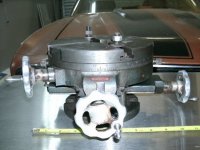
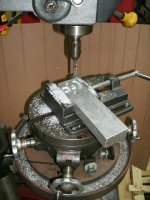
I would like to do a few small milling jobs and those anticipated are mostly aluminum motorcycle parts and an occasional small steel part. I have this cross-slide table with rotary motion that seems like it would be large enough for my parts.

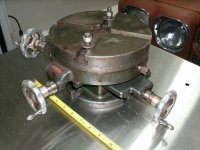
900-Mill-Table-01.JPG 901-Mill-Table-07.JPG 902-Mill-Table-08.JPG

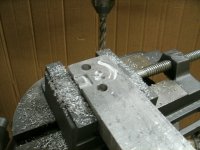
I doubt I will be using it to create complete parts but merely to add certain features to existing ones such as straight and curved slots, such as the one in the bracket shown here:

903-Mill-Table-11.JPG

I have two possible options at the moment until I get a real mill, and I would like your recommendations.

Choice #1 - USE DRILL PRESS
A GJ-specific Google search yielded this thread: Drill Press Milling Machine Thread.
It sounds like the consensus was that drill presses shouldn’t be used as a vertical mill. Due to the side loads, quill bearings will not last long and the Morse Taper tends to pop out.

I think I can come up with a way to hold the MT chuck in there. And the fact that I’m mainly working with aluminum and can go slow may increase the life of the bearings. So I think it is still a viable option.

904-Mill-Table-14.JPG

Choice #2 - USE LATHE
I also have an old 12x36 Atlas lathe that could be used. Although these aren’t the best machines out there, it has worked fine over the years for the small stuff I do.

Atlas did sell a milling attachment for it like the one shown below but reviews have been less than stellar on its performance. (This is not mine - just an example)
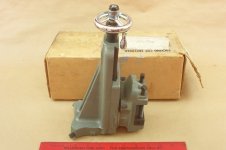
906-Atlas-Milling-Attachment-Example.jpg

My thought is that I can make an adapter to mount the cross-slide table onto the carriage when a mill job was needed. It’s just teetering there in the photo to give you an idea where it would go. (BTW, the lathe is just setting on a caster cart in the photo)
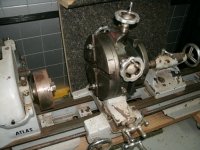
905-Mill-Table-18.JPG

So what is your recommendation and why? Thanks in advance.

.
 
To avoid these ads, REGISTER NOW!

larry_g

Well-known member
Joined
Apr 28, 2007
Messages
16,867
Location
oregon
You may hold the MT into the quill of the DP but don't forget teh JT taper that holds the chuck onto the adaptor. Yes it's been done by a select few but for most of us fail. I had a sanding drum for chucking in the DP and it was able t o dislodge the JT taper.

On the other hand many a milling job has been done on the lathe. Very common in the hobbiest circles, especially in Europe. My suggestion to you would keep on the lookout for a Milldrill. Not the best of tools but will beat the hell out of either a DP or lathe for milling work. By the time you get either of your solutions to work you will have probably enough time and money into it to buy a MD.

lg
no neat sig line
 

Omphaloskeptic

Well-known member
Joined
Oct 11, 2008
Messages
2,346
Location
Ultima Ratio, Wa.
Shopnut, are you trying to justify NOT buying another neat shop tool? :wtf: Sacrilege!

Kidding aside, do you know anyone that owns a mill that would help you do that occasional job? If not, I'd opt for the lathe milling attachment to avoid abusing the DP.
 

justanengineer

Well-known member
Joined
Apr 5, 2011
Messages
7,722
Location
Motor City
While neither is a good solution, if I had to choose it would definitely be the lathe. Im not a fan of the lathe milling attachments, but have been successful before using a lathe that has a cross slide with T-slots in it to mount the work and cut using only 2 axes.

http://www.practicalmachinist.com/vb/south-bend-lathes/machining-t-slotted-cross-slide-177054/

The last pic on this page shows one of these cross slides and you can see where you can mount work directly to the slide, though you likely should remove the tool post first.
 

back2class

Well-known member
Joined
Jan 7, 2009
Messages
2,723
lathe for sure. After I sold my Bridgeport and lathe I missed them and purchased a junky mill/drill/lathe. Hell of alot better than a file and a hand grinder! But in all honesty, sell the fancy rotary table and get a decent milling atachment if funds are limited. I just dont think that the mounting will be sturdy enough to mill.
 
OP
S

shopnut

Well-known member
Joined
Feb 22, 2006
Messages
4,237
Location
Florida
You may hold the MT into the quill of the DP but don't forget teh JT taper that holds the chuck onto the adaptor. Yes it's been done by a select few but for most of us fail. I had a sanding drum for chucking in the DP and it was able t o dislodge the JT taper.

On the other hand many a milling job has been done on the lathe. Very common in the hobbiest circles, especially in Europe. My suggestion to you would keep on the lookout for a Milldrill. Not the best of tools but will beat the hell out of either a DP or lathe for milling work. By the time you get either of your solutions to work you will have probably enough time and money into it to buy a MD.

lg
no neat sig line
Thanks larry_g.

So if I were to venture down the DP path (not saying this is best), would it pay to consider just removing the chuck completely to eliminate the Jacobs Taper issue? Perhaps some type of short MT adapter that has a straight bore in it and accepts milling bits (if they make such an animal)? Or maybe I could make that part in my lathe by placing a MT blank in my tailstock and drilling the proper hole to accept the bits and then add a set screw. Most of my second-hand bits have a 1/2” shank with a flat for a set screw so I might get by with just one MT adapter. The other benefit of this could be a shorter distance from the cutting tip to the quill bearings ---> less strain on the bearing.

BTW, I finally got around to taking your suggestion of adding flow control to the pneumatic window openers. New fittings arrived and should be installed in a week or two. Here’s where I mention them in my build thread: Reply #778

Thanks again for all your time and good advice.

(I will address the comments made by other members shortly when I have more time to reply - it's all great feedback - thanks)
 

kmacht

Well-known member
Joined
Apr 12, 2010
Messages
2,765
Location
Connecticut
If you take the money you were going to spend on a lathe milling attachment and add it to what you could sell that rotary table for you would probably have enough money for a mini-mill. A number of places sell it such as Grizzly, Harbor Freight, and LittleMachineShop

http://www.grizzly.com/products/Mini-Milling-Machine/G8689

These machines are alot tougher and heavier than they look. They require a little adjustment when first setting them up but after that you should have no problem milling aluminum with them. If you watch for a sale I have seen them go down to under $450 pretty regularly. They sometimes show up on craigslist as well.

Keith
 

gorilla

Well-known member
Joined
Dec 13, 2007
Messages
1,650
That rotary table gadget you have is intended to do light milling work in a drill press. I think that you should set it up and try it and see if it accomplishes what you need. Making an adapter to hold the end mills is a good idea, trying to hold end mills in a chuck never works that well. Remember sharp cutters and light cuts are your friend with that set up.
 
OP
S

shopnut

Well-known member
Joined
Feb 22, 2006
Messages
4,237
Location
Florida
Shopnut, are you trying to justify NOT buying another neat shop tool? :wtf: Sacrilege!

Kidding aside, do you know anyone that owns a mill that would help you do that occasional job? If not, I'd opt for the lathe milling attachment to avoid abusing the DP.

LOL - Hard to believe isn’t it! I WILL have a REAL mill someday.

We have one Bridgeport left at work after a massive machine shop downsizing and I could probably sneak a job or two in from time to time. But, I really like being self-sufficient when it comes to these things and I don't mine taking my time when tinkering.

While neither is a good solution, if I had to choose it would definitely be the lathe. Im not a fan of the lathe milling attachments, but have been successful before using a lathe that has a cross slide with T-slots in it to mount the work and cut using only 2 axes.

http://www.practicalmachinist.com/vb/south-bend-lathes/machining-t-slotted-cross-slide-177054/

The last pic on this page shows one of these cross slides and you can see where you can mount work directly to the slide, though you likely should remove the tool post first.

That is an awesome link and really gets the mind thinking. My compound rest slide doesn’t really lend itself to mounting something as large as this cross-slide to it. Although its a pretty major endeavor to make a new one, I could see this working satisfactorily. Thanks very much for that, I will keep it in mind.

Here’s the picture he is referring to:

Lathe-Compound-Rest-Adapter.jpg

lathe for sure. After I sold my Bridgeport and lathe I missed them and purchased a junky mill/drill/lathe. Hell of alot better than a file and a hand grinder! But in all honesty, sell the fancy rotary table and get a decent milling atachment if funds are limited. I just dont think that the mounting will be sturdy enough to mill.

Justanengineer’s solution of a compound rest adapter could solve the mounting to the lathe issue. But of course, it is a lot of work to make the part.

If I get rid of the rotary table, how do I machine curved slots or round profiles manually? It seems like I would get a stair-step profile if I’m not extremely synchronized with my X/Y feeds (good luck with that!). Is there a trick?
 

ptschram

Well-known member
Joined
Sep 8, 2006
Messages
2,573
Location
Churubusco, IN
Unless you are willing to weld a mill bit holder into the quill of your drill press, you will not be able to hold a mill in the chuck.

I have the South Bend milling attachment for my lathes and still won't use it!

A $750 mill/drill is a much better option, not that expensive and incredibly easy to sell when you upgrade. Think about it, how many times have you seen one for sale on the second-hand market, and how long did it last before it was sold?

I wouldn't consider a mill with less than one horsepower and even that is going to limit what you can do with it.
 

A_Pmech

Well-known member
Joined
May 8, 2007
Messages
8,002
Location
IL
I suppose you could mill with your drill press if you used small end mills held in a Morse Taper end mill adapter. Morse taper end mill adapters are designed for use with a drawbar. However, you could modify them and your spindle for a taper retaining key using the basic milling attachment for your Southbend.

Once all of that was complete you'll likely find the effort was wasted, as drill presses make really crappy milling machines even when carefully modified.
 
OP
S

shopnut

Well-known member
Joined
Feb 22, 2006
Messages
4,237
Location
Florida
If you take the money you were going to spend on a lathe milling attachment and add it to what you could sell that rotary table for you would probably have enough money for a mini-mill. A number of places sell it such as Grizzly, Harbor Freight, and LittleMachineShop

http://www.grizzly.com/products/Mini-Milling-Machine/G8689

These machines are alot tougher and heavier than they look. They require a little adjustment when first setting them up but after that you should have no problem milling aluminum with them. If you watch for a sale I have seen them go down to under $450 pretty regularly. They sometimes show up on craigslist as well.

Keith

How much is my rotary table worth anyways?

I was looking at the Grizzly catalog the other night and was thinking one the size shown in your link would probably be perfect. I want a smaller bench-mounted one so I can move it around easy. It won’t be used that much and I just can’t see it taking up valuable floor space all the time - mostly it will be tucked back in a corner somewhere. I will be willing to spend $500-$1000 for the right one when the time comes to make the plunge.

Thanks Keith - glad to know people approve of the smaller Grizzly’s and others like it.

That rotary table gadget you have is intended to do light milling work in a drill press. I think that you should set it up and try it and see if it accomplishes what you need. Making an adapter to hold the end mills is a good idea, trying to hold end mills in a chuck never works that well. Remember sharp cutters and light cuts are your friend with that set up.

This is probably the path of least resistance right now so it should be worth a try. If it doesn’t work out, there’s always plan “B” (or “C” even). Thanks for commenting.

A quick search yielded this MT2 end mill adapter for $44:

End-Mill-Adapter.jpg

Unless you are willing to weld a mill bit holder into the quill of your drill press, you will not be able to hold a mill in the chuck.

I have the South Bend milling attachment for my lathes and still won't use it!

A $750 mill/drill is a much better option, not that expensive and incredibly easy to sell when you upgrade. Think about it, how many times have you seen one for sale on the second-hand market, and how long did it last before it was sold?

I wouldn't consider a mill with less than one horsepower and even that is going to limit what you can do with it.

I've seen MT tangs with threaded holes in them (maybe #10-24 ???). If my quill is hollow (need to check), I might be able to run a bolt down through it to hold the MT arbor in place. With the slight taper of the MT, it shouldn't apply much force to the retainer screw to hold it in there while cutting aluminum. All depends on whether I can run a screw down through there, however.

Thanks for your advice on what should be on my future mill wishlist. I would like to exhaust all options on an interim solution before plunking down the bigger dollars for the dedicated mill.
 
Last edited:

HoosierBuddy

Well-known member
Joined
May 9, 2006
Messages
2,915
Location
Southern Indiana
I asked a very similar question on the South Bend Lathe forum about a month ago:

"Which is better a mill/drill or a milling adapter?"

I assumed that since everyone that haunts that site is a died-in-the-wool lathe junky the answer would obviously be the milling adapter. WRONG. They were unanimous in saying that "any mill you can point to is better than a milling adapter in a lathe." The backed that up with a lot of real world knowledge.

That being said, they were talking about mill/drills, not a drill press. Then...as the argument continues, you find that square column mill drills are better than the cheap round ones. Then you find that once you are in that market you are in site of buying a used knee mill.

So the answer to your need (and my need too!) is to buy a mill and there is really no getting around that.

Personally, I'm looking for a used millrite, van norman 12 or rockwell mill (as they are smaller than a bridgeport) due to space constraints. If you prefer new, Grizzly sells many. It's just a matter of budget.

Phil
 

ptschram

Well-known member
Joined
Sep 8, 2006
Messages
2,573
Location
Churubusco, IN
I've seen MT tangs with threaded holes in them (maybe #10-24 ???). If my quill is hollow (need to check), I might be able to run a bolt down through it to hold the MT arbor in place. With the slight taper of the MT, it shouldn't apply much force to the retainer screw to hold it in there while cutting aluminum. All depends on whether I can run a screw down through there, however.

Thanks for your advice on what should be on my future mill wishlist. I would like to exhaust all options on an interim solution before plunking down the bigger dollars for the dedicated mill.

It's called a drawbar and machines that accept them are called milling machines.
 
To avoid these ads, REGISTER NOW!
OP
S

shopnut

Well-known member
Joined
Feb 22, 2006
Messages
4,237
Location
Florida
I suppose you could mill with your drill press if you used small end mills held in a Morse Taper end mill adapter. Morse taper end mill adapters are designed for use with a drawbar. However, you could modify them and your spindle for a taper retaining key using the basic milling attachment for your Southbend.

Once all of that was complete you'll likely find the effort was wasted, as drill presses make really crappy milling machines even when carefully modified.

Trying to keep up with responses - Thanks guys, this is all good info!

And thank you for your response A_Pmech

Is the picture above the adapter you are talking about? And the "drawbar" you mention - does it screw into the threaded hole in the MT tang?

I will heed your warning about trying to use a DP, but my standards may be a bit lower than yours (I've seen your wonderful shop! :))
 

ptschram

Well-known member
Joined
Sep 8, 2006
Messages
2,573
Location
Churubusco, IN
I asked a very similar question on the South Bend Lathe forum about a month ago:

"Which is better a mill/drill or a milling adapter?"

I assumed that since everyone that haunts that site is a died-in-the-wool lathe junky the answer would obviously be the milling adapter. WRONG. They were unanimous in saying that "any mill you can point to is better than a milling adapter in a lathe." The backed that up with a lot of real world knowledge.

That being said, they were talking about mill/drills, not a drill press. Then...as the argument continues, you find that square column mill drills are better than the cheap round ones. Then you find that once you are in that market you are in site of buying a used knee mill.

So the answer to your need (and my need too!) is to buy a mill and there is really no getting around that.

Personally, I'm looking for a used millrite, van norman 12 or rockwell mill (as they are smaller than a bridgeport) due to space constraints. If you prefer new, Grizzly sells many. It's just a matter of budget.

Phil

I've been shopping for a mill since 1981. If I have the $, I don't have a place to put it. I've had a place to put one since 2003, haven't foudn one I could afford since then.

It's a vicious circle. You gain the skill to use the tools but can't afford to buy them because you're now in debt for all the reasons we find ourselves in debt.
 

A_Pmech

Well-known member
Joined
May 8, 2007
Messages
8,002
Location
IL
Trying to keep up with responses - Thanks guys, this is all good info!

And thank you for your response A_Pmech

Is the picture above the adapter you are talking about? And the "drawbar" you mention - does it screw into the threaded hole in the MT tang?

I will heed your warning about trying to use a DP, but my standards may be a bit lower than yours (I've seen your wonderful shop! :))

Yes. To use a retention wedge or tang you would need to modify your spindle and the endmill holder with a second, lower slot as shown in the right photo here:

radial-drill-as-jigbore-pacemaker-headstock.jpeg


A tapered wedge is driven into the slot which drives the taper adapter home in the spindle and keeps it from falling out. I would recommend that a hole is drilled in the back side of the tapered wedge to install a screw and locknut to prevent the wedge from flying out. Obviously, this limits speed to fairly low RPM, which isn't really a great combination for small endmills. But, it is the standard alternative to gun drilling your spindle for a drawbar.

Another alternative would be to modify your spindle and the morse taper adapter for a clamp-on retaining collar, which is shown in the left photo.
 
OP
S

shopnut

Well-known member
Joined
Feb 22, 2006
Messages
4,237
Location
Florida
I asked a very similar question on the South Bend Lathe forum about a month ago:

"Which is better a mill/drill or a milling adapter?"

I assumed that since everyone that haunts that site is a died-in-the-wool lathe junky the answer would obviously be the milling adapter. WRONG. They were unanimous in saying that "any mill you can point to is better than a milling adapter in a lathe." The backed that up with a lot of real world knowledge.

That being said, they were talking about mill/drills, not a drill press. Then...as the argument continues, you find that square column mill drills are better than the cheap round ones. Then you find that once you are in that market you are in site of buying a used knee mill.

So the answer to your need (and my need too!) is to buy a mill and there is really no getting around that.

Personally, I'm looking for a used millrite, van norman 12 or rockwell mill (as they are smaller than a bridgeport) due to space constraints. If you prefer new, Grizzly sells many. It's just a matter of budget.

Phil

Thanks for your input Phil. The time and dollars to set the lathe up for milling with this rotary table is not looking to attractive at the moment. Add to that your comments from the lathe forum and it is even less desirable :(

It's called a drawbar and machines that accept them are called milling machines.

One of the chucks I have must have come from a milling machine then. It always did look a little more robust than the rest :)

I've been shopping for a mill since 1981. If I have the $, I don't have a place to put it. I've had a place to put one since 2003, haven't foudn one I could afford since then.

It's a vicious circle. You gain the skill to use the tools but can't afford to buy them because you're now in debt for all the reasons we find ourselves in debt.
I need to get my shop done first before any serious money goes into machine tools. I'm getting close though. Good luck on finding a mill - I'm sure it's out there waiting for you.
 

gorilla

Well-known member
Joined
Dec 13, 2007
Messages
1,650
One last comment before I go make some parts on my milling machine, Milling adapters for lathes were meant to give you a way to put key ways in shafts. They do this reasonably well anything else they are a big PIA.
 

larry_g

Well-known member
Joined
Apr 28, 2007
Messages
16,867
Location
oregon
If you need one more nail in the coffin for using the DP, How are you going to hold the Z axis on the quill?

lg
no neat sig line
 
OP
S

shopnut

Well-known member
Joined
Feb 22, 2006
Messages
4,237
Location
Florida
Yes. To use a retention wedge or tang you would need to modify your spindle and the endmill holder with a second, lower slot as shown in the right photo here:

/snipped picture -see above/

A tapered wedge is driven into the slot which drives the taper adapter home in the spindle and keeps it from falling out. I would recommend that a hole is drilled in the back side of the tapered wedge to install a screw and locknut to prevent the wedge from flying out. Obviously, this limits speed to fairly low RPM, which isn't really a great combination for small endmills. But, it is the standard alternative to gun drilling your spindle for a drawbar.

Another alternative would be to modify your spindle and the morse taper adapter for a clamp-on retaining collar, which is shown in the left photo.
Again, thanks very much A_Pmech. Great food for thought and more ammo for internet searches.

I swear my dad's old drill press had two slots in the spindle like that. Maybe it was for two different length MT arbors? I seem to recall there being two different length MTs (standard and "stub" maybe)
 
OP
S

shopnut

Well-known member
Joined
Feb 22, 2006
Messages
4,237
Location
Florida
One last comment before I go make some parts on my milling machine, Milling adapters for lathes were meant to give you a way to put key ways in shafts. They do this reasonably well anything else they are a big PIA.
Makes sense - do your turning, then mill the keyway - done!
 
OP
S

shopnut

Well-known member
Joined
Feb 22, 2006
Messages
4,237
Location
Florida
If you need one more nail in the coffin for using the DP, How are you going to hold the Z axis on the quill?

lg
no neat sig line
Good point. There is a lock to limit the downward travel and a spring of course holds it up. I would say just add something to the handle to ensure it doesn't wander from the full up position, but my DP has a large rubber O-ring that cushions it at full up. I would imagine there would still be a small amount movement there. I bet someone solved that one already, though.
 

TAftw

Well-known member
Joined
Feb 2, 2009
Messages
1,727
Location
MA
I'm probably wrong, but I've been told that a drill press chuck can't handle a side load like the collets on a mill are designed to do. Therefore, you'd be limited to the lathe. Again, that's just my .02.
 

A_Pmech

Well-known member
Joined
May 8, 2007
Messages
8,002
Location
IL
It's called a drawbar and machines that accept them are called milling machines.

Horizontal boring mills, lathes, jig borers and other machines all have drawbars. Many older horizontal boring mills are equipped with a morse taper spindle, thus the availability of morse taper endmill adapters.

Interestingly, my Bridgeport is not even drilled for a drawbar as it came from the factory with the Erickson Quick Change System.
 
OP
S

shopnut

Well-known member
Joined
Feb 22, 2006
Messages
4,237
Location
Florida
I FINALLY HAVE A SOLUTION FOR MY MILLING NEEDS (PART 1)…

Things move along slowly in the Asylum, and parts have been sitting around for quite some time to rig up my temporary mill. I appreciate all the suggestions/warnings given above and it helped open my eyes to what I was up against. I choose to give the drill press route a try since I had that rotary table just collecting dust.

THINGS TO OVERCOME WHEN USING A DRILL PRESS (from this thread and others I have read):

1. Holding the end mill and keeping the MT from popping out of the spindle.
I found one of the MT end mill adapters A_Pmech mentioned for $20 on feebay. This is a great way to hold the end mill, but it doesn’t address the holder popping out of the MT in the spindle. Putting a side load on a Morse Taper will dislodge it in about 20 seconds.

My solution for that was a simple set screw. I figured it was important to tilt the axis up keeping the MT adapter forced up into the spindle. I removed the quill for the job and at the same time, this gave me the opportunity to measure the exact size of the quill bearing.

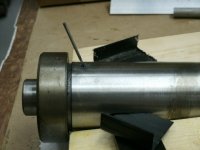
This picture roughly shows the angle for the set screw axis. I drilled a pilot hole with the parts together.

M11-Mill-Table-35.JPG

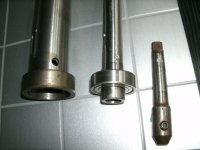
Here are the drill press quill and spindle, along with the MT end mill adapter after modification. The mods were a 1/2" clearance hole in the quill, a 1/4-28UNF tapped hole in the spindle for a set screw, and a flat ground onto the MT adapter for the set screw to bear on.

M12-Mill-Table-38.JPG M13-Mill-Table-40.JPG

And here are the parts put back together.

M14-Mill-Table-42.JPG M15-Mill-Table-53.JPG

To be continued...
 
OP
S

shopnut

Well-known member
Joined
Feb 22, 2006
Messages
4,237
Location
Florida
I FINALLY HAVE A SOLUTION FOR MY MILLING NEEDS (PART 2)…

THINGS TO OVERCOME WHEN USING A DRILL PRESS (CONTINUED):

2. Holding Z-axis on quill.
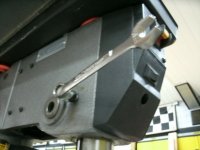
A solution for this presented itself pretty readily. On the side opposite the handle, there was a lock system that rides in a quill groove. It is meant to keep the quill from rotating in the head casting. I turned a dog-point tip onto a matching cap screw and this replaced the stock set screw.

M21-Mill-Table-30.JPG M22-Mill-Table-31.JPG

This will allow me to use the normal drill press tri-handle to set the depth of the quill and then lock it at any depth. One half turn on this temporary lever is enough to go from a free moving quill to locked. The wrench will be replaced with a more appropriate handle when time permits (probably next year! :)) Precision depth control? – No, but I think it will be adequate for my jobs.

M23-Mill-Table-34.JPG

3. Will the spindle bearings hold up?
The reason I really liked the idea of removing the drill chuck all together and replacing it with the MT end mill adapter was the reduction in the distance between the bit cutting edges and lower bearing. Any reduction there will help that lower quill bearing survive. As I mention above, this bearing was measured and as luck would have it, I had a spare motorcycle axle bearing in my parts bin (#6205) that will work as a backup should I munch one if these. I would hate to be without a drill press waiting on a bearing to show up. Now that I found out the quill/spindle is a piece of cake to remove, it really doesn't worry me at all.

4. Accuracy?
I’m not even going to attempt to put a number on this. When I tried to go fast, I got the sense that things where flexing a bit, so slow feed-rates will be a necessity. Let’s just say for the jobs I’m planning, I feel this setup will be adequate. I’m not building space shuttle parts here and I have plenty of time to take it slow.

5. So how did it work?
It worked reasonably well. I played around with a chunk of scrap aluminum (which will be the primary work material) to give it a test run. It definitely has limitations, but I foresee it working fine for my small jobs that come along every few months. Its great having another tool to add to my bag of tricks. One thing I foresee not liking about it is having one machine doing two jobs - I'm sure there will be times when I will want to drill something in the middle of a milling job. I'll just have to plan accordingly, I guess, until a separate milling machine comes along.

M24-Mill-Table-58.JPG M25-Mill-Table-56.JPG
 
Last edited:
To avoid these ads, REGISTER NOW!
Top Bottom