To avoid these ads, REGISTER NOW!

Machining and fabrication tips and tricks

OccupantRJ

Well-known member
Joined
May 15, 2009
Messages
10,906
Location
Eastern North Carolina
I'm starting this thread to allow anyone who wishes, to post a tip or trick they have used in either welding, fabrication, machining, or woodworking. I think you get the drift of the idea. I'll start off with one.


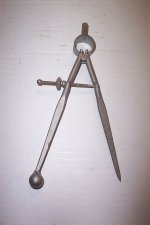
By cutting one leg of a pair of wing dividers shorter, then brazing or tig welding a steel ball to it, you can easily layout circles that are concentric to an existing hole. The leg with the ball sits partially in the hole and acts as a pivot for the marking leg, which is swung in a circle.
 

Attachments

  • tools 004.jpg
    tools 004.jpg
    84.7 KB · Views: 257
To avoid these ads, REGISTER NOW!

Griff93

Well-known member
Joined
Jul 25, 2009
Messages
1,121
Location
Huntsville, AL
Speaking of wing dividers, you can use them to lay out a series of holes on a center very fast and easily. First scribe a line down the part where you want a series of holes. Measure and punch the first hole on the line. Set your dividers to the distance you want the hole centers. Put one end in the center punched hole and drag the other end over the scribed line. Set this end down at the intersection of the scribed line and the line you just drew with the dividers. Then walk the dividers around 180 and repeat. After you have done this go back and center punch each intersecting pair of line to space the centers of each hole. This works really nice for that odd size you don't have a parallel or setup block to use for spacing. If this doesn't make sense, I'll take some pictures.
 
OP
O

OccupantRJ

Well-known member
Joined
May 15, 2009
Messages
10,906
Location
Eastern North Carolina
Here is a tool that automatically spaces the layout evenly.
http://www.eaavideo.org/video.aspx?v=1543236758

The Experimental Aircraft Association has a Hints for Homebuilders area on thier website. It has lots of fabrication tips.
http://www.eaavideo.org/channel.aspx?ch=ch_hints

George, you get a 10 point gold star for that one! I had not seen a rivet fan before, but it will become one of my future shop tool projects. Whether bolts or rivets, that takes a lot of work out of a linear layout.
 

ironheadtom

Well-known member
Joined
Dec 28, 2009
Messages
1,119
Location
Kentucky
Speaking of wing dividers, you can use them to lay out a series of holes on a center very fast and easily. First scribe a line down the part where you want a series of holes. Measure and punch the first hole on the line. Set your dividers to the distance you want the hole centers. Put one end in the center punched hole and drag the other end over the scribed line. Set this end down at the intersection of the scribed line and the line you just drew with the dividers. Then walk the dividers around 180 and repeat. After you have done this go back and center punch each intersecting pair of line to space the centers of each hole. This works really nice for that odd size you don't have a parallel or setup block to use for spacing. If this doesn't make sense, I'll take some pictures.

On that note, there's a formula for using that technique to put any number of evenly spaced holes on any diameter circle. Say for example you want 6 evenly spaced holes on a 5 inch circle, you would use this formula or chart, scribe your circle, and then set your dividers to the specified length. you could then lay out your holes using the technique above, walking around the circle. It's been a while and I don't remember the terminology, but I know it's in the machinist hanbook
 
OP
O

OccupantRJ

Well-known member
Joined
May 15, 2009
Messages
10,906
Location
Eastern North Carolina
On that note, there's a formula for using that technique to put any number of evenly spaced holes on any diameter circle. Say for example you want 6 evenly spaced holes on a 5 inch circle, you would use this formula or chart, scribe your circle, and then set your dividers to the specified length. you could then lay out your holes using the technique above, walking around the circle. It's been a while and I don't remember the terminology, but I know it's in the machinist hanbook

A 6 bolt circle can be walked out by using the radius setting of the circle itself.
 

mike13u

Well-known member
Joined
Mar 1, 2008
Messages
616
Location
S.Florida
I'm starting this thread to allow anyone who wishes, to post a tip or trick they have used in either welding, fabrication, machining, or woodworking. I think you get the drift of the idea. I'll start off with one.


By cutting one leg of a pair of wing dividers shorter, then brazing or tig welding a steel ball to it, you can easily layout circles that are concentric to an existing hole. The leg with the ball sits partially in the hole and acts as a pivot for the marking leg, which is swung in a circle.

That is really cool. Thank you for sharing. If you need a bolthole pattern and have access to a cpu, here is a bolt-hole calculator:

http://www.doov.com/cgi-bin/bolthole.cgi
 

mike13u

Well-known member
Joined
Mar 1, 2008
Messages
616
Location
S.Florida
RJ - Thanks for starting this thread. I'm just a weekend hack and always looking for tips and tricks in machining. Here is a very basic one that help me out when I started.

When trying to center your cutter to your workpiece, a quick and easy way to make sure its centeredon the piece is to place your steel rule between the cutter and the work and just 'eyeball' that the rule is standing verticle. If its slightly off, adjust your tool post up or down until the rule stands verticle.

IMAG0721.jpg

IMAG0720.jpg

IMAG0718.jpg


Also, since everyone knows NEVER leave the chuck key in a lathe chuck, either buy or make a key with a spring like this. It has to be pressed with force to remain in the chuck so you never have an accident.

IMAG0723.jpg

KEEP THE IDEAS COMING....
 
OP
O

OccupantRJ

Well-known member
Joined
May 15, 2009
Messages
10,906
Location
Eastern North Carolina
A quick and easy way to draw a straight line down a piece of pipe, tubing, or round stock is to place a piece of angle iron so that the cylindrical object is captured in the V groove of the angle, then mark away along the edge of the angle iron with the marker of your choice.
 
OP
O

OccupantRJ

Well-known member
Joined
May 15, 2009
Messages
10,906
Location
Eastern North Carolina
To divide a fraction in half, as in finding the center of an object during layout, simply doulble the bottom number. (the denominator) By dividing the whole number in half, along with dividing the fraction in half, you have the number for your center point.
 
OP
O

OccupantRJ

Well-known member
Joined
May 15, 2009
Messages
10,906
Location
Eastern North Carolina
To mark a piece of narrow material into equal width parts, lay a ruler flat on the material, then rotate the ruler until any inch marks on the ruler align with both outer edges of the material. By choosing the number of inches to use correctly, the material can be marked at each inch division to divide the material up equally. This gets rid of any fractions to deal with.
 
OP
O

OccupantRJ

Well-known member
Joined
May 15, 2009
Messages
10,906
Location
Eastern North Carolina
Squaring 2 lines.
Draw a line down an object, floor, or whatever.
Take a stick and drill two holes through it to fit a marking instrument, one at each end.
Backing down the length of the stick a ways, about 30% or more, drill another hole through it.
Pick a spot on the base line for your intersection.
Using the stick as a drawing compass, set on the shorter dimension, draw two arcs across your line, in opposite directions, using the intersection as center.
Now use the longer dimension on your stick. Place your pivot on one of the arc intersections previously drawn across your base line.
Reaching out from your pivot point, draw an arc at about 45 degrees out from your base line.
Do this on the opposite side of your baseline as well.
Now using the other original arc swung across the baseline as a pivot point, swing 2 more arcs outboard of the baseline.
You should now have a base line with an "X" off to each side of it.
Connect these 2 "X's" with a straight line, and you have now intersected the base line at 90 degrees.

This method comes in extremely handy when you have to lay out square lines, especially in a large area such as a concrete floor, or even outdoors. This is more accurate than trying to use something such as a framing square on a large area.

Hope this will help someone improve their layout skills. Have at it.
 

SWT Racing

Well-known member
Joined
Jun 13, 2009
Messages
137
Location
South Carolina
Squaring 2 lines.
Draw a line down an object, floor, or whatever.
Take a stick and drill two holes through it to fit a marking instrument, one at each end.
Backing down the length of the stick a ways, about 30% or more, drill another hole through it.
Pick a spot on the base line for your intersection.
Using the stick as a drawing compass, set on the shorter dimension, draw two arcs across your line, in opposite directions, using the intersection as center.
Now use the longer dimension on your stick. Place your pivot on one of the arc intersections previously drawn across your base line.
Reaching out from your pivot point, draw an arc at about 45 degrees out from your base line.
Do this on the opposite side of your baseline as well.
Now using the other original arc swung across the baseline as a pivot point, swing 2 more arcs outboard of the baseline.
You should now have a base line with an "X" off to each side of it.
Connect these 2 "X's" with a straight line, and you have now intersected the base line at 90 degrees.

This method comes in extremely handy when you have to lay out square lines, especially in a large area such as a concrete floor, or even outdoors. This is more accurate than trying to use something such as a framing square on a large area.

Hope this will help someone improve their layout skills. Have at it.

This also works when you need a perpendicular line to measure off of when doing race car chassis work in the garage. Find your centerlines at the front and back of the chassis and drop a plumb bob. Place a piece of tape on the floor under the plumb bob and mark the floor at each point. Using a similar tool to what RJ describes above, or masonry string tied around a marker, and make your arcs to get a perpendicular.

Now you can drop a plumb bob off any point and measure back to your perpendicular line.
 

SWT Racing

Well-known member
Joined
Jun 13, 2009
Messages
137
Location
South Carolina
This method works to more precisely determine the centerline of something that is wider than your arm span, or you want to take out any error due to the tang at the end. It also works quite well when measuring curved surfaces.

Take a rough measurement and divide it in half. Add whatever fraction back in to get to the nearest inch. Now measure from each side and make a mark with an ultra fine sharpie. You'll be left with two marks from which you can now more precicely find the center using a machinist's scale or the finer graduations at the beginning of the tape measure.
 

SWT Racing

Well-known member
Joined
Jun 13, 2009
Messages
137
Location
South Carolina
Finding the center of a square or rectangle.

Using a straightedge, draw a line across each corner. In the center of the "X" is the center.

If you want to cut a circle out of a square sheet, mark the sheet as described above. Now set your dividers or trammel using the center you found and the edge of the sheet and inscribe the circle.

You can also measure across the corners of a square or rectangle to ensure it is squared up (or a trapezoid for symmetry).
 
OP
O

OccupantRJ

Well-known member
Joined
May 15, 2009
Messages
10,906
Location
Eastern North Carolina
Good stuff there, fellow members! OK guys, who else is going to join in here with something? Remember, even though you yourself may be skilled, there are a lot of guys just starting out who can use this type of stuff. We all had to start somewhere.
 
OP
O

OccupantRJ

Well-known member
Joined
May 15, 2009
Messages
10,906
Location
Eastern North Carolina
When fabricating up an angle iron frame to weld, you can cut the pieces square, adding any internal frame clearance you may need. In other words, if you want to set a cabinet into the frame perimeter, you may want to add an eighth inch or so to allow the cabinet to drop into the angle frame after it's welded up. After cutting the frame pieces, miter cut only the horizontal flat of the angle with a saw or whatever, leaving the vertical part of the angle iron square. After fitting the pieces together, this will leave a corner where an outside weld can be performed, then ground to produce a nice rounded corner. It takes less work and skill to make a corner this way, and it's quick to do, and easy to fit.
 
Last edited:

tcsalvage

Well-known member
Joined
May 5, 2011
Messages
378
Location
brogue, pa
to center a lathe tool take a center head and blade and strike a line across the face of your stock and line the tool up to the line. to hold threaded material in a lathe take a nut with the same thread and cut it through from the center of one of the flats to the threads then run your piece through the nut and tighten it in your chuck. this only works with three and six jaw chucks. if you think you will forget to remove the chuck key just do it one time, you will never forget again. to hold polished stock cut a thin piece of brass stock and wrap the polished stock and chuck it tight. if you are making squirrels nests turning stock grind a groove parallel to your cutting edge right behind the edge itself, this will break the chips. to find out if your tailsock is below center take your center out of it and chuck up a dial indicator, (last word works ok) and turn your head over watching your dial. half of how much your dial moves from the top to the bottom gives you your wear from the ways and front to back is your wear from loading. your tailstock should be closed to do this.
 

ptschram

Well-known member
Joined
Sep 8, 2006
Messages
2,573
Location
Churubusco, IN
Curiously, the majority of the mathematical stuff you guys posted, I learned in a mechanical drafting class I took after I had my bachelors degrees.

I may have learned the theory in college, but vocational school and adult continuing ed taught me a lot of real-world stuff that probably serves me better than the academic stuff did.
 
To avoid these ads, REGISTER NOW!

Griff93

Well-known member
Joined
Jul 25, 2009
Messages
1,121
Location
Huntsville, AL
A piece of paper works well for not marking up finished stock as well if you don't have any brass shim stock.

If you are trying to line something up in your lathe chuck to run concentric and it has a hole or center mark in the end of it, put it in your chuck loosely. Then use a center in your tailstock to push it in slightly. Then tighten it down with the center still in it. Doing this method of course only works if you have lined up your tailstock. Speaking of, a coaxial indicator in the chuck works well for this. If that's not available, you can take a piece of stock and turn a point on one end of it. Then line this up with a center in the tailstock. This won't get it as accurate as an indicator but it's probably close enough for most hobby stuff.
 

SWT Racing

Well-known member
Joined
Jun 13, 2009
Messages
137
Location
South Carolina
Curiously, the majority of the mathematical stuff you guys posted, I learned in a mechanical drafting class I took after I had my bachelors degrees.

I may have learned the theory in college, but vocational school and adult continuing ed taught me a lot of real-world stuff that probably serves me better than the academic stuff did.

Fabrication and machining have helped me retain a lot of knowledge from math classes over the years. I took calculus in both high school and college, but I can't remeber any of it.

Unpacking a few boxes a while back, I came across one of my college calculus books with a full page proof folded inside one of the pages. . .I couldn't understand one bit of it. If I didn't recognize my own handwriting, I would have thought it was someone else's book! I do remember most of my geometry and trig though, since I use it so much.:D
 

SWT Racing

Well-known member
Joined
Jun 13, 2009
Messages
137
Location
South Carolina
Good stuff there, fellow members! OK guys, who else is going to join in here with something? Remember, even though you yourself may be skilled, there are a lot of guys just starting out who can use this type of stuff. We all had to start somewhere.

Agreed!:beer2:

RJ,

How about how to tram the head of a mill? I'd do it, but I don't have a mill in my garage (yet). Another good one is how to use a sine bar.

While we're on the subject of tramming the head of a mill, whenever I move the head of the mill for angled cut or move the mill vise, I always write on the vise or table "Tram Head" or "Align Vise" with a sharpie so I remember to re-align everything when done. The other method is to leave the head or vise so far out out alignment that there is no doubt that things need to be squared up if you (or someone else) need to work on the machine.
 

SWT Racing

Well-known member
Joined
Jun 13, 2009
Messages
137
Location
South Carolina
Here's a trick I used to use in my tool and die maker days.

If you need some very thin shim stock, use aluminum foil. It is exactly .001" thick. You need .005"? Place 5 pieces under your part, sine bar, lathe jaw, etc.

If you need .0005", use the cellophane wrapping that cigarette packs are sealed in.
 

onewaydave

Well-known member
Joined
Sep 28, 2009
Messages
961
Location
Down the road from Dorothy and Toto
Along the lines of the OP.

Say you want to mount a new chuck (has a center hole and say 6 mounting holes around the perimeter) to a new generic face plate that has a 2 1/4" threaded center and no mounting holes. The divider/ball leg wouldn't work (the threads would give a false center of the ball) and using dividers to project from the center wouldn't work (as the center is a hole). I assume that one would mount the face plate on the lathe to be used and use a tool mounted to scribe a concentric circle on the face plate. Then one could step off the centers around the circle to drill, but...

1. How to determine the diameter of the circle on which the holes would be drilled?
2. How to determine the distance of the holes center to center to step off?

I'll bet this has something to do with the trig I've forgotten.

I could draw a circle with the diameter of the circle of the mounting holes on the chuck. I'm just having a problem determining that diameter and feeling I'm accurate. and divide into 60' , but would this be accurate enough?

Dave.
 

Kevin54

MEMBER EMERITUS
Joined
Jan 12, 2005
Messages
29,341
Location
Urbana, Ohio
Here's a trick I used to use in my tool and die maker days.

If you need some very thin shim stock, use aluminum foil. It is exactly .001" thick. You need .005"? Place 5 pieces under your part, sine bar, lathe jaw, etc.

If you need .0005", use the cellophane wrapping that cigarette packs are sealed in.

Just to add to that, a piece of notebook paper is .003
 

Kevin54

MEMBER EMERITUS
Joined
Jan 12, 2005
Messages
29,341
Location
Urbana, Ohio
For the lathe operators

Have you ever had the need for a small collet but your 5C collets just don't hold the piece tight enough, or you have multiple runs for say modifying a screw or bolt with a head. It's a pain to have to unscrew a collet to load it from the backside. Take a drill bushing the size that you need, and with a small Dremel or die grinder and a very small cutting wheel, split the drill bushing on one side. This then makes a nice hardened collet that you can load and unload easily in a 5C collet. Or for a very quick bushing, take a piece of round stock, say aluminum, drill the hole to the size that you need, then split it in a bandsaw. You now have a collet that you can use in a three jaw chuck. By doing so, if you have a threaded part, or a part that you don't want to damage, the soft aluminum will protect it, but still hold it firmly in a three jaw chuck.
 

Kevin54

MEMBER EMERITUS
Joined
Jan 12, 2005
Messages
29,341
Location
Urbana, Ohio
For lathes

If you have a hard time centering a square piece in a 4 jaw chuck, tale a long piece of small barstock, say maybe 1/4" in diameter and maybe 12"-18" long. Put a center mark in your square piece that you want to turn and chuck up the barstock in the tailstock. Put the pointed end in the piece that you intend to turn. Using a dial indicator chucked up in your compound put the point of the indicator on top of the piece of barstock close to your workpiece. You can now adjust your jaws until you get the same reading on your indicator all around.
 

Attachments

  • 4 jaw.JPG
    4 jaw.JPG
    101.4 KB · Views: 233
OP
O

OccupantRJ

Well-known member
Joined
May 15, 2009
Messages
10,906
Location
Eastern North Carolina
Along the lines of the OP.

Say you want to mount a new chuck (has a center hole and say 6 mounting holes around the perimeter) to a new generic face plate that has a 2 1/4" threaded center and no mounting holes. The divider/ball leg wouldn't work (the threads would give a false center of the ball) and using dividers to project from the center wouldn't work (as the center is a hole). I assume that one would mount the face plate on the lathe to be used and use a tool mounted to scribe a concentric circle on the face plate. Then one could step off the centers around the circle to drill, but...

1. How to determine the diameter of the circle on which the holes would be drilled?
2. How to determine the distance of the holes center to center to step off?

I'll bet this has something to do with the trig I've forgotten.

I could draw a circle with the diameter of the circle of the mounting holes on the chuck. I'm just having a problem determining that diameter and feeling I'm accurate. and divide into 60' , but would this be accurate enough?

Dave.

You could measure the diameter of the backplate, then deduct your bolt circle. Divide the remainder in half. Set your calipers to this dimension, and using the step measuring method, mark your backplate on opposing edges to locate your circle. Check yourself by setting the calipers to the bolt circle diameter, and measuring your intended circle marks. If a 6 bolt circle is required, set wing dividers to the radius of your bolt circle. This will be correct to step off 6 holes on the perimeter of the bolt circle.
 
OP
O

OccupantRJ

Well-known member
Joined
May 15, 2009
Messages
10,906
Location
Eastern North Carolina
Some Atlas/Craftsman lathes have a push-pull pin located behind the chuck area. Inside the headstock is a pulley with many holes drilled around the perimeter of it. This allows the spindle to be locked into fixed position in various degrees of rotation. This allows bolt circle layouts to be created on parts, lines to be scribed around a piece of stock in increments, splines to be shaved, and other various things, depending on your imagination. I once shortened a set of car axles back in the 70's, and had a gunmaker friend spline them on a 12 inch Craftsman lathe, which I later purchased when he moved.
 

DSparks

New member
Joined
Nov 4, 2011
Messages
1
Ok since I am new here and this is my first post I thought id start here.

converting fractions to decimal divide the top number by the bottom number for example 1 divided by 16 = .0625

Here is another tip. Say you are milling 2 pieces of stock but they are not the same size to start with. You can use a piece of card board on the movable jaw it will take up as much as .0625 if not more
 

Griff93

Well-known member
Joined
Jul 25, 2009
Messages
1,121
Location
Huntsville, AL
Another one is you can use a center finder to find the middle of a slot if it's narrow enough for your center finder to fit in it.

If you want to chamfer a part the same on all sides, set up to run parallel to the fixed jaw and just rotate the part in the vise. This is much easier than trying to get all sides exactly the same with the part staying in the vise.
 

Kevin54

MEMBER EMERITUS
Joined
Jan 12, 2005
Messages
29,341
Location
Urbana, Ohio
Ok since I am new here and this is my first post I thought id start here.

converting fractions to decimal divide the top number by the bottom number for example 1 divided by 16 = .0625

Here is another tip. Say you are milling 2 pieces of stock but they are not the same size to start with. You can use a piece of card board on the movable jaw it will take up as much as .0625 if not more

Along those same lines, never ever assume that just because you milled two pieces the same width, that they are exactly the same, or that the vise is precision. Any time that you have more than one piece the same size in a vise ( I've actually had 6+ pieces before) I always fold a sheet of paper two or three times and use it on the moveable jaw. This will take up enough of the difference in vice movement or the few thousandths your pieces may be off from one another.
 
Last edited:
OP
O

OccupantRJ

Well-known member
Joined
May 15, 2009
Messages
10,906
Location
Eastern North Carolina
You can make an expanding arbor by turning a properly sized area on the end of a piece of round stock, along with a shoulder for the object to stop against. Then drill and tap into the end for a nominal 1/8" tapered pipe plug. Cut through the turned area the long way with a hacksaw in several places to create segments that will expand when the tapered plug is tightened. A countersunk head screw can be used instead of the pipe plug if a countersink is created in the end of the round stock before sawing the splits.
 
OP
O

OccupantRJ

Well-known member
Joined
May 15, 2009
Messages
10,906
Location
Eastern North Carolina
Ok since I am new here and this is my first post I thought id start here.

converting fractions to decimal divide the top number by the bottom number for example 1 divided by 16 = .0625

Here is another tip. Say you are milling 2 pieces of stock but they are not the same size to start with. You can use a piece of card board on the movable jaw it will take up as much as .0625 if not more

Thanks for your input DSparks, and welcome to the board!
 

SWT Racing

Well-known member
Joined
Jun 13, 2009
Messages
137
Location
South Carolina
You can make an expanding arbor by turning a properly sized area on the end of a piece of round stock, along with a shoulder for the object to stop against. Then drill and tap into the end for a nominal 1/8" tapered pipe plug. Cut through the turned area the long way with a hacksaw in several places to create segments that will expand when the tapered plug is tightened. A countersunk head screw can be used instead of the pipe plug if a countersink is created in the end of the round stock before sawing the splits.

You can make a half-*** erickson collet or "emergency" collet in much the same way.

Drill a piece of 1018 CR round bar stock the same ID that you need, and use a pipe thread die to thread the end. Slit the threaded end at 180° increments with a slitting saw or thin cutoff wheel. Then drill a pipe cap through the center about .125" larger than the ID you drilled on the bar stock.

Slide the part you need to machine into the new "collet" and tighten down the drilled pipe cap.

If you need a stop for the new collet you just made, tap the opposite end the appropriate size, and thread in a bolt or threaded rod with a jam nut for a collet stop.
 
To avoid these ads, REGISTER NOW!
Top Bottom