To avoid these ads, REGISTER NOW!

Machining and fabrication tips and tricks

BigMike782

Well-known member
Joined
Dec 19, 2008
Messages
1,831
Location
49120
I will be glad to add to this thread........in another 40 or 50 yrs when I am any where near as smart as you guys!
Thanks for this amazing thread:thumbup:
 
To avoid these ads, REGISTER NOW!

Kevin54

MEMBER EMERITUS
Joined
Jan 12, 2005
Messages
29,341
Location
Urbana, Ohio
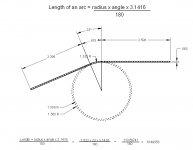
Here are a couple of quick sketches showing how to measure for sheetmetal length needed to fab up a part. These are just simple sketches but will also apply to complicated parts if you know your angles and radii. There are quite a few charts out there showing bend radii dimensions and almost all of the charts vary from each other. Over the years I have found this is the best way to figure it. Most will come to within .010 of what is needed depending on the materials. I always use the middle of the material for the radius. So note the material thickness of the sections shown. I forgot to mention on the second sketch that the inside radius is 1/2" or .500


I'll post up a more complicated sheetmetal part in a little while.
 

Attachments

  • Length of an arc.jpg
    Length of an arc.jpg
    90.2 KB · Views: 327
  • Length of an arc1.jpg
    Length of an arc1.jpg
    67.6 KB · Views: 308
Last edited:

hunter1151

Well-known member
Joined
Jun 19, 2011
Messages
202
Location
Kansas
Here are a couple of quick sketches showing how to measure for sheetmetal length needed to fab up a part. These are just simple sketches but will also apply to complicated parts if you know your angles and radii. There are quite a few charts out there showing bend radii dimensions and almost all of the charts vary from each other. Over the years I have found this is the best way to figure it. Most will come to within .010 of what is needed depending on the materials. I always use the middle of the material for the radius. So note the material thickness of the sections shown. I forgot to mention on the second sketch that the inside radius is 1/2" or .500


I'll post up a more complicated sheetmetal part in a little while.

Kevin...are you not familiar with bend radius and set back charts for sheet metal?? If not I will try to find a source on line to reprint. I use these charts to make parts for airplanes all the time. They usually include standard and minimum bend radiuses for a given material and spring back for different materials. With these charts you can look up the bend allowance or setback and calculate your flat pattern before you bend anything. They also include the K factor for when you bend over 90 degrees.
 

SeanM

Well-known member
Joined
Mar 6, 2011
Messages
92
Buy a machinery handbook!!! I have two at my desk at work, one in my garage and one at my desk at home.
 

Kevin54

MEMBER EMERITUS
Joined
Jan 12, 2005
Messages
29,341
Location
Urbana, Ohio
Kevin...are you not familiar with bend radius and set back charts for sheet metal?? If not I will try to find a source on line to reprint. I use these charts to make parts for airplanes all the time. They usually include standard and minimum bend radiuses for a given material and spring back for different materials. With these charts you can look up the bend allowance or setback and calculate your flat pattern before you bend anything. They also include the K factor for when you bend over 90 degrees.

I'm familiar with the bend radius charts. I have probably 6 or more at work and almost all of them vary to some degree. I don't think any two match each other. I also work in the aircraft industry. What I posted was a simple way for someone at home in the garage to figure out a length if they needed to. As far as the bend allowances, it only gives a rough idea as to what you need. There is still tweeking to be done. I didn't post the views as a 100% means of being dead on, as there are no cast in concrete formulas to get you dead on, only close. But still, post up the formulas. I'll add them to the rest that I have. One never knows, your may be better yet.

Buy a machinery handbook!!! I have two at my desk at work, one in my garage and one at my desk at home.

If the reply was directed at me, I have a Machinery Handbook.
 

NASTYZEN

Well-known member
Joined
Jun 11, 2010
Messages
2,823
Location
St-Colomban,Que. Canada
Great machining tips guys.
Here is a trick for fish mouthing tube that I use. This only works for equally sized tubing and at a 90 deg. intersection.

First, draw or scribe a line down the length of your tube if you need to line up opposite end fish mouths.

imgp6540.jpg


Next, I made myself a transfer jig out of a larger dia. tube and machined a proper sized fish mouth for the job.
This can be made of paper or card board.
I made marks at 90 deg. increments for precise rotations.

imgp6542.jpg


I use a vertical band saw to cut it out. Note that I hold my tube at an angle for this cut.

imgp6544.jpg


Next I grind down to my scribed markings. I have a dedicated grinder with radiused stones for this purpose.

imgp6545.jpg


And there's the fit.

imgp6546.jpg


:beer:
 

bad_idea

Well-known member
Joined
Jun 11, 2011
Messages
4,329
Location
Pasquotank, NC
there is a commercially available jig/fixture for use with a drill press and a hole saw for fish mouthing pipe at any angle. i have never used one, but am curious why you go through all that trouble when the jig seems so simple? thanks for humoring my curiosity.
 

Nelson58

Well-known member
Joined
May 29, 2010
Messages
278
Location
New York, New York
Agreed!:beer2:

RJ,

How about how to tram the head of a mill? I'd do it, but I don't have a mill in my garage (yet). Another good one is how to use a sine bar.

While we're on the subject of tramming the head of a mill, whenever I move the head of the mill for angled cut or move the mill vise, I always write on the vise or table "Tram Head" or "Align Vise" with a sharpie so I remember to re-align everything when done. The other method is to leave the head or vise so far out out alignment that there is no doubt that things need to be squared up if you (or someone else) need to work on the machine.

I have a mill, and would love to see some tips for tramming it. Thanks for these great tips!


Nelson
 

NASTYZEN

Well-known member
Joined
Jun 11, 2010
Messages
2,823
Location
St-Colomban,Que. Canada
Great tip for cutting smooth joining surfaces in tubing. Thanks!

Nelson

My pleasure Allthumbs.

I owe you a case of beer for this.

Canadian beer , I assume? You can PM for my address.....:drool:

there is a commercially available jig/fixture for use with a drill press and a hole saw for fish mouthing pipe at any angle. i have never used one, but am curious why you go through all that trouble when the jig seems so simple? thanks for humoring my curiosity.

The idea was to show a simple method of notching for the average Joe, using simple tools.
There are many ways to skin a cat.....
I have a Williams low buck tool notcher.......somewhere...I also have 2 milling machines...but this is the way I've been notching for the last 25 years...
You would think I would of gotten myself a notcher by now.:lol_hitti
 
OP
O

OccupantRJ

Well-known member
Joined
May 15, 2009
Messages
10,906
Location
Eastern North Carolina
The milling table on a Bridgeport mill generally has actuators on a rod that can be slid side to side and locked into place to set right to left table travel when running repeat cuts. A horizontal cutting setup at work needed to be done to allow the operator to clamp the vise with their right hand, and to load the vise with their left, since the operator was right dominant. I made a new stop collar out of stronger material, that would accept a 3 inch long bolt as the clamp bolt, instead of the standard socket set screw. A piece of rubber hose was forced over the bolt for a hand cushion. This allowed the bolt to be used as a second travel actuator to allow the machine to be operated from the left side, for thousands of repeat cuts.
 
OP
O

OccupantRJ

Well-known member
Joined
May 15, 2009
Messages
10,906
Location
Eastern North Carolina
I am classifying this one as fabrication, because it involves bending metal. When making trim from aluminum trim coil during vinyl siding installs, open the box of trim coil on one end, leave the coil in the box, and cut one corner of the cardboard box lengthwise from box end to box end with a razor knife. Place the free end of the metal stock through the slot, then tape the box end back up. This will allow the box to be used as a dispenser for the material as needed, by simply pulling on the material to extract the amount you need from the box. If you lay the box in the proper orientation, the appearance side of the stock will face down, allowing marking and cutting from the back side. This prevents having to flip the metal over before placing in the bending brake. I developed this method because of not having a dispenser, and got tired of chasing the unruly metal. It also prevents scratching the material when trying to dereel it from the inside core while it is still in the box.
 
To avoid these ads, REGISTER NOW!
OP
O

OccupantRJ

Well-known member
Joined
May 15, 2009
Messages
10,906
Location
Eastern North Carolina
An old school carpenter's nail set can be ground on the tip to make a slim centerpunch, and they work extremely well. My Dad was a trim carpenter, and gave me his cast offs that were too worn to use for nail sets. I have three at work, and like them as well as my Starretts. They work really well for collapsing threads of a broken bolt after drilling, and in rotational removal of broken bolts.
 

Dustball

Well-known member
Joined
Jun 25, 2011
Messages
2,081
Location
Hudson, WI
George, you get a 10 point gold star for that one! I had not seen a rivet fan before, but it will become one of my future shop tool projects. Whether bolts or rivets, that takes a lot of work out of a linear layout.

Another variation of this is by using a piece of elastic string from a crafts store. Straighten out the string and mark the string at an even spacing using a ruler alongside the string. When you stretch out the string, the markings will remain spaced evenly.

This is ideal for longer distances.
 
OP
O

OccupantRJ

Well-known member
Joined
May 15, 2009
Messages
10,906
Location
Eastern North Carolina
I mounted an eyebolt to the left end of my work lathe to act as a hanger for a LOW pressure air hose and blowgun. The air is used to keep swarf from piling up in the work area, blowing out bores, and also used as a coolant and chip extraction during turning some materials. This also has the advantage of providing a good line of sight when visually attempting to reach a predetermined spot while watching the lathe tool bit. Just be careful that others are not around the immediate area when blowing swarf. I'm the only one in my shop, so this is not an issue. You should already be wearing proper safety glasses in the shop.
 

Kevin54

MEMBER EMERITUS
Joined
Jan 12, 2005
Messages
29,341
Location
Urbana, Ohio
Just to add to what Occupant stated about Safety Glasses. Find a good pair that wraps around and that fits close to your face. I wear Harley Davidson safety glasses now. THey are close to $20 but may be less at other places. They fit close to the face and wrap around. Some other safety glasses I have wore, have let chips get in behind and into the eye. All glasses and faces are different. So find a pair that fits. Even at $20, that's cheap compared to a trip to the E.R. or losing an eye.

HD501.jpg
 

NASTYZEN

Well-known member
Joined
Jun 11, 2010
Messages
2,823
Location
St-Colomban,Que. Canada
Here are some soft jaws made of thin Aluminum sheet I made for my lathe chuck.
I have to make some new ones soon. I spun a couple pieces in it tapping some parts the other day.
I kept a flat template of them last time I made some up. So it's no longer a hassle to make up a set.


:beer:
 
Last edited:

Kevin54

MEMBER EMERITUS
Joined
Jan 12, 2005
Messages
29,341
Location
Urbana, Ohio
Nasty, I know that you know, but you could also make up three aluminum blanks with holes and unbolt the steel jaws and bolt on the aluminum jaws. We used to keep about a half a dozen sets of aluminum jaws for specialty jobs.
 

NASTYZEN

Well-known member
Joined
Jun 11, 2010
Messages
2,823
Location
St-Colomban,Que. Canada
Nasty, I know that you know, but you could also make up three aluminum blanks with holes and unbolt the steel jaws and bolt on the aluminum jaws. We used to keep about a half a dozen sets of aluminum jaws for specialty jobs.

Thank's Kevin,yes I did know, but I meant to show a cheap n quick way a guy could get soft jaws for his backyard shop. So many ways to skin a cat....
The solid alu. ones are harder and better at centering and parts. You can even buy the blanks off the shelf and machine exactly what you need your self.
I use these to tap the backside of a knurled bushing. These soft jaws I made of 1100 Alloy and don't damage this particular part.
Also takes only a second to install.
 
OP
O

OccupantRJ

Well-known member
Joined
May 15, 2009
Messages
10,906
Location
Eastern North Carolina
Since I do both repair and machining, I run into unusual situations at times, so have to get a little creative. Here is a trick that I use to rethread a tapped hole when access is difficult or impossible with a standard tap wrench. Take an appropriately sized hex nut, and using a vise, press the nut onto the drive square of the needed tap. It will broach a pathway through the threads of the tap, as the threads provide chip clearance during broaching. You now have a tap that can be driven using standard tools such as an end wrench or socket and extension for hard to reach areas. Be sure to wear a face shield and gloves when doing the pressing. A flanged hex nut works even better for this. A socket can also sometimes be used in this manner, but I keep taps in my repair box with nuts pressed onto them because it allows the use of several drive methods.
 

Attachments

  • Tap 003.jpg
    Tap 003.jpg
    70.5 KB · Views: 157

larry_g

Well-known member
Joined
Apr 28, 2007
Messages
16,858
Location
oregon
Take an appropriately sized hex nut, and using a vise, press the nut onto the drive square of the needed tap.

I inherited tools from my FIL and he had nuts pressed onto most all of his taps. He was a diesel mechanic in the '50's thru the '70's. Great for chasing threads not so good for tapping virgin holes.

lg
no neat sig line
 
OP
O

OccupantRJ

Well-known member
Joined
May 15, 2009
Messages
10,906
Location
Eastern North Carolina
I used the following tip again today, so decided to pass it on. In my work, I have to do a decent amount of modifications to existing items without marring the existing finish. If you have holes to drill or cutouts to make in a surface you want to protect, just layer the surface with masking tape, then using a pen, mark all locations for drilling and cutting. After the work is done, simply peel off the tape and clean the surface. This eliminates errant marks and blueing from contaminating your good surface.
 

johno

Well-known member
Joined
Oct 16, 2009
Messages
2,418
Location
Southern Ont.
Re - Woodwork

When cutting something that needs a nice finish, run a legth of masking tape on the side the saw blade exits the work.
This will prevent a lot of tear out.

Doors spring to mind.
 
OP
O

OccupantRJ

Well-known member
Joined
May 15, 2009
Messages
10,906
Location
Eastern North Carolina
Whenever you set up on the parallels, hammer the part down with a dead blow hammer. If you can move the parallels afterward, you are not set up properly. Indicate the bottom of the vise also. It needs to be true to prevent milling a taper. First rule of machining for you, other than safety, is never assume ANYTHING. On critical operations, measure every drill bit right before you chuck it. If not, you will learn why. Never remove a part immediately after milling. Think first. Make sure everything is as needed before removing that part, or you may blow the next step in the operation. Make a 8 inch long, 4 inches wide bar with a T shaped linear profile, to clamp in the vise, with various tapped holes in it to hold odd size and shaped parts. You can even mill curved slots in parts with it. Control the situation and you control the job.
 
Last edited:

kazlx

Well-known member
Joined
Oct 30, 2012
Messages
2,851
Location
Tustin, CA
I made one of these and it makes centering work really easily when you don't need something super precise. I use it all the time for little one off gizmos.


4EyedTurd

Well-known member
Joined
Oct 3, 2009
Messages
595
Location
Texas
Any pointers for turning parts and getting a smooth finish? I manage to get some smooth finishes and some not
 

Richard D

Well-known member
Joined
Jan 19, 2007
Messages
1,921
Location
Texas City, between Houston and Galveston
Any pointers for turning parts and getting a smooth finish? I manage to get some smooth finishes and some not

I saw some videos by Jose Rodriguez years ago, he had some little right angle gear reduction motors, that turned super slow. He hooked a flexible shaft from the motor to the nut holding on the feed handle. Nice slow, steady feed rate. I don't know exactly what these motors were called, but they turned super slow.
 
Last edited:

kazlx

Well-known member
Joined
Oct 30, 2012
Messages
2,851
Location
Tustin, CA
Make sure your cutter is sharp. Do you grind your own cutters or are you using out of the boox? On my finish pass, I usually take 1-2 thou and use WD-40 to lube.

bracket_zps3c9cfda1.jpg
 

Kevin54

MEMBER EMERITUS
Joined
Jan 12, 2005
Messages
29,341
Location
Urbana, Ohio
Any pointers for turning parts and getting a smooth finish? I manage to get some smooth finishes and some not

There is a lot of variables that can cause a ****** finish. Do you sharpen your own tools? If so, I can almost bet you have a sharp point on them. If you buy the tool, you are probably buying a tool that is sharp. By that I mean it is a point on the end.

Whether carbide, or high speed steel, you want a slight radius on the end. ZCutting with a sharp tool will almost always give you a piece that looks "furry" Break the point by adding a slight radius. If you don't have one, buy a diamond hone. That is about the only thing you can use on carbide by hand. If High Speed Steel, use a hard India Stone. All you have to do is take a few swipes around the nose of the tool to radius. Something as small as a .005 radius will make all the difference in the world as to the finish.
 

Kevin54

MEMBER EMERITUS
Joined
Jan 12, 2005
Messages
29,341
Location
Urbana, Ohio
Whenever you set up on the parallels, hammer the part down with a dead blow hammer. If you can move the parallels afterward, you are not set up properly. Indicate the bottom of the vise also. It needs to be true to prevent milling a taper. First rule of machining for you, other than safety, is never assume ANYTHING. On critical operations, measure every drill bit right before you chuck it. If not, you will learn why. Never remove a part immediately after milling. Think first. Make sure everything is as needed before removing that part, or you may blow the next step in the operation. Make a 8 inch long bar with a T shaped linear profile, to clamp in the vise, with various tapped holes in it to hold odd size and shaped parts. You can even mill curved slots in parts with it. Control the situation and you control the job.

To go along with what Occupant says about the "moving parallels", if you are using a KURT Vise or a KURT knockoff, make sure the movable side of the vise is just a little snug. If you can move it up and down by hand, the setscrew for the half ball is too loose. This screw is right in the middle at the handle side of the movable block. Snug it up to where you can just move the jaw with the handle but not too snug where it is hard to turn. If you have a part sitting on fairly tall parallels, and the screw is a little loose, when you tighten up the part, it will let the block raise somewhat pulling your part off of the parallel. KURT's are designed to pull down. The knockoffs should be made close to the same way but not all are. Older KURT's may have been taken apart before and the screw not tightened correctly.
 

4EyedTurd

Well-known member
Joined
Oct 3, 2009
Messages
595
Location
Texas
Thanks Kevin, I'm not positive about the tip as I assumed it was a setup issue. It's at work were there are a few mechanics that actually use the lathe for all kinds of stuff and I've thought about getting bits and tips to keep in my toolbox.
 

Kevin54

MEMBER EMERITUS
Joined
Jan 12, 2005
Messages
29,341
Location
Urbana, Ohio
Thanks Kevin, I'm not positive about the tip as I assumed it was a setup issue. It's at work were there are a few mechanics that actually use the lathe for all kinds of stuff and I've thought about getting bits and tips to keep in my toolbox.

Depending on whether you want to use High Speed Steel or Carbide, if you want them to last, then most definitely keep them in your toolbox. Carbide seems to be the most common anymore, so you would want to order a holder and some inserts. Depending on what you want to turn or if it is just general turning a triangular insert would work well. With a triangular insert you can get up against a shoulder and you'll have three tries to use it before it gets tossed. I'd have to look in a catalog to get you the proper part number, but I have always ordered TPG-321 inserts. They have a .010 radius on the nose and will give you a very smooth finish on most materials. Once you get into turning a lot of stuff, you'll figure out what you need as you go. What I recommend is to order a catalog from a place like Travers or Enco, or MSC. They show you the tool and they all have excellent descriptions as to the tools use.
 
To avoid these ads, REGISTER NOW!
Top Bottom