To avoid these ads, REGISTER NOW!

Wiring my 24 x 40 shop

Coolerman

Well-known member
Joined
May 2, 2012
Messages
133
Location
Paint Lick, KY
Ok I have finally saved up enough money to start wiring my new shop. I have spent several days on this site reading about all your cool garages and how you lit and wired them. So many ideas, so little budget... :willy_nil

The variables:

Shop is 24 x 40 all steel. I have 4 large sky lights and 5 windows for plenty of light during the day. Shop is insulated including 12' door. Heating via future wood stove, no cooling planned.
I have a 1 1/4" PVC conduit between the main house and shop for power. There are two other 1 1/4" conduits. One for water the other for all low voltage circuits like phone, satellite, ethernet and security. My phone and satellite actually pass through the shop on their way to the house.
Total distance feeder wire will run including allowing loop of wire in each panel is 75'.
House has two, 200 amp, panels with plenty of space available in each.
Known loads in shop will be 220V 7 hp compressor, 220V kitchen oven (for powder coating) 220V outlet for future welder, 20A circuit for 115V mig welder, 30amp outlet on outside of building for camper connection (rarely used) and of course lighting and outlets. No water heater, no AC.

I plan to run all the conduit myself and mount the panel, pull the wires blah blah. I am familiar with electrical (electronics is my talent) but am not an electrician. I will get a permit of course and have my electrician check my work before final inspection.

Question 1: Sizes of 4 wire feeder to 100 amp load center in garage? I prefer copper wire.
Question 2: Size of breaker in house to feed 100 amp garage panel?
Question 3: Shop is not attached to the house (75' away)but will have other electrical connections like phone, satellite, security. How will the grounding need to be connected? Ground rod required at shop or bonded in the house, or both? Seems to be a lot of confusion on this subject here.
Question 4: The phone, satellite TV and satellite internet are all grounded to a ground rod that was installed by the phone company next to the building. The building is NOT currently connected to this ground rod. If code requires bonding at the house and bonding the steel building to the shop panel, can I then ground the phone, satellite TV and satellite internet to the frame of the building and disconnect them from the existing ground rod?

I plan to use 3/4" PVC for all shop conduit runs and will pull individual wires for the circuits. I am going with the screw in compact fluorescent bulbs for lighting.

ANY additional tips, tricks or other knowledge you care to pass on would be highly appreciated.
 
To avoid these ads, REGISTER NOW!
OP
C

Coolerman

Well-known member
Joined
May 2, 2012
Messages
133
Location
Paint Lick, KY
Oh, one more question: Do the outlets in the shop have to be on GFI breakers, Arc fault breakers or normal breakers?

My house was wired with Arc faults. The electrician did not care for the Arc faults at all. Told stories of constant tripping for no reason, but I have only had one trip for no reason so far.
 

Falcon67

Well-known member
Joined
Jun 11, 2009
Messages
18,371
Location
Merkel, TX
#1 - somebody will specify, I don't have the info here. Probably #1 CU but don't run to the store with that.
#2 - 100A
#3 - 4 wire feed, the building should have it's own grounding system. Ground path separate at the shop panel, UFER ground system preferred
#4 - For the lower power stuff, the shop should be just another run like in the house - I would not think you'd need to ground that out there. I think that's why the 4 wire feed is now required, to allow for possible other conductive paths between buildings. From what little I know about phone, the "ground" on your demark at the house is not grounding any phone conductor, it's for surge at the demarc. They don't care if your house cable goes boom.
#5 - all outlets need to be on a GFCI. Buy the 20A units head each plug run with one.

For my 24x40, I used romex, no conduit for all the end runs. I used MC cable for wall outlets that may want to move in the future. I chewed up right close to 1000' of cable.
 
Last edited:

pattenp

Well-known member
Joined
Jun 4, 2008
Messages
10,175
Location
Virginia - USA
I'm probably repeating a lot of what Falcon said...

#1 – 100A will be #3 CU or #1 AL. I recommend AL because it’s a lot cheaper.
#2 – 100A breaker in the house and 100A main breaker panel in the garage.
#3 – Place 2 ground rods min of 6ft apart at the garage if you don’t have a ufer ground via the rebar in foundation. Grounds and neutrals are bonded in the main house panel only and isolated in the sub-panel in the garage. All the grounds should be bonded together, phone , cable, etc.

Oh yeah... GFCI outlets in garage. On the Ceiling too.
 

Falcon67

Well-known member
Joined
Jun 11, 2009
Messages
18,371
Location
Merkel, TX
FWIW - in my shop, the only things not on a GFCI are the lights and any dedicated power runs - compressor, heater, well pump, AC, mill.

Also - the closer to the center of the building you can get the power panel, the more you'll save on wire. I put mine on the end which is why I used so much romex.
 
Last edited:

Charles (in GA)

Well-known member
Joined
Jan 11, 2006
Messages
12,489
Location
50 mi south of Atlanta
120v receptacles that are "not readily accessible" which code defines as 7 ft or higher off the floor, are not, that I recall, required to be GFCI.

From your description, this is a typical steel structured, steel skinned building, C channel, Z purlins and girts, etc??? correct?

How high is the peak?, how high is the eave?

Are you doing ceiling fans? End gable fans?

Edit: I see that you are planning on using CFL's for lighting. Any particular reason. have you considered T5's?, T8's?, Metal Halide? How many circuits and switches for the lights?

Personally, I don't like the look of PVC. I think you will find it more expensive by the time you end up buying all the 45's, 90's and other pieces and gluing it all together.

Bending EMT is not easy but it can be learned and allows you to easily custom install your conduit to get a nice looking job. With EMT you do not have to have a ground wire (though I run one anyhow) while with PVC you must run the ground wire.

HERE is a good GJ thread on using LARGE CFL's

T5HO lighting thread discussion

MY GJ lighting thread

60" CEILING FAN thread


Charles
 
Last edited:

pattenp

Well-known member
Joined
Jun 4, 2008
Messages
10,175
Location
Virginia - USA
All 125V 15A and 20A outlets in a residential garage are required to be GFCI. 2011 NEC 210.8 (B) (8)

120v receptacles that are "not readily accessible" which code defines as 7 ft or higher off the floor, are not, that I recall, required to be GFCI...............

Charles
 

Norcal

Well-known member
Joined
Mar 16, 2008
Messages
13,751
All 125V 15A and 20A outlets in a residential garage are required to be GFCI. 2011 NEC 210.8 (B) (8)

The NEC edition adopted by the area the OP lives in will decide what has to be done. There have been a lot of changes in each successive code........
 

Speedy Petey

Well-known member
Joined
Apr 22, 2012
Messages
1,430
Location
NY State
The NEC edition adopted by the area the OP lives in will decide what has to be done. There have been a lot of changes in each successive code........
And this has been code for quite some time, since the 2008 edition of the NEC. I'd be surprised if the OP's area was that far behind the times.

Pattenp is absolutely correct.
 

Norcal

Well-known member
Joined
Mar 16, 2008
Messages
13,751
And this has been code for quite some time, since the 2008 edition of the NEC. I'd be surprised if the OP's area was that far behind the times.

Pattenp is absolutely correct.


Kentucky is on the 2011 NEC according to this:

http://www.mikeholt.com/necadoptionlist.php

I did not check beforehand. CA used to be as slow as molasses in January in adopting new editions of codes, they have got up to the '08 NEC.
 

Charles (in GA)

Well-known member
Joined
Jan 11, 2006
Messages
12,489
Location
50 mi south of Atlanta
We seem to have lost the OP in this discussion.

1¼ conduit is kinda marginal for a 100 amp feed. By marginal I mean, it will be a pain to pull thru. Pulling a three #1 aluminums and one ground, whatever size it has to be, is probably going to be nearly impossible in 1¼. Copper will be smaller and much easier, though a lot more expensive.

If you are going to have water, I assume you will have a sink. Cannot imagine why you would not want hot water, even if only a 2 gal tank model that plugs into a 120v circuit.

Charles
 

ra42mario

Banned
Joined
Sep 5, 2011
Messages
116
My repair shop has a little 6 Gal hot water tank for washing our hands. You WILL want hot water in the winter.


You only really need 1 GFCI outlet per circuit. All outlets downstream from the GFCI circuit are protected.

I have T8's for lighting with the "daylight deluxe" bulbs from Home Depot... white light is much better than yellow light in my opinion.
 
OP
C

Coolerman

Well-known member
Joined
May 2, 2012
Messages
133
Location
Paint Lick, KY
Sorry for not posting in my own thread but work has a way of interfering with things sometimes.

For the question about why the compact bulbs? It seems they work very well, according to several on this site, they are cheap to install and replace, and mounting them is simple.

Hot water will rarely be needed in my shop. I have a heated solvent tank for degreasing parts and in the winter the 54 degree water coming from the cold water will feel warm in comparison. ;)

Seriously, I plan to add one of those plug in, instant on, heaters later. When the need arises.

I have never worked with EMT. I would have to buy a bender, and learn to use it. :scared: Normally I would jump on learning a new skill, but only if it benifits me in the long run. Knowing how to bend conduit won't help me down the road. :D So... I know how to glue PVC. ;)

I will go with the #3 copper for the feed. Should I go with individual wires or use that mobile home feeder stuff? Seems that would be harder to pull than individual wires?

I will get the GFI Breakers for all non-dedicated outlets. I also plan on a 30 amp RV outlet. Since most campers have GFI outlets would there be a need for a GFI breaker for that dedicated circuit?

Lastly someone asked if it was a typical metal building with Z purloins, girts and C channel? Yes to all and the peak ceiling height is 13' 2" with wall height of 11'. Two ceiling fans are planned along with two "drop" outlets (4 gang outlet box with SO cable going up to a junction box). I read the thread on fans and seems like the HD 60" fan is the cost effective way to go.
All this advice is VERY much appreciated. :bowdown:
 
Last edited:

Charles (in GA)

Well-known member
Joined
Jan 11, 2006
Messages
12,489
Location
50 mi south of Atlanta
PVC conduit will require a lot more support, especially in areas where it spans girts and purlins, as it WILL sag, especially in the summer heat.

Conduit bender is cheap. Best instructions I've seen for bending conduit are HERE

attachment.php


attachment.php


attachment.php


attachment.php
 

pattenp

Well-known member
Joined
Jun 4, 2008
Messages
10,175
Location
Virginia - USA
My suggestion is to use the Aluminum Mobile Home Feeder (MHF) if you can get it. It may not be available in #1 or 1/0, so you may need to jump to #2/0. I know #2 MHF is available and is good to 90A, which may be really all you need. It will still be cheaper than copper. Even if you use individual wires you should pull them all at once. The MHF is not hard to pull providing you use large enough conduit, such as 2” as a minimum.

I also suggest using GFCI outlets as the first outlets in the circuit to protect all downstream outlets instead of using GFCI breakers. For one thing it’s cheaper and protects the all outlets just the same.

......
I will go with the #3 copper for the feed. Should I go with individual wires or use that mobile home feeder stuff? Seems that would be harder to pull than individual wires?
I will get the GFI Breakers for all non-dedicated outlets. I also plan on a 30 amp RV outlet. Since most campers have GFI outlets would there be a need for a GFI breaker for that dedicated circuit?
 

Charles (in GA)

Well-known member
Joined
Jan 11, 2006
Messages
12,489
Location
50 mi south of Atlanta
Personally, I think the quality of GFCI receptacles is lacking. They are better than in the past, but I have replaced several of the ones I have in my house and shop. I find them tripped even when nothing is plugged into them. While expensive, I think in the long run, the breaker type GFCI units are probably better quality.

Charles
 

VHF

Well-known member
Joined
Oct 27, 2008
Messages
420
Location
NW Wisconsin
I will go with the #3 copper for the feed. Should I go with individual wires or use that mobile home feeder stuff? Seems that would be harder to pull than individual wires?

Use individual THHN/THWN conductors. Three #3 CU for your two hots and neutral. The gound can be smaller. I think #8 is sufficent, but please verfiy that with an electrician/inspector/code book. The smaller ground will save you some money on wire and make pulling through a 1 1/4" conduit easier.

I also plan on a 30 amp RV outlet. Since most campers have GFI outlets would there be a need for a GFI breaker for that dedicated circuit?

I don't think the GFCI requirement applies to a 30A 120V TT (travel trailer) recepticle. But under current NEC all 15A or 20A recepticles must be GFCI protected--as already mentioned previous exclusions for being high or not readilly accessible have been eliminated.
 

hh76

Well-known member
Joined
Nov 9, 2010
Messages
3,439
Location
NE Wisconsin
PVC conduit will require a lot more support, especially in areas where it spans girts and purlins, as it WILL sag, especially in the summer heat.

Conduit bender is cheap. Best instructions I've seen for bending conduit are HERE

attachment.php

Looks like you did a nice job with the bender, but what's up with the FMT? Looks like it could use some support?
 
To avoid these ads, REGISTER NOW!

Charles (in GA)

Well-known member
Joined
Jan 11, 2006
Messages
12,489
Location
50 mi south of Atlanta
Looks like you did a nice job with the bender, but what's up with the FMT? Looks like it could use some support?

Thats one of my "code violations". It is a section about 6 ft that spans (horizontal though the pic makes it look sloped or drooped) from the box to another box on a section of unistrut that supplies a 3n1 mill/drill/lathe unit and parts washer and drill press. Ideally I should have gone all the way to the roof, some 20 ft up, and over and then back down again.

Its one of those "temporary" installations that has been there longer than it should.

Charles
 

rippered

Well-known member
Joined
Nov 27, 2010
Messages
440
Location
Olympia,WA
I had never bent emt before and found it very easy to work with. Only messed up one stick on the whole job, it had multiple compound bends.
 
OP
C

Coolerman

Well-known member
Joined
May 2, 2012
Messages
133
Location
Paint Lick, KY
OK, you guys have convinced me to go with EMT. So don't be offended when I ask lots of questions! :evil:

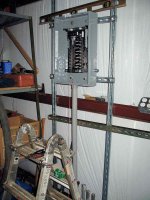
I went to Home Depot and bought a 100 amp Square D HomeLine panel. It came with the 100 amp main breaker and 5 20 amp breakers. I also bought 3 GFI breakers for feeding the outlet circuits.

After I got it home and opened it I discovered there was no equipment ground buss installed? Is it common to not include the equipment ground buss in this line of panels? I will pick that up today when I go back to get the things I forgot the first time...

I decided to go with individual feeder conductors as recommended. Since I only have a 1 1/4" conduit I got three #3 THNN copper feeders and a #8 solid copper ground. These will easily fit the conduit. The pull will be an easy one. It's only 75 feet total and there is only one 90 degree bend in the pull.

I bought a 1/2" bender and for the two 3/4 runs, I will just buy the pre-bent fittings needed to connect them. 20 sticks 1/2" EMT, 4 10' sections of Uni-Strut, Clamps, connectors, boxes, light sockets blah blah blah. About $900.00 later I'm ready to start wiring my shop!

Realized I had never posted a pic of the shop. First pic is the inside (before I filled it full of stuff). Second pic is the HD shopping trip results and the last is a pic of the box with a question: I circled two areas of that pic. One is the top showing what appears to be a removable buss bar across the two neutral buss's. Can that jumper be removed so that one of the buss's could be used as the equipment ground buss? The second area circled shows where the, soon to be purchased, ground buss attaches to the panel? There are identical threaded holes on each side. The documentation that came with the panel does not even mention the ground buss issue.
 

Attachments

  • IMG_4224W.jpg
    IMG_4224W.jpg
    40 KB · Views: 199
  • IMG_5796W.jpg
    IMG_5796W.jpg
    51.5 KB · Views: 189
  • IMG_5798W.jpg
    IMG_5798W.jpg
    51.8 KB · Views: 248

Charles (in GA)

Well-known member
Joined
Jan 11, 2006
Messages
12,489
Location
50 mi south of Atlanta
Smaller panels, and "cheaper" ones, they omit a separate ground bar, you have to purchase and install it yourself.

You can use the two existing bars both for neutrals by leaving the cross bar in place, and install a ground bar separate, or you can probably remove the cross bar and use one existing bar for ground and one for neutral. Your instructions should tell you this.

Charles
 
OP
C

Coolerman

Well-known member
Joined
May 2, 2012
Messages
133
Location
Paint Lick, KY
Thanks Charles, I'll get the additional buss to make wiring a bit easier. Just thought I would ask. :D

My concrete guy ran 3/4" PVC conduit through the garage slab to each corner of the shop. Along with the 1 1/4 PVC feed to the house, he stubbed them all up against the wall. I used the uni-strut to mount the breaker box about 6' off the floor above these conduits. I'm going PVC into the breaker box and EMT out. Where the 3/4" PVC is stubbed up in the shop corners, I'll use adapters to go to 1/2" EMT for my outlets. The lighting circuits will run straight from the breaker box in EMT.

My 240V 3.5 HP 16 amp compressor will mount 10' from the breaker box. I'll run 10/2 to a J-Box mounted to the wall then go flex from there to the compressor pressure switch. A 30 amp breaker should do the trick.

My kitchen oven (used to bake on powder coatings) will get the same hookup though using 8/2 and a 40 amp breaker.

I'll add a dedicated run later for a 240V welder with an appropriate plug...

All comments welcome. ;)
 

Attachments

  • IMG_5808W.jpg
    IMG_5808W.jpg
    51.5 KB · Views: 204

bjcouche

Well-known member
Joined
Sep 11, 2010
Messages
509
Location
Ohio
Coolerman,

Just checked one of your pictures and I see a case of what looks to be 18 GFI receptacles. You only need ONE GFI outlet per circuit. You place the GFI outlet as the first one from the breaker box and then the downstream outlets are protected as well. Open up one of the GFI boxes and the instructions will show you how to do this. You should be able to return about 12 of these saving you more than $100. There are those folks that want every single outlet to be individually protected but it's not necessary. I'd recommend taking the money saved and buying more tools...


Brian Couchene
 

n2ocamaro

Well-known member
Joined
Aug 3, 2011
Messages
183
Location
Clarksville, IN
Leave them as two neutral busses, makes for neater wiring and add the ground buss as you have planned. don't install the bonding screw

I agree. I installed 2 ground bars (one on each side of the box) for neater wiring.

http://sphotos.**.fbcdn.net/hphotos-snc6/208841_424547007590475_459614135_n.jpg
 
OP
C

Coolerman

Well-known member
Joined
May 2, 2012
Messages
133
Location
Paint Lick, KY
Coolerman,

Just checked one of your pictures and I see a case of what looks to be 18 GFI receptacles. You only need ONE GFI outlet per circuit. You place the GFI outlet as the first one from the breaker box and then the downstream outlets are protected as well. Open up one of the GFI boxes and the instructions will show you how to do this. You should be able to return about 12 of these saving you more than $100. There are those folks that want every single outlet to be individually protected but it's not necessary. I'd recommend taking the money saved and buying more tools...


Brian Couchene

Those are not GFI's they are Leviton 20 amp heavy duty outlets. I bought 3 20 amp GFI breakers to protect the outlet circuits. You may also see the box of 16 porcelain lamp holders.
 
OP
C

Coolerman

Well-known member
Joined
May 2, 2012
Messages
133
Location
Paint Lick, KY
Dang! I had no idea you could mount the breaker box upside down? That would have saved about 10 total feet of #3 wire AND would have looked better! Of course I can still flip it over as I have not connected anything to it yet except the #3 wires...

Last night I got the wires pulled from one of the two 200 amp panels in the basement. I choose the one that had the least load on it and ran 1 1/4" conduit from it to the conduit coming from the shop. I installed a pull box where it comes through the wall.

I thought this would be an easy pull... It's only 75 feet total. 4' from the shop box to the first 90 degree sweep in the concrete slab, 68' straight run to a pull box in the basement, 90 degree out of the pull box to a 4' straight run along the wall, then 90 degree sweep up into the 200 amp main in the basement. I pulled from the shop end so I could lay all the cables out straight in the unfinished basement. I used 1/8 vinyl covered wire rope as the pull cable . This turned out to not be a good idea. The vinyl covering tended to 'stick' to the PVC, making the pull much harder than it should have been. Anyway I staggered the ends of the #3's about 6" apart and taped them to the pull rope, went to the shop and started trying to pull it by myself. I could get it to move about 3' then it would hang. I finally got the wife in the basement to push while I pulled. That worked pretty good, but it was quite a workout! Yes, I know! I should have done two things: One I should have gotten some of the flat pull tape or even small a rope, and two I should have used cable lube. Regardless it's in!

I did get the ground buss and mounted it in the box. Tonight I should have it terminated on both ends, and at least one outlet box wired so I can at least have power in the shop without an extension cord.

Then I can start practicing conduit bending. I got all the guides you folks pointed out but I can tell it's just a matter of doing it to learn it...
 
OP
C

Coolerman

Well-known member
Joined
May 2, 2012
Messages
133
Location
Paint Lick, KY
OK I got the compressor wired. I used a "dryer" receptacle and new dryer cord I robbed from my friends recycling center. I am currently mounting outlet boxes on the ceiling purlons and am trying to layout how I want to hook everything together. Of course I have a new question or two. :D

My concrete guy ran 4 conduits under the slab to each corner of the garage. He stubbed up 3/4 SCH40 PVC about 3 inches from the 3" thick insulation on the wall so 6" from the actual steel. It's about 4' from the slab to the girt that runs around the shop. What is a good way to support this conduit? I plan to drill a hole in the girt and extend the conduit through the hole and into a 4" box so it will be firmly attached at both ends but it's sort of just sitting out there begging to be hit... One idea I had was to use a pipe flange bolted to the floor with a 1" galvanized pipe going to the bottom of the girt and attached to another flange. This would slip over the PVC stub and would offer plenty of protection. Another idea was to use a couple of sections of uni-strut to make some kind of "cage" around the conduit....

Any other suggestions or am I being too paranoid?
 

Attachments

  • IMG_5839[1].jpg
    IMG_5839[1].jpg
    26.6 KB · Views: 139

Charles (in GA)

Well-known member
Joined
Jan 11, 2006
Messages
12,489
Location
50 mi south of Atlanta
Dang! I had no idea you could mount the breaker box upside down? That would have saved about 10 total feet of #3 wire AND would have looked better! Of course I can still flip it over as I have not connected anything to it yet except the #3 wires...

You can, on most panels install either way. Some come flat out and say so in the instructions, some give you subtle clues, such as the instruction sheet inside the door being printed both right side up and upside down, some have the word MAIN stamped in the metal at the main breaker knockout, both ways, a few will have a specific statement that it cannot be installed but one way.

I came in the back of my panel, lower LH corner as you stand looking at it. I considered "upside down, but virtually all wiring goes out the top and without a main breaker in the panel (its on the other side of the wall, outside in the meter box) I had a lot of room to run wires out the top with the panel in its normal position. End result is the four wires (two hots, neutral and ground) all enter the panel and run up the sides, and make a 180 into their respective terminals. Not great, but I needed to be able to use the open space up top, it would not do me any good on the bottom.

Other point to remember, the main breaker, and all of the branch breakers, have to work either horizontally, or if they work in a vertical direction (as many main breakers do) up must be ON. Down can NEVER be on. This is apparently not true in Canada and many panels in Canada are installed "sideways" as a result.

Charles
 
Last edited:
OP
C

Coolerman

Well-known member
Joined
May 2, 2012
Messages
133
Location
Paint Lick, KY
Well I decided to leave the load center as it was, but did notice then the word LINE was printed right side up and upside down so that box could be mounted either way. IMG_5829W.jpg

I also got two ground busses and mounted one on each side of the box. Is it necessary to bond those two busses together with wire as shown in post #28, or do the mounting screws provide proper bonding to the panel?
 

BigGMC

Well-known member
Joined
Jun 6, 2012
Messages
278
Location
Land of Confusion - NY
Bond them together, then there's no question about the gnd integrity...... I only see one gnd buss tho???
Watch your tails (those two black wires), getting close to the backplane (maybe box not hot yet?)
Looking good so far!
 

Speedy Petey

Well-known member
Joined
Apr 22, 2012
Messages
1,430
Location
NY State
You do not need a bond wire between the two ground bars. Just make sure they are tight to the box.

With a panel like that, and most all newer panels, there is NO upside down or right side up.
 
OP
C

Coolerman

Well-known member
Joined
May 2, 2012
Messages
133
Location
Paint Lick, KY
Wow, does life have a way to interfere with a guys plans!

I got so busy with my job, that after putting in my panel last summer, I did not get a chance to work on my garage wiring until about a two weeks ago! :sad: However, I have got a lot done in those two weeks of evenings and week ends. :D

After trying several different layouts for lights and knowing I was not going to be a good conduit bender, I decided to lay out 6 rows of 7 lights following the steel purlins supporting the roof. Yes that is 42 lights in a 24 x 40 shop! :eyecrazy: Overkill? Maybe but I have failing eye sight and don't want a lot of shadows.
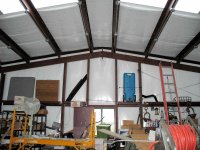
I included a couple of pics of the layout. I have the lighting conduit completed and as of yesterday (ran out of 12ga white wire) I have half of the light bulb bases wired. I should be able to have all the lights in by the end of the week. I will run these on three 20 amp breakers, through three 20 amp light switches so that switch 1 tuns on the two inner rows going down the center of the shop, switch 2 turns on the next two rows out from the center and switch 3 turns on the outer two rows on the outside walls over the work benches. That way I can control the amount and location of light and can selectively turn off banks if service is required.

My issue is this: having 42 lights, which wattage bulb should I choose? I want the 5000k full spectrum bulbs. I bought a couple of 150 watt 2700k bulbs and they are two yellow. Would 100 watt bulbs do the trick?
I want to order bulbs today. I take it 1000Bulbs is the place to get them?
All advice appreciated!
 

Attachments

  • IMG_6538W.jpg
    IMG_6538W.jpg
    52.6 KB · Views: 133
  • IMG_6540W.jpg
    IMG_6540W.jpg
    53.3 KB · Views: 147
OP
C

Coolerman

Well-known member
Joined
May 2, 2012
Messages
133
Location
Paint Lick, KY
Hmmm... I was basing using 42 100W bulbs (4200w's of light) in a 24 x 40 shop with 13' ceiling on the Veno thread where he only used 16 250W (4000w's of light) in a 30 x 50 shop with 17' ceilngs. I have no problem going with more light but don't want it too bright. :lol:

There is also the price difference... Using 1000bulbs.com...
100W 5000K bulbs are $3.42 ea. That's $139.02 for 42 bulbs
150W 5000K bulbs are $6.61 ea. That's $277.62 for 42 bulbs quite a bit of difference!
 

pattenp

Well-known member
Joined
Jun 4, 2008
Messages
10,175
Location
Virginia - USA
I'm going by lumens per square foot and I think 100 to 125 lumens per sqft is good. The 150W bulbs have an output of about 2600 lumens. So 42 X 2600 / 960 = 113.75 lumens per sqft.

IMHO I wouldn't do less than 100 lumens per sqft. I think there are some 100W bulbs that are 2000 lumen.
 
Last edited:
OP
C

Coolerman

Well-known member
Joined
May 2, 2012
Messages
133
Location
Paint Lick, KY
OK you have convinced me to go with the 150w's. I'll get them ordered now and hopefully have them by the weekend. I'll post pics of all 42 lit up... Should be an amazing sight...
 
To avoid these ads, REGISTER NOW!
Top Bottom