To avoid these ads, REGISTER NOW!

Debunking the Franzinator

er3456df

Well-known member
Joined
Dec 1, 2009
Messages
230
So there a several (very several) threads about water condensation, and the Franzinator in particular. There has not been, to my knowledge, any thorough analysis of what actually needs to happen to make dry air come out of a hose, or what the end-all, be-all best way to do it is. So, I'll show my cards, and submit what I've discovered while trying to reduce this down to a math problem. If I have made any errors, please help me out and see where this discussion goes.

=========================

Dew point. Dew point is defined as the temperature below which the water vapor in a volume of humid air at a given constant barometric pressure will condense into liquid water at the same rate at which it evaporates. Thus, to remove as much water as possible from the air, we want the Dew point to be as high as possible. Dew point is a function of Relative Humidity. If we can get the RH to be 100%, then we have achieved the goal of maximum Dew point, and therefore maximum condensation.

RH is defined as the ratio of the partial pressure of water vapor in the air, to the evaporation pressure of any liquid water in the same volume. This means we want the partial pressure to be as high as possible, and the evaporation pressure to be as low as possible.

HERE'S MY ASSESSMENT- maximizing partial vapor pressure is a function of the air pressure itself, which means it's dictated by the regulator on the tank. If your reg is set to 150, and you don't have any significant restrictions along the way, then your partial vapor pressure is fixed, and is not affected by the air temp. Raising the regulator setting will increase water removal.

Evaporation pressure of the liquid, however, is not affected by pressure but IS affected by the temperature of the water. Making this temperature lower will increase water removal. Note that without using any refrigeration equipment, the lowest possible temperature is going to be whatever your ambient temp is. Therefore, if you don't want a refrigerated system, all you need to do is reach ambient at max PSI, and then separate the water. If you leave the water in the tank, and start running your tools, the drop in pressure will cause the liquid to re-evaporate.

So in essence, if you can get the compressed air to return to ambient temp before hitting your tank, you will have the driest air possible for your situation.

=======================

So what about the Franzinator? Franz says that the pressure drop causes a temperature drop (which is true) and that the temperature drop causes further condensation (which I am about to disprove).

Remember the RH? Dropping the pressure of the air does drop the temperature- OF THE AIR. Notice how the partial vapor pressure was not affected by the air temp? It's only dependent upon the pressure, which we just killed by using a restriction/expansion chamber. Thus, our RH has dropped, and along with it, the Dew point. The "refrigeration effect" does not exist. Further to illustrate the point- the low pressure area of a refrigeration system is called and "evaporator", not a condenser. Refrigerant evaporates when it is expanded- why would water be any different?

What the Franzinator DOES- is give a large, heavy chunk of metal for the air to contact, which acts as a heat-sink to drop the air temp back to ambient faster than it would otherwise. It's adding cooling capacity. It also acts as an air separator. If your setup already brings the air back to ambient before hitting the hose, and gives the liquid someplace to go without being caught in the airstream, you're good to go and don't need this thing.

==========================

TL;DR: Nothing special about the Franzinator that any other method of adding metal to the distribution line wouldn't also accomplish.
 
To avoid these ads, REGISTER NOW!
OP
E

er3456df

Well-known member
Joined
Dec 1, 2009
Messages
230
A couple more thoughts- if you aren't auto-draining the water, and run the tank low (as in, run it down faster than it can replenish pressure), then while the pressure is low the water is re-evaporating from the tank into the air inside the tank- INCLUDING the air inside the hose. When the pressure recovers, the water will once again condense out, wherever it happens to be - INCLUDING in the hose. So, usage patterns will also affect water coming out of the hose. I know for a fact that I get more water out of the line when I'm working the compressor hard. This is probably why.

Auto-draining the water would theoretically fix this, but I haven't used a system with an autodrain so YMMV.

Also, copper is better pound for pound, but not dollar for dollar. This is the reason steel pipe wins- it's thicker (more mass) for a comparable installation. The material itself is not actually superior.
 

CNGsaves

Well-known member
Joined
Sep 26, 2012
Messages
13,233
Location
KS and OK
Where you from??

What compressor you using for this "testing" . . / specs ??

Let's see your airline system / dryer / etc??

:needpics:
 

383 240z

Well-known member
Joined
Dec 4, 2006
Messages
4,295
Location
Findley Twp. Allegheny Co.
I have been waiting for a Mythbusters style testing of these. Will this be a theory based exersize, or did you build one and plan on doing real data collection testing on?? Keith
 
Last edited:

fflintstone

Well-known member
Joined
Jul 18, 2010
Messages
2,722
Location
MOFnowhere Mi.
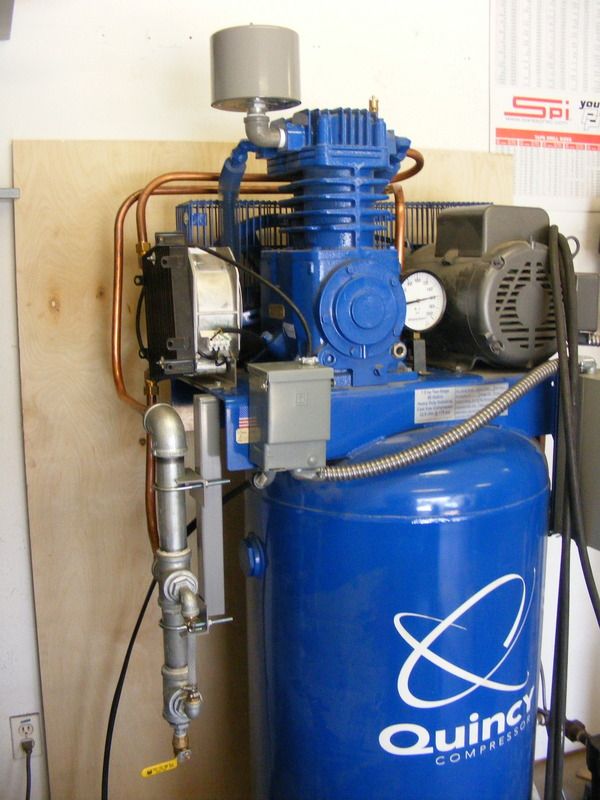
Someone recently showed using a hydraulic oil cooler and moisture trap between the compressor and the tank. I would love to have a setup like that.

Hell I don’t even have cast iron air lines yet.
 

brianpgriset

Well-known member
Joined
Sep 29, 2006
Messages
1,042
Location
Beaumont, TX
Someone recently showed using a hydraulic oil cooler and moisture trap between the compressor and the tank. I would love to have a setup like that.

Hell I don’t even have cast iron air lines yet.

DSCF1991.jpg


The op has the basic idea right, lower temp air can't hold as much water as high temp air at equal pressure.

One more thing to consider when attempting to remove liquid droplets from gas streams: low velocities promote small droplets to fall out (not entrained in fast moving vapor). That's why I added the drip leg.

And another thing: you can use coalescence to aid moisture removal by making larger droplets which are also less likely to be entrained in vapor.

So, methods to remove moisture: temp, low velocities, coalescence, dessicants. All are effective and commonly used in chemical and refining processes (knock out pots, demister pads, compressor interstate coolers, etc...)
 

Falcon67

Well-known member
Joined
Jun 11, 2009
Messages
18,371
Location
Merkel, TX
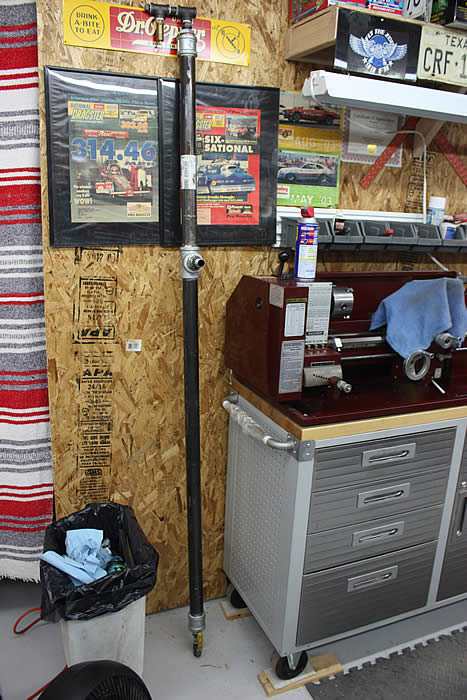
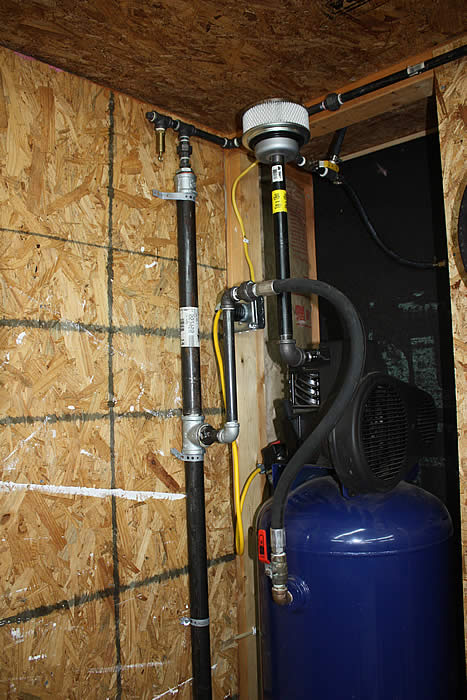
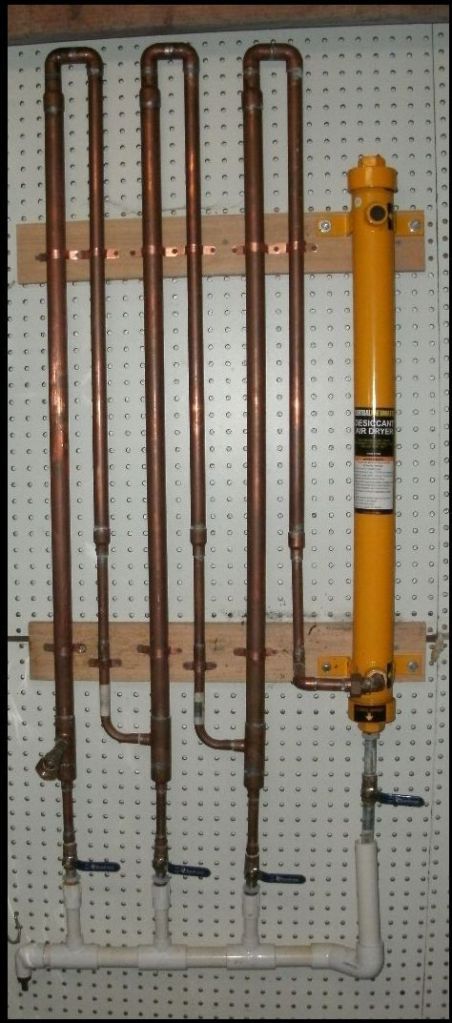
Here's mine - I figure if a little might be OK, a lot could be better, so it's 7' tall. If nothing else, it adds 14' of air line in a compact space. The air enters a 1/2" line and expands at the bottom to 2 1/2". I get condensate out the bottom. As I've noted in other threads, I also live where "humid" starts at 45%. So there's not a lot of water in the air around here a lot of time.

Air6.jpg


Air7.jpg

 
OP
E

er3456df

Well-known member
Joined
Dec 1, 2009
Messages
230
So, methods to remove moisture: temp, low velocities, coalescence, dessicants. All are effective and commonly used in chemical and refining processes (knock out pots, demister pads, compressor interstate coolers, etc...)

I notice you didn't say "expansion chamber".

:D
 
OP
E

er3456df

Well-known member
Joined
Dec 1, 2009
Messages
230
Here's mine - I figure if a little might be OK, a lot could be better, so it's 7' tall. If nothing else, it adds 14' of air line in a compact space. The air enters a 1/2" line and expands at the bottom to 2 1/2".
[/B]

Looks great! nice and tall, and wide to kill the velocity. Can't see any droplets getting out of that thing.
 

Kevin C

Well-known member
Joined
Aug 4, 2011
Messages
1,653
Location
Portland OR
RH is defined as the ratio of the partial pressure of water vapor in the air, to the evaporation pressure of any liquid water in the same volume. This means we want the partial pressure to be as high as possible, and the evaporation pressure to be as low as possible.

Correct but a bit confusing. RH is the ratio of the partial pressure to the saturation pressure at a given temperature. To get the moisture out of the air we want to drop the temperature.

Dropping the temperature decreases the saturation pressure, increasing the RH to a point where for a given amount of moisture in your air you cross the dew point and it ( the moisture) condenses out.

-----

Two factors dictate how much water air can hold, temperature and pressure.

As you increase the pressure, the water capacity decreases.

As you decrease temperature water capacity decreases.

Move those two variables around to get a dew point low enough to prevent condensation in either your air lines or at the point of use.

For general shop air a dew point of 45°F to 50 °F is more than enough. Medical / food grade air needs to be a lower ( class 2 has a dew point of -40°F, class 1 -94°F)

I agree with your premise that for a non flow system the lowest moisture capacity the air will have (with out some type of cooling to bring the temp below ambient) is at max pressure and room temp. That is as good as you can get without using a desiccant.

If we have a flow system we get a pressure drop, that pressure drop decreases the temperature. So we are working both variables, but one is going the wrong way (lower pressure increases moisture capacity and lower temperatures decrease moisture capacity).

We want to decrease moisture capacity to get the water out.

So to have this system work, we need to get enough of a temperature drop to decrease the dew point more than the pressure drop increased it.

http://www.engineeringtoolbox.com/water-content-compressed-air-d_1275.html Handy charts on moisture capacity, temperature and pressure.

At 70°F and 116 PSI if you drop 29 PSI across your nozzle, the air temp needs to drop to 64° to get the dew point lower (moving both the temperature and pressure variables).

Two things.. That's a significant pressure drop and it did not require a very big temperature drop to decrease the dew point. I'm saying not disproved....


Other thoughts...

It is possible to use a Vortex cooler to drop the dew point. If the exhaust is separate the design would be pretty easy and very straight forward (although it would not be super efficient).

http://en.wikipedia.org/wiki/Vortex_tube

That could be a whole new subject.... Could a Vortex type cooler work in a flow system?
 
Last edited:

Mr onetwo

Well-known member
Joined
Apr 6, 2011
Messages
2,006
Location
Coastal Maine
Here's mine - I figure if a little might be OK, a lot could be better, so it's 7' tall. If nothing else, it adds 14' of air line in a compact space. The air enters a 1/2" line and expands at the bottom to 2 1/2". I get condensate out the bottom. As I've noted in other threads, I also live where "humid" starts at 45%. So there's not a lot of water in the air around here a lot of time.

Air6.jpg


Air7.jpg


If I am looking at your pictures right your setup is not hooked up correctly.:wtf:You must run the outlet of the compressor head to the center of the "Franzinator".From there into the tank and then from tank to air piping.Please correct me if I am not seeing your pictures correctly.You will see a huge change in how it works if you swap it around and you will keep most of the moisture out of the tank.
 

Attachments

  • 100_2710.jpg
    100_2710.jpg
    127.3 KB · Views: 229

Tim The Tool Man

Well-known member
Joined
Mar 1, 2012
Messages
1,520
Location
Lehigh Valley, PA
There was a decent debate thread on this topic recently: http://www.garagejournal.com/forum/showthread.php?t=186531&highlight=compressor+venturi&page=3

In my unscientific opinion the OP misses one important aspect of the frazinator which is the venturi effect created when a small diameter nozzle releases into a larger volume. This sudden change in pressure momentarily cools the air which releases suspended moisture. If there is a solid wall just opposite this venturi the water droplets will cling to it and drip down before being re-evaporated.

Below are a couple images of my set up which, strictly speaking isn't a frazonator but I think it might run on a similar principal. (I made it befor I was told about the fraz here on the GJ) As for real world experience, all I can say is that in the first chamber I collect lots of moisture and progressively less in the next two. I haven't looked at my desiccant media in a while so I can't offer recent data on it...

This is a copy/paste from a few posts I made about how I "think" it works:

Over the years I have designed some fairly elaborate custom filtration systems for the koi ponds I've installed for clients. Among the designs I have developed some pretty cool bubblers. I also dabble in HVAC on weekends with a friend, who is a pro.

Anyhow the reason I explained this is because I like to know how things work and therefore I have become knowledgeable about the venturi principle and how it can cool gasses (http://en.wikipedia.org/wiki/Venturi_effect). Take a compressed air blower nozzle and clean the dust off your saw, when you are done feel the tip, it will be cold and moist.

Because I had some spare time, copper pipe, and the wall space I can up with this gizmo:
venturi_zps5fe3e9fb.jpg

Basically, as some others have stated, it is designed to take the compressed air from a small diameter pipe and instantly move it through to a larger diameter pipe which will cool the air and allow the water to drop out of suspension. My system basically moves the air from a 3/8 nozzle into a 1" dia. pipe several times over. Here is a diagram of one of these nozzles which I brazed within the pipes:
CompVenturi_zpsfba210c3.jpg

I sold the compressor that the system was attached to and am rebuilding an old American Kellogg so there is nothing attached to it now but once everything is back together there will be, from the compressor pump, a 3/4" flexible hydraulic hose, a filter, then the venturi dryer gizmo, then a horrible freight desiccant dryer, then the tank and onto my shop piping...


I have no pics of my current set up to share...
 
Last edited:

CNGsaves

Well-known member
Joined
Sep 26, 2012
Messages
13,233
Location
KS and OK
Nice post Tim . . . .you're a patient and teaching man !!

This may just be pedagogical exercise as OP may not even have an air compressor or airline system what so ever! :lol:
 

Falcon67

Well-known member
Joined
Jun 11, 2009
Messages
18,371
Location
Merkel, TX
>If I am looking at your pictures right your setup is not hooked up correctly.

Technically true, but it's where I want it. The tank and the stack are both water catchers. I'm not sweating having water in the big tank. I still get dry air. I also have a 10 CFM air chiller stashed in the shed that I can add to the system should I need it. So far, I'm catching nothing in the water traps and in the drain pipes at the drops.
 
To avoid these ads, REGISTER NOW!
OP
E

er3456df

Well-known member
Joined
Dec 1, 2009
Messages
230
Apparently Mr. "I'm gonna debunk this myth!!" has left the building..

Yep, pretty much. The thread got locked for a while, I was called a spammer, and it turns out nobody besides me really cares whether this thing is any better than a straight pipe.

Back to your regular program.
 

roofster

Well-known member
Joined
Jul 1, 2008
Messages
200
Location
NE Indiana
I'm not sure they are better than a straight pipe. Franz recommends two for a 5hp compressor, so perhaps that's why mine doesn't seem to do much.

I'm putting 17 cfm into it and never get water out. The top gets hot and the bottom hotter. I added an automotive a/c condenser in line, followed by a DeVilibuss Clean-Air unit and that spits and collects water.

View media item 39236
 
Last edited:
OP
E

er3456df

Well-known member
Joined
Dec 1, 2009
Messages
230
Kevin C's comment from page 1 is correct that I neglected the refrigeration effect of the pressure drop- my assumption was that it would be negligible, but he's right that my math hasn't disproven anything. Thanks Kevin for humoring me. My original point still stands, though- even though I failed disprove it, it was never proven to begin with.

So show me why a regular old iron or copper distribution line wouldn't do exactly the same thing? Refrigeration due to pressure drop, you say?

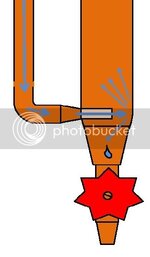
Using the cartoon picture from Tim the Toolman's post, you see that the increased pressure before the nozzle is going to condense water out, so you'll be spraying "wet" air through the nozzle into the expansion zone. To quantify the refrigeration effect there, we have to not only account for pressure drop of the air, but also the pressure drop of the water- so my assertion is that just saying "it feels cold" doesn't mean that it's actually getting any drier. Water spray turning to vapor will cause most of the cooling effect there. If it's cooling because the water is re-evaporating... surely there's no need to explain why this is counterproductive?

Maybe if each nozzle had a drip leg just before the restriction?- like this:
attachment.php


For a system with multiple nozzles, you'd be dividing up the pressure drop over X number of segments, so each nozzle gets a proportionally small pressure drop- my gut says that they won't add back up to the same amount of cooling and thus one expansion stage is better, but I am out of energy for math at the moment. Maybe Kevin C can tell us.

We still have the problem of when the compressor cycles off, and the flow stops. Any sub-ambient temps will start to rise back to ambient, and the water condensed due to this refrigeration effect will re-evaporate. You'd be right back to where you were without any refrigeration happening. An auto drain that works off the unloader pressure would work, but you'd need one at every point that liquid water collects.
 

Attachments

  • dripleg.jpg
    dripleg.jpg
    32.1 KB · Views: 395

Falcon67

Well-known member
Joined
Jun 11, 2009
Messages
18,371
Location
Merkel, TX
My comment to roofster would be "it's way too small" - especially since you went with 1 1/2" instead of 2 1/2". IMHO, part of the reason mine works is because it's big and there's a lot of iron wall space to help dissipate heat. I'd think the pressure drop aspect would be different going from 1/2" to and aire space created by 2 1/2" vs 1/2" to 1 1/2" diameter pipe. I used 1/2" to make sure I always had volume but I considered using 3/8". I'm thinking more "poor man's venturi" where we're slowing the air speed to encourage the water to condense out of the air, then making a sharp turn to help give it a chance to drop out of the air stream. Same thing in a intake manifold - downstream of the carb its not unusual to have raw fuel flowing on the intake walls due to speed and path changes giving the fuel a chance to drop out of the air stream. The air moves fastest in the center of the port and any change in direction really bangs up the mixture. Take a close look at some of the intake plenums from the Engine Masters competition - you'll see bumps and pits in the bottom where the air has to make the turn into the port channels heading to the cylinder heads. They are there to help force the fuel back into suspension. Part of what the Fraz does - I think - is the opposite.
 
Last edited:

sberry

Banned
Joined
Jun 18, 2005
Messages
35,747
Location
Brethren, Michigan
I agree its really a simple heat sink. As for using it on a large comp while you may not get water out of it and its getting hot the idea is to get rid of the heat and lower the temp, would help water condensate in the tank or anywhere further down the line.
 

Tim The Tool Man

Well-known member
Joined
Mar 1, 2012
Messages
1,520
Location
Lehigh Valley, PA
Kevin C's comment from page 1 is correct that I neglected the refrigeration effect of the pressure drop- my assumption was that it would be negligible, but he's right that my math hasn't disproven anything. Thanks Kevin for humoring me. My original point still stands, though- even though I failed disprove it, it was never proven to begin with.

So show me why a regular old iron or copper distribution line wouldn't do exactly the same thing? Refrigeration due to pressure drop, you say?

Using the cartoon picture from Tim the Toolman's post, you see that the increased pressure before the nozzle is going to condense water out, so you'll be spraying "wet" air through the nozzle into the expansion zone. To quantify the refrigeration effect there, we have to not only account for pressure drop of the air, but also the pressure drop of the water- so my assertion is that just saying "it feels cold" doesn't mean that it's actually getting any drier. Water spray turning to vapor will cause most of the cooling effect there. If it's cooling because the water is re-evaporating... surely there's no need to explain why this is counterproductive?

Maybe if each nozzle had a drip leg just before the restriction?- like this:
attachment.php


For a system with multiple nozzles, you'd be dividing up the pressure drop over X number of segments, so each nozzle gets a proportionally small pressure drop- my gut says that they won't add back up to the same amount of cooling and thus one expansion stage is better, but I am out of energy for math at the moment. Maybe Kevin C can tell us.

We still have the problem of when the compressor cycles off, and the flow stops. Any sub-ambient temps will start to rise back to ambient, and the water condensed due to this refrigeration effect will re-evaporate. You'd be right back to where you were without any refrigeration happening. An auto drain that works off the unloader pressure would work, but you'd need one at every point that liquid water collects.

I'm not going to challenge anybody's math on this and just state simply that my set-up seems to work, at least with my 80 gallon 5hp American Kellogg. The first leg has a fairly constant drip/flow while the final leg drip much less. The media in my desiccant dryer also lasts quite a while, in fact I have not had to regenerate it yet (two years).

All I do is just lightly crack open each valve when I'm doing a project that requires a constant flow of air. If I'm just filling a few tires with air then the valves stay shut. I am also not using this in an industrial setting and would not recommend it for that purpose. I think my picture my have been doctored as well because I do not have a drip leg to the left of my nozzles...

My drip leg scamatic


Here is the compressor it is now hooked up to. This was taken as I was moving into the back room where it now lives. I don't have any pictures of it all put together to show how it works...
 

hondacivic247

Well-known member
Joined
Sep 15, 2014
Messages
538
Anything ever come of all this as I just built something like this to give it a try. I'm pretty sure I'll have dry air by the time it goes through everything as the quincy 325 I have doesn't produce a lot of heat, I can hold my hand on the discharge pipe off the head to the tank the entire time from empty to 150psi my last emglo GT pump ran so hot the tank actually got warm..
 

dynahoe

Well-known member
Joined
Oct 25, 2014
Messages
515
Location
londonderry nh
seems to me the shops with the biggest problems were always set up by some "genius"that installed all the lines level.water drains are great but they work better if the lines drain into them.i run 1"i.d. pex-al-pex and have no water issues so far after 7 months.i drain the tank every other day.
 

Streetbu

Well-known member
Joined
Jan 7, 2014
Messages
3,082
Location
Central NY
I think part of the problem people aren't realizing is were talking about two different things. Most people are concerned about dry air coming out if their outlets. The Frazinator was NOT designed to fix that. It was made to stop water from even getting into the tank. Even a half *** designed system will probably have no water in the lines, but the tank may have to be drained daily depending on usage. The other thing people forget is local weather. The middle of the Arizona probably doesn't have as much humidity as somewhere on the east coast, like Georgia. I plumbed my system without one and have had absolutely NO water in the LINES since day one. My tank on the other hand is a different story. I drain that every time I use it. Usually only a small amount of water, but sometimes more in the summer when its hot and muggy. I don't mind draining my tank manually, and I'm not concerned about if the tank will last 100 years. If it fails during my lifetime I would be surprised, but I'll buy a new one. Cross that bridge when I get there.
 

LS6 Tommy

Well-known member
Joined
Dec 27, 2013
Messages
26,162
Location
Northern NJ
Please show me where I'm wrong. I'm know probably missing something big, but I see no place where there would be a large "pressure drop" in any of the sketches or schematics. The venturi effect doesn't happen in a closed system. Pressure is equal everywhere in a closed vessel, regardless of pipe size. The outlet of the Franzinator would have to be at a significantly lower pressure than the inlet to create any refrigeration effect due to pressure drop. Is the concept based on Delta P across the venturi as the pressure is reduced as the compressed air is used & expelled to atmosphere by the air tool?

Tommy
 

Streetbu

Well-known member
Joined
Jan 7, 2014
Messages
3,082
Location
Central NY
Tommy I agree, but how does it occur in an air conditioner system? Is it with the fixed orifice? Because it is SO small and because it's going from a liquid to a gas?
 

LS6 Tommy

Well-known member
Joined
Dec 27, 2013
Messages
26,162
Location
Northern NJ
Tommy I agree, but how does it occur in an air conditioner system? Is it with the fixed orifice? Because it is SO small and because it's going from a liquid to a gas?


In an HVAC system there is a pressure drop, change of state and increase of volume. I still may be 100% wrong, but as far as I can tell, you don't have any of those factors in a Franzinator. It's a heat sink.


Tommy
 
Last edited:
To avoid these ads, REGISTER NOW!
Top Bottom