To avoid these ads, REGISTER NOW!

30'x48'x10' Garage Ligting Solution

600SL

Well-known member
Joined
Apr 26, 2012
Messages
1,794
Location
Connecticut
Hello

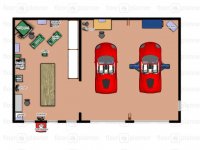
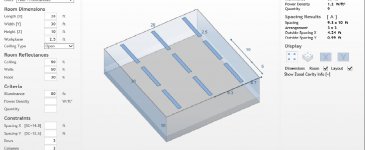
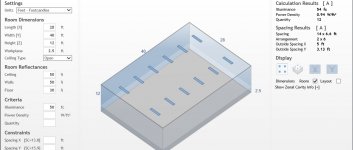
I'm working on my proposed garage lighting. Attached are some pictures of what I have in mind.

I'm trying to keep overall lighting above 50 cf and supplement task areas as required.

I will probably put 3 sets of TL 2 32' across the front of the garage area where I work instead of 2.

Questions for the forum

Not sure what the difference is between apertured version TLA 2 32 and non apatured version TL 2 32. I thought the aperture was a reflector but pictures seem to show these as the same.

Comments and suggestions welcome.
 

Attachments

  • 2D Layout.jpg
    2D Layout.jpg
    67.9 KB · Views: 442
  • 3D Layout.jpg
    3D Layout.jpg
    43.2 KB · Views: 373
  • Garage Lighting.jpg
    Garage Lighting.jpg
    15.6 KB · Views: 304
  • Machine Shop.jpg
    Machine Shop.jpg
    15.7 KB · Views: 182
To avoid these ads, REGISTER NOW!

2ManyProjects

Well-known member
Joined
Jul 18, 2013
Messages
757
Hello

I'm working on my proposed garage lighting. Attached are some pictures of what I have in mind.

Those screen captures from the Acuity/Lithonia lighting calculator are far too small to make out any detail; but I can see enough to know you're headed WAY off-course.

I'm trying to keep overall lighting above 50 cf and supplement task areas as required.

Make that 100 lumens/ft.^2, at minimum; and set up the switching so that you don't have to use it all, all the time.

I will probably put 3 sets of TL 2 32' across the front of the garage area where I work instead of 2.

That would in effect be a small Band-Aid, applied to a fundamentally wrong-headed overall approach.

Taking the main garage area first: You're showing virtually all of the lighting located directly ABOVE the vehicles. As such, it will do a stellar job of brightly illuminating the roofs of those parked cars -- and very little else. What you WANT to do is place at least most of the lighting around the perimeter of the vehicles, where you'll actually be working. In most cases (probably including this one), that means more-or-less continuous "runs" of twin-tube F32T8 fixtures on at least three sides, typically 2-3 feet (4 feet, at most) away from the walls, where they will also do a good job of lighting up any wall-mounted storage, etc.

The plan you show for the machine shop is SOMEWHAT better, but still far short of ideal. In this case, the task lights you'll need for each of those machines/workstations will likely form a significant portion of the overall lighting. So until you get that worked out, it's difficult to make a specific recommendation.

Not sure what the difference is between apertured version TLA 2 32 and non apatured version TL 2 32. I thought the aperture was a reflector but pictures seem to show these as the same.

AIUI, "apertured" indicates that there are slots/holes in the reflector, to allow SOME of the light to be distributed upward. But the point is arguably moot, as NEITHER of these is what you want to use in that application, except MAYBE as dedicated task lights over some of the machinery.

With only a 10-foot ceiling, the LAST thing you need to do is concentrate the light output from each fixture into a tighter pattern than necessary; hence, those on-fixture reflectors are actually counterproductive. What you WANT is the most dispersion and diffusion as possible. To this end, use either open-tube "strip" fixtures, or simple "wrap" fixtures, such as I have cited here on numerous occasions. (This also presumes that your ceiling is indeed finished, flat, and painted a light color such as white; but since you didn't state otherwise, that's the theory I'm working on.)

Second, they're both so-called "tandem" 8-foot fixtures, which significantly limits your placement and switching flexibility, vis-a-vis individual four-foot fixtures.

 
OP
6

600SL

Well-known member
Joined
Apr 26, 2012
Messages
1,794
Location
Connecticut
Those screen captures from the Acuity/Lithonia lighting calculator are far too small to make out any detail; but I can see enough to know you're headed WAY off-course.


Make that 100 lumens/ft.^2, at minimum; and set up the switching so that you don't have to use it all, all the time.


That would in effect be a small Band-Aid, applied to a fundamentally wrong-headed overall approach.

Taking the main garage area first: You're showing virtually all of the lighting located directly ABOVE the vehicles. As such, it will do a stellar job of brightly illuminating the roofs of those parked cars -- and very little else. What you WANT to do is place at least most of the lighting around the perimeter of the vehicles, where you'll actually be working. In most cases (probably including this one), that means more-or-less continuous "runs" of twin-tube F32T8 fixtures on at least three sides, typically 2-3 feet (4 feet, at most) away from the walls, where they will also do a good job of lighting up any wall-mounted storage, etc.

The plan you show for the machine shop is SOMEWHAT better, but still far short of ideal. In this case, the task lights you'll need for each of those machines/workstations will likely form a significant portion of the overall lighting. So until you get that worked out, it's difficult to make a specific recommendation.


AIUI, "apertured" indicates that there are slots/holes in the reflector, to allow SOME of the light to be distributed upward. But the point is arguably moot, as NEITHER of these is what you want to use in that application, except MAYBE as dedicated task lights over some of the machinery.

With only a 10-foot ceiling, the LAST thing you need to do is concentrate the light output from each fixture into a tighter pattern than necessary; hence, those on-fixture reflectors are actually counterproductive. What you WANT is the most dispersion and diffusion as possible. To this end, use either open-tube "strip" fixtures, or simple "wrap" fixtures, such as I have cited here on numerous occasions. (This also presumes that your ceiling is indeed finished, flat, and painted a light color such as white; but since you didn't state otherwise, that's the theory I'm working on.)

Second, they're both so-called "tandem" 8-foot fixtures, which significantly limits your placement and switching flexibility, vis-a-vis individual four-foot fixtures.


Keeping the lights off the tops of the cars seems like a good idea. But populating the lights to 100 cf I have a problem with because I know my self and I would come in the door and immediately turn on all switches. The dedicated task lit areas has worked for me in the past for turning on only what I need.

So for the garage 3 rows of 8 footers left side of cars, right side of cars and center of cars may be a good solution. and perhaps two 8 footers in the front of the garage.

If I'm really going to need 100 cf I will need to have to find out for myself because I'm used to a 28 x 26 garage with 2 tandem 8ft and 2 tandem 4 ft. Yes it sucked but not un workable.
 

Angelfire

Well-known member
Joined
Mar 22, 2012
Messages
1,367
Location
New Mexico and Ireland
How old are you? And how much longer are you planning to work there? And what kind of work are you planning to do?

Reason I ask is, as you age, you're eyes naturally need more light to see. Typically when one passes 40, it becomes apparent. If you're not doing detail work regularly, then less than 100l/SF would probably work with task lighting for the odd detail job.

But I have found with my eyes at least, once I hit 40, they started down the downhill slope and even now at 47, I prefer a brighter work area regardless of what I'm doing.

Cheers.
 

2ManyProjects

Well-known member
Joined
Jul 18, 2013
Messages
757
Keeping the lights off the tops of the cars seems like a good idea. But populating the lights to 100 cf I have a problem with because I know my self and I would come in the door and immediately turn on all switches.

Do you really have THAT little self-control? And even if the answer is "Yes", do you really want to severely cripple your overall lighting plan in a bass-ackwards attempt to work around that?

If you're REALLY all that worried about your inability to moderate your usage, consider installing one or more of these in place of the "normal" toggle switches:

http://www.smarthome.com/2487S/Keyp...pad-with-On-Off-Switch-Dual-Band-White/p.aspx
2487sbig.jpg


Then set things up so that the main (large) buttons control your "normal" lights, and any of the small ones add in the additional ones which would only be used "when needed".

The dedicated task lit areas has worked for me in the past for turning on only what I need.

And in the context of task lighting, that's fine. But task lighting and general lighting are two different things.

So for the garage 3 rows of 8 footers left side of cars, right side of cars and center of cars may be a good solution. and perhaps two 8 footers in the front of the garage.

Get off the 8-foot fixture idea.

If nothing else, go with that same basic arrangement, but use two twin-tube four-foot fixtures in place of each 8-foot tandem. This will allow you to both space the fixtures better (with smaller and more evenly distributed end-to-end gaps), AND retain more switching flexibility, so that you won't be as tempted to just mindlessly throw everything on, all the time.

If I'm really going to need 100 cf I will need to have to find out for myself because I'm used to a 28 x 26 garage with 2 tandem 8ft and 2 tandem 4 ft.

Ummm... "tandem 4 ft." is an oxymoron, at least if you are referring to FIXTURE length. OTOH, if you are referring to the lengths of each individual tube in four-tube "tandem" fixtures, then you had a lot more light in there than you think you did. Taking a semi-wild guess: Eight F96T12s at about 4,500 lumens each, plus eight F40T12s at about 2,500 lumens each, gives us a total of about 56,000 lumens. Averaged out over 728 ft.^2, that's about 77 lumens/ft.^2, at the sources.

Yes it sucked but not un workable.

So why KNOWINGLY set yourself up for "sucked" again? Most folks prefer to learn from their mistakes. :)

 
Last edited:

JoeFin

Well-known member
Joined
Sep 13, 2013
Messages
717
Location
NorCal - where the Rednecks Race
Reason I ask is, as you age, you're eyes naturally need more light to see. Typically when one passes 40, it becomes apparent. If you're not doing detail work regularly, then less than 100l/SF would probably work with task lighting for the odd detail job.

Cheers.

Glad some one finally stated the obvious. But I don't think you took it quite far enough.

In addition to needing more light at 56 and wearing bifocals and doing extremely detailed work in association with machining, not only have my eyes become sensitive to the lack of enough light, they have become sensitive to the direction of light - in addition to any glare on my glasses.

Flooding the area with 100 cndl/ft light is probably a good start but if that light is being reflected from all sorts of different directions I find I still have to pull out a 4 battery Mag-light and shine it directly into the work to make out fine indentations, or variations in the work piece. Same thing for reading 10th mics as well

Agreed - not everyone has a need or is looking for this type of detail - but for my needs it is imperative.

Once you dig a little deeper into lighting design then the standard "Free On-line Lighting Calculator" provides, they start referring to the "Work Envelope" and ratios of reflected/indirect vs: direct light and the task types best suited by each. In fact indirect light is preferred for what we are doing right now - typing on a computer. NOT detailed precision work!!!

My solution - and agreed it is some what outside the box is to box the 4' T-8 tandems into 6" deep, 12" wide boxes up into the ceiling for a total of 75-80 cndl/ft over all light. Finished with white paint it still reflects lots of light down into the work envelope but cuts down on the glare on my glasses tremendously.

Additionally over sensitive work/inspection areas the fluorescent lighting is augmented with recessed 50 watt 4" Adjustable Gimbals Halogen fixtures. This increases those areas to 130 cndl/ft - on the work surface

That is called "Lighting Design" not punching numbers into a lighting calculator
 

JoeFin

Well-known member
Joined
Sep 13, 2013
Messages
717
Location
NorCal - where the Rednecks Race
Let me illustrate my point a little better so as not to offend anyone

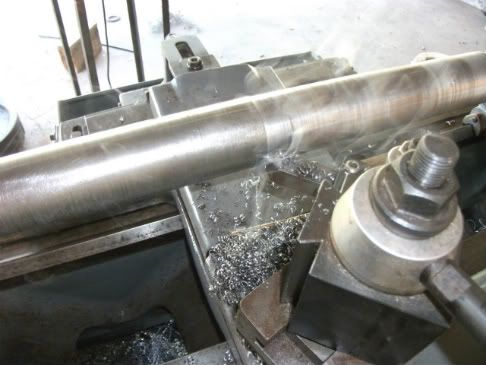
Can you tell from this photo is the cutting tool shearing the metal or burnishing it ?

DSCF0488.jpg


Like wise - can you tell from this photo did the grinder gouge out the metal or shear it properly ?

Valve-2001-1.jpg


While those subtle differences might mean squat to you - they mean every thing to me and the work I perform. Hence the need to minimize indirect light and accentuate detail on the work surface
 
OP
6

600SL

Well-known member
Joined
Apr 26, 2012
Messages
1,794
Location
Connecticut
How old are you? And how much longer are you planning to work there? And what kind of work are you planning to do?

Reason I ask is, as you age, you're eyes naturally need more light to see. Typically when one passes 40, it becomes apparent. If you're not doing detail work regularly, then less than 100l/SF would probably work with task lighting for the odd detail job.

But I have found with my eyes at least, once I hit 40, they started down the downhill slope and even now at 47, I prefer a brighter work area regardless of what I'm doing.

Cheers.

I'm 57 and my eyes have definitely gone down hill. In fact I will be getting my second cataract procedure performed next month.

As for 100 cf its just a level I'm not used to and still consider it a luxury.

Attached is my old 28 x 26 ft garage with 4 8 ft fixtures the one on the left side is not shown. It wasn't to bad after replacing my 2 4 ft shop lights up front with 2 8 ft HO but there were obviously some dark areas. Machine shop area lighting was OK but I did need to have a task light available.
 

Attachments

  • P7290006.jpg
    P7290006.jpg
    139 KB · Views: 255
OP
6

600SL

Well-known member
Joined
Apr 26, 2012
Messages
1,794
Location
Connecticut
Do you really have THAT little self-control? And even if the answer is "Yes", do you really want to severely cripple your overall lighting plan in a bass-ackwards attempt to work around that?

You bring up a very good point. My lack of self control may be based of that I had too little light to begin with. With a good lighting base that may be easier to control.

If you're REALLY all that worried about your inability to moderate your usage, consider installing one or more of these in place of the "normal" toggle switches:

http://www.smarthome.com/2487S/Keyp...pad-with-On-Off-Switch-Dual-Band-White/p.aspx
2487sbig.jpg


Then set things up so that the main (large) buttons control your "normal" lights, and any of the small ones add in the additional ones which would only be used "when needed".

This looks like a good option.

And in the context of task lighting, that's fine. But task lighting and general lighting are two different things.

For me general lighting in the garage are would mean more light up front where most of the detailed work is performed For example 100cf in front of the cars and 50 cf everywhere else would probably work out fine.

For task lighting wall mounted fixtures at 5 ft high along the exterior wall on the sides of the cars and maybe a higher density of lights above between the cars.

For the machine shop area a very general even light would be optimum with task lighting as required at each station.

Get off the 8-foot fixture idea.

If nothing else, go with that same basic arrangement, but use two twin-tube four-foot fixtures in place of each 8-foot tandem. This will allow you to both space the fixtures better (with smaller and more evenly distributed end-to-end gaps), AND retain more switching flexibility, so that you won't be as tempted to just mindlessly throw everything on, all the time.

OK admittedly there is a bit of laziness on my part for installation and wiring. I'm also kind of sold on you strip lights on each side and down the center arrangement for the garage area.

I found a good deal for 15 4' twin tube light with Sylvania QHE 2x32T8/UNV ISL-SC ballasts which I am considering.

Ummm... "tandem 4 ft." is an oxymoron, at least if you are referring to FIXTURE length. OTOH, if you are referring to the lengths of each individual tube in four-tube "tandem" fixtures, then you had a lot more light in there than you think you did. Taking a semi-wild guess: Eight F96T12s at about 4,500 lumens each, plus eight F40T12s at about 2,500 lumens each, gives us a total of about 56,000 lumens. Averaged out over 728 ft.^2, that's about 77 lumens/ft.^2, at the sources.


So why KNOWINGLY set yourself up for "sucked" again? Most folks prefer to learn from their mistakes. :)


I miss spoke they were 4 ' twin tube Home Depot cheep shop lights. When I replaced those two with 8' twin tube HO's lighting was tolerable but not optimum. There is a picture in this thread in one of my other posts.

So the shop originally had 2 8' twin tube fixtures for a total of 4 8' tubes and 2 4' twin tube fixtures for a total 4 4' tube. which sucked

It was then changed to four with 8' twin tube HO's lighting which was not too bad.

The plan if I had stayed was to add another four 8' twin tube HO's for a 8 with 16 tubes. I believe that would have been hot in 728 ft.^2

So it is more like 13,500 lumens over 728 ft.^2 sucked, 18,000 lumens over 728 ft.^2 was workable. and I can only assume 36,000 lumens over 728 ft.^2 was would have been hot ****.
 
OP
6

600SL

Well-known member
Joined
Apr 26, 2012
Messages
1,794
Location
Connecticut
Let me illustrate my point a little better so as not to offend anyone

Can you tell from this photo is the cutting tool shearing the metal or burnishing it ?

DSCF0488.jpg


Like wise - can you tell from this photo did the grinder gouge out the metal or shear it properly ?

Valve-2001-1.jpg


While those subtle differences might mean squat to you - they mean every thing to me and the work I perform. Hence the need to minimize indirect light and accentuate detail on the work surface

Burnishing on the right and shearing on the left.

For the grinding I wouldn't know how to tell the difference, but do elaborate because I recently got a surface grinder.
 

JoeFin

Well-known member
Joined
Sep 13, 2013
Messages
717
Location
NorCal - where the Rednecks Race
Burnishing on the right and shearing on the left.

For the grinding I wouldn't know how to tell the difference, but do elaborate because I recently got a surface grinder.

The second pic is a valve under a 30x tool scope - yes it was shearing nicely

Always check because some of the newer engines use curious alloys that require very different grain and composition wheels. Silicon-carbide for Titanium, Soft wheels for Stellite, and Aluminum-Oxide for general purpose, and yet another for sodium valves the name I can't remember right now

Its pretty tough keeping the wheels clean and sharp on surface grinders when grinding some alloys. Hopefully yours has the diamond dresser installed. The "Burn marks" are 1000s of tiny little cracks from heat. Controlling heat with mist is how I do it
 
Last edited:

2ManyProjects

Well-known member
Joined
Jul 18, 2013
Messages
757
I'm 57 and my eyes have definitely gone down hill. In fact I will be getting my second cataract procedure performed next month.

As for 100 cf its just a level I'm not used to and still consider it a luxury.

Any nicety we're not accustomed too probably seems like a luxury at first, until we DO get accustomed to it -- and then wonder how we survived without. How do you feel about that Bend-Pak, for example? Or your air compressor? Or any of your machine tools? I'd wager heavily that ANY of these items (with the possible exception of the compressor, if it is a relatively small/cheap one) cost far more than even the most completely over-the-top, ne-plus-ultra lighting system possibly could.

But really good lighting is such a basic thing, with such far-reaching implications in ways I can't even count, and is (at least usually) so relatively easy/cheap to do, that it really is something which SHOULD be taken for granted, IMCO. Further, given what you just told us about your eyes, a reasonable argument could easily be made that you should not stop at even 100 lumens/ft.^2. All things considered, 150 lumens/ft.^2 (or even more) may in fact be a more appropriate target, as long as you set up the switching correctly so as to really be able to control it. The point here is, even if you don't take things quite that far, you should not hesitate to install enough (good quality, well-distributed) lighting to average at least 100 lumens/ft.^2, on demand. There is simply no "up side" to deliberately depriving yourself here.

Attached is my old 28 x 26 ft garage with 4 8 ft fixtures the one on the left side is not shown. It wasn't to bad after replacing my 2 4 ft shop lights up front with 2 8 ft HO but there were obviously some dark areas. Machine shop area lighting was OK but I did need to have a task light available.

Photos are nearly always deceiving in terms of actual light levels, due to the way a camera's metering and exposure-control systems work. But that said, the deep shadow areas in this one are easy to discern. I'm quite certain that I would NOT be happy with that lighting.

You bring up a very good point. My lack of self control may be based of that I had too little light to begin with. With a good lighting base that may be easier to control.

Or, to put it another way... You never had the chance to NOT turn it "all" on, because the rest of "all" didn't exist. So the "how much light do I need today?" decision was already made for you, right or wrong. You were in effect ALWAYS operating in "casual work / low-intensity" mode.

{re: Insteon keypad}
This looks like a good option.

And it carries with it a number side benefits which may not be directly relevant to this project, but which you WILL enjoy. ;)

For me general lighting in the garage are would mean more light up front where most of the detailed work is performed For example 100cf in front of the cars and 50 cf everywhere else would probably work out fine.

Allow me to re-phrase that: You might indeed be able to "get by" with that arrangement, despite it falling far short of ideal. And at some point, you might even convince yourself that you are "satisfied" with such less-than-ideal lighting, particularly if you never got the opportunity to compare it to "better" lighting. But the point remains: WHY should you have to just "get by"? That question seems particularly relevant right now, when you have a "Golden Opportunity" to avoid such distasteful compromises.

For task lighting wall mounted fixtures at 5 ft high along the exterior wall on the sides of the cars and maybe a higher density of lights above between the cars.

Be VERY careful with that. While I understand the desire to light up the underside of a car which is up on the lift, mounting light sources at/near eye level can be very problematic. In addition to the glare being just plain annoying, it becomes next-to-impossible to consistently avoid looking directly at the light sources as you work and move around the shop, which in turn causes your irises to clamp down, and... well, you get the idea. I've yet to find my ideal "under lift" lighting solution; but budget permitting, the approach which seems to offer the most promise is to embed lights in the floor, directly under the vehicle. Sorry... No examples of suitable fixtures, as yet.

For the machine shop area a very general even light would be optimum with task lighting as required at each station.

I agree with this, as far as it goes; but I suspect that we have different ideas on just how bright that "general even light" should be.

{re: Use 4-foot fixtures in place of 8-footers}
OK admittedly there is a bit of laziness on my part for installation and wiring. I'm also kind of sold on you strip lights on each side and down the center arrangement for the garage area.

The installation and wiring is something you do ONCE. You then have to live with the results forever. And besides, it's really not THAT much more work.

I found a good deal for 15 4' twin tube light with Sylvania QHE 2x32T8/UNV ISL-SC ballasts which I am considering.

OK. No first-hand experience with that ballast; but a quick Google search turns up one possible red flag: This appears to be a commercial-rated ballast, with Power-Factor Correction. In some ways, that is "A Good Thing"; but in others -- particularly it's likely propensity for spewing EMI/RFI about -- not so much. For this reason, I generally prefer Residential-rated ballasts.

Are these open-tube strips? Or "wrap" fixtures"? Or so-called "shop lights" with integral reflectors? Either of the first two should be OK; but I'd be considerably less enthusiastic about the third, given your relatively low ceilings.

I miss spoke they were 4 ' twin tube Home Depot cheep shop lights. When I replaced those two with 8' twin tube HO's lighting was tolerable but not optimum. There is a picture in this thread in one of my other posts.
So it is more like 13,500 lumens over 728 ft.^2 sucked, 18,000 lumens over 728 ft.^2 was workable. and I can only assume 36,000 lumens over 728 ft.^2 was would have been hot ****.

I've already commented on the pic; and as noted, the lighting is clearly quite uneven and shadowy, regardless of whatever the actual brightness level may have been. However, there is no way on this planet that I would characterize even the most perfectly placed/distributed 50 lumens/ft.^2 as "hot ****". ;)

That said, I'll also point out that if forced to choose between evils, I would rather have a REALLY well-done 50 lumens/ft.^2 than a spotty, shadowy, uneven and generally poorly done 100 lumens/ft.^2. The thing is, the former is next to impossible to achieve with a 10-foot ceiling; and the later is all too common.

 
OP
6

600SL

Well-known member
Joined
Apr 26, 2012
Messages
1,794
Location
Connecticut
Any nicety we're not accustomed too probably seems like a luxury at first, until we DO get accustomed to it -- and then wonder how we survived without. How do you feel about that Bend-Pak, for example? Or your air compressor? Or any of your machine tools? I'd wager heavily that ANY of these items (with the possible exception of the compressor, if it is a relatively small/cheap one) cost far more than even the most completely over-the-top, ne-plus-ultra lighting system possibly could.

But really good lighting is such a basic thing, with such far-reaching implications in ways I can't even count, and is (at least usually) so relatively easy/cheap to do, that it really is something which SHOULD be taken for granted, IMCO. Further, given what you just told us about your eyes, a reasonable argument could easily be made that you should not stop at even 100 lumens/ft.^2. All things considered, 150 lumens/ft.^2 (or even more) may in fact be a more appropriate target, as long as you set up the switching correctly so as to really be able to control it. The point here is, even if you don't take things quite that far, you should not hesitate to install enough (good quality, well-distributed) lighting to average at least 100 lumens/ft.^2, on demand. There is simply no "up side" to deliberately depriving yourself here.


Photos are nearly always deceiving in terms of actual light levels, due to the way a camera's metering and exposure-control systems work. But that said, the deep shadow areas in this one are easy to discern. I'm quite certain that I would NOT be happy with that lighting.


Or, to put it another way... You never had the chance to NOT turn it "all" on, because the rest of "all" didn't exist. So the "how much light do I need today?" decision was already made for you, right or wrong. You were in effect ALWAYS operating in "casual work / low-intensity" mode.

{re: Insteon keypad}


And it carries with it a number side benefits which may not be directly relevant to this project, but which you WILL enjoy. ;)


Allow me to re-phrase that: You might indeed be able to "get by" with that arrangement, despite it falling far short of ideal. And at some point, you might even convince yourself that you are "satisfied" with such less-than-ideal lighting, particularly if you never got the opportunity to compare it to "better" lighting. But the point remains: WHY should you have to just "get by"? That question seems particularly relevant right now, when you have a "Golden Opportunity" to avoid such distasteful compromises.


Be VERY careful with that. While I understand the desire to light up the underside of a car which is up on the lift, mounting light sources at/near eye level can be very problematic. In addition to the glare being just plain annoying, it becomes next-to-impossible to consistently avoid looking directly at the light sources as you work and move around the shop, which in turn causes your irises to clamp down, and... well, you get the idea. I've yet to find my ideal "under lift" lighting solution; but budget permitting, the approach which seems to offer the most promise is to embed lights in the floor, directly under the vehicle. Sorry... No examples of suitable fixtures, as yet.


I agree with this, as far as it goes; but I suspect that we have different ideas on just how bright that "general even light" should be.

{re: Use 4-foot fixtures in place of 8-footers}


The installation and wiring is something you do ONCE. You then have to live with the results forever. And besides, it's really not THAT much more work.


OK. No first-hand experience with that ballast; but a quick Google search turns up one possible red flag: This appears to be a commercial-rated ballast, with Power-Factor Correction. In some ways, that is "A Good Thing"; but in others -- particularly it's likely propensity for spewing EMI/RFI about -- not so much. For this reason, I generally prefer Residential-rated ballasts.

Are these open-tube strips? Or "wrap" fixtures"? Or so-called "shop lights" with integral reflectors? Either of the first two should be OK; but I'd be considerably less enthusiastic about the third, given your relatively low ceilings.


I've already commented on the pic; and as noted, the lighting is clearly quite uneven and shadowy, regardless of whatever the actual brightness level may have been. However, there is no way on this planet that I would characterize even the most perfectly placed/distributed 50 lumens/ft.^2 as "hot ****". ;)

That said, I'll also point out that if forced to choose between evils, I would rather have a REALLY well-done 50 lumens/ft.^2 than a spotty, shadowy, uneven and generally poorly done 100 lumens/ft.^2. The thing is, the former is next to impossible to achieve with a 10-foot ceiling; and the later is all too common.


Some really good points here. Somewhat the obvious but sometimes its good to her it from people who have been there done that.

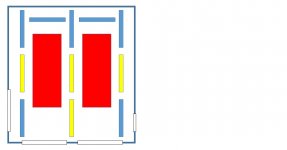
For the garage I recalculated a 3 x 3 arrangement of 8' strips yielding 86 cf. But like I said I want more up front so I added 2 additional fixtures in the front area where I would expect that area to be over 100 cf. I have also depicted two circuits blue would always be used and yellow could be turned on if required. In addition I would move the outer fixtures closer to the wall to better pickup the sides of the cars.

I'm finding it difficult to see any advantage for four foot fixtures in the garage area since as you say lighting up the tops of cars would be of little value. For the machine shop that is a different story.

I've worked in the Aerospace industry for the past 25 years and I always assumed that the lighting in our typical high bay areas was targeted at 100cf which appears to be the industry standard for that application. Yes it is nice. My company I work for now uses HID's in the building that was built about 6 years ago. The latest building completed in 2013 has gone to LED's in the high bays.

The four foot fixtures I found are straight tube fixtures without reflectors. What is the down side to EMI/RFI. Also is it better to wire light at 120v or 240v. Since I can do either.

Thank You
John Roncallo
 

Attachments

  • Lighting Layout.jpg
    Lighting Layout.jpg
    38.9 KB · Views: 82
  • 3x3 TL 32 2 lighting layout.jpg
    3x3 TL 32 2 lighting layout.jpg
    98.7 KB · Views: 86

JoeFin

Well-known member
Joined
Sep 13, 2013
Messages
717
Location
NorCal - where the Rednecks Race
What is the down side to EMI/RFI. Also is it better to wire light at 120v or 240v. Since I can do either.

EMF? RFI causes Noise/Interference on the radio and possibly cell phone reception. 240 volt kind of sets up another problem with your switching options but does save a very slight amount of electricity from reduced line loss.

I'm not sure most shop floors even in the aerospace industry design for 100 cf. I think it would be substantially less - quite possibly in the 70-75 cf range or less

I thought you said you have already undergone 1 cataract surgery and may be possibly heading towards another ? Can't say I understand or have any experience with the effects as I only need bifocals at this point.

Is changing focus from 1 object to the next distance difficult ?

If so there are other considerations other then the number of cf you need to be concerned with - if you want to have a pleasurable experience in your shop. Yes a good amount of light certainly helps - but if you have to stop and wait for your eyes to adjust at every turn it won't be pleasurable by any means.

Scotopic/Photopic ratios, or S/P ratios. They are independent of light level and express a property of the light or lamp spectrum and express the extent to which a lamp favors scotopic effects. Sources with larger S/P ratios (such as high color temperature
fluorescent lamps) can be expected to permit a greater depth of field and better acuity than those with smaller S/P ratios

You might try going through the mall and seeing what types of lighting works best for you. Compare Big Box stores to jewelery counters at the Dept stores to boutiques as the lighting schemes will differ greatly.
 
Last edited:

2ManyProjects

Well-known member
Joined
Jul 18, 2013
Messages
757
Some really good points here. Somewhat the obvious but sometimes its good to her it from people who have been there done that.

Thank you. And yes, sometimes just "thinking out loud" is enough to make something which had been elusive suddenly seem clear.

For the garage I recalculated a 3 x 3 arrangement of 8' strips yielding 86 cf. But like I said I want more up front so I added 2 additional fixtures in the front area where I would expect that area to be over 100 cf.

Well... You're getting closer, if at an agonizingly slow pace. ;)

I have also depicted two circuits blue would always be used and yellow could be turned on if required. In addition I would move the outer fixtures closer to the wall to better pickup the sides of the cars.

I'm finding it difficult to see any advantage for four foot fixtures in the garage area since as you say lighting up the tops of cars would be of little value. For the machine shop that is a different story.

A large part of the answer is in that diagram you just referred to. With only the "blue" lights on, you've got a 12-foot "gap" of NON-illuminated space on each side of the garage (even more than that in the center), and it's in a rather critical area, at that (right where you'd be working on wheels, brakes, or under the lifted car). Now, by simply swapping out those 8-foot fixtures for twice as many 4-footers and slightly re-adjusting their end-to-end spacing, you can reduce the worst-case "gaposis" to no more than six feet. And if you ALSO take this opportunity to add one more 4-foot fixture in each of those fore/aft "runs", that "worst-case gaposis" shrinks to about four feet, even when running in "low intensity" mode.

I've worked in the Aerospace industry for the past 25 years and I always assumed that the lighting in our typical high bay areas was targeted at 100cf which appears to be the industry standard for that application. Yes it is nice. My company I work for now uses HID's in the building that was built about 6 years ago. The latest building completed in 2013 has gone to LED's in the high bays.

High-bay lighting in very large open spaces is a somewhat different animal; so direct comparisons are risky at best. But even so, having experienced that "nice" lighting, can you think of any good reason to NOT want the lighting in your shop to be at least as good?

The four foot fixtures I found are straight tube fixtures without reflectors.

OK. Then they are at least potentially suitable.

What is the down side to EMI/RFI.

You ever listen to the radio while working? And particularly if this is an attached garage (or a detached one located close to the house), does your wife ever watch TV while you're puttering in the shop? "If Mama ain't happy, ain't nobody happy."

Also is it better to wire light at 120v or 240v. Since I can do either.

Go for 120V. AIUI, if this shop can even be considered as a "residential garage", that's a code requirement. But even if not, there is nothing to be gained by going to 240V; so 120V is the way to go, particularly if there is ANY chance of your wanting a control system more sophisticated than a simple toggle switch (such as that Insteon keypad discussed earlier, for example). Also, notwithstanding the multiple switch banks already discussed, DO split the lighting between at least two circuit breakers, so that if/when one trips (or must be thrown for maintenance), you won't be left completely in the dark.

 
OP
6

600SL

Well-known member
Joined
Apr 26, 2012
Messages
1,794
Location
Connecticut
EMF? RFI causes Noise/Interference on the radio and possibly cell phone reception. 240 volt kind of sets up another problem with your switching options but does save a very slight amount of electricity from reduced line loss.

I'm not sure most shop floors even in the aerospace industry design for 100 cf. I think it would be substantially less - quite possibly in the 70-75 cf range or less

I thought you said you have already undergone 1 cataract surgery and may be possibly heading towards another ? Can't say I understand or have any experience with the effects as I only need bifocals at this point.

Is changing focus from 1 object to the next distance difficult ?

If so there are other considerations other then the number of cf you need to be concerned with - if you want to have a pleasurable experience in your shop. Yes a good amount of light certainly helps - but if you have to stop and wait for your eyes to adjust at every turn it won't be pleasurable by any means.


You might try going through the mall and seeing what types of lighting works best for you. Compare Big Box stores to jewelery counters at the Dept stores to boutiques as the lighting schemes will differ greatly.

Well the cataract surgery made my one eye act 20 years younger. I will be getting the other eye done next month.

I think making a comparison by going to various stores would be pointless without a light meter. But I do have time so maybe I can research getting a light meter.

Thanks
John Roncallo
 
OP
6

600SL

Well-known member
Joined
Apr 26, 2012
Messages
1,794
Location
Connecticut
A large part of the answer is in that diagram you just referred to. With only the "blue" lights on, you've got a 12-foot "gap" of NON-illuminated space on each side of the garage (even more than that in the center), and it's in a rather critical area, at that (right where you'd be working on wheels, brakes, or under the lifted car).

That's exactly my point. When working on brakes I would turn on the side lights. But breaks are a fairly quick job and not too often done. The rear area of the cars is essentially corridor space. Maybe a tire and balancing machine will be in the back between the two overhead doors. But not a task that requires significant lighting. If I can figure out how to do it I may work out a switching circuit that will turn either the left and center or right and center.

Now, by simply swapping out those 8-foot fixtures for twice as many 4-footers and slightly re-adjusting their end-to-end spacing, you can reduce the worst-case "gaposis" to no more than six feet. And if you ALSO take this opportunity to add one more 4-foot fixture in each of those fore/aft "runs", that "worst-case gaposis" shrinks to about four feet, even when running in "low intensity" mode.

The actual interior dimensions of the garage are 28.5 by 27. the walls are about 9" thick with the interior PBR paneling installed (white). Therefor at most only 1 4' can be added to each row. in re calculating based on those dimensions the cf goes up to from 86 to 92cf. If I set it up as 21 4 ft equivalent to 9 8' and 3 4' the cf jumps to 107. But my question is, would that extra 2 ft of light butted right up to the walls be effective for anything being that there will be 1' shelf around the perimeter of the garage 2' below the light.

High-bay lighting in very large open spaces is a somewhat different animal; so direct comparisons are risky at best. But even so, having experienced that "nice" lighting, can you think of any good reason to NOT want the lighting in your shop to be at least as good?
.

Only that I have to pay the bill at home. I'm still not sold on the 100 cf requirement and at 92cf with the 3x3 9 fixture arrangement plus two front lights bringing the front well over 100cf I believe I have a reasonable solution Work on switching is still questionable and obviously the 21 light 4' solution would have advantages in that area although it would seem to be a research project to figure which lights to switch. A pull chain solution on each light has some advantages.;)


OK. Then they are at least potentially suitable.

You ever listen to the radio while working? And particularly if this is an attached garage (or a detached one located close to the house), does your wife ever watch TV while you're puttering in the shop? "If Mama ain't happy, ain't nobody happy."

Go for 120V. AIUI, if this shop can even be considered as a "residential garage", that's a code requirement. But even if not, there is nothing to be gained by going to 240V; so 120V is the way to go, particularly if there is ANY chance of your wanting a control system more sophisticated than a simple toggle switch (such as that Insteon keypad discussed earlier, for example). Also, notwithstanding the multiple switch banks already discussed, DO split the lighting between at least two circuit breakers, so that if/when one trips (or must be thrown for maintenance), you won't be left completely in the dark.


Garage is about 200 ft from the house. I don't listen to the radio much but never saw any problems with radios in some of the industrial plants I have worked in.

Thanks
John Roncallo
 

Attachments

  • 3x7 L 32 2 lighting layout.jpg
    3x7 L 32 2 lighting layout.jpg
    107.5 KB · Views: 64

JoeFin

Well-known member
Joined
Sep 13, 2013
Messages
717
Location
NorCal - where the Rednecks Race
I think making a comparison by going to various stores would be pointless without a light meter. But I do have time so maybe I can research getting a light meter.

Thanks
John Roncallo

I wouldn't go as far as purchasing a light meter but I would highly suggest a little comparison shopping as far as scheme.

2Many confuses Quantity with Quality when it comes to lighting and the whole point of the pictures posted above. And by Quality I am not simply referring to a greater color spectrum.

The picture through the tool scope showed great detail because type of light and angle it was applied. You can have a 100 cf of light and still not be able to distinguish detail as well as 80 cf of quality light.

Take for example reading a glossy print magazine in bright daylight where the reflection makes it impossible to distinguish dark areas on a white background. The reader must constantly move the task (or his head) to eliminate the veiling reflections.

Not everyone considers such things but thats just me
 
Last edited:

2ManyProjects

Well-known member
Joined
Jul 18, 2013
Messages
757
I think making a comparison by going to various stores would be pointless without a light meter. But I do have time so maybe I can research getting a light meter.

I don't think the light meter would do you much good. The more commonly available types are aimed at photography, and (at least for the most part) won't give you a useful direct ambient luminance reading anyway (at best, the "incident" readings will still be expressed in f-Stop/Shutter-Speed/ISO values; good luck converting that to a meaningful lumens/ft.^2 value, on the fly). Besides, for what you'd spend to purchase a decent light meter (cf. http://www.bhphotovideo.com/c/buy/Lightmeters-Accessories/ci/900/N/4077634543), you could more than cover the incremental cost of just taking our word for it and buying more lights.

{re: reduced "gaposis" using 4-foot fixtures}
That's exactly my point. When working on brakes I would turn on the side lights. But breaks are a fairly quick job and not too often done.

Your point is well-taken, but it kind'a misses mine. For purposes of deciding between 4-foot fixtures and 8-foot fixtures, the specific locations of any given 8-footer is pretty much moot. I only pointed to those particular fixtures because they were an already-handy example. The thing I was TRYING to illustrate was that with 4-foot fixtures, the OVERALL lighting remains more even and less "spotty/shadowy" throughout the space. Therefore, it will "suffice" a greater percentage of the time.

Ideally, you want NO "gaposis" even when operating at reduced intensity. That can be difficult/impossible to do with standard linear fluorescent tubes, at least in most cases. [Side Note: Yes, at least in theory you could put a second (or third, or fourth) ballast into each fixture, and thus switch the individual side-by-side tubes on/off independently; but that is rarely done except in large/high-power fixtures which use 4-6 (or more) tubes side-by-side in each fixture; and that sort of fixture is not appropriate for your application anyway.] So the next-best thing is to reduce the SIZE of these inter-fixture gaps as much as possible, so that the overall lighting in the space remains as evenly distributed as possible even when not all of the tubes are operating. If you wanted to take this approach to its logical extreme, you would not use even four-foot fixtures; they'd all be two-footers using F17T8 tubes. But in practice, that is (at least usually) not necessary.

The rear area of the cars is essentially corridor space. Maybe a tire and balancing machine will be in the back between the two overhead doors. But not a task that requires significant lighting. If I can figure out how to do it I may work out a switching circuit that will turn either the left and center or right and center.

If you go with the Insteon control system (or similar), all manner of complex (and even semi-redundant) combinations (called "scenes") can be defined. But again, this kind'a misses the point.

It seems to me that you're still thinking more in terms of "zoning" than "intensity control" -- i.e., "I can get away with letting this area go dark, as long as I have good light in this other place...", etc. -- i.e., robbing Peter to pay Paul, at least in a sense. But the point is, such trade-offs are simply not necessary, if you set up the lighting right in the first place. While zoning CAN be useful in larger spaces, it doesn't really take the place of intensity control. And besides, your shop is small enough that zoning would be nearly useless anyway. (Obviously, I'm ignoring the machine shop portion of the building here. It and the main work area do indeed form two separate zones, with separate lighting requirements; but that's not what I'm talking about ATM.) So if it comes down to a decision between zoning and intensity-control, the latter should be the higher priority.

The actual interior dimensions of the garage are 28.5 by 27. the walls are about 9" thick with the interior PBR paneling installed (white). Therefor at most only 1 4' can be added to each row.

I'm with you so far...

in re calculating based on those dimensions the cf goes up to from 86 to 92cf.

You're in the range where every little bit helps; but this is a small enough incremental improvement that it is NOT really the reason to use the (additional) 4-foot fixtures. So let's keep going...

If I set it up as 21 4 ft equivalent to 9 8' and 3 4' the cf jumps to 107.

Better still. Not enough of a change from 93 to be a drastic improvement; but still "better".

But my question is, would that extra 2 ft of light butted right up to the walls be effective for anything being that there will be 1' shelf around the perimeter of the garage 2' below the light.

First, unless I misunderstand your various diagrams, that shelf could only possibly occupy three of the four major "walls", because the overhead doors are in the way on one side.

Second, your latest diagram (off the Acuity/Lithonia site) showed those "outer" runs as being 4.5 feet off the side walls. That's probably a little more than "ideal"; but ignore that nitpick for now. The point being, there is MORE than enough room for both the 1-foot shelf running down that wall AND for the light to effectively illuminate both that shelf and whatever is placed below it (tool boxes, wall-mounted storage, etc.).

Finally, to the point I think you're asking about:

When we get to the ends of the runs, a very small portion of the "last" tubes in each strip will presumably be located above the shelf on the back wall, thus potentially allowing the shelf to cast a small shadow directly below. But the "obscured" portion of the tube is so small relative to the unobscured portion (which is, of course, immediately adjacent), that I very highly doubt you could even notice it in practice.

The reason to use the extra fixtures in each of those runs is NOT to bring the light all the way out to the front/back walls; that's just a coincidence. The real point is to reduce the inter-fixture gaps everywhere within the run, and especially to reduce the length of the "un-lit" portions when only some of the fixtures are operating.

If the "tight fit" of seven four-foot fixtures is really all that much of a concern, substitute ONE two-foot/F17T8 fixture for one of the four footers (probably the one in the middle, or close to it) in each run. That will reduce the overall length of each run to about 26 feet, with gaps of about one foot to the walls on each end. So it will not only fit very nicely; the shelves, etc., become a moot point. (And as a side benefit, these three two-footers could together also serve admirably as your "walk-through" lighting.)

Also, with respect to that latest diagram... While I obviously do think using seven four-footers in place of three eight-footers for those main fore/aft runs is a significant improvement, you ALSO need to replace the crossways runs at/near the back of the shop which you were showing in the earlier incarnations, but deleted in this version. You're showing nine feet between each of those fore/aft runs; so two 4-foot fixtures should fit nicely. I'd suggest spacing them maybe 3-4 feet or so off the wall (depending in part on just "how far in" you tend to park the vehicles when working on them); certainly no less than two feet.

{re: why not have "good" lighting at home}
Only that I have to pay the bill at home.

I think you're letting that tail wag the dog. Not even the tail, really; it's more the fear of that tail which is dominating your thinking -- the costs here just aren't all that high, no matter how you slice it. But to the extent that this might be a real concern, part of the point in using individual 4-foot fixtures (in place of tandem 8-footers) is that they will be LESS expensive to operate, in the long run. Go back to our earlier example of those two 8-foot "yellow" fixtures on each side. With 4-foot fixtures throughout, you will less often feel the need to kick on the "Stage 2" (for lack of a better term) lighting. The same degree of "extra" brightness will still be available for when you DO need it; but you won't be forced to use it in those situations where, had the "low-intensity" light been better distributed, you would have been happy with it.


[The BBS software is nattering at me that the message is too long. So I'm breaking it here. Continued in next message...]

 
Last edited:

2ManyProjects

Well-known member
Joined
Jul 18, 2013
Messages
757
[...Continued from previous message.]

I'm still not sold on the 100 cf requirement and at 92cf with the 3x3 9 fixture arrangement plus two front lights bringing the front well over 100cf I believe I have a reasonable solution

The difference between 100 lumens/ft/^2 and 92 lumens/ft/^2 is really not great enough to worry about. So if you do indeed implement about that much average illumination, I certainly won't claim that you are wildly off the mark. But earlier, you were aiming for just 50 lumens/ft/^2, which would indeed be inadequate, IMCO. OTOH, recall what we said earlier about even 150 lumens/ft/^2 being potentially useful. as long as you are not forced to use it all the time due to inflexible placement/switching. So that 92 (or 100) lumens/ft/^2 level certainly should NOT be taken as some sort of limit or ideal; it is at best "good enough, maybe".

Work on switching is still questionable and obviously the 21 light 4' solution would have advantages in that area although it would seem to be a research project to figure which lights to switch. A pull chain solution on each light has some advantages.;)

This brings us back to that Insteon keypad. Just one of those can potentially provide you with at least five different combinations or "scenes" (plus "All Off", of course), at the push of a button -- certainly easier that walking around the shop pulling chains over and over again. There's also an eight-button conversion kit, which could give you even more choices:

http://www.smarthome.com/2401WH8/8-Button-Change-Kit-for-KeypadLinc-White/p.aspx
2401wh8big.jpg


Now, "Full Discosure" time: To implement that degree of on-the-fly flexibility, you will also need some additional load controllers, in the form of either additional "Wall Switch" modules:

http://www.smarthome.com/2477S/Swit...-Remote-Control-Switch-Dual-Band-White/p.aspx
2477sbig.jpg


or dedicated "hidden" load modules such as:

http://www.smarthome.com/2475SDB/In...ontrol-In-Line-On-Off-Switch-Dual-Band/p.aspx
2475sdbbig.jpg


either of which will add some cost. But the point is, you get to decide just how carried away you want to get in terms of micro-managed control.

Garage is about 200 ft from the house. I don't listen to the radio much but never saw any problems with radios in some of the industrial plants I have worked in.

In which case, your "found" fixtures will probably be OK. Worst-case, you'll need to change out the ballasts and/or add EMI/RFI filters if interference DOES become a problem; but at this point, I'm not expecting that.


2Many confuses Quantity with Quality when it comes to lighting and the whole point of the pictures posted above. And by Quality I am not simply referring to a greater color spectrum.

I am confusing nothing, despite your repeated attempts to put words in my mouth.

The picture through the tool scope showed great detail because type of light and angle it was applied. You can have a 100 cf of light and still not be able to distinguish detail as well as 80 cf of quality light.

That was, rather obviously, a special-case example, which doesn't even come close to being applicable to the case of general shop illumination. Yes, any time you want to emphasize/exaggerate shadows (which is exactly what you were doing in that scope pic), a strongly unidirectional light source will help. But that is by no means even close to the goal of general area illumination -- quite the opposite, in fact.

Take for example reading a glossy print magazine in bright daylight where the reflection makes it impossible to distinguish dark areas on a white background. The reader must constantly move the task (or his head) to eliminate the veiling reflections.

And you just made my point for me. That glare/reflection on the glossy magazine page exists precisely BECAUSE direct Sunlight is indeed unidirectional (a single point-source, 93 Million miles away). That's why that small change in the relative geometry between the light source (Sun), the object (magazine), and the observer (the reader's head/eyes) that you mentioned works to (at least temporarily) alleviate the problem.

 
To avoid these ads, REGISTER NOW!

JoeFin

Well-known member
Joined
Sep 13, 2013
Messages
717
Location
NorCal - where the Rednecks Race
I am confusing nothing, despite your repeated attempts to put words in my mouth.

Been gently trying to get you to make at least a minimal investigation into what is "Quality vs: Quantity" lighting wise without ruffling too many feathers, and no I don't believe I've "put words in your mouth.


That was, rather obviously, a special-case example, which doesn't even come close to being applicable to the case of general shop illumination. Yes, any time you want to emphasize/exaggerate shadows (which is exactly what you were doing in that scope pic), a strongly unidirectional light source will help. But that is by no means even close to the goal of general area illumination -- quite the opposite, in fact.

That is where you repeatedly run astray - and actually its a very common mistake. But no - that is a strong directional light source on the object in the scope and see how the "Texture" is illuminated.


And you just made my point for me. That glare/reflection on the glossy magazine page exists precisely BECAUSE direct Sunlight is indeed unidirectional

Yep - liken the light reflected off walls and ceilings - "Unidirectional" or like the first picture - lacking a crisp texture.

We can talk about "Rods and Cones" or the way humans perceive depth texture or focus - but in short while maximizing the efficiency of fluorescent fixtures you can readily trade off the latter - being lighting quality

So where is the efficiency if your running 100cf of lighting when you have to drag out an additional task light, run an extension cord across the floor and then light the task properly.

Gawd knows your a nice enough guy taking the time to walk these guys through a very detailed process to create an efficient will lit shop - but then you repeatedly fall down on this 1 critical component of lighting design. Sorry but it just kills me to read it repeatedly

Don't take my word for it - look into some of the many various studies performed by architectural grad students and industry professionals readily available on the internet. I only became exposed to it when I was performing energy management control systems design some 20 yrs ago going into various Department store chains or industrial environments and having to deal with the architects over the phone directing me which lighting loads were critical and why.

So to reiterate - 80 fc of quality lighting will enable the user to distinguish detail better, perform task better, and be more comfortable then 100 fc of low quality lighting. Don't take my word for it - its a well documented scientific fact
 
OP
6

600SL

Well-known member
Joined
Apr 26, 2012
Messages
1,794
Location
Connecticut
I wouldn't go as far as purchasing a light meter but I would highly suggest a little comparison shopping as far as scheme.

2Many confuses Quantity with Quality when it comes to lighting and the whole point of the pictures posted above. And by Quality I am not simply referring to a greater color spectrum.

The picture through the tool scope showed great detail because type of light and angle it was applied. You can have a 100 cf of light and still not be able to distinguish detail as well as 80 cf of quality light.

Take for example reading a glossy print magazine in bright daylight where the reflection makes it impossible to distinguish dark areas on a white background. The reader must constantly move the task (or his head) to eliminate the veiling reflections.

Not everyone considers such things but thats just me

I really do have quite the mall to go comparison shopping right at work. I work at Honda Aircraft and we have many large and small bays to get ideas from.

But for example we have a wood shop about the size of my garage with only 8 4' fixtures not sure if they are T8 or T12 but the lighting in that shop is adequate for that shop. But I realize that if I had a car in there working on the side against a wall the light would be blocked and it would be inadequate. So overall lighting I would say is good and in fact appears to be even, but the ability for that setup to not be blocked by large object like cars would really ****. That is why I like the 3 row strip lighting for the garage. It will essentially hit everywhere.

I think what I will do is get the dimensions of that shop and light models and model it in the Acuity software. That would be a good baseline starting point.

Thanks
John
 
OP
6

600SL

Well-known member
Joined
Apr 26, 2012
Messages
1,794
Location
Connecticut
Wow quite a post. I best not re-quote and I certainly appreciate you taking the time.

OK so to summarize

My understanding is that you are concerned with shadowy areas which I understand but at 92 cf overall with some lights turned off those shadowy areas would be in the neighborhood of 46 cf which is considered acceptable for general auto repair according to manufactures guide lines. At the same time this is a 1 maybe 2 person shop. If I'm working on the left side of the car I turn on the left lights ect.

My main concern is that the light hits everywhere which I have found to be more important than how bright it is. The three row solution addresses that even when some of them are off.

Of course your solution is optimum in customizing ability but there are the things I have to consider as well. One being cost ~ 75% more, the other being lack of simplicity as in 21 ballast to maintain verses 9 and then installation. I will have to weigh these up.

As far as adding an additional 4 footer to take up the last two feet at each end I believe that wont be feasible due to roll up door hoods that would be physically in the way of the installation with the exception of the center strip.

As far as the light scene switch, are you saying it has the capability of physically dimming lights, or just turning some on and some off. And can it be made to work with 2 circuits.

In any case the scheme for now remains at 9 8 footers at 92 cf. Spacing will be modified to place the side rows 3ft from the walls and cross lighting up front can be evaluated and installed as required.

Machine shop will be a different animal because generally I work all over the place. So a even distribution of light is required. I probably will do the garage first to evaluate and then decide how to do the machine shop.

I do not believe that any reasonable system will negate the use of task lights at machines be them flash lights or a halogen machine light aiming at the tool action.

Thank You
John Roncallo
 

2ManyProjects

Well-known member
Joined
Jul 18, 2013
Messages
757
Been gently trying to get you to make at least a minimal investigation into what is "Quality vs: Quantity" lighting wise without ruffling too many feathers, and no I don't believe I've "put words in your mouth.

The term "Quality Lighting" can mean almost anything; and depending on the context, it WILL mean very different (perhaps diametrically opposed) things at different times and in different places. So let's at least try to be specific and objective, as opposed to just throwing around purely subjective comments like "Quality vs: Quantity."

That is where you repeatedly run astray - and actually its a very common mistake. But no - that is a strong directional light source on the object in the scope and see how the "Texture" is illuminated.

How exactly have I "run astray"?!? I said that scope pic used (at least predominately) unidirectional lighting; you said "a strong directional light source" -- poe-tay-toe, poe-tah-toe.

And illuminating "texture" is exactly the same thing as "emphasize/exaggerate shadows".

So we are SAYING THE SAME THINGS. Yet somehow, you are accusing me of being wildly off-base. :dunno:

Yep - liken the light reflected off walls and ceilings - "Unidirectional" or like the first picture - lacking a crisp texture.

HUH?!?

Light reflected off walls & ceilings (or any other broad flat surface), particularly from multiple original sources (or inherently already-dispersed sources like a linear fluorescent tube), is anything but "unidirectional". You're not making sense.

So where is the efficiency if your running 100cf of lighting when you have to drag out an additional task light, run an extension cord across the floor and then light the task properly.

Is it not obvious that part of the goal is to not need that task light, at least most of the time?!? Sure, there will always be special-case situations requiring an extra-close inspection of something or other. And if/when that comes up, bringing a task light to bear is not an unreasonable move. It's part of the reason I consider at least one ceiling-mounted cord reel with a good drop light on it "de rigueur" for any well-equipped (automotive) shop. But the fact that you MAY (probably will) from time to time need that task light is not a reasonable excuse to do a poor job on the general area illumination.

Gawd knows your a nice enough guy taking the time to walk these guys through a very detailed process to create an efficient will lit shop - but then you repeatedly fall down on this 1 critical component of lighting design. Sorry but it just kills me to read it repeatedly

Well, sorry to disappoint you. But you still haven't made it clear just what it is you think I'm falling down on.

So to reiterate - 80 fc of quality lighting will enable the user to distinguish detail better, perform task better, and be more comfortable then 100 fc of low quality lighting. Don't take my word for it - its a well documented scientific fact

That statement is so general and so subjective that it cannot be considered "incorrect"; but by the same token, it also is not meaningfully "correct", either.

 
OP
6

600SL

Well-known member
Joined
Apr 26, 2012
Messages
1,794
Location
Connecticut
Hey guys

Lot of good information here but it appears to be turning into a flame war.

I got a lot of good info out of this thread and I believe any why I go will be successful.

We have discussed the following.

1) Pros and cons of evenly distributed lighting
2) Need for placing the lights where they will do the most good
3) Level of cf required.
4) Requirements for task lighting
5) Effects of EMI/RMI
6) Scene light switching options

Any one reading this thread will now be able to see these arguments and judge for themselves and come to a conclusion that will best satisfy there short and long term goals. And after all that is the goal of these forums.

The only thing left for me to do is take this info and execute a solution and report back the pros and cons of what worked and what could be better. Unfortunately I do not expect to get these light installed for another month or so.

Thanks for all the effort.
John Roncallo
 

Kevin C

Well-known member
Joined
Aug 4, 2011
Messages
1,653
Location
Portland OR
Hey guys

Lot of good information here but it appears to be turning into a flame war.

I got a lot of good info out of this thread and I believe any why I go will be successful.

We have discussed the following.

1) Pros and cons of evenly distributed lighting
2) Need for placing the lights where they will do the most good
3) Level of cf required.
4) Requirements for task lighting
5) Effects of EMI/RMI
6) Scene light switching options

Any one reading this thread will now be able to see these arguments and judge for themselves and come to a conclusion that will best satisfy there short and long term goals. And after all that is the goal of these forums.

The only thing left for me to do is take this info and execute a solution and report back the pros and cons of what worked and what could be better. Unfortunately I do not expect to get these light installed for another month or so.

Thanks for all the effort.
John Roncallo

I wanted to stay out of the kerfuffle so I added a new thread with some info that I hope helps you out.

http://www.garagejournal.com/forum/showthread.php?t=231996
 

bczygan

Well-known member
Joined
Nov 4, 2009
Messages
22,002
Location
DETROIT! Arsenal of Scrappers
If worse comes to worse, you can always buy a quantity of lights and temporarily hang them and wire them. Then adjust as needed.

Please report what you eventually do and how it works for you.
 

2ManyProjects

Well-known member
Joined
Jul 18, 2013
Messages
757
I really do have quite the mall to go comparison shopping right at work. I work at Honda Aircraft and we have many large and small bays to get ideas from.

But for example we have a wood shop about the size of my garage with only 8 4' fixtures not sure if they are T8 or T12 but the lighting in that shop is adequate for that shop.

Fair enough; but those aren't the only variables. Among the other things we (or more importantly, you) would need to make an even semi-valid comparison would be:

-- The number of tubes in each fixture

-- The specific TYPE of tubes. There can be a whale of a difference in output between various different "four foot" tubes.

-- The height of the ceiling in that shop

-- The height at which the fixtures are mounted

-- The specific photometrics of those particular fixtures, especially if they are even vaguely similar to "High Bay" types.

-- The way the ceiling, walls, and floor are finished

But I realize that if I had a car in there working on the side against a wall the light would be blocked and it would be inadequate. So overall lighting I would say is good and in fact appears to be even, but the ability for that setup to not be blocked by large object like cars would really ****. That is why I like the 3 row strip lighting for the garage. It will essentially hit everywhere.

And that is exactly why I also often recommend what I call the "Big 'U'" or "Big 'W'" layouts.

I think what I will do is get the dimensions of that shop and light models and model it in the Acuity software. That would be a good baseline starting point.

That could be interesting, IF you can get ahold of all of the pertinent data with sufficient accuracy.

Wow quite a post. I best not re-quote and I certainly appreciate you taking the time.

You're welcome. And please don't let the little "Tempest in a Teapot" between Joe and myself throw you off-track.

My understanding is that you are concerned with shadowy areas which I understand but at 92 cf overall with some lights turned off those shadowy areas would be in the neighborhood of 46 cf which is considered acceptable for general auto repair according to manufactures guide lines.

Ahhh, HA!

I think we may have just discovered the root source of some of your misunderstanding, and in turn why you have been SO recalcitrant about installing really adequate lighting...

In short: It doesn't work that way.

Even in the most perfectly idealized lighting plan, that "average brightness" figure is just that: a statistical AVERAGE. There WILL be some areas which are brighter than others, and in turn, some which are dimmer. And MOST importantly, just saying that a given plan produces "NNN lumens/ft.^2" does NOT address this in any way! For purposes of illustration, let's just throw an arbitrary dart and say that for some imaginary "decent, but not perfect" lighting plan, this bright/dim variance is perhaps 20% of the overall average. So if the "average" illumination of the entire space is 100 lumens/ft.^2, you could expect some areas to be about 120 lumens/ft.^2 and others to be about 80 lumens/ft.^2. (FWIW, minimizing this difference is part and parcel of creating a GOOD lighting plan.)

Now, a very critical point: If/when you arbitrarily disable ANY of the individual light sources within that plan, you necessarily make the difference between the "bright" areas and the "dim" areas MUCH more extreme.

So, let's take your example above... If the overall average illumination level is 93 lumens/ft.^2 with all the lights on, turning off half of them would indeed make the new "average" 46(.5) lumens/ft.^2. But again, that's the OVERALL AVERAGE for the entire space. Furthermore, it should be intuitively obvious that the "bright" areas did NOT get any brighter. So it follows that the "dim" areas necessarily got MUCH dimmer -- in fact, they probably fell to near-zero, if that 46(.5) lumens/ft.^2 overall "average" is to be maintained. [In practice, it would not be QUITE that bad, due to "spillover" from one area to the next. Also, by turning off some fixtures, we are also killing some of the (formerly) "bright" areas in the process, which also works to lower the overall average without requiring the "dim" areas to actually go to zero. But regardless, the fundamental point -- which I'm probably not explaining very well -- remains.] This is why we want the maximum "granularity" possible when implementing such a "two-stage" lighting system, so that the "dim" areas we create when dousing SOME of the lights are kept as small as possible, and thus the "spillover" from the adjacent fixtures has a smaller "hole" to fill.

At the same time this is a 1 maybe 2 person shop. If I'm working on the left side of the car I turn on the left lights ect.

True; but this gets us back into "zoning" vs. "intensity control". And really, if you're doing a brake job, or the twice-yearly Summer/Winter wheel & tire change-over, or simply detailing the car... Do you REALLY want to have to re-adjust your lighting in the middle of the job?

My main concern is that the light hits everywhere which I have found to be more important than how bright it is. The three row solution addresses that even when some of them are off.

As alluded to above, and notwithstanding any nitpicks about what exactly those "rows" should consist of, I largely agree with you on this, at least in principle. I've said here many times that proper location of the light sources is AT LEAST as important as (and usually more important than) the total light level, as long as the latter is not allowed to go way off-scale. Your "three row" approach is essentially the same thing as my "Big 'U'" or "Big 'W'" approach, save for my ALSO using a fourth "crossways" row near the front of the vehicles (i.e., a few feet off the back wall). This addition does two things, both important: It lights up whatever cabinetry, shelving, or other storage which may be mounted to that back wall; and it throws some additional light into the open engine compartments of any parked vehicles.

Of course your solution is optimum in customizing ability but there are the things I have to consider as well. One being cost ~ 75% more, the other being lack of simplicity as in 21 ballast to maintain verses 9 and then installation. I will have to weigh these up.

I'm not sure I'm following you here. There's no way on this planet that simply going to 4-foot fixtures in place of tandem 8-footers would add 75% to the cost. In fact, depending on the specific fixtures in question, it MIGHT even be cheaper (tho' that's a hair I'd prefer to not split -- it is rarely productive to try all that hard for THE cheapest solution).

As far as adding an additional 4 footer to take up the last two feet at each end I believe that wont be feasible due to roll up door hoods that would be physically in the way of the installation with the exception of the center strip.

If I understand what you mean by "door hoods" correctly, that should be a non-issue. With roll-up doors, placement of those "outer" runs is somewhat less critical than it would be with conventional overhead doors; but presuming you have the room (which I think you do), they probably still ought to be mounted outside the "footprint" of the doors themselves. And like I said before, if seven four-footers is too tight a fit, then six four-footers and one two-footer will solve the problem.

As far as the light scene switch, are you saying it has the capability of physically dimming lights, or just turning some on and some off.

Depends on the specific keypad/switch/load-module chosen. That in turn depends on the type of load they will need to control. The ones I pointed you to are designed to be used with fluorescent lights (which are themselves inherently non-dimmable); and so they use relays to switch the load, and do not offer a dimming capability. Hence, your "intensity control" is accomplished by running more/less fixtures at any given moment.

And can it be made to work with 2 circuits.

Do you mean two breaker circuits? Sure. Each given "bank" of lights would be controlled by a single load module (be that a keypad, a paddle switch, or an in-line module). You WILL have at least three of them en toto (one for the "walk through" lights, and two for the "main" lighting), just as would be the case with conventional switching. In turn, you power these various load modules from one breaker or the other, making sure that at least the two "main" banks are on different breakers -- again, just as with conventional switching.

In any case the scheme for now remains at 9 8 footers at 92 cf. Spacing will be modified to place the side rows 3ft from the walls and cross lighting up front can be evaluated and installed as required.

PLEASE heed what I said above, and use the four-foot fixtures! The ONLY down side is a bit more complication in the wiring and installation; and that is a trivial concern in the long run.

Machine shop will be a different animal because generally I work all over the place. So a even distribution of light is required. I probably will do the garage first to evaluate and then decide how to do the machine shop.

For the machine shop, a more-or-less conventional "rank & file" arrangement will likely be your best bet.

I do not believe that any reasonable system will negate the use of task lights at machines be them flash lights or a halogen machine light aiming at the tool action.

I tend to agree.


JoeFin

Well-known member
Joined
Sep 13, 2013
Messages
717
Location
NorCal - where the Rednecks Race
The term "Quality Lighting" can mean almost anything; and depending on the context,

as opposed to just throwing around purely subjective comments like "Quality vs: Quantity."

Will I've been alluding to it for quite a few post hoping your inquisitive nature would at least attempt to grasp the subject matter through a least a google search.

"Rod & Cones", Scotopic Vision, S/P level - any of this ringing a bell yet


And illuminating "texture" is exactly the same thing as "emphasize/exaggerate shadows".

So we are SAYING THE SAME THINGS. Yet somehow, you are accusing me of being wildly off-base. :dunno:


Again - a simple google search would have answered the question


Here lets quit the bantering back and forth

Start by reading here

http://www.iar.unicamp.br/lab/luz/ld/Arquitetural/diversos/Lighting design considerations.pdf

althou I doubt you will
 
OP
6

600SL

Well-known member
Joined
Apr 26, 2012
Messages
1,794
Location
Connecticut
If worse comes to worse, you can always buy a quantity of lights and temporarily hang them and wire them. Then adjust as needed.

Please report what you eventually do and how it works for you.

That is another good point. Its not like I'm hiring an electrician to come in and do the job and once he leaves I'm stuck. The real decision that I will have to live with is 4' vs 8'. And the eight footers can be wired staggering the ballast elevating the gap issue.
 

2ManyProjects

Well-known member
Joined
Jul 18, 2013
Messages
757
Well, sorry to disappoint you. But you still haven't made it clear just what it is you think I'm falling down on.

Will I've been alluding to it for quite a few post hoping your inquisitive nature would at least attempt to grasp the subject matter through a least a google search.

"Rod & Cones", Scotopic Vision, S/P level - any of this ringing a bell yet

Well, you're still throwing around a lot of semi-random buzzwords; but you have yet to answer my question above.

Again - a simple google search would have answered the question

So go ahead and Google, if you must; then ANSWER THE QUESTION.

Here lets quit the bantering back and forth

Start by reading here

http://www.iar.unicamp.br/lab/luz/ld/Arquitetural/diversos/Lighting design considerations.pdf

althou I doubt you will

Heh... You had to go to Brazil for that? Nonetheless, I indulged you enough to download it and take a quick look: 42 pages of deeply bureaucratic verbiage, and it wasn't even the whole document. Maybe I'll get to the rest of it at some point. But first, I'll wait for you to fulfill my simple request.


2ManyProjects

Well-known member
Joined
Jul 18, 2013
Messages
757
The real decision that I will have to live with is 4' vs 8'. And the eight footers can be wired staggering the ballast elevating the gap issue.

Assuming that was a typo, and you really meant, "eliminating the gap issue", that is only true IF the fixtures in question have two ballasts. However, AFAIK, at least most 8-foot tandems use a single ballast to drive all four tubes.

Further, even presuming two ballasts per fixture, that's still not an ideal solution, because you do not have the opportunity to adjust the inter-fixture gaps to be evenly distributed between each and every pair of tubes. In effect, you'd be butting two four-foot fixtures tight together, which in turn will produce a "double-sized" gap between them and the next pair, and so on down the line. And since (separately) wiring twin-ballasted tandems is just as much work as wiring two independent four-footers, you STILL haven't really gained anything.

 
OP
6

600SL

Well-known member
Joined
Apr 26, 2012
Messages
1,794
Location
Connecticut
Fair enough; but those aren't the only variables. Among the other things we (or more importantly, you) would need to make an even semi-valid comparison would be:

-- The number of tubes in each fixture

-- The specific TYPE of tubes. There can be a whale of a difference in output between various different "four foot" tubes.

-- The height of the ceiling in that shop

-- The height at which the fixtures are mounted

-- The specific photometrics of those particular fixtures, especially if they are even vaguely similar to "High Bay" types.

-- The way the ceiling, walls, and floor are finished


absolutely

And that is exactly why I also often recommend what I call the "Big 'U'" or "Big 'W'" layouts.


I can easily start with 3 rows and convert to the big W after evaluation.

That could be interesting, IF you can get ahold of all of the pertinent data with sufficient accuracy.

I might have to get up on the table saw but I think its available.;)

You're welcome. And please don't let the little "Tempest in a Teapot" between Joe and myself throw you off-track.

Well I may be new to this forum but I'm not new to forums.

Ahhh, HA!

I think we may have just discovered the root source of some of your misunderstanding, and in turn why you have been SO recalcitrant about installing really adequate lighting...

In short: It doesn't work that way.

Even in the most perfectly idealized lighting plan, that "average brightness" figure is just that: a statistical AVERAGE. There WILL be some areas which are brighter than others, and in turn, some which are dimmer. And MOST importantly, just saying that a given plan produces "NNN lumens/ft.^2" does NOT address this in any way! For purposes of illustration, let's just throw an arbitrary dart and say that for some imaginary "decent, but not perfect" lighting plan, this bright/dim variance is perhaps 20% of the overall average. So if the "average" illumination of the entire space is 100 lumens/ft.^2, you could expect some areas to be about 120 lumens/ft.^2 and others to be about 80 lumens/ft.^2. (FWIW, minimizing this difference is part and parcel of creating a GOOD lighting plan.)

Now, a very critical point: If/when you arbitrarily disable ANY of the individual light sources within that plan, you necessarily make the difference between the "bright" areas and the "dim" areas MUCH more extreme.

So, let's take your example above... If the overall average illumination level is 93 lumens/ft.^2 with all the lights on, turning off half of them would indeed make the new "average" 46(.5) lumens/ft.^2. But again, that's the OVERALL AVERAGE for the entire space. Furthermore, it should be intuitively obvious that the "bright" areas did NOT get any brighter. So it follows that the "dim" areas necessarily got MUCH dimmer -- in fact, they probably fell to near-zero, if that 46(.5) lumens/ft.^2 overall "average" is to be maintained. [In practice, it would not be QUITE that bad, due to "spillover" from one area to the next. Also, by turning off some fixtures, we are also killing some of the (formerly) "bright" areas in the process, which also works to lower the overall average without requiring the "dim" areas to actually go to zero. But regardless, the fundamental point -- which I'm probably not explaining very well -- remains.] This is why we want the maximum "granularity" possible when implementing such a "two-stage" lighting system, so that the "dim" areas we create when dousing SOME of the lights are kept as small as possible, and thus the "spillover" from the adjacent fixtures has a smaller "hole" to fill.


I do understand all that. But you are also stating that the general guidelines are inadequate. If that is true I will need to discover that for myself.

True; but this gets us back into "zoning" vs. "intensity control". And really, if you're doing a brake job, or the twice-yearly Summer/Winter wheel & tire change-over, or simply detailing the car... Do you REALLY want to have to re-adjust your lighting in the middle of the job?


I'm not seeing an issue with that. If I'm doing a brake job I'm going to set the lights up to do the brake job. I have also come up with a switching scheme that works using two circuits and controls three zones.

As alluded to above, and notwithstanding any nitpicks about what exactly those "rows" should consist of, I largely agree with you on this, at least in principle. I've said here many times that proper location of the light sources is AT LEAST as important as (and usually more important than) the total light level, as long as the latter is not allowed to go way off-scale. Your "three row" approach is essentially the same thing as my "Big 'U'" or "Big 'W'" approach, save for my ALSO using a fourth "crossways" row near the front of the vehicles (i.e., a few feet off the back wall). This addition does two things, both important: It lights up whatever cabinetry, shelving, or other storage which may be mounted to that back wall; and it throws some additional light into the open engine compartments of any parked vehicles.


I think we are on the same page with this but I will probably apply the W after evaluating the three rows on there own.

I'm not sure I'm following you here. There's no way on this planet that simply going to 4-foot fixtures in place of tandem 8-footers would add 75% to the cost. In fact, depending on the specific fixtures in question, it MIGHT even be cheaper (tho' that's a hair I'd prefer to not split -- it is rarely productive to try all that hard for THE cheapest solution).

Well using Zoro Tools for comparison one 8' $64.00 one 4' = $48.00 = $96.00 for 8' 96/64 =1.5 so 50% is more realistic based on this source.

If I understand what you mean by "door hoods" correctly, that should be a non-issue. With roll-up doors, placement of those "outer" runs is somewhat less critical than it would be with conventional overhead doors; but presuming you have the room (which I think you do), they probably still ought to be mounted outside the "footprint" of the doors themselves. And like I said before, if seven four-footers is too tight a fit, then six four-footers and one two-footer will solve the problem.

That would probably put the lights at about 18" off the walls. I have had issues with that not working for me when working on benches just below a light fixture but the work just to the outside of the light causing shadows.

Depends on the specific keypad/switch/load-module chosen. That in turn depends on the type of load they will need to control. The ones I pointed you to are designed to be used with fluorescent lights (which are themselves inherently non-dimmable); and so they use relays to switch the load, and do not offer a dimming capability. Hence, your "intensity control" is accomplished by running more/less fixtures at any given moment.


Do you mean two breaker circuits? Sure. Each given "bank" of lights would be controlled by a single load module (be that a keypad, a paddle switch, or an in-line module). You WILL have at least three of them en toto (one for the "walk through" lights, and two for the "main" lighting), just as would be the case with conventional switching. In turn, you power these various load modules from one breaker or the other, making sure that at least the two "main" banks are on different breakers -- again, just as with conventional switching.


PLEASE heed what I said above, and use the four-foot fixtures! The ONLY down side is a bit more complication in the wiring and installation; and that is a trivial concern in the long run.


For the machine shop, a more-or-less conventional "rank & file" arrangement will likely be your best bet.


I tend to agree.
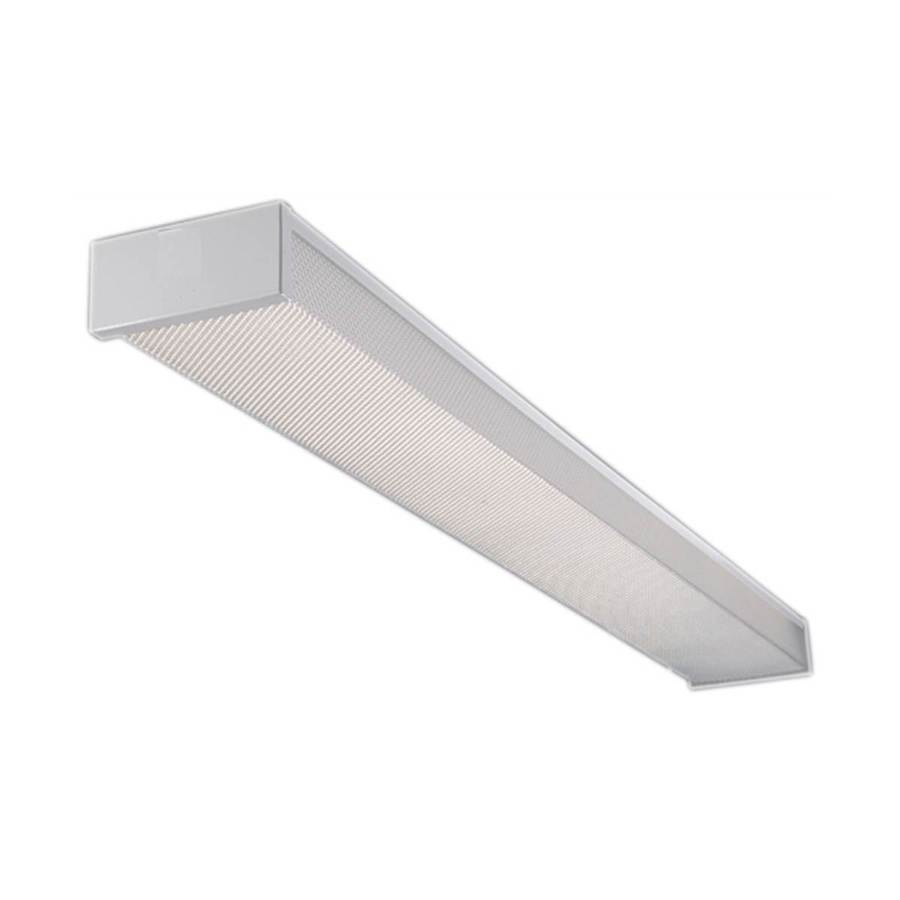

The 4' or 8' fixtures are still being considered.
 

2ManyProjects

Well-known member
Joined
Jul 18, 2013
Messages
757
I can easily start with 3 rows and convert to the big W after evaluation.

True. And I do indeed understand the compulsion to "prove it to yourself". But the thing is, I really am completely convinced that you WILL want those additional fixtures, sooner or later. And doing it in two steps could very easily make the job significantly harder than it really needs to be, particularly in terms of setting up the wiring & switching. When setting up the "two-stage" switching system, the ideal arrangement of which fixtures get assigned to which switch loops would presumably change "with" vs. "without" those additional "crossways" fixtures. So you just MIGHT be looking at a fairly extensive re-wiring job on the existing fixtures when you go to add the others, just to make everything come out right in the end.

Well I may be new to this forum but I'm not new to forums.

Fair enough.

I do understand all that. But you are also stating that the general guidelines are inadequate.

I suppose that depends on what you mean by "inadequate".

If you mean that I think the numbers are simply too low, then maybe you misunderstand me; because that is certainly not what I intended to convey. I have no fundamental objection to the "generally recommended" 100 lumens/ft.^2 (at working height) target for typical garage-like applications, in and of itself.

OTOH, I very much DO contend that those "recommended average illumination levels" fall FAR short of telling the whole story. So yes, in THAT sense, they are "inadequate", and should NOT form the tail that wags the dog.

The thing to understand is, ALL of those "general recommendations" are at best rather sweeping generalizations (and at least somewhat subjective ones, at that). That is not to imply that they are "wrong", per se; only that they should NOT be taken as inviolate gospel -- or worse, interpreted as some sort of hard-and-fast limit (more often, they should be considered "reasonable minimums").

So whatever arbitrary "average" light level you throw a dart at, the FAR more important thing is getting the light into the right places. It is (mostly) for that reason that I've been beating the drum so hard for using that additional "crossways" run discussed above (i.e., it puts light into some important places that the three main runs just don't cover all that well). The fact that this might raise the calculated overall "average" illumination level beyond what you think you "need", or even beyond some arbitrary "guideline", is largely irrelevant, because getting good light everywhere you need it trumps that six ways to Sunday. Any fears about having "too much" light can be easily assuaged by making sure that you have CONTROL over that lighting. But even ignoring that point, it is actually MUCH more difficult to come up with "too much" than you might think: There is a HUGE (several-fold; maybe more like an order of magnitude) difference between "more than the dead minimum required" and "so much that it actually becomes detrimental." And obviously, the closer you attempt to come to "just barely enough", the greater the odds are that you will actually wind up at "not quite enough."

The "bottom line" (so to speak) here is, having "more" light available WHEN YOU NEED IT is by definition better than NOT having it available. Hence, when estimating one's required lighting levels, it is always safer to guess a bit on the high side, than to fall short. Even more to the point: If the best layout (from a "put light everywhere you need it" perspective) happens to produce a somewhat higher average illumination level than some arbitrary "general recommendation" would suggest, so be it -- that is simply not a problem worth worrying about.

To put it still another way: The correct thing to fear is indeed "not enough", because "too much" just won't be an issue until and unless you go WILDLY over-the-top.

{re: zoning vs. intensity-control}
I'm not seeing an issue with that. If I'm doing a brake job I'm going to set the lights up to do the brake job. I have also come up with a switching scheme that works using two circuits and controls three zones.

At this point, I'm probably going to have to chalk this up to me simply not getting the point across. One more attempt: In such a relatively small (well under 800 ft.^2) workspace, "zoning" just won't be as effective as real intensity control, in terms of day-to-day energy savings. This may be another one of those "need to prove it to yourself" issues; but I am at something of a loss as to how to suggest you go about that, as the two approaches would require vastly different wiring/switching schemes.

{re: three runs only vs. "Big 'W'"}
I think we are on the same page with this but I will probably apply the W after evaluating the three rows on there own.

See above. I'm less worried about this than your overall approach to switching; but it still constitutes a case of making more work for yourself, in the long run.

{re: cost of using 4-ft. fixtures vs. 8-ft. tandems}
Well using Zoro Tools for comparison one 8' $64.00 one 4' = $48.00 = $96.00 for 8' 96/64 =1.5 so 50% is more realistic based on this source.

Well then, perhaps you should also consider:

http://www.lightbulbsurplus.com/index.php?main_page=product_info&products_id=2570
t8-strip-shop-light.jpg


http://www.homedepot.com/p/Lithonia...rescent-Strip-Light-C-2-32-120-GESB/100543144
605b448d-ee09-419e-9720-65ab0b5b79b4_1000.jpg


http://www.homedepot.com/p/Lithonia-Lighting-2-Light-Utility-Light-3348-2L32W-WRAP/100654395
92eeea00-35d4-4de6-9cd6-11e57dd051fc_300.jpg


http://www.homedepot.com/p/Lithonia...hite-Fluorescent-Light-Fixture-3324/202192968
39000172-ebf4-4c9c-8544-fe78d1fd119c_300.jpg


http://www.lowes.com/pd_163697-337-WP232RLU_0__?productId=3181895
080083518647.jpg


http://www.lowes.com/pd_336745-13537-336745_0__?productId=3686312
037949005377.jpg


http://www.lowes.com/pd_384285-337-WP217RNKLLU_0__?productId=50077497
080083615506.jpg


{re: placing lights JUST outside the door footprints}
That would probably put the lights at about 18" off the walls.

It looked like more than that on the plan; but I'll take your word for it.

I have had issues with that not working for me when working on benches just below a light fixture but the work just to the outside of the light causing shadows.

At 18 inches off the wall, you'd be pushing your luck a little in terms of "nicely" illuminating any wall mounted cabinets, shelves, etc.; but 24-30 inches should work fine, if you can swing it. In any event, any workbenches located along those walls definitely ought to have their own dedicated task lighting, in addition to the general area lighting we've been discussing.

The 4' or 8' fixtures are still being considered.

Preconceived notions can be REALLY tough to shake, eh? ;)

 
OP
6

600SL

Well-known member
Joined
Apr 26, 2012
Messages
1,794
Location
Connecticut
Assuming that was a typo, and you really meant, "eliminating the gap issue", that is only true IF the fixtures in question have two ballasts. However, AFAIK, at least most 8-foot tandems use a single ballast to drive all four tubes.

Further, even presuming two ballasts per fixture, that's still not an ideal solution, because you do not have the opportunity to adjust the inter-fixture gaps to be evenly distributed between each and every pair of tubes. In effect, you'd be butting two four-foot fixtures tight together, which in turn will produce a "double-sized" gap between them and the next pair, and so on down the line. And since (separately) wiring twin-ballasted tandems is just as much work as wiring two independent four-footers, you STILL haven't really gained anything.


Assuming I go with the nine light setup there would be no gaps in between just 2 ft at each end. Then couldn't I reroute one set of wires from one fixture over to the next. Thereby getting a setup that I could turn every other light off on one circuit.? Still some work and some ugly wiring agree.
 
OP
6

600SL

Well-known member
Joined
Apr 26, 2012
Messages
1,794
Location
Connecticut
True. And I do indeed understand the compulsion to "prove it to yourself". But the thing is, I really am completely convinced that you WILL want those additional fixtures, sooner or later. And doing it in two steps could very easily make the job significantly harder than it really needs to be, particularly in terms of setting up the wiring & switching. When setting up the "two-stage" switching system, the ideal arrangement of which fixtures get assigned to which switch loops would presumably change "with" vs. "without" those additional "crossways" fixtures. So you just MIGHT be looking at a fairly extensive re-wiring job on the existing fixtures when you go to add the others, just to make everything come out right in the end.


Fair enough.


I suppose that depends on what you mean by "inadequate".

If you mean that I think the numbers are simply too low, then maybe you misunderstand me; because that is certainly not what I intended to convey. I have no fundamental objection to the "generally recommended" 100 lumens/ft.^2 (at working height) target for typical garage-like applications, in and of itself.

OTOH, I very much DO contend that those "recommended average illumination levels" fall FAR short of telling the whole story. So yes, in THAT sense, they are "inadequate", and should NOT form the tail that wags the dog.

The thing to understand is, ALL of those "general recommendations" are at best rather sweeping generalizations (and at least somewhat subjective ones, at that). That is not to imply that they are "wrong", per se; only that they should NOT be taken as inviolate gospel -- or worse, interpreted as some sort of hard-and-fast limit (more often, they should be considered "reasonable minimums").

So whatever arbitrary "average" light level you throw a dart at, the FAR more important thing is getting the light into the right places. It is (mostly) for that reason that I've been beating the drum so hard for using that additional "crossways" run discussed above (i.e., it puts light into some important places that the three main runs just don't cover all that well). The fact that this might raise the calculated overall "average" illumination level beyond what you think you "need", or even beyond some arbitrary "guideline", is largely irrelevant, because getting good light everywhere you need it trumps that six ways to Sunday. Any fears about having "too much" light can be easily assuaged by making sure that you have CONTROL over that lighting. But even ignoring that point, it is actually MUCH more difficult to come up with "too much" than you might think: There is a HUGE (several-fold; maybe more like an order of magnitude) difference between "more than the dead minimum required" and "so much that it actually becomes detrimental." And obviously, the closer you attempt to come to "just barely enough", the greater the odds are that you will actually wind up at "not quite enough."

The "bottom line" (so to speak) here is, having "more" light available WHEN YOU NEED IT is by definition better than NOT having it available. Hence, when estimating one's required lighting levels, it is always safer to guess a bit on the high side, than to fall short. Even more to the point: If the best layout (from a "put light everywhere you need it" perspective) happens to produce a somewhat higher average illumination level than some arbitrary "general recommendation" would suggest, so be it -- that is simply not a problem worth worrying about.

To put it still another way: The correct thing to fear is indeed "not enough", because "too much" just won't be an issue until and unless you go WILDLY over-the-top.

{re: zoning vs. intensity-control}


At this point, I'm probably going to have to chalk this up to me simply not getting the point across. One more attempt: In such a relatively small (well under 800 ft.^2) workspace, "zoning" just won't be as effective as real intensity control, in terms of day-to-day energy savings. This may be another one of those "need to prove it to yourself" issues; but I am at something of a loss as to how to suggest you go about that, as the two approaches would require vastly different wiring/switching schemes.

{re: three runs only vs. "Big 'W'"}


See above. I'm less worried about this than your overall approach to switching; but it still constitutes a case of making more work for yourself, in the long run.

{re: cost of using 4-ft. fixtures vs. 8-ft. tandems}


Well then, perhaps you should also consider:

http://www.lightbulbsurplus.com/index.php?main_page=product_info&products_id=2570
t8-strip-shop-light.jpg


http://www.homedepot.com/p/Lithonia...rescent-Strip-Light-C-2-32-120-GESB/100543144
605b448d-ee09-419e-9720-65ab0b5b79b4_1000.jpg


http://www.homedepot.com/p/Lithonia-Lighting-2-Light-Utility-Light-3348-2L32W-WRAP/100654395
92eeea00-35d4-4de6-9cd6-11e57dd051fc_300.jpg


http://www.homedepot.com/p/Lithonia...hite-Fluorescent-Light-Fixture-3324/202192968
39000172-ebf4-4c9c-8544-fe78d1fd119c_300.jpg


http://www.lowes.com/pd_163697-337-WP232RLU_0__?productId=3181895
080083518647.jpg


http://www.lowes.com/pd_336745-13537-336745_0__?productId=3686312
037949005377.jpg


http://www.lowes.com/pd_384285-337-WP217RNKLLU_0__?productId=50077497
080083615506.jpg


{re: placing lights JUST outside the door footprints}


It looked like more than that on the plan; but I'll take your word for it.


At 18 inches off the wall, you'd be pushing your luck a little in terms of "nicely" illuminating any wall mounted cabinets, shelves, etc.; but 24-30 inches should work fine, if you can swing it. In any event, any workbenches located along those walls definitely ought to have their own dedicated task lighting, in addition to the general area lighting we've been discussing.


Preconceived notions can be REALLY tough to shake, eh? ;)


Most of the lights you are showing here have diffusers. That's a subject we haven't hit on in this thread. To diffuse or not to diffuse. The first two lights you presented are cheep < $30 shop lights. Been there done that at least with T12's was not impressed. That is why I opted for the industrial versions that I'm hoping really will go down to 0°F
 
OP
6

600SL

Well-known member
Joined
Apr 26, 2012
Messages
1,794
Location
Connecticut
As promised I modeled the wood shop where I work to gage the lights.

The wood shops dimensions are 28 x 24 with an estimated 18 foot ceiling. The lights are suspended 10' of the floor. There are a total of 6 4' fixtures with 3 T8 tubes FO32/735/ECO. Each fixture has an aperture reflector installed. and a protective cage over the tubes. The walls floor and ceiling is painted beige and is somewhat dirty. Above the lights is about 8 ft of empty space with ducts wiring and trusses.

The best matching fixture I could find was the Lithonia MS8 3 32 SBL WD. Putting this into the model yields a 52 cf solution.

I also modeled the company machine shop. which is 28x40x18 with the same fixtures at 12' height. The machine shop is fitted with FO32/850/ECO tubes. and has a light grey walls ceiling and floor with new clean paint. Putting this into the model yields a 54 cf solution.

OK here's where the models are limited. Everyone agrees that the wood shop could use more lighting but everyone feels that the machine shop is beautiful. Yet they essentially yield the same results. Also the machine shops tubes were refitted about 6 months ago. They originally had the same FO32/735/ECO as the wood shop. The Forman in the machine shop states that there was a night and day change with the FO32/850/ECO tubes.

Also the wood shop tubes are old and wearing out black spots on the ends, no one ever recalls them being changed.

It is pretty clear that who ever designed the lighting in these shops was targeting 50 cf.

50 cf is the industry standard that I often see quoted for both these types of areas except for grinding operations which are not performed there.

I believe replacement of the wood shop tubes with new FO32/850/ECO tubes is all that would be necessary to make the lighting appear as nice as the machine shop.

Both of these shops are not as bright or as nice as our production high bays which are illuminated with HID's again according to industry standards calling for 100cf in these areas.

In both cases the lighting appears uniform and the presents of the large gaps is not apparent with the exception of if there is a machine in the way of the light.

It is for these reasons I am hesitant about setting 100cf overall lighting as a base with additional boosting in high use areas above 100 cf.

My conclusion is that the 92 cf solution I came up with using 9 8' fixtures with gaps equal to those found in the above two examples that will only be apparent when the lights are partially dimmed will be a more than adequate starting point.
 

Attachments

  • Wood Shop.jpg
    Wood Shop.jpg
    101.7 KB · Views: 20
  • Machine Shop.jpg
    Machine Shop.jpg
    98.8 KB · Views: 28

2ManyProjects

Well-known member
Joined
Jul 18, 2013
Messages
757
Assuming that was a typo, and you really meant, "eliminating the gap issue", that is only true IF the fixtures in question have two ballasts. However, AFAIK, at least most 8-foot tandems use a single ballast to drive all four tubes.

Further, even presuming two ballasts per fixture, that's still not an ideal solution, because you do not have the opportunity to adjust the inter-fixture gaps to be evenly distributed between each and every pair of tubes. In effect, you'd be butting two four-foot fixtures tight together, which in turn will produce a "double-sized" gap between them and the next pair, and so on down the line. And since (separately) wiring twin-ballasted tandems is just as much work as wiring two independent four-footers, you STILL haven't really gained anything.

Assuming I go with the nine light setup there would be no gaps in between just 2 ft at each end.

Not an ideal arrangement; but in and of themselves, those two-foot gaps are not the biggest problem.

Then couldn't I reroute one set of wires from one fixture over to the next. Thereby getting a setup that I could turn every other light off on one circuit.? Still some work and some ugly wiring agree.

If you are referring to the SUPPLY wiring feeding each fixture, that would still not accomplish your goal, due to having only one ballast in each fixture.

OTOH, if you are talking about replacing the fixtures' existing internal wiring AND bridging that internal wiring from one fixture to the next... That would be a rather horrid kludge, at best. I am uncertain that it would even meet code. But even if it could be done in a code-compliant matter, it is CERTAINLY not worth the effort. Just use separate four-foot fixtures (or even a mix of four-foot and two-foot fixtures, if that works out better), and BE DONE WITH IT.

 
To avoid these ads, REGISTER NOW!
Top Bottom