Anyone who knows Wolverine Coatings knows that we don't put a lot of energy or resources into marketing. Although we have some of the most technologically advanced coatings in the world, we have a mediocre website and not even one glossy brochure to give out. We are a company that is focused on technology... NOT marketing spin.
Marketing spin, isn't that something we all hate? I can remember commercials that made the
"GI Joe with the Kung Fu Grip" look SO cool. Then, when you got it, well... it really wasn't as cool as it looked in the commercials. MANY companies oversell their products and make claims that just aren't true. That's we've become so cynical and suspicious of product claims.
This isn't the first time we've heard a marketing expert say something like this...
...and then back off on their promise.
Here are just a few claims (found here:
http://www.garagejournal.com/forum/showthread.php?t=26584 recently posted in this forum that I think would be very difficult (if not impossible) to back up.
This is opinion stated as a fact. That’s not the trend we’re seeing in the coatings market. Keep in mind that almost all our business is with commercial and industrial accounts and contractors. But, I am a technical consultant to a large company who sells resin systems for manufacturing acrylic epoxy. I think that this statement would have been a stretch even before the housing bust.
This is stated as a fact... and... it's not even close to accurate. Acrylics are UV resistant... not UV proof! If this were true, the acrylic paint on houses would never discolor or break down. So if someone could supply info on a 100% UV stable acrylic it’d be news to us, and we’d like to know more about it. But absent reliable 3rd party info that says that this will never yellow, lose gloss, or break down in sunlight… yet more marketing spin.
Hate to be repetitive, but yet another opinion stated as fact. This is written to mislead you to believe that acrylics are tougher and more abrasion resistant than 100% solids epoxies. However, you will notice that it doesn't actually say what chemistry acrylics are tougher and more abrasion resistant than. More spin than the Hula Hoop ******* Letterman. (Personally, I like Grinder Girl Better)
Again, this is that same marketing tactic. You are led to believe this is a comparison to 100% solids epoxies without actually saying that. I think if you were to ask most people here who have already done their garage, they are going to tell you that prep is 90% of the job and the most likely place that you are going to make a mistake. Products that require 'less prep' are just like houses that require less of a foundation. The longer a coating is expected to last the better the foundation (surface prep) needs to be.
To build a big building you need a good foundation:
And, when you are not building something that will last... well... cinder blocks are allot less work and will do just fine!
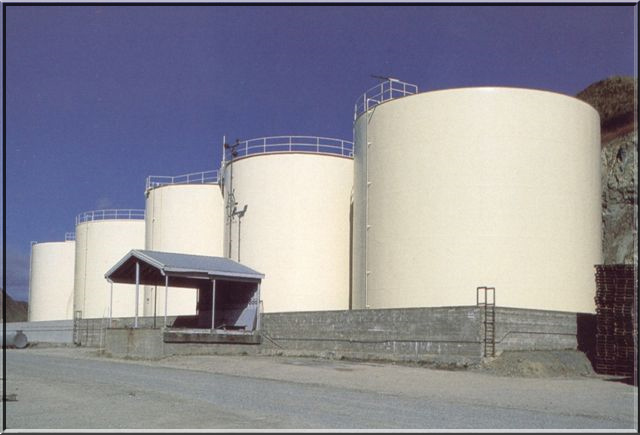
Again, a 'marketing expert' will claim anything to make a sale. This claim is the easiest one to research for yourself. We make linings for chemical storage tanks. Our products are actually sprayed on the insides of HUGE chemical storage tanks.
We have thousands of 'epoxy type' formulations for chemical storage tank linings and ZERO acrylics. In fact, I've never ever ever seen an acrylic chemical storage tank lining. A quick reality check... Given that acrylics are considerably less expensive than epoxies, if most acrylics did have better chemical resistance than epoxies, doesn't it follow that they would be used for chemical storage tank linings? But they're not, not at all.
Want proof? Let's hit Google... Here are the results for "acrylic tank lining" (
1 result... and... it's an acrylic tank top... a shirt... lol)
http://www.google.com/search?hl=en&q=%22acrylic+tank+lining%22
Here are the results for "epoxy tank lining" (
too many to count)
http://www.google.com/search?hl=en&q=%22epoxy+tank+lining%22
So, if most acrylics are more chemical resistant (and MUCH cheaper) than epoxies... then... EVERYONE would be using them for chemical storage tank linings!
We have epoxies that dry in 5 minutes. Dry time matters if you were going to put the same (dry) thickness of an Acrylic on a floor as you would 100% solids epoxy because most acrylics would need 5-20 coats to equal 1 coat of a good 100% solids epoxy. As far as the other 'spin' here.... epoxies come in clear and the brightest and most vivid colors too... Ho Hum...
Again - either post test results from an independent lab, or stop referring to them. It is a fact, or it is, at best, spin - and at worst, a lie.
Additionally, even if this claim were true (which is doubtful) we would also need to look at impact resistance. Coating a floor is a significant undertaking, both in time and costs. We can easily make an acrylic that will test well in some abrasion resistance tests... but... it might be very brittle. Glass tests really well for abrasion resistance... but you don't want to drop anything on it.
When it comes to tests, they can be twisted to mean anything if you don't understand how the test is done, what the result means, and what other properties are affected. In other words, impact resistance is a much more meaningful test on a garage floor. Most damage is going to come from dropping things as opposed to dragging heavy items across the surface. There are MANY different tests for abrasion resistance and even variations of those tests. Unless you're familiar with the tests, the perfect balance of coating properties, and the effects of one property over another... watch out!
Is the point of the "Tammy Faye" reference to convince us that a thinner coating is better than a thicker coating? Often thicker is better, it depends what Tammy Faye looks like under the coating. Furthermore makeup is just for looks - not protection. If you have perfect concrete (which no one does) then you have less of a need for thickness. The thicker the coating, the more concrete defects (like pits and divots) it is going to hide.
So, when you read 'marketing spin' like this you can bet the product is one that can't be put on thick in a single coat. Even if you put on 20 coats of a product that can only be applied in thin coats, all the layers will follow the surface of the divots and defects and only gradually minimize defects by the 20th coat. A good self-leveling coating, that can be put on thick, will fill those defects and leave you with a smooth floor, which will look much better.