To avoid these ads, REGISTER NOW!

Cree T8 4ft LED Review

Denwood

Well-known member
Joined
Sep 22, 2014
Messages
4,180
Location
Thunder Bay, Ontario, Canada
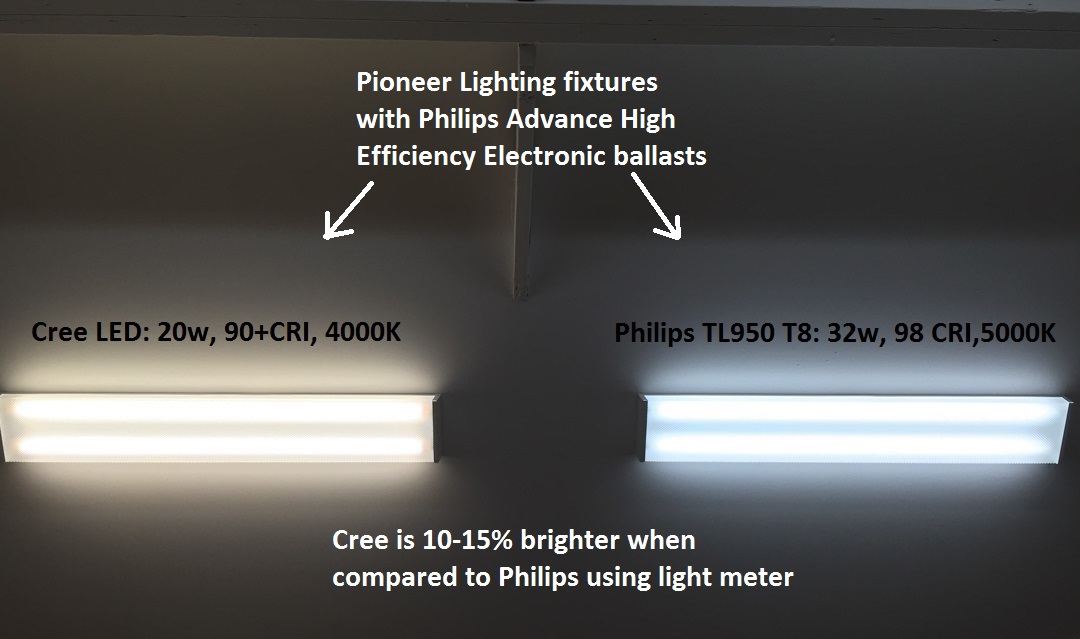
Here's a comparison of the new Cree 4ft T8 LED replacement vs my standard favourite Philips TL-950, 98 CRI, T8, 4ft bulbs. Colour rendering index is a big deal for me, so our entire Cinevate facility is lit with these bulbs. My team loves them. How do the Cree T8 LED units compare?

First, if you don't understand CRI (colour rendering index) here's a quick primer. CRI is basically a description of how accurately colours illuminated by a light source would appear to your eye. Noon day sun has a CRI of 100 (as good as it gets!), with colour temp of 5000K. A typical compact fluorescent, or fluorescent tube has a CRI in the 78-85 range. This means if you were trying to separate dark blue socks from black socks under that light, it would be difficult to differentiate.

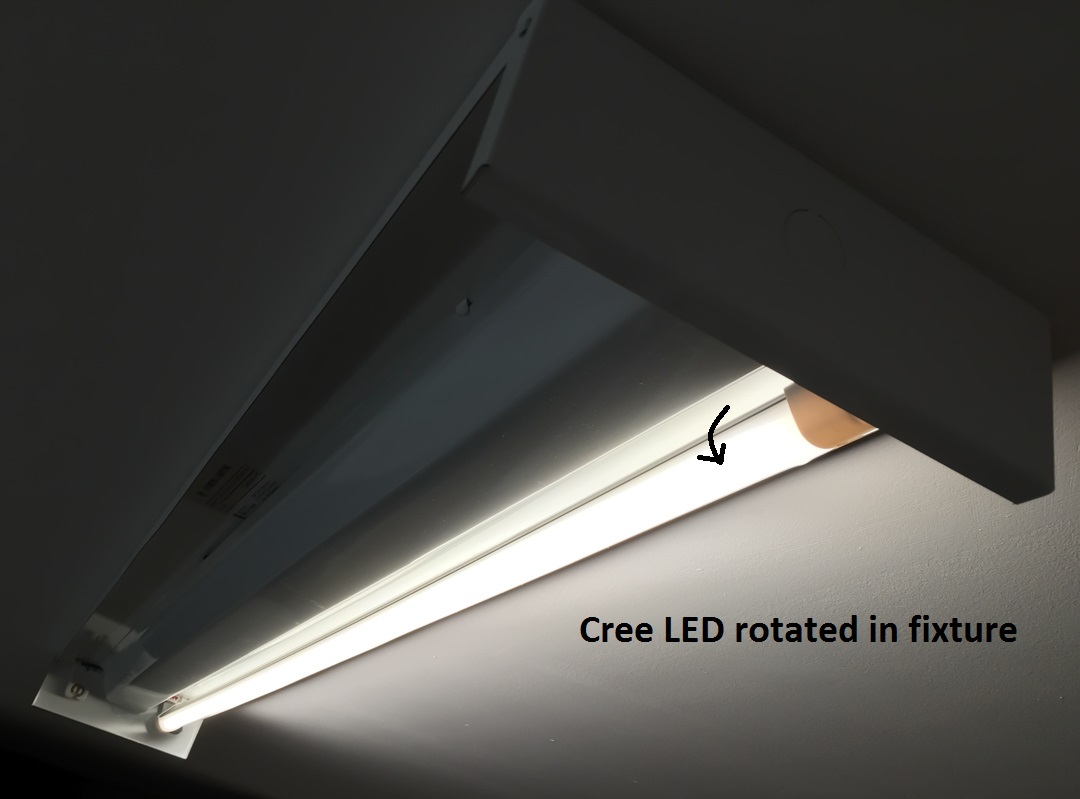
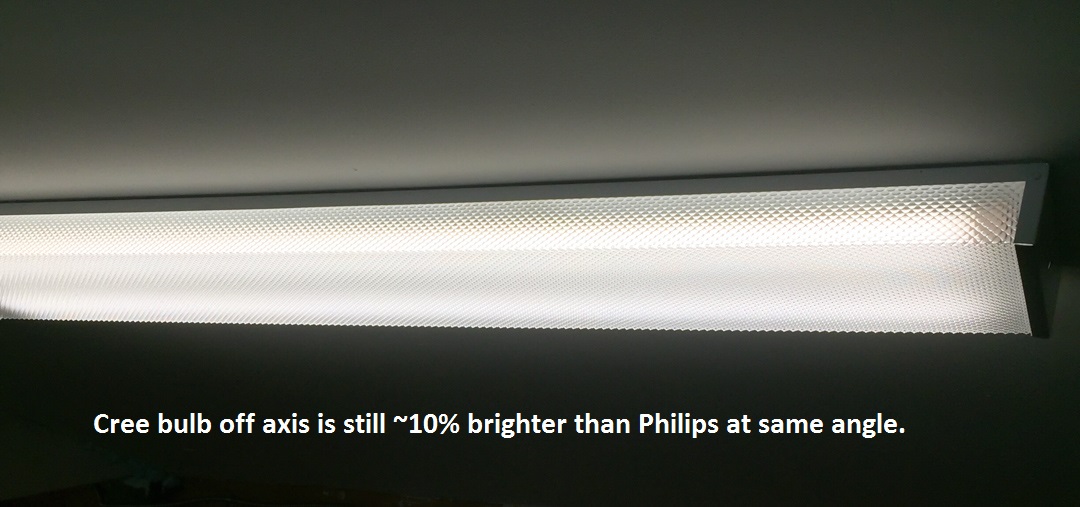
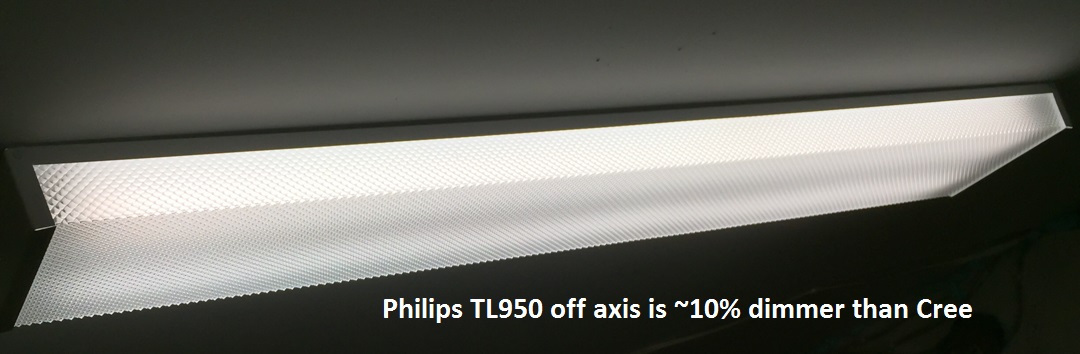
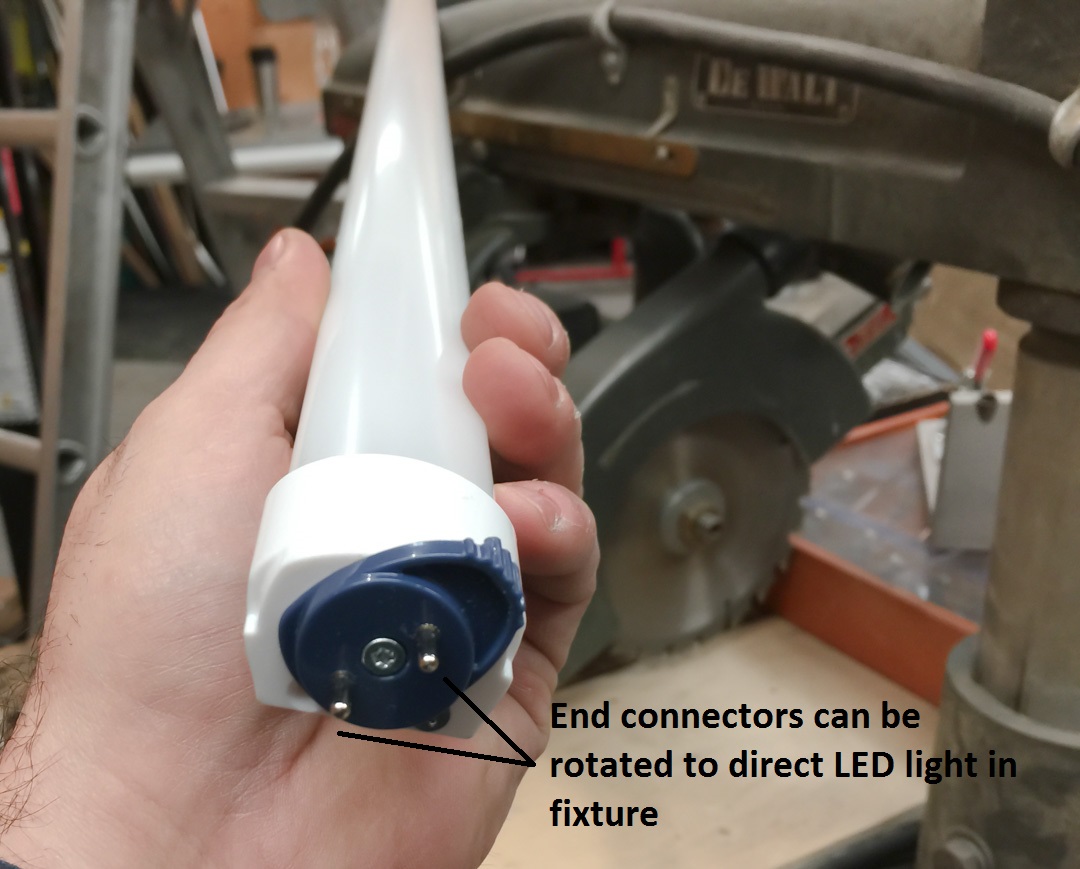
Most LED lights also have a pretty poor CRI rating, however the Cree T8 lights have a CRI in the 90+ range. Cree provides a lumens rating of 1700 to 2100, depending on the T8 ballast used. The exisiting T8 ballast in your fixture stays connected exactly as stock. My fixtures are made by Pioneer lighting and use Phillips Advance high efficiency electronic ballasts. The Philips TL950 bulbs are spec'd at 2000 lumens, so pretty similar. Checking exposure on my iphone 6+ when taking these shots, it wanted to use ~1/700s for the Cree lamps, and 1/600s for the Philips bulbs. In other words, the Cree lamps are definitely brighter both straight on, and also off axis. To a casual observer, they look pretty close in terms of brightness, however the Cree is an honest 10-15% brighter, while using 20 watts vs the T8 flourescent at 32 watts. The Cree lamps are a bit brighter, while using 33% less power compared to the T8 fluorescents. Because the Cree lamps can be rotated in the fixture, they may compare even better in terms of brightness over a fluorescent tube if you are directing the LED lamp(s) over a workbench or similar.

Here's how the lamps would compare:

Noon day sun:
100 CRI
5000K

Cree T8 LED (4ft array)
90 CRI
4000K
20 watts

Philips T8 TL950 (4ft tube)
98 CRI
5000K
32 watts

So which bulb would I recommend given this quick test? If you're painting in your shop, I would have to go with the TL950 at a higher CRI. I really like these lamps. If you're looking for bit "warmer" light source though, want to maximize illumination and reduce your lighting power consumption by 33%, the Cree LEDs are the way to go. For those in cold climates, the Cree is at 100% brightness the moment it's fired up. The fluorescent bulbs take a few minutes to reach maximum brightness. In terms of price, Cree would run approx. $30 US, vs the TL-950 bulbs at $8/bulb when purchased by the case. The local supplier I purchased the Cree from mentioned that the local power utility provides rebates on each bulb, so the cost difference could be a lot less when this is factored in.

cree1.jpg


cree2.jpg


cree3.jpg


cree4.jpg


cree5.jpg


cree6.jpg


Edit: added some detail as well as some tests.

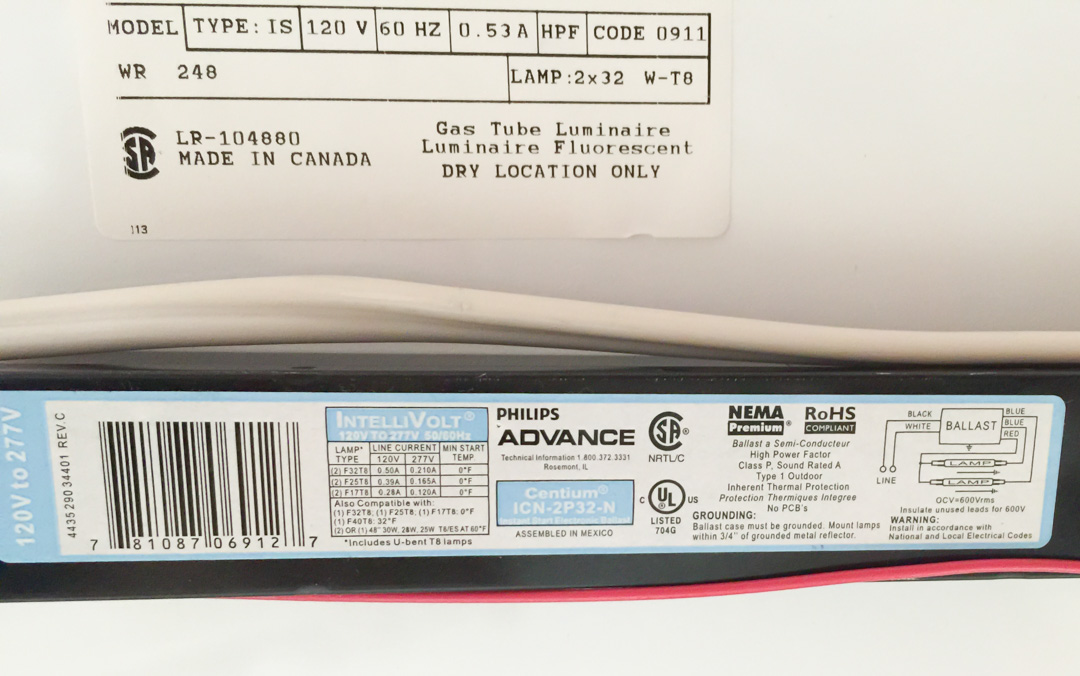
The ballast and fixture used in the two tube comparison. The fixture is from pioneerlighting.ca
creetests-1.jpg


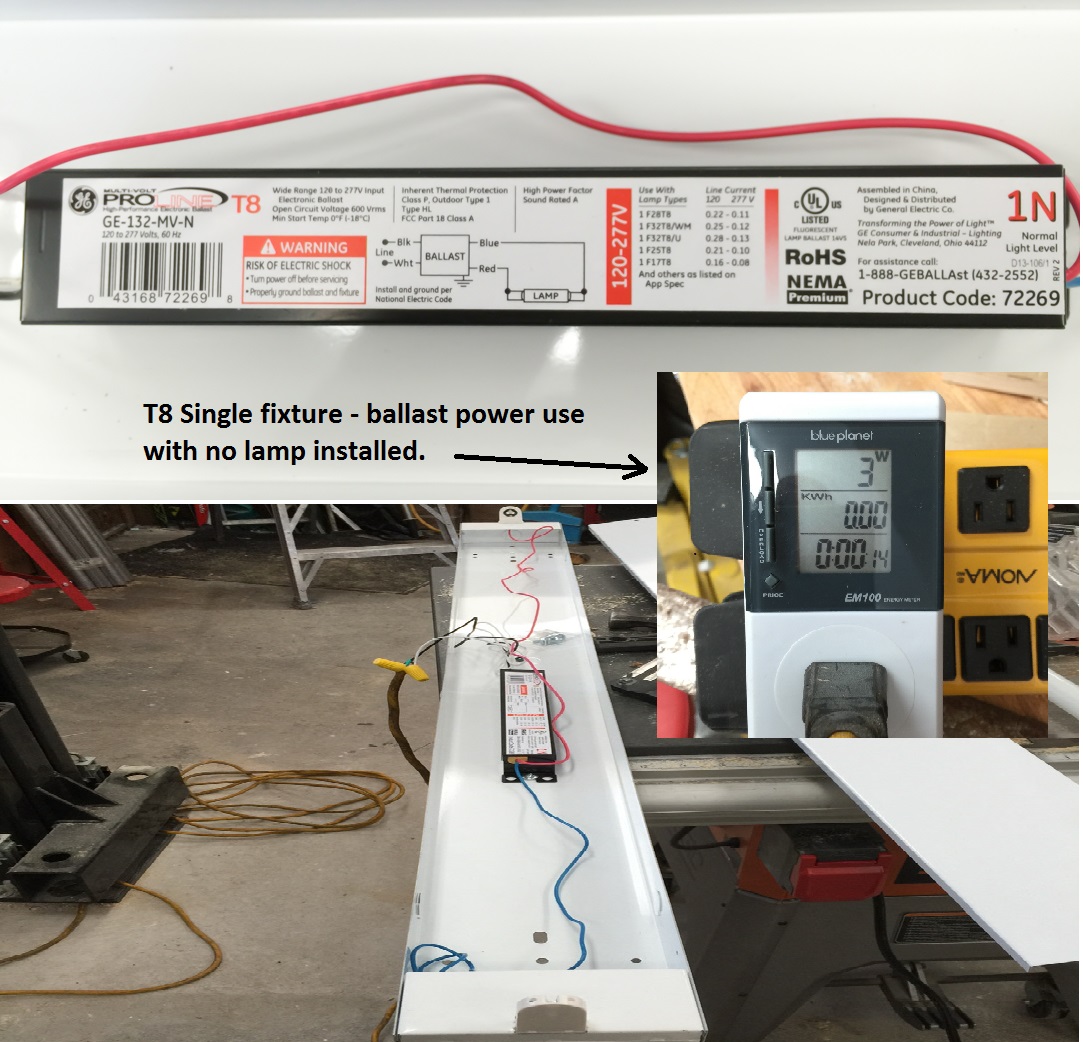
Here's a few tests I ran based on questions regarding LED lights, ballasts and power use..cross posted here for reference.

The "test rig". Ha. You can see here that the fluorescent ballast uses about 3 watts with no lamp installed.
cree_composite1.jpg


The following two photos were taken at exactly the same exposure...so the relative light brightness is as seen in the photos. The Cree LED uses exactly what you might expect as it's rated at 21 watts, and we know the ballast uses up 3. 24 watts total.

creetest_composite2.jpg


Not sure how to explain this but the Philips TL950 with a 32 watt bulb is actually using 27 watts. Only five watts more than the Cree LED, with a 98 CRI output at 5000K.

cree_composite3.jpg
 
Last edited:
To avoid these ads, REGISTER NOW!

Mr onetwo

Well-known member
Joined
Apr 6, 2011
Messages
2,002
Location
Coastal Maine
Very informative & thorough writeup!:thumbup: I have 6500K Phillips bulbs in my shop...will have to see if Cree has those available.
 

cybrdyke

Well-known member
Joined
Sep 9, 2014
Messages
3,442
Location
USA
Denwood, really nice write up with pics!
The Cree is a great example of how fast LED technology advances. Similar product is available at Home Depot and at local electrical suppliers by Philips, called InstantFit.
These tubes leave the ballast by-pass tubes in the dust. For large energy saving projects like your work facility, they are a great solution. Super easy to install. Most importantly, to me, is that this is a NAME BRAND product, not one of those hokey gizmo's that so many on this forum seem to find on the internet. This is a legit product that professionals would use. So is the Philips.
There's so many other advantages to these lamps, too.
Good job.
CD
 
OP
D

Denwood

Well-known member
Joined
Sep 22, 2014
Messages
4,180
Location
Thunder Bay, Ontario, Canada
Thanks for the kind words gentlemen :) I've been using LED lamps for some time now, but this would be my first look at a decent CRI 4ft tube replacement. I'm quite impressed.
 

mark11

Well-known member
Joined
Jul 8, 2013
Messages
135
Nice writeup, thank you.
Maybe someone that knows more than I can dispel what an electrician recently told me. He said that keeping the T8 ballast but using LED bulbs wouldn't really use much less electricity because you're still powering the same ballast. I didn't know enough about it to dispute.
 
OP
D

Denwood

Well-known member
Joined
Sep 22, 2014
Messages
4,180
Location
Thunder Bay, Ontario, Canada
That is not entirely true. The ballast is not 100% efficient, so you would be better (by a few watts) to direct connect LED lamps at 120V. This study is rather dated (so LED light outputs are low) however you do see a power savings with LED lights using a standard t8 32 watt ballast. 7-56 here uses 25w/bulb: http://apps1.eere.energy.gov/buildings/publications/pdfs/ssl/troffer_benchmark_01-09.pdf

Based on my light measurements the high efficiency Philips Advance electronic ballasts in my light fixtures are very good at maximizing light output from the Cree LED lights. They are performing pretty close to their max (2100 lumens) as they are definitely brighter than the TL-950s rated at 2000 lumens.
 
Last edited:

cybrdyke

Well-known member
Joined
Sep 9, 2014
Messages
3,442
Location
USA
Nice writeup, thank you.
Maybe someone that knows more than I can dispel what an electrician recently told me. He said that keeping the T8 ballast but using LED bulbs wouldn't really use much less electricity because you're still powering the same ballast. I didn't know enough about it to dispute.
Nothing true about that.
Using a 2 lamp fixture as an example...
The electronic ballast plus 2 F32T8 lamps uses a total (ballast + 2 lamps) of 59 watts.
The electronic ballast plus 2 Philips 12w InstantFit lamps uses a total of 29 watts. That's 50% savings.
The ballast only contributes a couple watts per tube.
It's not his fault, though. This technology is very new and he's probably not seen it in action yet.
CD
 

Techie1961

Well-known member
Joined
Feb 18, 2014
Messages
1,520
Location
Pickering Ontario Canada
Excellent write up. So, I am not really clear on these. Can they be used without a ballast to in effect repair a unit with a bad ballast so that you don't have to spend the money on a new ballast? Or are they available as a bulb without ballast and one type with ballast?
 
OP
D

Denwood

Well-known member
Joined
Sep 22, 2014
Messages
4,180
Location
Thunder Bay, Ontario, Canada
Mark, you're welcome. Tech, as far as I know, Cree only has the T8 bulb as a replacement where a functioning ballast is installed. There are versions out there though that would connect directly to your house wiring at 120V, so would be the way to go if your ballasts are old or failing. Finding a 120v direct connect LED with a CRI rating over 90 (from a reputable vendor) would take a bit of searching. In a few years I suspect we'll see the mainstreaming of very nice low profile LED fixtures and bulbs at the same cost as current flourescent...with no ballast requirement. That's a lot of power saving :)
 

cybrdyke

Well-known member
Joined
Sep 9, 2014
Messages
3,442
Location
USA
Excellent write up. So, I am not really clear on these. Can they be used without a ballast to in effect repair a unit with a bad ballast so that you don't have to spend the money on a new ballast? Or are they available as a bulb without ballast and one type with ballast?

Techie,
These Cree tubes, as well as similar tubes from a Philips and Sylvania are used WITH a ballast. The ballast has to be a T8 electronic ballast, not a T12 or T5 ballast. They cannot run without a ballast, so if you are trying to repair a unit with a bad ballast, you would need to do one of these:

  • Replace the bad ballast with a new T8 electronic one and then put these tubes into the sockets.
  • Bypass the ballast, bringing the black and white wires right to the sockets and use another kind of LED tube
Both versions are available.
CD
 

Ribbed Doors

Member
Joined
Dec 21, 2014
Messages
8
Location
Roseville, CA
The Cree T8 LED lamps seem like a great product. I just installed a few hundred at work and am happy with the quality and light output. And the best part, no florescent flicker!
 

Platonic Solid

Well-known member
Joined
Nov 29, 2014
Messages
3,587
Location
CT-USA
As stated, you will save energy using the ballast compatible LED tubes, just not as much as you would save by eliminating the useless ballast from the equation. If you’re going to go LED then go LED all the way. Get rid of the ballast. I’m actually disgusted at both Cree and Philips for not putting out direct wire medium bipin 4ft tubes. I understand why Philips doesn’t = they own “Advance Ballast” and want everyone to keep buying fluorescent ballasts. I have no explanation for Cree, though they do have their UR series which installs into completely gutted fluorescent fixtures (no fluorescent ballast or lamp holders used). So if you want “name brand” no fluorescent ballast LED tubes it’ll cost you $100 for a pair which includes installation hardware and driver.

Keep in mind that none of these lamps are made in the U.S. It’s time to consider alternate sources. Wash your mind of the “brand name” requirement and get rid of the ridiculous idea of putting an LED lamp inline with a fluorescent ballast. The current leader in "Lumens per Watt" 4ft retrofit lamps is RemPhos.
 
OP
D

Denwood

Well-known member
Joined
Sep 22, 2014
Messages
4,180
Location
Thunder Bay, Ontario, Canada
Ribbed, the electronic ballasts in the light fixtures operate in excess of 40KHz so there is no detectable flicker, and zero noise with conventional t8 bulbs. That said, it would be interesting to see how the Cree lamps do with older ballasts. A few hundred lamps installed is a lot of saved power!

Notgrown, my choice for now in this shop would be the TL-950s, largely due to their color temp and accuracy for painting. This pic shows how well they match to the sunlight outside:

strut5.jpg


Platonic, I think Cree has targeted this product more for commercial retrofit. The Canada Games Complex here in town apparently installed a pile into existing fixtures. That said, I'd agree that for new installs, a dedicated LED fixture sans ballast makes more sense than these Cree bulbs. I'm still waiting for a 95+ CRI LED. Given the ease of omitting the ballast (would only add 5 minutes to install time) I'd agree that line level makes sense. I'm looking forward to see what the industry does in terms of very low profile lighting packages that are free of the 4ft/8ft tube limitations.
 
Last edited:

cybrdyke

Well-known member
Joined
Sep 9, 2014
Messages
3,442
Location
USA
I'm still waiting for a 95+ CRI LED. Given the ease of omitting the ballast (would only add 5 minutes to install time) I'd agree that line level makes sense.

There are a few 90+ CRI LED lamps just starting to come out. At this point, they are mostly in PAR lamps. This is a very difficult thing to acheive with LED's, but it's gonna happen. The effort is being driven by California's energy codes, which very soon will require new LED products to be 90+ CRI or they wont be able to be sold in CA. The manufacturers are going to respond to that requirement because they dont want to miss out on selling their products in CA, the largest "green" state market for their products.

Also, you're correct that these LED tubes are designed with commercial installations in mind, hardly any thought given to residential. The residential market for fluorescent tubes is so small, it's not even a blip on their radar screen. As for ballast by-pass technology, it's on it's way out the door. It wont be around much longer.
CD
 

Platonic Solid

Well-known member
Joined
Nov 29, 2014
Messages
3,587
Location
CT-USA
There are a few 90+ CRI LED lamps just starting to come out. At this point, they are mostly in PAR lamps. This is a very difficult thing to acheive with LED's, but it's gonna happen. The effort is being driven by California's energy codes, which very soon will require new LED products to be 90+ CRI or they wont be able to be sold in CA. The manufacturers are going to respond to that requirement because they dont want to miss out on selling their products in CA, the largest "green" state market for their products.
I believe it's called "The California Energy Commission (CEC) Voluntary Quality LED Lamp Specification", thus not mandatory. As this article states: "The new CEC Voluntary California Quality LED Lamp Specification is as the name states a voluntary guideline, but could quickly become necessary for lamps to be included in market-incentive programs including utility rebates."

and

"Cree's standard Soft White A-lamp announced early this year has a CRI of 80 and the 60W-equivalent product consumes 9.5W. The new 93-CRI lamp consumes 13.5W so efficacy was clearly impacted. Moreover, the high CRI version sells for about a $5 premium."

I doubt California is going to ban ≥80 CRI LED lamps in favor of less energy efficient (less green?) ≥90 CRI LED lamps.

... As for ballast by-pass technology, it's on it's way out the door. It wont be around much longer.
CD
Please provide backup info to support this statement and what qualifies you to make it.
 
Last edited:

Techie1961

Well-known member
Joined
Feb 18, 2014
Messages
1,520
Location
Pickering Ontario Canada
Thanks guys. It kind of reminds me of the start up of LCD flat computer monitors. At first you couldn't find digital monitors easily as most people had VGA connectors on their computers. Now everybody has DVI plugs on their computer's video cards and don't need the analog connection. Once the units with ballast retrofits are done, most will start to replace them with non-ballast units. All the old lamps will become obsolete unless you keep a ballast in place. By that time, they will have paid for themselves in power savings anyways.
 

Platonic Solid

Well-known member
Joined
Nov 29, 2014
Messages
3,587
Location
CT-USA
... I'm still waiting for a 95+ CRI LED. ...
Now you're getting into the specialty lamp market. I have made >95 CRI LED lamps (not T8 retrofit bulbs), but there's a price tag involved here which the average consumer isn't going to pay. Your TL-950 is an excellent choice. It's worth noting that you're sacrificing efficiency and lumen output per bulb for High CRI.
 
Last edited:

Notgrownup

Well-known member
Joined
May 5, 2014
Messages
5,846
Location
Snow Hill NC
I am probably going to stick with T8 for now... As I will not be in the shop all the time the savings VS cost of acquisition might not be a deal for me...
 
To avoid these ads, REGISTER NOW!

cybrdyke

Well-known member
Joined
Sep 9, 2014
Messages
3,442
Location
USA
I believe it's called "The California Energy Commission (CEC) Voluntary Quality LED Lamp Specification", thus not mandatory. As this article states: "The new CEC Voluntary California Quality LED Lamp Specification is as the name states a voluntary guideline, but could quickly become necessary for lamps to be included in market-incentive programs including utility rebates."

and

"Cree's standard Soft White A-lamp announced early this year has a CRI of 80 and the 60W-equivalent product consumes 9.5W. The new 93-CRI lamp consumes 13.5W so efficacy was clearly impacted. Moreover, the high CRI version sells for about a $5 premium."

I doubt California is going to ban ≥80 CRI LED lamps in favor of less energy efficient (less green?) ≥90 CRI LED lamps.

Please provide backup info to support this statement and what qualifies you to make it.
As the article you referenced states about 90CRI..TODAY it's voluntary. But their intention is to make it mandatory in order for the products to qualify for rebate programs. And SMUD has already adopted the program, as recommended by the CEC. Others will follow. You can see the insinuation that CEC intends to drive this program from voluntary today to code tomorrow. They wont back down from this. By making rebates available only for 90 CRI stuff, they feel this will drive the manufacturers to push R&D forward so that there are more products available and so that these products are as efficient as lower CRI products are today. They dangle the carrot of being able to supply lamps to California...or not. It's too big of a carrot for the manufacturers to not chase it. And it will also require a full 5 year warranty. All of this is really good for the consumer. Better quality bulbs, rebates, warranties, energy efficiency...I'm surprised you're not more on board.

As for the LED tubes, including your conspiracy theory, Philips has been making LED tubes for about 6 years now. Much longer than most others. The first 3 generations were all ballast by-pass versions. So much for the Advance conspiracy. Next generations were external driver versions, akin to the Cree UR that you referenced. The newest generation is the ballast ready version. In 6 months, it's already outsold all of the other previous versions combined. Philips dumped the bypass and external driver versions into the dumpster. Further evidence that this is the new way....CREE introduces their first entree into the field and it's a ballast ready version, not a ballast bypass. Sylvania's most recent product launch...Substitube, a ballast ready version. Energy Focus, maybe the most staunch advocate of the bypass version is going to launch a ballast ready version very soon. GE's ballast ready version will be launched any day now.
CD
 

cybrdyke

Well-known member
Joined
Sep 9, 2014
Messages
3,442
Location
USA
Ballast ready is to service retrofits in warehouses and large industrial uses.
They are a stop gap to improve sales.
when LED is needed as a new install, nothing makes less sense than the ballast that everyone hates, and fails, and is heavy and useless in a normal LED install.

STOP GAP measure needed to make research costs pay off. Without this stop gap, LED might die or become HID's flash in the pan.

Are you really saying that all LED is expected to, in the future, use an unneeded ballast?

How many LED replacement bulbs are YOU currently running?

Every time this subject comes up there is a lot of speculation from a lot of folks who did not PERSONALLY take the leap to LED four foot replacements....

No, I'm not talking about new installations. Those will be some sort of new LED fixture, appropriate for the application.
These tubes are intended for lighting upgrades from existing 32w T8's to LED. The best applications are those with long burn hours, such as office buildings, hospitals and retail.
No, they're not just some flash in the pan to recoup some funds. They are a legit product designed to take aim at the gazillion T8's that are out there.


As far as the notion that "everyone hates" ballasts, I dont think that's true. There are millions of ballasts that have been in service for many many years. Failure rate on T8 electronic ballasts is very low, at least from the quality manufacturers.

BTW, you DO realize that all LED products have ballasts, too, dont you?
 

Platonic Solid

Well-known member
Joined
Nov 29, 2014
Messages
3,587
Location
CT-USA
... By making rebates available only for 90 CRI stuff, they feel this will drive the manufacturers to push R&D forward so that there are more products available and so that these products are as efficient as lower CRI products are today. They dangle the carrot of being able to supply lamps to California...or not. It's too big of a carrot for the manufacturers to not chase it. And it will also require a full 5 year warranty. All of this is really good for the consumer. Better quality bulbs, rebates, warranties, energy efficiency...I'm surprised you're not more on board.
Californian's will still be able to purchase and install more energy efficient lower than 90 CRI lamps, they just won't get the rebate. Too much push for better innovation without actually funding the research involved only serves to push today's development under the rug in favor of what may come tomorrow. By the time we develop the latest technology and get it to market, it's already obsolete. Where's the incentive? I only see huge R&D costs and massive risk.

As for the LED tubes, including your conspiracy theory, Philips has been making LED tubes for about 6 years now. Much longer than most others. The first 3 generations were all ballast by-pass versions. So much for the Advance conspiracy. Next generations were external driver versions, akin to the Cree UR that you referenced. The newest generation is the ballast ready version. In 6 months, it's already outsold all of the other previous versions combined. Philips dumped the bypass and external driver versions into the dumpster. Further evidence that this is the new way....CREE introduces their first entree into the field and it's a ballast ready version, not a ballast bypass. Sylvania's most recent product launch...Substitube, a ballast ready version. Energy Focus, maybe the most staunch advocate of the bypass version is going to launch a ballast ready version very soon. GE's ballast ready version will be launched any day now.
CD
Not a conspiracy theory, just a logical deduction. All that really tells me is that people are too lazy to remove a fluorescent ballast and be truly "green". That tune will change when their fluorescent ballasts start failing. To further push my previous point I present you with what's coming next that covers both bases = Ballast compatible retrofit lamps that can run with or without the fluorescent ballast installed. Energy Focus (though an insignificant player in this arena) has been making them for years, though it's questionable whether they're really a contender after they released several key employees. Other less known companies are currently jumping onto this bandwagon and succeeding.
 

cybrdyke

Well-known member
Joined
Sep 9, 2014
Messages
3,442
Location
USA
Californian's will still be able to purchase and install more energy efficient lower than 90 CRI lamps, they just won't get the rebate. Too much push for better innovation without actually funding the research involved only serves to push today's development under the rug in favor of what may come tomorrow. By the time we develop the latest technology and get it to market, it's already obsolete. Where's the incentive? I only see huge R&D costs and massive risk.

Not a conspiracy theory, just a logical deduction. All that really tells me is that people are too lazy to remove a fluorescent ballast and be truly "green". That tune will change when their fluorescent ballasts start failing. To further push my previous point I present you with what's coming next that covers both bases = Ballast compatible retrofit lamps that can run with or without the fluorescent ballast installed. Energy Focus (though an insignificant player in this arena) has been making them for years, though it's questionable whether they're really a contender after they released several key employees. Other less known companies are currently jumping onto this bandwagon and succeeding.

I agree that the dual source LED is next to be launched. There's a couple of them already out there. I did look at the link that you provided for RemPhos, but the info is confusing.
I dont think the deduction is logical seeing as how the ballast manufacturers, both Sylvania and Advance both had bypass versions out there, while still making ballasts. That proves that the interest in the LED is not to sell more ballasts.
Also, lazy isn't the word I'd use to describe why people choose the ballast ready over the ballast bypass. There's lots of legit reasons. Energy being one of the biggest. The Philips InstantFit is only 14.5 watts per tube, ballast included. DLC compliant. That's pretty low.
CD
 
OP
D

Denwood

Well-known member
Joined
Sep 22, 2014
Messages
4,180
Location
Thunder Bay, Ontario, Canada
One "advantage" of the Cree bulb using the existing ballast is that you don't need to worry about which end goes where. The way that they've engineered the tube/tilt feature (asymetric), you DO need to swap the tube end for end, depending on which way you are directing the tube. We have a large installation using the TL-950s and Phillips Advance Electronic Ballasts (~120 fixtures, 250 TL-950 bulbs over 9500 square ft). All of these are on sensors (ambient sensing/motion/sound) so they are off and on a lot. Other than about 4 TL-950 tubes replaced, we've had zero issues with the ballasts so far during the first 3 years of commercial use.

Given how well the team (including creative) like the 5000K/98 CRI illumination, I'd be tending towards LED for the building only when a 4ft LED alternative with those specs becomes available. Our building was solar modeled to maximize natural light, so window placement, clerestory installation and internal solar tubes are part of our lighting scheme. This means matching our internal lighting to natural lighting is also part of the power saving scheme...and ambient sensors hold the TL-950s off when natural light is sufficient.

Anything less than 95 CRI is pretty much off the table.

W151699-2T.jpg
 
Last edited:

cybrdyke

Well-known member
Joined
Sep 9, 2014
Messages
3,442
Location
USA
The rest of the world calls them "Drivers".

Ezacktley! Alot of people dont understand that, like most other light sources (fluorescent, HID, Induction), LED's also require them. I often hear people talk about LED not needing ballasts, when, in fact, they do. Except they're called drivers. And historically, drivers have been the weak link in the lamp or fixture. Not always, but quite often.
CD
 

Platonic Solid

Well-known member
Joined
Nov 29, 2014
Messages
3,587
Location
CT-USA
I agree that the dual source LED is next to be launched. There's a couple of them already out there. I did look at the link that you provided for RemPhos, but the info is confusing.
I dont think the deduction is logical seeing as how the ballast manufacturers, both Sylvania and Advance both had bypass versions out there, while still making ballasts. That proves that the interest in the LED is not to sell more ballasts.
Also, lazy isn't the word I'd use to describe why people choose the ballast ready over the ballast bypass. There's lots of legit reasons. Energy being one of the biggest. The Philips InstantFit is only 14.5 watts per tube, ballast included. DLC compliant. That's pretty low.
CD
Though I'll be ridiculously busy when I return to work after the holiday shutdown, I will take some real world measurements in the near future to compare a commercial LED T8 120VAC retrofit lamp with a fluorescent ballasted LED T8 retrofit lamp.

At the moment it seems like we're all (LED lamp and fixture manufacturers) throwing s#!t at the wall to see what sticks and expending an awful lot of resources in the process.
 

e36jon

Well-known member
Joined
May 2, 2013
Messages
237
Location
San Francisco CA
Great thread! Thanks for posting the review.

I am mid-remodel on my garage and need lights, so this was a timely read. I spent time yesterday looking for retrofit LED bulbs with a 90+ CRI, other than CREE, and couldn't find any. So, I was looking at ~$70 for two of the CREE bulbs + the cost of a fixture, so ~$110 all in. It was bugging me to start from scratch with a ballast I didn't really need...

My next step was looking at available 4' LED fixtures and the big-box / Amazon options were all at CRI ~80-83. I ended up going with a couple of CREE's LS4-4 fixtures at ~$128 each, from Earth LED (http://www.earthled.com/products/cr...nt-light-fixture-44w-4000-lumens#.VKRZuqYtAbw) If I like them I'll be in for ~22 more...

The only downside I can see is that when this lamp fails I replace the whole deal, vs. just a new bulb. Otherwise I really like the compact dimensions (I have low ceilings in my shop) and clean design.

Anyway, thanks again for the review as it got me off the fence and actually doing something!

Cheers,

Jon
 

cybrdyke

Well-known member
Joined
Sep 9, 2014
Messages
3,442
Location
USA
Though I'll be ridiculously busy when I return to work after the holiday shutdown, I will take some real world measurements in the near future to compare a commercial LED T8 120VAC retrofit lamp with a fluorescent ballasted LED T8 retrofit lamp.

At the moment it seems like we're all (LED lamp and fixture manufacturers) throwing s#!t at the wall to see what sticks and expending an awful lot of resources in the process.

It's always fun to play, but the tests have been done by DLC. It's probably already there on their site. Agreed about the resources spent and the speed of advancement in technology. And then the profit margins aren't there to support it.
 

machsnell

Well-known member
Joined
Jun 12, 2010
Messages
942
Location
Northern Virginia
My next step was looking at available 4' LED fixtures and the big-box / Amazon options were all at CRI ~80-83. I ended up going with a couple of CREE's LS4-4 fixtures at ~$128 each, from Earth LED (http://www.earthled.com/products/cr...nt-light-fixture-44w-4000-lumens#.VKRZuqYtAbw) If I like them I'll be in for ~22 more...


Please let me know what you think i am in the market for approx 20 and like the sleek design with option to dim. and of course the 92cri.
 
OP
D

Denwood

Well-known member
Joined
Sep 22, 2014
Messages
4,180
Location
Thunder Bay, Ontario, Canada
A single Cree 44 watt tube (I would be using the 5000K, 92 CRI) would deliver the same light output as two of the units I tested. Factor this in to your calculations. They look great.
 

Platonic Solid

Well-known member
Joined
Nov 29, 2014
Messages
3,587
Location
CT-USA
It's always fun to play, but the tests have been done by DLC. It's probably already there on their site. Agreed about the resources spent and the speed of advancement in technology. And then the profit margins aren't there to support it.
DLC (Design Lights Consortium) doesn't actually test anything. The manufacturer submits required data from independent laboratories. In other words the manufacturer takes their best version of their product and has it tested. There's actually no oversight by the DLC to confirm that the product tested is the same as the product being sold. Independent testing of off-the-shelf-product is far from play and likely holds more real-world value than the numbers you see on the DLC website.

...The Philips InstantFit is only 14.5 watts per tube, ballast included. DLC compliant. That's pretty low.

Just for the fun of it, I looked for the Philips InstantFit 14.5 Watt tube you reference above. Unfortunately the 14.5T8/48 is not DLC listed and is not 14.5W with ballast included. What you are actually referring to is the 12W 12T8/48 which is rated 14.5W by Philips and DLC reported at 15W. In other words, you're using 25% more power as a direct result of the fluorescent ballast. Now consider that the data Philips provided to the DLC is putting their best foot forward. Odds are the actual power consumption from an off-the-shelf-product is higher.

What I find more insulting is the misdirection found in the Philips literature which claims "50% energy savings vs F32T8 electronic instant start systems" with a small print note later stating:
"(2) Lamp F32t8 Electronic Instant start system with 0.88 Ballast Factor= 58 system Watts; (2) philips LED t8 InstantFit =29 system Watts; 58 - 29 = 29 system Watts saved; 29/58 = 50% Energy saved".

What a total load of cr@p!
Rated Lumen Output of a typical F32T8 lamp is 2800 lumens. 2800 x 2 lamps /58W = 97 L/W (Lumens per Watt)
Rated Lumen Output of the InstantFit 12T8/48 is 1500 lumens. 1500 x 2 lamps /29W = 103 L/W

You might as well take all your 4 lamp fluorescent fixtures - remove 2 lamps and you'll yeild the same 50% energy savings. We'll just ignore the fact that you now also have 50% less light.

Cool. I just proved that ballast compatible LED lamps don't save you anything, well at least not the InstantFit 12T8/48 anyway.
 
Last edited:

bullnerd

Well-known member
Joined
Sep 17, 2012
Messages
5,690
Location
Jersey
Holy S!@T , my head is spinning!

Hopefully soon someone will say "just buy this one!"
 

cybrdyke

Well-known member
Joined
Sep 9, 2014
Messages
3,442
Location
USA
DLC (Design Lights Consortium) doesn't actually test anything. The manufacturer submits required data from independent laboratories. In other words the manufacturer takes their best version of their product and has it tested. There's actually no oversight by the DLC to confirm that the product tested is the same as the product being sold. Independent testing of off-the-shelf-product is far from play and likely holds more real-world value than the numbers you see on the DLC website.


Just for the fun of it, I looked for the Philips InstantFit 14.5 Watt tube you reference above. Unfortunately the 14.5T8/48 is not DLC listed and is not 14.5W with ballast included. What you are actually referring to is the 12W 12T8/48 which is rated 14.5W by Philips and DLC reported at 15W. In other words, you're using 25% more power as a direct result of the fluorescent ballast. Now consider that the data Philips provided to the DLC is putting their best foot forward. Odds are the actual power consumption from an off-the-shelf-product is higher.

What I find more insulting is the misdirection found in the Philips literature which claims "50% energy savings vs F32T8 electronic instant start systems" with a small print note later stating:
"(2) Lamp F32t8 Electronic Instant start system with 0.88 Ballast Factor= 58 system Watts; (2) philips LED t8 InstantFit =29 system Watts; 58 - 29 = 29 system Watts saved; 29/58 = 50% Energy saved".

What a total load of cr@p!
Rated Lumen Output of a typical F32T8 lamp is 2800 lumens. 2800 x 2 lamps /58W = 97 L/W (Lumens per Watt)
Rated Lumen Output of the InstantFit 12T8/48 is 1500 lumens. 1500 x 2 lamps /29W = 103 L/W

You might as well take all your 4 lamp fluorescent fixtures - remove 2 lamps and you'll yeild the same 50% energy savings. We'll just ignore the fact that you now also have 50% less light.

Cool. I just proved that ballast compatible LED lamps don't save you anything, well at least not the InstantFit 12T8/48 anyway.

Read my post again. I said the 14.5w tube with ballast included, which is the 12w version. Dont know how you got that mistaken.

Now,When you're done patting yourself on the back, let me know and I'll show you where you went wrong.
CD
 

Platonic Solid

Well-known member
Joined
Nov 29, 2014
Messages
3,587
Location
CT-USA
Read my post again. I said the 14.5w tube with ballast included, which is the 12w version. Dont know how you got that mistaken.
You were unclear, but it makes no difference.

Now,When you're done patting yourself on the back, let me know and I'll show you where you went wrong.
Why post that? Either make your argument or don't post.
 
To avoid these ads, REGISTER NOW!
Top Bottom