
To avoid these ads, REGISTER NOW!

Channellock Torture Test: GL10 VS GRADE 8 BOLT

TOOL FANATIK

Well-known member
Joined
Sep 20, 2014
Messages
566
Location
Bennington, VT
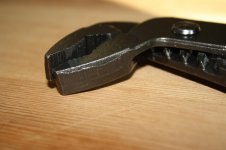
Decided to see how the 10" Channellock Griplock pliers would hold up in a torture test with the infamous grade 8 bolt. This is a small, 3/8" shank bolt with a 9/16" hex, and 1.5" in length. The test was simple: stack the bolt to the top with grade 5 nuts with matching thread size, and put it in the vise. Then just tighten the bolt on the nuts until I couldn't tighten anymore or until the nut threads strip out or the grade 8 bolt shears...OR until my test subject fails!. Results? Grade 8- 1, Channellock- 0.
0f27e745692405da3f2b19f0adb0e407.jpg
781c7362da16f6e672172ebe98b5af32.jpg
11252110a852892363d04b8605240ded.jpg
04b8af42952d6d6f49e518298459f0e6.jpg
46bb9e0b059f42d0e9cfdce34404dd01.jpg
ad1530c5f1840e9970c5763b675dd9c8.jpg

Note the section that chipped off the top tongue of the pliers. Also note how the bottom jaw is now bent. In all fairness, I used all my force (no cheater bars were used, only my extremely rediculously ripped arms) and the bolt did yield. When the pliers failed they were kind of on an angle, which probably helped to cause the failure- the plier jaws are wider than the flats of the bolt, so half of the jaw width was not on anything. But, still a very real world situation, to mimmick a frozen and rounded off bolt that has been subject to harsher climate. Hope you enjoyed! I did! questions, comments?
 
Last edited:
To avoid these ads, REGISTER NOW!

jeremy v

Banned
Joined
Jul 26, 2011
Messages
784
Thanks for doing this test, but I am honestly not too surprised at the result. I own and like much of the Channellock product line, but I happen to think Channellock v-jaw pliers are much better pliers for the same price.

The Griplock pliers have a very small arc engagement area compared to a regular pair of Channellocks, so any force on the hinge channel is going to be much more concentrated. The Channellock nutbuster pliers (which are really the correct plier for this brute force style task) have two separate and complete channels engaged at all times to keep the joint strong and stable which is a huge difference. What did surprise me a little bit is that the jaw teeth seem to be in better condition than I expected after tackling a grade 8 bolt. I expected them to be chewed up a bit more, but maybe that is just the slight blurriness of the pictures hiding the damage.

To all the Knipex fanboys. I own and use a lot of their products also and they have their pluses and minuses too, but you have to compare apples to apples here. The Griplocks are US made and they can be found very easily and locally for around $10 or in 2 packs with a larger 12" size for around $24. The only real competition for Griplock pliers at their price point is China made. They are good pliers for $10, but in my opinion the $12-14 Channellock v-jaws are much better bang for the buck. Knipex or NWS are better pliers in many ways, but they should be since they cost almost 3x as much. I personally only use my German push button style pliers in the garage, because they stick, grind, and jam too easily when working outside in dirt and mud. Channellocks can go anywhere with little or no fuss, and that's why I usually grab them first even though I have other options.
 
Last edited:

jeremy v

Banned
Joined
Jul 26, 2011
Messages
784
I don't know how alligators would do, I guess it would depend on how easily the sides of the circular hinge cutouts want to spread or deform under higher hinge forces. I have them in the 12" size and I never really liked them because they were always a hassle to adjust one handed compared to regular Channellocks.

I would expect regular Cobra pliers to do better than the Griplocks, but possibly not as well as a regular pair of Channellocks in terms of joint strength. It is hard to say though. The one that I would really like to see torture tested is the Self-adjusting Cobra plier which has a couple small engagement teeth only on one side of the push button sliding channel. That design depends very heavily on steel quality and proper heat treatment so it would be interesting to see that design really put to the test.
 
OP
T

TOOL FANATIK

Well-known member
Joined
Sep 20, 2014
Messages
566
Location
Bennington, VT
Thanks for doing this test, but I am honestly not too surprised at the result. I own and like much of the Channellock product line, but I happen to think Channellock v-jaw pliers are much better pliers for the same price.

The Griplock pliers have a very small arc engagement area compared to a regular pair of Channellocks, so any force on the hinge channel is going to be much more concentrated. The Channellock nutbuster pliers (which are really the correct plier for this brute force style task) have two separate and complete channels engaged at all times to keep the joint strong and stable which is a huge difference. What did surprise me a little bit is that the jaw teeth seem to be in better condition than I expected after tackling a grade 8 bolt. I expected them to be chewed up a bit more, but maybe that is just the slight blurriness of the pictures hiding the damage.

To all the Knipex fanboys. I own and use a lot of their products also and they have their pluses and minuses too, but you have to compare apples to apples here. The Griplocks are US made and they can be found very easily and locally for around $10 or in 2 packs with a larger 12" size for around $24. The only real competition for Griplock pliers at their price point is China made. They are good pliers for $10, but in my opinion the $12-14 Channellock v-jaws are much better bang for the buck. Knipex or NWS are better pliers in many ways, but they should be since they cost almost 3x as much. I personally only use my German push button style pliers in the garage, because they stick, grind, and jam too easily when working outside in dirt and mud. Channellocks can go anywhere with little or no fuss, and that's why I usually grab them first even though I have other options.
No, the teeth are flawless on these bent pliers. I'm surprised that you are surprised, being that channellock claims a Rockwell hardness of 59-61 range, HSS territory. I put the 10" nutbusters to the test prior. They don't bite and hold nearly as well as the gl. As far as the v jaws I have the 422 also which are 10". Didn't get to those yet, but I will. As well as the knipex 10" alligator pliers. I agree, they are great pliers, but kind of like the snap-on or Milwaukee thing where they get highly overrated. I spot flaws in these knipex in particular which is why I chose them. The point here is to see how far can these tools go. Thanks for your input.
 

AllAboutTools

Well-known member
Joined
Mar 23, 2009
Messages
127
Location
WV
I love the way my cobra's grip...but I have also noticed some "wear" on the teeth with limited use.
 

jeremy v

Banned
Joined
Jul 26, 2011
Messages
784
No, the teeth are flawless on these bent pliers. I'm surprised that you are surprised, being that channellock claims a Rockwell hardness of 59-61 range, HSS territory.

I knew the relative spec for the plier jaw hardness, but I just looked up the hardness of a grade 8 bolt and I was originally thinking it was much higher than it actually is. It is a little hard to tell though, because they seem to go by core hardness instead of surface hardness for bolts. The core is often softer than the outside because I know heat treatments usually have a hard time penetrating deep into metal. Interesting stuff.
 
OP
T

TOOL FANATIK

Well-known member
Joined
Sep 20, 2014
Messages
566
Location
Bennington, VT
I knew the relative spec for the plier jaw hardness, but I just looked up the hardness of a grade 8 bolt and I was originally thinking it was much higher than it actually is. It is a little hard to tell though, because they seem to go by core hardness instead of surface hardness for bolts. The core is often softer than the outside because I know heat treatments usually have a hard time penetrating deep into metal. Interesting stuff.
Yes sir... Now, I just tried the 10" v jaw and it performed GREAT. This I think highly due to my greater level of consciousness as opposed to the rather sloppy initial test. This time I was much more precise with teeth placement, planted my feet better, and did it with much more form overall. Anyway, after a long hard battle kinda like reeling in a sea monster, finally the grade 8 bolt fatigued and sheared right off. This was a new bolt, New nuts. I'm sure if I took so much care in the first test with the gl, I would've gotten it done. All in all, I walk away happy that my pliers got it done, but it was their fight to lose. I walk away with even more respect for the extreme son of a gun toughness in grade 8. These are no joke and I feel like I was turning and turning forever, just waiting for the damn thing to break!
 

jeremy v

Banned
Joined
Jul 26, 2011
Messages
784
One thing that contributes some to the difference in grip results is the tooth design. The Knipex Cobra type pliers have great bite when the teeth are sharp, but that is mainly because the teeth are directional. The trade off is that they only really grab in one direction of spin. If you have to spin the pliers the other direction for the handles to clear an obstruction they have almost zero grip. The Chanellock v-jaw pliers don't have directionally biased jaw teeth, so if you flip them backwards you will lose the self clamping jaw capability (just like you would with any of the other similar plier designs), but if you use some hand strength the jaw teeth will usually still bite, grab, and work just fine. There are quite a few situations where you need the flexibility to use pliers in both directions.

To me a tool is often more valuable if it does everything well than if it does only half of the job superbly. Losing 10% capability at performing a specific task is often a welcome trade off if it enables me to carry around less tools when working and still perform all the work required. That is probably the main reason why tools like Cobra pliers never really impressed me much. Other tools with a push button hinge (like pliers wrenches) work equally well in both directions so they are one of my favorites and are used regularly.

I also find many of Knipex's products to have jaws that are to thin for quality work with things like brass fittings, ball valves, etc. They concentrate the force to much and mar or gouge the brass deeply with their teeth. Chanellocks have a wider jaw so it happens less, but something like a pipe wrench or large adjustable work the best because the jaws are so wide they spread the force way out so softer metals are unharmed.
 
Last edited:
OP
T

TOOL FANATIK

Well-known member
Joined
Sep 20, 2014
Messages
566
Location
Bennington, VT
Yea the regular channellocks have 90* teeth. Unbiased grip either way you turn your pliers. The griplocks however have teeth on top and bottom jaw angled toward one another like a pipe wrench....Good for going in one direction only. Suddenly need to losen back up after tightening? Simply spin your pliers around. Same with vise grip groovelock pliers. Which, since you mention knipex narrow jaws, vise grip has the widest. But that is a good thing in some cases, not the best in others. It's often a tradeoff. The vise grips I think is worth mentioning, have cheaper steel. The easily wearing teeth are proof of that.
 
OP
T

TOOL FANATIK

Well-known member
Joined
Sep 20, 2014
Messages
566
Location
Bennington, VT
This is an important point and part of the reason I like to maintain a good selection of tools. There are times you need narrow jaws to fit into tight places, and there are times that wider jaws distribute the forces out better. Many people might not know this, but Channellock used to make all their plier jaws quite narrow by essentially shaving off one side of the jaws during the production process. They no longer do this and the jaws are now almost twice as wide as they used to be. That's why I have one of each of the main sizes I use in the new style and the old style so I have two of each size plier for double wrenching purposes, and I can also pick whichever jaw width works best for single plier jobs.

I attached a couple pictures of old vs new Channellock jaws for comparison. The old ones had about the same width as current production Knipex Cobras. The two pliers compared by themselves are the old vs new 440 pliers.
I showed my Fiance the video of the torture test, and she asked me what the point is. Among other things, the main purpose is so I know what my best tool is for the job. Who's going to get it done the safest, quickest, and with the least amount of effort. That way when faced with a stubborn bolt, I know who my #1 go to tool is. In this case it's the gl and/or v jaw. I won't, however grab my Petersen vise grip locking wrench (prior to this test I swore by these, but they eventually slip off similar to an oe of a wrench) or my 410 nutbusters (i can't trust the bite down grip, mostly due to not being the ideal size. 10" nutbuster, only 4 adjustments, I was not happy with any of the jaw positions on this particular size fastener, 9/16" hexagonal. A slightly larger or smaller hex fastener may have better suited the 410 and given me the true bite down never let go these guys are known for), or my 430's (these dangerously lost grip under extreme torque. I only pulled for the whole test, and never pushed my pliers. Still, I flew back on several occasions while testing the Petersen vise grip lw7's, the 430's and 410's. The gl's and the 422's never let go). As far as the channellocks of old, I never knew that. I appreciate you showing us the pics as hard evidence. Now the knipex guys can see, USA has been there, done that. Lol. A lot of what you have said on this thread I agree with 100%. Now for the big question. Am I a jerk for getting a replacement gl10 on warranty lol. (i don't care, I'm doing it anyway[emoji48])
 

Pansy

Active member
Joined
Apr 16, 2014
Messages
32
:lol: I hear you Vantastic, but I have a little cautionary tale for you. It contains within it a valuable lesson.
You are nervously needing to turn a rusty fastener in a cold, dark, damp and musty corner of a dilapidated house filled with nothing but dirty hypodermic needles and used condoms. You shiver with fear at the task before you because there is a fierce hulk of a man behind you with a cold gun firmly resting against the back of your head. He is gruffly telling you that the completion of this task will determine how many unused bullets remain in his gun at the end of this night.

You tremble with a cold sweat and pull out your brand new Knipex Cobra pliers only to quickly realize that they are thin enough to grab the fitting, but they are worthless. They don't grab tight enough in the required direction because another pipe is in the way. You think you have all the answers so you arrogantly breathe a silent sigh of relief, and instead reach for your backup pair of Channellocks, only to realize that they are the new style and the jaws are too wide to fit in the tight location. You mutter an almost imperceptible whimper just as you feel a warm trickle begin to run down your pant leg.

"If only I had read that one GJ thread more carefully and taken it more seriously!" you think to yourself as you realize you could've performed the task admirably if only you had carried with you a pair of the old style Channellocks. A few moments later just down the street, under the cold light of the moon shining down upon her house, an old woman hears two faint pops as she turns out her light and goes to sleep. Weeks later at your funeral your family shouts "Why him, why him, he was such a good man!", but the answer is clear to all in attendance... it was all a direct result of you being a GJ thread hater.:p


Wow! This is elegant.
 
To avoid these ads, REGISTER NOW!

Nele

Well-known member
Joined
May 5, 2014
Messages
150
Thanks for the review, sounds like ill have to stick to knipex..
 

BFHtime

Well-known member
Joined
Mar 31, 2012
Messages
983
I would like to see the Knipex go through the same torture.

I find my channel locks do not flex like my Knipex do. I am afraid often that my Knipex will break, and maybe that I will be injured due to the force. If I have to crank down on something I never use Knipex. My channel locks are my go to slip joint pliers. The Knipex pliers wrench does not display that type of flex. Twisting motion makes Knipex flex quite a bit.
 
Last edited:

BFHtime

Well-known member
Joined
Mar 31, 2012
Messages
983
It would be cool to see a video of both the channel lock and Knipex abuse testing.
 
OP
T

TOOL FANATIK

Well-known member
Joined
Sep 20, 2014
Messages
566
Location
Bennington, VT
I would like to see the Knipex go through the same torture.

I find my channel locks do not flex like my Knipex do. I am afraid often that my Knipex will break, and maybe that I will be injured due to the force. If I have to crank down on something I never use Knipex. My channel locks are my go to slip joint pliers. The Knipex pliers wrench does not display that type of flex. Twisting motion makes Knipex flex quite a bit.
I will be doing the exact same test with the knipex alligator 10" pliers. I redid this test using the channellock 422 v jaws. These pliers did great. When I tested the gl's I had little respect for the grade 8 bolt. It did not occur to me for a second that I'd ruin my pliers. Also this was meant to mimic real world scenarios, so my feet were never planted, and my overall form did not promote the pliers' success. When they broke, the jaws were unstable on the workpiece...and granted, that is how most guys work when they are tired, hungry and pissed off at something! I say all that to say this: I have no doubt that if I redo the test with the gl, it would be able to shear the bolt, just as the 422's did. The knipex I'm not sure about...
 
OP
T

TOOL FANATIK

Well-known member
Joined
Sep 20, 2014
Messages
566
Location
Bennington, VT
Thanks for the review, sounds like ill have to stick to knipex..

Did you miss the post where the channellock 422's were able to shear the bolt? in the end, it was not a question of will they be able to shear the bolt, but when will they shear it. ill post how knipex does when i get around to testing it.
 

Zrexxer

Well-known member
Joined
Jan 23, 2007
Messages
5,058
Location
Pflugerville, TX
I showed my Fiance the video of the torture test, and she asked me what the point is. Among other things, the main purpose is so I know what my best tool is for the job.
I could have told you that without you ruining your Channellocks. The best tool for that job is a WRENCH.
 
OP
T

TOOL FANATIK

Well-known member
Joined
Sep 20, 2014
Messages
566
Location
Bennington, VT
Because wrenches are what are used to loosen and tighten nuts and bolts, not pliers.
Yea they are, but when discussing a stuck bolt, wrenches are notorious for rounding the fastener. Once your wrench slips the first time, good luck getting it to budge. That's when you throw that wrench down and grab your channellocks, and watch that nut spin.
 
OP
T

TOOL FANATIK

Well-known member
Joined
Sep 20, 2014
Messages
566
Location
Bennington, VT
Because wrenches are what are used to loosen and tighten nuts and bolts, not pliers.
Keep in mind, I was not trying to fasten anything. I mimicked a stuck bolt situation by tightening it to a stack of nuts in a vice. Any 9/16" WRENCH (save a proto ASD wrightgrip or snap on flank drive plus or anything with similar design) would have slipped right over the corners. Open or box.
 
OP
T

TOOL FANATIK

Well-known member
Joined
Sep 20, 2014
Messages
566
Location
Bennington, VT
It was interesting to me Tool fanatik that the nutbusters didn't work that well in your tests. I wonder if it has to do with the fact that the nutbuster teeth are so sharply angled and thin at the leading edge. Instead of the 90* tooth edge angle of the v-jaws there seems to only be about a 60* tooth angle. I would think that would help them to dig much more deeply into softer or heavily rusted metals, but maybe by design that also leaves them lacking and the v-jaw pliers the better option when it comes to higher strength harder bolts.

I don't have any heavily rusted stuff laying around to try, so I went to the opposite extreme in regards to firmness, PVC pipe. I clamped a piece of thick wall 3/4" PVC pipe in my vice and tried cranking on it with Cobras, V-jaw pliers, and nutbuster pliers. A commonly encountered situation when working with irrigation systems.

I was surprised by how terrible the Cobras performed. Since they only grab a round object with two toothed surfaces (and the jaws are also quite thin) they just basically smashed the pipe the harder I cranked until they would deform the pipe enough to cause the tooth grip to easily slip or the pipe to kink. It didn't really take much torque at all for that to happen.

The nutbuster pliers did much better, but they have a wider jaw and they grab the pipe from 3 angles instead of two so they had a lot more teeth and surface area in the game. The pipe tried to deform into a triangle when it was cranked on, but it had a much lower tendency to want to just kink on you. I would guess it handled at least 40% more torque before slipping compared to the Cobras.

The v-jaws however, did the best by an obvious margin. When they clamped down it allowed all 4 angles of the plier to grab and bite into the pipe. The PVC deformed only slightly and into more of a square shape. Then it held its' integrity for a very hard cranking before the teeth started to chatter and slip as the PVC itself began to tear away from the pipe in tooth sized chunks. I would guess they held 20-30% more torque than even the nutbusters. That makes the Cobras pretty worthless by comparison when dealing with something soft like PVC pipe.
Just saw this...awesome. I like the test. I really think the only thing that went against the nutbuster in my test was the inability to get the ideal jaw opening. You mentioned a few things earlier that I wanted to capitalize on, because I don't think most people notice these things on their tools. The nutbusters use two tongues, one on top and one on bottom. Not only do I agree with you in that it makes for a stronger joint, but also it offers a lot less slack than your typical channellock design. You also mentioned how the gl has much less support for the tongue. This is critical, and I did notice that the chip that came off of the tongue is the same size and depth of the small, groove wall. This tells me that all the energy was focused on that tiny comma shaped wall, and in the v jaw situation, that energy would have been dispersed across the much bigger groove wall. I feel very confident that these pliers failed because the tongue and groove engagement being inadequate. Clearly not a design for extreme high torque.
 

ttpete

Well-known member
Joined
Mar 8, 2011
Messages
6,737
Location
Dearborn, MI
Professional mechanics don't use pliers on hex fasteners. They use the proper tools and don't round them off to begin with. If the fastener is found buggered up, there are better ways to remove it than with water pump pliers.

All you've proved is that it's possible to break a pair of channellocks by abusing them. They were never designed to be treated that way.
 

1950mercury

Well-known member
Joined
Mar 26, 2013
Messages
2,246
Location
metro detroit
Professional mechanics don't use pliers on hex fasteners. They use the proper tools and don't round them off to begin with. If the fastener is found buggered up, there are better ways to remove it than with water pump pliers.

All you've proved is that it's possible to break a pair of channellocks by abusing them. They were never designed to be treated that way.

1St reponse that made sense
 

bob15

Well-known member
Joined
Dec 8, 2011
Messages
6,863
Location
Northeasten, CT
Yea they are, but when discussing a stuck bolt, wrenches are notorious for rounding the fastener. Once your wrench slips the first time, good luck getting it to budge. That's when you throw that wrench down and grab your channellocks, and watch that nut spin.

What wrench is notorious for rounding fasteners? Also, use the box end, it is designed for breaking fasteners free.

I have never (nor seen anyone) round a nut or bolt off with a wrench, and then use channellock to take fastener out.....I'ved used vise-grips, for rusted fasteners, not channellocks.
 
OP
T

TOOL FANATIK

Well-known member
Joined
Sep 20, 2014
Messages
566
Location
Bennington, VT
Professional mechanics don't use pliers on hex fasteners. They use the proper tools and don't round them off to begin with. If the fastener is found buggered up, there are better ways to remove it than with water pump pliers.

All you've proved is that it's possible to break a pair of channellocks by abusing them. They were never designed to be treated that way.
I don't want to make this thread a debate about anything. At the end of the day I wanted to see which of my tools could tackle a tough situation such as the one I created. This was for my own enjoyment and decided to share my experience. In my next torture test I will include my disclaimer in the heading. Btw, I learned a little bit ago, if you are not a pro, don't tell us what a pro may or may not do. The actual truth might surprise you.
 
To avoid these ads, REGISTER NOW!
Top Bottom