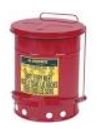
I like to practice all around safety for fire potential. I treat ANY kind of rag in my shop as a potential fire hazard.
You have several different types of fire threats in a garage/shop (the examples below are by far not complete).
Liquids with heavier than air flammable vapors such as gasoline are pretty bad, as the vapors can flow along a floor in much the way that a liquid flows (however, invisible), and seek out a source of ignition, such as a pilot light. These can be ignited by the presence of a flame while nobody is around, but are not actually spontaneous combustion.
Rags are a risk, in that the fine fibers are easy to ignite. Lint is actually an amazingly good tinder. I keep all my shop rags in a closed drawer to protect them from an errant grinding spark and such.
But rags alone do not auto-ignite. If they weren't already smoldering when you left, once the shop is unoccupied, they are not going to start a fire. This is essentially a tiger in a cage. Safe, if you don't let it out.
Boiled linseed oil is about as bad as it gets with spontaneous combustion in a shop. But other oils are potentially dangerous as well. "Boiled" linseed oil, like other modified "drying" oils are special in that they are designed to rapidly oxidize in the presence of air (though all vegetable based oils rancidify to a degree, which is for our purposes the same thing). The oxidation causes them to polymerize and thicken, which is a good thing in a paint. But the process also liberates heat. That becomes an issue when the heat is trapped inside of a pile of rags. Even a few layers can insulate enough so that the center can rise above the auto-ignition temperature (staring a fire when none existed before).
It may not be burning when you close the shop door, but can start all on its own later.
This is a tiger in a cage with an unlocked door, and is what sets apart spontaneous combustion from simply storing flammable materials.