To avoid these ads, REGISTER NOW!

spontaneous combustion hazard - is this one?

Duct Tape Man

Well-known member
Joined
Jul 13, 2013
Messages
994
Location
Shenandoah Valley, VA
I know varnishes, stains, lacquers, and other petroleum distillates, if you have an oily rag with that stuff on it, it is considered a spontaneous combustion hazard and should be tossed in a safety can for disposal. If you leave it around balled up, might just burst into flames.

Was wondering if the same could be said for rags that were used with WD-40, PB Blaster, and other light lubricants? If I oil something around the house with WD-40, do I need to treat the rags or paper towels I used as a fire hazard? Or, just toss in the trash?
 
To avoid these ads, REGISTER NOW!

LXCam

ALLIANCE MEMBER
Joined
Apr 23, 2013
Messages
19,113
Location
AZ
WD is highly flammable, I kill spidies with it often. PB, I don't know, guess I'll have to find out :)
 

Beater5liter

Well-known member
Joined
Oct 19, 2014
Messages
101
Location
Central Ohio
Would never take a chance. I've painted for twenty years and personally witnessed rags cook and combust on job sites due to negligence of my own and other painters. I've been lucky to catch them before damage was done. Won't make that mistake again!
 

rlitman

Well-known member
Joined
Oct 18, 2010
Messages
24,596
Location
Long Island
For safety's sake, I try watch what I do with any rag with a petroleum product on it.

This is good advice, as such rags would be quite flammable, however it is the heat formed by curing oils oxidizing that leads to SPONTANEOUS combustion. Oils that do not oxidize quickly in the air do not pose this same risk.
 

Jlbc212

Well-known member
Joined
Dec 7, 2013
Messages
1,530
Location
Northeast MA
A general rule of thumb is any oil derived from animals or vegetables (includes trees) may spontaneously ignite. Mineral (from the earth) oils will not.
 

G_P

Well-known member
Joined
Jul 11, 2010
Messages
7,135
Location
Central CT
I put all oily/greasy rags in a metal trash can with a metal lid. Solvent rags I lay out and let the solvent evaporate away.

Its not 100% fireproof but its a lot better than throwing them in the normal trash barrel.
 

Mike70

Well-known member
Joined
Apr 26, 2010
Messages
47
This is good advice, as such rags would be quite flammable, however it is the heat formed by curing oils oxidizing that leads to SPONTANEOUS combustion. Oils that do not oxidize quickly in the air do not pose this same risk.

What he said. If the oil will cure and harden, then it is a fire hazard. WD40 won't spontaneously combust.
 

VictorBravo

Well-known member
Joined
Jul 13, 2014
Messages
321
Location
Asotin County, Washington
A general rule of thumb is any oil derived from animals or vegetables (includes trees) may spontaneously ignite. Mineral (from the earth) oils will not.

I hadn't heard this before, but here is verification of what Jlbc says:

Investigations involving the contributions of drying oils are more common for the ordinary fire investigator, but also much more difficult to identify. The drying oils involved are those non-saturated oils found in vegetable and animal products. The saturated hydrocarbon oils such as found in petroleum products are not subject to self-heating or spontaneous ignition at ordinary temperatures. The materials of concern here are vegetable oils such as linseed, rapeseed, cottonseed, peanut, and sometimes even corn oil and safflower oil (such as those found in cooking products). Fish oils and fish meal are highly subject to self-heating.

http://www.interfire.org/res_file/fseab_si.asp
 
To avoid these ads, REGISTER NOW!

Malczewski

Banned
Joined
Jan 28, 2015
Messages
141
Location
Naples/all over the planet
Linseed oil is (was) notorious.Old fiddle makers and gun guys used to use itt all the time before all this techno **** showed up. I was on a knife forum the other morning and some guy does handles with a SuperGlue finish.Pass the Tung oil.:(
 

Andamo

Well-known member
Joined
Mar 23, 2005
Messages
154
Location
Trinity, Florida
I worked in the oil/chemical industry for close to 40 years and we had special lids that fit on 15 and 30 gallon open top drums we used for trash. If whatever in the can started to smolder, the way the lid was designed it would force the smoke back down into the can and rob it of oxygen.
 

Malczewski

Banned
Joined
Jan 28, 2015
Messages
141
Location
Naples/all over the planet
I worked in the oil/chemical industry for close to 40 years and we had special lids that fit on 15 and 30 gallon open top drums we used for trash. If whatever in the can started to smolder, the way the lid was designed it would force the smoke back down into the can and rob it of oxygen.
Do you recall who made them ? Sounds brilliant.
 

Andamo

Well-known member
Joined
Mar 23, 2005
Messages
154
Location
Trinity, Florida
I don't know if this is who we bought them from, but here is what they look like.

http://www.grainger.com/product/JUSTRITE-Drum-Top-WP154291/_/N-nq1?s_pp=false&picUrl=//static.grainger.com/rp/s/is/image/Grainger/14N874_AS01?$smthumb$
 

gungatim

Well-known member
Joined
Jan 8, 2013
Messages
8,101
Location
west mich
A general rule of thumb is any oil derived from animals or vegetables (includes trees) may spontaneously ignite. Mineral (from the earth) oils will not.

I thought it was the other way around. had a garage fire when I was a kid. was in the process of rebuilding a TH350 transmission and had spilled ATF all over the floor (and I mean ALL over!). I used cat litter to soak it up. 3Pm that afternoon got called out of school that house was on fire. I was told mineral oil and cat litter react to combust by the fire inspector and that was listed as the official cause...ATF (at the time) was comprised mainly of mineral oil...

could all be bunk, though, that's just what I was told and I was only 15 and fairly gullable...
 

Andamo

Well-known member
Joined
Mar 23, 2005
Messages
154
Location
Trinity, Florida
The biggest majority of so-called ''mineral oils'' are hydrocarbon based and are part of the distillation process in making gasoline and are flammable, to some degree, but with relatively high (over 300 degrees F) flash point.
 

OccupantRJ

Well-known member
Joined
May 15, 2009
Messages
11,045
Location
Eastern North Carolina
I thought it was the other way around. had a garage fire when I was a kid. was in the process of rebuilding a TH350 transmission and had spilled ATF all over the floor (and I mean ALL over!). I used cat litter to soak it up. 3Pm that afternoon got called out of school that house was on fire. I was told mineral oil and cat litter react to combust by the fire inspector and that was listed as the official cause...ATF (at the time) was comprised mainly of mineral oil...

could all be bunk, though, that's just what I was told and I was only 15 and fairly gullable...

And shaking in your shoes, I bet!
 

Dennis Leigh Henry

Well-known member
Joined
Apr 8, 2013
Messages
6,302
Location
South Central, IN USA
From the NFPA.ORG website...excerpts..

Spontaneous combustion is a byproduct of spontaneous heating, which occurs when a material increases in temperature without drawing heat from its surroundings. If the material reaches its ignition temperature, spontaneous ignition or combustion occurs. Examples of materials that are prone to spontaneous combustion include: oily rags, hay, and other agricultural products.

**

How can spontaneous combustion be prevented?

Agricultural products: Spontaneous heating in agricultural products can be prevented by control of moisture. Proper drying and adequate airflow will limit heating. Regular checks of temperature should be made.

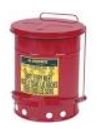
Oily Rags: Rags that have absorbed oils such as linseed oil or turpentine should be kept in well-covered metal cans and thoroughly dried before collection or transport.1

1Fire Protection Handbook. 20. 1. Quincy, MA: National Fire Protection Association, 2008. 6-288 – 6-292. Print

*********
Wikipedia does a good job of this subject too: http://en.wikipedia.org/wiki/Spontaneous_combustion

********
I use those oily rag cans myself at home as well as water / can and "spread out to dry" methods..
 

Attachments

  • oily rag can - justrite.JPG
    oily rag can - justrite.JPG
    10.1 KB · Views: 128

rlitman

Well-known member
Joined
Oct 18, 2010
Messages
24,596
Location
Long Island
I thought it was the other way around. had a garage fire when I was a kid. was in the process of rebuilding a TH350 transmission and had spilled ATF all over the floor (and I mean ALL over!). I used cat litter to soak it up. 3Pm that afternoon got called out of school that house was on fire. I was told mineral oil and cat litter react to combust by the fire inspector and that was listed as the official cause...ATF (at the time) was comprised mainly of mineral oil...

could all be bunk, though, that's just what I was told and I was only 15 and fairly gullable...

The early ATF formulations were actually WHALE oil (and remained that way until some time in the '70's).
As for ATF spontaneously combusting, I'm not convinced. ATF is not prone to oxidation (or it would thicken into jello in your transmission), and has an auto ignition temperature comparable to motor oil.
 

DekeT

Well-known member
Joined
Aug 12, 2011
Messages
2,234
Location
USA
I like to practice all around safety for fire potential. I treat ANY kind of rag in my shop as a potential fire hazard.
 

rlitman

Well-known member
Joined
Oct 18, 2010
Messages
24,596
Location
Long Island
I like to practice all around safety for fire potential. I treat ANY kind of rag in my shop as a potential fire hazard.

You have several different types of fire threats in a garage/shop (the examples below are by far not complete).

Liquids with heavier than air flammable vapors such as gasoline are pretty bad, as the vapors can flow along a floor in much the way that a liquid flows (however, invisible), and seek out a source of ignition, such as a pilot light. These can be ignited by the presence of a flame while nobody is around, but are not actually spontaneous combustion.

Rags are a risk, in that the fine fibers are easy to ignite. Lint is actually an amazingly good tinder. I keep all my shop rags in a closed drawer to protect them from an errant grinding spark and such.
But rags alone do not auto-ignite. If they weren't already smoldering when you left, once the shop is unoccupied, they are not going to start a fire. This is essentially a tiger in a cage. Safe, if you don't let it out.

Boiled linseed oil is about as bad as it gets with spontaneous combustion in a shop. But other oils are potentially dangerous as well. "Boiled" linseed oil, like other modified "drying" oils are special in that they are designed to rapidly oxidize in the presence of air (though all vegetable based oils rancidify to a degree, which is for our purposes the same thing). The oxidation causes them to polymerize and thicken, which is a good thing in a paint. But the process also liberates heat. That becomes an issue when the heat is trapped inside of a pile of rags. Even a few layers can insulate enough so that the center can rise above the auto-ignition temperature (staring a fire when none existed before).
It may not be burning when you close the shop door, but can start all on its own later.
This is a tiger in a cage with an unlocked door, and is what sets apart spontaneous combustion from simply storing flammable materials.
 
To avoid these ads, REGISTER NOW!
Top Bottom