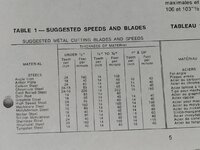
A few weeks ago, I found a beautifully restored Craftsman Bandsaw (103.24280) on Craig's List. I called the guy and when I went to pick it up, I was greeted by a collect...
To read the rest of this blog entry from The Garage Journal, click here.

So if you don't me asking roughly how much did you end up having in the conversion? I see wood cutting band saws sell quite cheap on fairly regular basis but ones that run slow enough for metal bring quite the premium.


Why didn't you use a Variable Frequency Drive?
because it's a DC motor. VFD's only work with AC motors (variable frequency drive). DC motors don't have a frequency, since it's direct current.
The stock motor was single phase, not three phase. While they do have methods to control single phase AC motors, the VFD's for them are rather expensive.
Additionally AC/VFD drives, unlike DC drive systems, do not perform very well on the low end of the speed range that is needed for a single reduction drive.
The BEST way to do the conversion is with a gear box directly coupled to the drive wheel shaft. That is how production saws work. This is about the second best way and will be fine given the limitations of the saw itself and intended uses.
A few weeks ago, I found a beautifully restored Craftsman Bandsaw (103.24280) on Craig's List. I called the guy and when I went to pick it up, I was greeted by a collect...
To read the rest of this blog entry from The Garage Journal, click here.
Ryan, very cool. There is an unrestored saw that looks just like that near me for sale. Seeing this makes me want to buy it, as I've been wanting a metal cutting band saw.
I was looking at the motor and controller you used on the SurplusCenter website and wondering, how did you determine which ones to use? There are a bunch of different options.
Have you cut metal with it yet? Was it easy to find metal cutting blades in the correct size?
Thanks.
Honestly, I just picked a 3/4 HP DC motor and then asked them what controller would work best...
As for metal cutting, I have not yet. I ordered some bimetal blades and they came in but they were sized wrong. The BS takes normal 80" blades...
I read that statement, but I'm not sure what "do not perform very well on the low end" means. Is it lack of torque? Smoothness? Can you elaborate on that?
If you happen across an old treadmill most of those will work with their DC drive system. Some are better suited than others those, especially in mounting as their frames can be non standard type mounts.
Another hard learned lesson I had was having one bandsaw for metal, wood and plastic. While in theory it is a great idea, in practicality not so much; especially if you care about your wood projects as metal chips will find their way into the wood, no matter how hard you try to keep them off the tires/blade/etc.
Thus, while the internal gear box saws are nice, one can accomplish the same thing with a standard 14" wood saw and an external ~30:1 gear box. What I would like to see is for one of the small off shore companies to put one of their 4x6 horizontal saws into a roll in/marvel style vertical frame for sub $300. That would be a very hot seller me thinks. Hey there is an idea for the swag company. A 4x6 bandsaw upgrade.
Not to knock Ryan, but I personally wouldn't have put the conversion on the saw he did. The ubiquitous 14" delta and its clones are so abundant yet quite a bit more stout than the 12" and smaller class saws. If one wants to do a conversion the 14" delta style is the minimum I would start with. Then again I don't get the impression he will be taxing the saw much so for him it will probably work out quite well.
If the speed controller requires a large heat sink to work correctly, I'm not sure I'd place it inside a sealed enclosure. Some vents on the top and bottom, or an exhaust fan and inlet, might be helpful. I've crammed DC power supplies and HMIs into small non-vented enclosures but neither gives off much heat.
You should also be aware that inverter motors are designed specifically for VFD applications. They have heavier insulation to withstand high voltage spikes from the VFD and are designed to handle the heat from running at lower speeds. Standard ac motors may not withstand the heat when run at greatly reduced speeds due to loss of airflow. The motor manufacturer can typically provide minimum allowable motor speeds for each model. Single phase applications for VFDs are more readily available for 240 VAC.I know that. I'm wondering why saw the need to purchase a DC motor and controller instead of a using a VFD and retaining the AC motor it came with, if the goal was just to slow it down.