To avoid these ads, REGISTER NOW!

20 Amp Circuit with 15 Amp Receptacle

lakeroadster

Well-known member
Joined
Jan 19, 2015
Messages
5,166
Location
Central Colorado
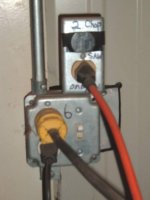
So I'm out in the barn today and noticed the outlets that the Sparky's installed are not 20 amp., as was specified. :wtf:

Opened the electric panel and the circuit has a 20 amp breaker :headscrat

Checked and all romex is 12 gauge on the circuit.


  • Either the outlets should be changed to 20 amp
or
  • The breaker should be changed to 15 amp

Am I right or is there some NEC rule that I am not aware of?

Thanks,

John
 
To avoid these ads, REGISTER NOW!

Alchymist

Well-known member
Joined
Mar 1, 2009
Messages
4,423
Location
Central PA
Dual outlets - "duplex"- are considered 2 outlets and are allowed on a 20 amp circuit. Usually the only difference between 15 and 20 amp outlets is the horizontal slot in the 20 amp.
 

Stuart in MN

Well-known member
Joined
Sep 8, 2005
Messages
23,042
Location
Minneapolis
The NEC allows more than one 15 amp receptacle to be used on a 20 amp circuit, and a standard duplex receptacle counts as two, so you're fine. Actually, the only difference between a 15 amp and 20 amp receptacle is the slots on the front, the internal parts are identical. Also, most people don't have any tools or appliances that actually have a 20 amp plug on them so the 20 amp receptacles are almost never really needed.
 

wyliesdiesels

Well-known member
Joined
Aug 14, 2012
Messages
19,994
Location
Modesto, CA
Perfectly fine and meets code.

If u took the faceplate off a 15a outlet and a 20a outlet, u would see they are constructed exactly the same.
 

Daedalus

Well-known member
Joined
Sep 28, 2009
Messages
5,975
jeez, I need to read threads in this forum more often. Very educational.
 

dw1

Well-known member
Joined
Jan 26, 2015
Messages
1,335
Location
Ky
If it was a single receptacle, it would need to be a 20 amp but as stated, a duplex can be 15.
 

wssix99

Well-known member
Joined
Mar 2, 2011
Messages
5,156
Location
Chicago, IL
Thanks guys. Makes no sense at all to me... but that's fine. Just want everything to meet code.

It works just like plumbing. If you hook a 1/2" copper line up to a 3/4" main, then you'll only get as much flow as that 1/2" stem can handle.

Your appliances going in to the outlet have 15A plugs on them, so a duplex outlet would be able to handle 30A in total. (Plus a margin of safety, if you hooked two appliances up to them pulling the maximum loads for their plugs.)

The thing to look out for is really the grade of outlet. My understanding (from when I sold electrical materials a long long long time ago) is that the cheap 89 cent bin outlets have weaker contacts in them and can wear out over time with repeated use in kitchens and shops. The more expensive "heavy duty" outlets are beefier in construction and are more durable.
 

sberry

Banned
Joined
Jun 18, 2005
Messages
35,747
Location
Brethren, Michigan
I have a couple but generally don't use the 20's unless its on a dedicated wire. I really don't have a lot of sensitive or parasitic stuff running on most generals but don't have anything that comes with factory 20 plug.
They are really to prevent equipment from being used in the wrong place especially in commercial and cleaning equipment may be a good example. I saw a vaccuum with a 14 cord and 20 end.
Equipment that comes with a 15 end (120 v) needs to have cord and internals or further fusing to be able to be plugged to 20A ocpd. The 15 end on an appliance or tool says it has less than 15 draw and it leaves some headroom for additional load on other recepts.
If we had 2 loads of 15 would trip the breaker, xame for plugging a 20A in to a 15 circuit, it would trip the breaker. So there are really 2 reasons a 20 may be needed. The equipment may really need heavier service, it may cause tripping and may be aggravated by other loads on the same circuit so by using a 20 end can limit where it is plugged in, either on a circuit where it doesn't matter or is specifically intended for it to isolate it,,, it simply doesn't let the janitor plug in to anywhere but often have a long cord and a circuit for the sweeper. They don't get to use the ones the experiments, computers or other sensitive equipment is plugged in to.
A lighter cord may be used on a tool, the thermal load is limited by the design and power required but is rated for short circuit of 20 and goes direct to the tool with no way for the operator to add additional load to it along the way. (30A 120v circuits use a different plug) If we add additional recepticals to a 20A circuit we need to use 12 wire or in the case of a power strip with a 15 end and 14 wire need to add in additional protection hence the little breaker. 20A is good for motor starts, the equipment would run from a 16 or 14 wire but some may be problematic.
 

sberry

Banned
Joined
Jun 18, 2005
Messages
35,747
Location
Brethren, Michigan
The duplex could essentially handle 40 depending on how it was wired but as it is made it will go on a circuit limited to and will pass thru 20. Most of the loads if it doesn't pass thru to additional recepts will be way less than 15 due to the plug design, continuous load of 13 or so, maybe more with electric heater.
A 3 way connection should either handle 20A or have a breaker. A 20A outlet simply isolates the options for the operator to plug in specific equipment.
 
Last edited:

sberry

Banned
Joined
Jun 18, 2005
Messages
35,747
Location
Brethren, Michigan
My chop saw is factory wired 15 but will trip a 20 on starts. I didn't use a 20 recept because I don't have other equipment with 20A ends, irrelevant and it is likely a 50 cent recept but has 30 breaker on it. Its the only one on the circuit.
The saw has a 14 cord and internals will withstand 30. I forgot I even had it and may have tested some pos inverter welder from it that tripped a 20 before it finished a rod.
 

Attachments

  • chop saw only.JPG
    chop saw only.JPG
    30.3 KB · Views: 96
Last edited:

rlitman

Well-known member
Joined
Oct 18, 2010
Messages
24,591
Location
Long Island
...Actually, the only difference between a 15 amp and 20 amp receptacle is the slots on the front, the internal parts are identical...

They can be. I know that on some 15A Hubbel outlets I have, you can look through the slot and see the three blades that would be found in a 20A receptacle.

Anyway, the point I'd make is that unless you have something that has the T oriented prongs that requires a 20A outlet (not something you see all to often), don't worry about the fact that your outlets only say 15A.
 

rlitman

Well-known member
Joined
Oct 18, 2010
Messages
24,591
Location
Long Island
My chop saw is factory wired 15 but will trip a 20 on starts. I didn't use a 20 recept because I don't have other equipment with 20A ends, irrelevant and it is likely a 50 cent recept but has 30 breaker on it. Its the only one on the circuit.
The saw has a 14 cord and internals will withstand 30. I forgot I even had it and may have tested some pos inverter welder from it that tripped a 20 before it finished a rod.

Well, that's one solution. I'd think that a better breaker would be a better way to go. My chop saw trips the 20A breaker occasionally on starting too. But not often enough that I've had reason to do anything about it.
 

sberry

Banned
Joined
Jun 18, 2005
Messages
35,747
Location
Brethren, Michigan
What breaker might be better? This is the only tool and only recept on the wire. My helper pulled the wire and used 10 on it which really didn't help. It tripped on different circuits, this is now its home. It originally had 25 ft of 16 cord and right to a panel and about every 5th start of so it would pop. I got little air comp I add 50 ft of 14 to. It runs in attended or with guys on roof so I use the 14.
 

rlitman

Well-known member
Joined
Oct 18, 2010
Messages
24,591
Location
Long Island
That depends on who makes your panel, but you can look for a "high magnetic" breaker. That will give you the magnetic characteristics of a 30A or maybe even 40A breaker (i.e. not trip for your saw), but the thermal characteristics (safety margin) of a 20A breaker.
 

sberry

Banned
Joined
Jun 18, 2005
Messages
35,747
Location
Brethren, Michigan
Its a QO. I really don't need additional thermal, the wire in the circuit is well above the size of the wire on the unit.
I burned one up back in the day, took out the armature and I was distracted and cut some 4 inch pipe one after another and was on a 20 at the time, never did trip.
Spose a guy could chop the plug off, change to a 30, change fuses or breaker to a specialty but this is somewhat the 30 is intended for and as long as we dedicate it to this tool not an issue especially since its not running unattended or automatic. I don't have to share it with other stuff.
They put sump pumps on special circuits, little dinky pump, 30 breaker and 12 wire. Thing draws 5A run.
 
Last edited:
To avoid these ads, REGISTER NOW!
OP
L

lakeroadster

Well-known member
Joined
Jan 19, 2015
Messages
5,166
Location
Central Colorado
Here's a photo of NEC Table 210.24. It seems that for every other circuit the receptacle rating must match or exceed the circuit rating.


Attachments

  • Spock Logic.jpg
    Spock Logic.jpg
    33.1 KB · Views: 36
Last edited:

revamped

Well-known member
Joined
May 23, 2012
Messages
312
Location
Bremerton, WA
The only reason I am installing 3 outlets with 20A industrial receptacles is to designate that they are individually fed back to the panel for my plasma cutter which has the horizontal blade. That way someone doesn't try to plug it in a loaded circuit with an adapter or something.
 

theoldwizard1

Well-known member
Joined
Feb 22, 2011
Messages
43,114
Location
SE MI
So I'm out in the barn today and noticed the outlets that the Sparky's installed are not 20 amp., as was specified. :wtf:
If it was spec'd I would call him on it !

Not because it is a code violation, buy because 20A outlet are usually more "robust" that 15A outlets. You should get what you pay for !
 

Rigpig

Well-known member
Joined
Feb 13, 2010
Messages
188
Location
Victoria,BC
There has to be something somewhere in the NEC that says its not allowed? What's the point in having a 20a rated receptacle then if its the same as the 15a? The CEC allows a 20a on a 15a cct, but not the other way around. The CEC adopts a lot of its code rules from the NEC and surprised it allows this basic one.
 

CJ7VFR

Well-known member
Joined
Jan 13, 2015
Messages
2,939
Location
Central New Jersey
If it was spec'd I would call him on it !

Not because it is a code violation, buy because 20A outlet are usually more "robust" that 15A outlets. You should get what you pay for !

And the 20 amp receptacles usually cost more too! So if you paid for them, and they were not installed, I would call them out on it also and say either you come back here and install what I paid for, or give me some bucks back.

Jim
 

CJ7VFR

Well-known member
Joined
Jan 13, 2015
Messages
2,939
Location
Central New Jersey
...The CEC allows a 20a on a 15a cct, but not the other way around. The CEC adopts a lot of its code rules from the NEC and surprised it allows this basic one.

Isn't it the other way around?

You can put 15 amp receptacles on a 20 amp circuit fed by a 20 amp breaker, using 12 gauge wire, but you can't put 20 amp receptacles on a 15 amp circuit fed by a 15 amp breaker using 14 gauge wire.

You can always use a smaller device on a larger circuit, but you should never go larger on a smaller circuit. A 20 amp receptacle installed on a 15 amp circuit, fed by a 15 amp breaker, and having 14 gauge wire, is a big no-no.

If you were to plug in something that actually uses the 20 amp male plug into that 20 amp receptacle on that 15 amp circuit, the least that could happen is you pop the breaker. The worst that can happen is you can burn up the wiring and start a fire.

If you have 15 amp receptacles on a 20 amp circuit, fed by a 20 amp breaker, using 12 gauge wire, the only tool you could plug into that 15 amp receptacle would be one that could only draw 15 amps max. That would not trip the 20 amp breaker and not burn up the 12 guage wire.

Maybe I am totally wrong here, but that is what I was always taught, and what I have read here on this website by the sparkies who post.

Jim
 
Last edited:

Radix2

Well-known member
Joined
May 28, 2014
Messages
1,853
Location
the thumb!, MI
There is no practical way to design for 15A vs 20A in a duplex outlet, most of which has to carry at least 20A when connected to a 12ga/20A circuit anyway - since there are two 15A receptacles connected - so the contacts are the same. Better/more expensive plugs have better design and material in the contacts for longer life - life which is used by by wear and loss of spring force.

Revamped has it exactly right - use the 20A horizontal pin outlets to force certain 20A loads onto clean circuits by installing the correct 20A plugs onto them.
 

Rigpig

Well-known member
Joined
Feb 13, 2010
Messages
188
Location
Victoria,BC
Isn't it the other way around?

You can put 15 amp receptacles on a 20 amp circuit fed by a 20 amp breaker, using 12 gauge wire, but you can't put 20 amp receptacles on a 15 amp circuit fed by a 15 amp breaker using 14 gauge wire.

You can always use a smaller device on a larger circuit, but you should never go larger on a smaller circuit. A 20 amp receptacle installed on a 15 amp circuit, fed by a 15 amp breaker, and having 14 gauge wire, is a big no-no.

If you were to plug in something that actually uses the 20 amp male plug into that 20 amp receptacle on that 15 amp circuit, the least that could happen is you pop the breaker. The worst that can happen is you can burn up the wiring and start a fire.

If you have 15 amp receptacles on a 20 amp circuit, fed by a 20 amp breaker, using 12 gauge wire, the only tool you could plug into that 15 amp receptacle would be one that could only draw 15 amps max. That would not trip the 20 amp breaker and not burn up the 12 guage wire.

Maybe I am totally wrong here, but that is what I was always taught, and what I have read here on this website by the sparkies who post.

Jim

Hey Jim,
The idea is that you can install a device rated for more current on the circuit, but not a device rated for less. The receptacle isn't drawing any more current but is still rated for more and not the other way around. You don't want to undersize devices if the circuit is rated for more.
Ultimately you want to protect the conductor, so you match the breaker to the conductor size to prevent fires etc...
Cheers!
 

wssix99

Well-known member
Joined
Mar 2, 2011
Messages
5,156
Location
Chicago, IL
And the 20 amp receptacles usually cost more too! So if you paid for them, and they were not installed, I would call them out on it also and say either you come back here and install what I paid for, or give me some bucks back.

Jim

I'd rather have a heavy duty 15A socket if all I had was equipment with 15A plugs.

I have 20A circuits in my garage with 15A outlets. In the unlikely event I ever need to use a device with a 20A plug, it's easy enough just to send the wife out there to wire up a different outlet. :shocking:
 

sberry

Banned
Joined
Jun 18, 2005
Messages
35,747
Location
Brethren, Michigan
Someone had it right, its to force the user on the correct circuit. Its to keep people from plugging in to general use circuits
 
Last edited:

ishiboo

Well-known member
Joined
Oct 27, 2010
Messages
9,481
Location
Oshkosh, WI
Here's a photo of NEC Table 210.24. It seems that for every other circuit the receptacle rating must match or exceed the circuit rating.


15A are general purpose receptacles and so the rules are a little bit different. Remember that electrically they are actually rated for 20A per device, 20A passthrough... so think of it more like a 20A device than a 15A. It is simply the NEMA receptacle configuration on the front (5-15) that is different. General purpose 5-15 plugs could be anything from a 2 watt night light to a 1500 watt hair dryer and beyond, while 5-20 receptacles are usually devices which almost always CAN use more than 15A. IE, a 120V welder.
 

sberry

Banned
Joined
Jun 18, 2005
Messages
35,747
Location
Brethren, Michigan
Yes. The service is good, the wire is short, a few ft from a 3/0 feeder, lets it dump just that much more. If it had 100 ft of wire on it may not.
 

teamextreme

Well-known member
Joined
Aug 10, 2013
Messages
867
Location
Lakewood, CO
Yes. The service is good, the wire is short, a few ft from a 3/0 feeder, lets it dump just that much more. If it had 100 ft of wire on it may not.

That was exactly my experience. In my old shop my chop saw would trip the breaker probably every other start. It was maybe 8 feet from the panel, #12 on a 20a breaker, dedicated circuit. I just replaced the breaker with a 30a to avoid the hassle (I put it back to a 20a when I moved, BTW). In my new shop The circuit is 40 ft or better, with the last 10 ft temporarily fed by a #14 extension cord. It hasn't tripped the breaker once.
 

Alchymist

Well-known member
Joined
Mar 1, 2009
Messages
4,423
Location
Central PA
Question to the 2 guys that said their chop saws will trip a 20a circuit breaker, is that the only thing on that circuit?

It was. Main panel in house is fairly new 200A service, 60 amp breaker with approx 90 feet of #4 copper to sub panel in garage, then about 35-40 feet of #12 on a 20 amp breaker to the outlet. All Square D QO if it matters.....

It's not uncommon in my experience to have a large Skil saw or other heavy current draw (such as the chop saw) pop a 20 amp breaker under heavy load. When the breaker pops on my chop saw, it's under a heavy load, approaching stall. Don't know about others, but I have to regulate the down pressure on the handle of the chop saw to control cutting, and sometimes a little too much will pop the breaker. Usually happens when cutting larger solid bar stock or 3X5 tubing, etc.

That was exactly my experience. In my old shop my chop saw would trip the breaker probably every other start. It was maybe 8 feet from the panel, #12 on a 20a breaker, dedicated circuit. I just replaced the breaker with a 30a to avoid the hassle (I put it back to a 20a when I moved, BTW). In my new shop The circuit is 40 ft or better, with the last 10 ft temporarily fed by a #14 extension cord. It hasn't tripped the breaker once.

Quite possible the old setup had a weak breaker, it happens, or, depending on manufacturer, (older breakers) the trip curve didn't account for the inrush current.

As to the new setup, better breaker? And have you tried it without the extension cord? Sometimes an extension cord will limit the current enough to prevent a breaker popping on start up. Plug the saw in with out the extension, and start it a half dozen times to see if it pops, then run it under heavy load and let us know what happens.
 

MopardudeWI

Well-known member
Joined
Oct 14, 2016
Messages
76
Location
Whitewater, WI
It's not uncommon in my experience to have a large Skil saw or other heavy current draw (such as the chop saw) pop a 20 amp breaker under heavy load.

I have experienced the same that's why I was curious about it. Most of the time I find something on the same circuit that no one told me about. Like for example the wife comes into the shop and plugs in something to be charged when I am not looking. lol

And have you tried it without the extension cord? Sometimes an extension cord will limit the current enough to prevent a breaker popping on start up.

I don't know about limiting, usually if you run to small of a cord that's a good way to make it pop.
 

Alchymist

Well-known member
Joined
Mar 1, 2009
Messages
4,423
Location
Central PA
I don't know about limiting, usually if you run to small of a cord that's a good way to make it pop.

Depends on the circumstances - length of cord, voltage drop, etc. You are right in that most times it will drop the voltage and cause excessive current to be drawn by the motor. (Characteristic of a motor, drop the voltage and it draws more current). But get it just right, and it inhibits current draw just enough that the motor will come up to speed before the breaker pops. Note that on a resistive circuit - heater, lamp, etc, the current will not increase as the voltage drops at the load.
 

sberry

Banned
Joined
Jun 18, 2005
Messages
35,747
Location
Brethren, Michigan
Yes, as I mention I treated the little comp we used on roofing differently. I did reduce the wire but only to 14 and increased the length. I have done it on saws with 16 but here the comp was down on the ground, a fitting leaked and it ran for 30 minutes. We didn't want to add a wire that would overheat.
 

wssix99

Well-known member
Joined
Mar 2, 2011
Messages
5,156
Location
Chicago, IL
Here's a photo of NEC Table 210.24. It seems that for every other circuit the receptacle rating must match or exceed the circuit rating.


I expect this is because circuits can be wired "through" an outlet. If you wired a 20A outlet on a 50A circuit, you could have a situation where 50A (from some downstream device) is physically flowing through that thin strip of brass connecting the two terminal screws on the side. If that strip on the 20A outlet is only tested and rated for 20A, this situation would result in outlet flambé.

The 15A duplex outlet is special because of its common use on 20A circuits and the fact that two 15A plugs can draw more than 15A. As per above, (as a result of its common application) the outlet innards' would need to be rated for 20A+.
 
To avoid these ads, REGISTER NOW!
Top Bottom