To avoid these ads, REGISTER NOW!

Ryan

Administrator
Staff member
Joined
Jan 26, 2006
Messages
5,690
Location
Texas/Hawaii
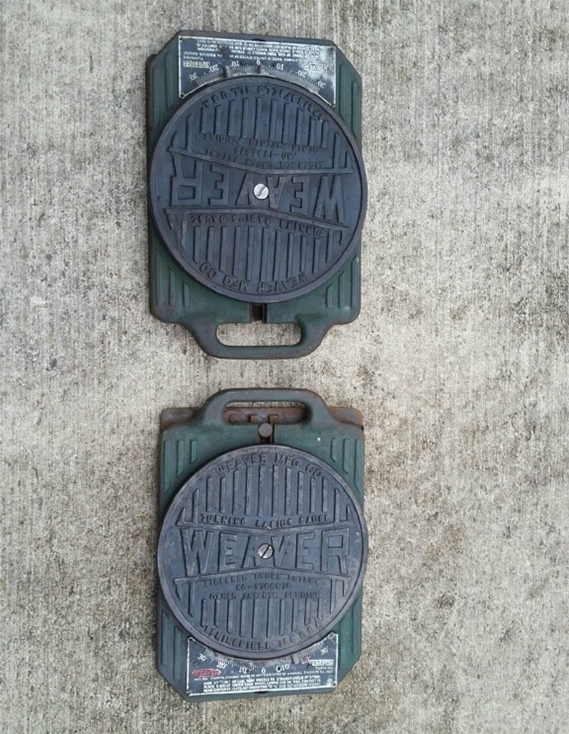
weaver.jpg


I thought you guys would get a kick out of the above... Essentially, they are 1940's era degree alignment plates made by Weaver. My buddy found them at an abandoned sign s...
To read the rest of this blog entry from The Garage Journal, click here.
 
To avoid these ads, REGISTER NOW!

phred

Well-known member
Joined
Apr 23, 2009
Messages
525
Location
NC
Id trust those more than the fancy computer alignment gear. I can't remember the last time I had one of my vehicles and alignment shop. I cant get everything set in the shop with a tape and level. Id love a pair of those plates!!!
 

F124C

Well-known member
Joined
Aug 19, 2013
Messages
1,829
Location
Ireland
They're positioned under the steered wheels and measure no. of degrees steered/turned by the wheels. These alignment plates have built-in turntables. The other/rear wheels need to be raised and supported by the same thickness as the A. plates.

They're used to check 'toe-out-on-turns', steering angles left/right and when measuring castor angle etc. You also need castor/camber/kingpin inclination gauges and tracking (toe-in/toe-out) gauges to do a full wheel and suspension alignment.

All the above has now afaik been supplanted (learned a new big word, been waiting a while to use it!) by the modern computerised alignment rack with laser sights?

Al.
 
To avoid these ads, REGISTER NOW!

DeucePhaeton

Member
Joined
May 14, 2008
Messages
15
Location
Grand Ledge, MI
When I was living in Texas I worked for Overseas Motors in Ft. Worth,a British Leyland dealership. We used these to align Rolls Royce, Jaguar, MG and Triumph as well as whatever else we would get in, and this was 1978/79.
 

F124C

Well-known member
Joined
Aug 19, 2013
Messages
1,829
Location
Ireland
Pics of the underside / mechanics of these?

Just remembered, they also have a slider mechanism built in because you shouldn't drive up onto them and when you lower a car down on a floor jack the wheels tend to move outwards as the suspension is compressed.. the track of the front wheels also changes as the wheels are steered.

Al.
 

F124C

Well-known member
Joined
Aug 19, 2013
Messages
1,829
Location
Ireland
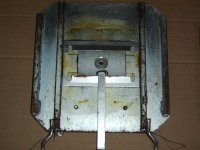
Not of Weaver Degree Alignment Plates but here's some pics of something similar.
Photo 1 - Plate with locking pins removed
" 2 - Plate with locking pins in place (for transport or driving onto)
" 3 - Underneath of plate showing sliding mechanism, up/down/l/r.
" 4 - Enlarged view of slider mechanism underneath plate. Upper plate
rotates c.40 degrees left or right on bearing in centre of shot.
Al.
 

Attachments

  • STA70375.JPG
    STA70375.JPG
    82.3 KB · Views: 20
  • STA70376.JPG
    STA70376.JPG
    80.5 KB · Views: 15
  • STA70377.JPG
    STA70377.JPG
    78.9 KB · Views: 16
  • STA70378.JPG
    STA70378.JPG
    74.2 KB · Views: 16

F124C

Well-known member
Joined
Aug 19, 2013
Messages
1,829
Location
Ireland
They're positioned under the steered wheels and measure no. of degrees steered/turned by the wheels. These alignment plates have built-in turntables. The other/rear wheels need to be raised and supported by the same thickness as the A. plates.

They're used to check 'toe-out-on-turns', steering angles left/right and when measuring castor angle etc. You also need castor/camber/kingpin inclination gauges and tracking (toe-in/toe-out) gauges to do a full wheel and suspension alignment.

All the above has now afaik been supplanted (learned a new big word, been waiting a while to use it!) by the modern computerised alignment rack with laser sights?

Al.


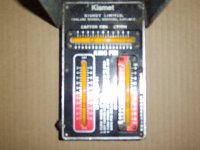
Pics of similar Castor/Camber/KPI gauges. Including mounting frame to attach to wheel rim. There are also alternative mounting types e.g. magnetic/ for spoked wheels/ clamp onto hub nut.
 

Attachments

  • STA70379.JPG
    STA70379.JPG
    82.2 KB · Views: 7
  • STA70380.JPG
    STA70380.JPG
    80.8 KB · Views: 9
  • STA70382.JPG
    STA70382.JPG
    81.6 KB · Views: 10

ttpete

Well-known member
Joined
Mar 8, 2011
Messages
6,737
Location
Dearborn, MI
Pics of similar Castor/Camber/KPI gauges. Including mounting frame to attach to wheel rim. There are also alternative mounting types e.g. magnetic/ for spoked wheels/ clamp onto hub nut.

The ones I used were magnetic. You pulled the wheel bearing cap and they seated on the flat end of the hub. You read camber direct and then set the caster bubble level with wheels straight ahead, then turn the wheel hard out and read caster.
 

F124C

Well-known member
Joined
Aug 19, 2013
Messages
1,829
Location
Ireland
The ones I used were magnetic. You pulled the wheel bearing cap and they seated on the flat end of the hub. You read camber direct and then set the caster bubble level with wheels straight ahead, then turn the wheel hard out and read caster.

Ya' got it! :thumbup:

(The type I showed is really only good for steel rims.)

Al.
 
To avoid these ads, REGISTER NOW!
Top Bottom