
torqueman2002
Well-known member
The purpose of this thread is to bring to light the potential dangers of using vintage/old grinding stones found on used bench grinders.
As many of you know, there are several threads about vintage grinders - Craftsman 'Block' grinders in particular.
Also, many readers are probably familiar with the 'ring test' to determine if the grinding stone has unseen flaws/cracks.
See: 1, below.
I have had questions about my practice of destroying vintage/old grinding stones, that I find on CM Block grinders.
I do this, because vitreous stones are susceptible to moisture damage. The bonding material can become degraded, and the stone can come apart at speed.
"Vitrified wheels may be sensitive to repeated temperature variations. Irregularly absorbed moisture may throw the wheel out of balance. Consequently, it is most important that wheels are carefully handled at all stages and kept in an orderly manner in a dry and protected place."
See: 2, below.

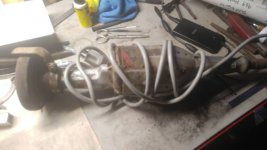
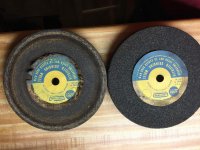
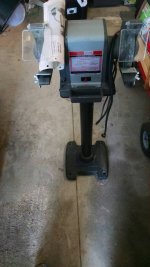
The following pictures of used grinding stones came from vintage CM Block grinders. They appear to be original, and probably 4 decades old.
6" dia. 1/3-HP Block grinder m-397.19580 | Note the rust rings.


Same as above, plus 8" dia. 1-HP Block m-397.19360 | Note evidence of grinding on the sides of the stones, which they are not designed for.


Note evidence of non-ferrous metal (aluminum) embedded in the 8" stones. This can result in stone failure when ferrous metal is ground without proper dressing of the wheel.

It's a shame to destroy vintage tools, but these are consumables and not worth the risk. IMO

Use aluminum oxide wheels for all types of steels.
Use silicon carbide green wheels for tungsten cabide and non-ferrous metals such as brass, bronze and aluminum.
Thanks for reading.

For more grinder related links and resources, follow the link below and see post #1.
http://www.garagejournal.com/forum/showthread.php?t=249539
=======================================
Additional information/links
1 Link for one of the many YouTube videos on 'Ring Testing' a grinding stone. --> http://www.youtube.com/watch?feature=player_embedded&v=NDtL4gisZYo
2 A Google search for "vitrified grinding stones and moisture" produced several links, one of which is below.
Grinding and Polishing - Encyclopaedia of Occupational Health and Safety.
http://www.iloencyclopaedia.org/par...sing-and-metal-working/grinding-and-polishing
As many of you know, there are several threads about vintage grinders - Craftsman 'Block' grinders in particular.
Also, many readers are probably familiar with the 'ring test' to determine if the grinding stone has unseen flaws/cracks.
See: 1, below.
I have had questions about my practice of destroying vintage/old grinding stones, that I find on CM Block grinders.
I do this, because vitreous stones are susceptible to moisture damage. The bonding material can become degraded, and the stone can come apart at speed.
"Vitrified wheels may be sensitive to repeated temperature variations. Irregularly absorbed moisture may throw the wheel out of balance. Consequently, it is most important that wheels are carefully handled at all stages and kept in an orderly manner in a dry and protected place."
See: 2, below.
The following pictures of used grinding stones came from vintage CM Block grinders. They appear to be original, and probably 4 decades old.
6" dia. 1/3-HP Block grinder m-397.19580 | Note the rust rings.
Same as above, plus 8" dia. 1-HP Block m-397.19360 | Note evidence of grinding on the sides of the stones, which they are not designed for.
Note evidence of non-ferrous metal (aluminum) embedded in the 8" stones. This can result in stone failure when ferrous metal is ground without proper dressing of the wheel.
It's a shame to destroy vintage tools, but these are consumables and not worth the risk. IMO
Use aluminum oxide wheels for all types of steels.
Use silicon carbide green wheels for tungsten cabide and non-ferrous metals such as brass, bronze and aluminum.
Thanks for reading.
For more grinder related links and resources, follow the link below and see post #1.
http://www.garagejournal.com/forum/showthread.php?t=249539
=======================================
Additional information/links
1 Link for one of the many YouTube videos on 'Ring Testing' a grinding stone. --> http://www.youtube.com/watch?feature=player_embedded&v=NDtL4gisZYo
2 A Google search for "vitrified grinding stones and moisture" produced several links, one of which is below.
Grinding and Polishing - Encyclopaedia of Occupational Health and Safety.
http://www.iloencyclopaedia.org/par...sing-and-metal-working/grinding-and-polishing
Last edited:






 a little more, I believe replacing used stones of unknown history is prudent.