To avoid these ads, REGISTER NOW!

Mystery Logo on Inside Micrometer

Private Lugnutz

Well-known member
Joined
Mar 30, 2012
Messages
30,574
Location
The Authentic Jersey Shore
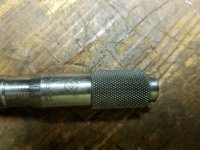
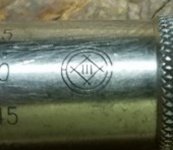
As first reported on the 2018 Garage Sale thread, I picked up a 125-150mm inside micrometer at the flea market today. It has a model number 126 stamped on the body. Starrett used that model number for one of their inside micrometers, but it's not marked Starrett. Strangely, it's not marked with any name. It has a logo stamped on it, but I am not familiar with it. See thumbnail #3 below.

Does anyone recognize it?
 

Attachments

  • 20180428_092248.jpg
    20180428_092248.jpg
    78.4 KB · Views: 121
  • 20180428_092304.jpg
    20180428_092304.jpg
    120.1 KB · Views: 108
  • 20180428_092304 zoom.jpg
    20180428_092304 zoom.jpg
    91.1 KB · Views: 140
To avoid these ads, REGISTER NOW!

larry_g

Well-known member
Joined
Apr 28, 2007
Messages
16,879
Location
oregon
Not sure on the logo. It's also a bit strange that the thimble end does not seem to have a radius on it, does it? That is some different kind of a devise.

lg
no neat sig line
 
OP
P

Private Lugnutz

Well-known member
Joined
Mar 30, 2012
Messages
30,574
Location
The Authentic Jersey Shore
There are short anvils on both ends, larry. The anvil on the thimble end is hidden from view by the angles of the photos. Both anvils are radiussed. This is an inside micrometer. It's not provisioned for longer rods, though. The black material is Bakelite. I am guessing 1930's to early 1940's.

I'll try to take some additional photos later.
 

Provincial

Well-known member
Joined
Sep 21, 2011
Messages
6,869
Location
Near Salem, OR
The plastic is there to insulate the micrometer from body heat transferred from the fingers. That indicates that, given the estimated age, this micrometer was intended for measuring very critical dimensions, as for inspecting gauge blocks or other precision parts.

The lack of provision for interchangable anvils and the somewhat cumbersome lock mechanism also point toward this use.

The combination of age and metric gradations indicate foreign origin. I have no clue to the marking.
 
OP
P

Private Lugnutz

Well-known member
Joined
Mar 30, 2012
Messages
30,574
Location
The Authentic Jersey Shore
Thanks for your thoughts, guys. I agree with all your analysis and conclusions, Provincial, except for the COO. I am not wholly convinced it's not US-made quite just yet. Note that Starrett was making a metric inside micrometer (No. 126M) as early as 1917. It was 7-25cm, though, and I will admit it is strange to have no brand and no COO markings.
 

davethorik

Well-known member
Joined
Sep 14, 2013
Messages
4,992
Location
Norka, Ohio
I was going suggest the micrometer head for an end measure set, but with the rubber piece on there it would not sit flat.
 

MShaw

Well-known member
Joined
Mar 2, 2015
Messages
1,013
Location
York, Pa.
"I was going suggest the micrometer head for an end measure set"
That was my thought also. Same reason why not.
 

Mintgrun

Well-known member
Joined
Oct 7, 2015
Messages
2,124
Location
Kingston, Wa.
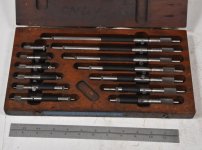
I did a little image searching, just for fun and found a set by Brown and Sharpe that look quite similar, though not identical. Not much help, I know; but, here ya go.

B S inside mic set.jpg
 
To avoid these ads, REGISTER NOW!

DadsTools

Well-known member
Joined
Jul 27, 2017
Messages
1,852
The logo does seem to hint at an oriental design. I've seen similar marks on Asian ceramic and pottery.

If it's imported, one would think it should have a COO mark based on US trade laws, even if just on the tube. An exception is when it might be part of a larger kit or set. For example, a tea pot may be marked on the base of the pot, but not requiring a mark on the lid. The unmarked tube may indicate it was part of a set, the larger packaging or components that bore the COO info.
 

4xdog

Well-known member
Joined
Aug 18, 2012
Messages
5,611
Location
Santa Fe, NM
There's no way, IMO, that micrometer could have been made forty or fifty-plus years ago in China.

Even in the twenty-plus years I've been traveling there I've seen the country progress from a state where precision tools had to be imported to one where it has its own strong internal capability.

Small chance of Taiwan, but I doubt that. I'd bet on Japan, or European, if not USA.
 

DadsTools

Well-known member
Joined
Jul 27, 2017
Messages
1,852
The opposite is true: if it had been "Made in USA" it would be so marked.

It is almost certainly Chinese.
Yes, if it were USA, it would be likely all over it, though I've seen a few examples of vintage USA tools that were not so marked.

The point I was trying to make is that, according to US trade laws, imported items MUST be marked with COO. However, that mark can be in various places. One place it's allowed is on the packaging. You can mark the package with the COO without marking the tools inside. Excellent case in point is modern Chinese made tools that have no COO mark on the tool itself, and this has become the norm in recent years. However, if you look at the packaging, it will definitely have the COO buried somewhere on it.

You could have a China socket set complete with blow mold case and the only COO will be found on the cardboard retail sleeve the case was in.

In the instance of the OP tool, the fact that neither the toll nor the tube is marked with any COO or brand name indicates to me that it was part of a larger set, the COO info being on the packaging or a large main component within the set, or on the main case itself.

It should be noted also that just because an item incorporates bakelite or one of its close relatives (can't recall the names of these 'me-too' compounds, but would be easy to look up) does not automatically indicate older production. Bakelite is still being used in modern production. Look at the link to these modern, common bakelite ashtrays you've seen everywhere:

https://www.katom.com/370-AST4BK.html?gclid=EAIaIQobChMIjPze1uLi2gIVESlpCh0T_g9DEAQYAyABEgL8W_D_BwE

I know that as late as the 1960s, bakelite was still being used on larger radio knobs and handles for what were considered then to be 'portable' radios, as well as electrical components like sockets. It was still being used at that time on some side plates for conventional fishing reels like Penn or Ocean City. I bet it wouldn't be too hard to find examples of even later production on some common items.

So I don't think, Lugz, that we can offhand date the tool that early based solely on a bakelite-type component. We'd need some other corroborating clue.

I recall when working on a milling project one time that these cardboard tubes were still in use as late as the 1990s. I'm not sure about that anymore, I'd imagine they'd be all plastic but I don't know.

If it's Chinese--and that's a big "if"--based on my experience with other collectibles and vintage item categories outside tools, such a marking would be characteristic of Chinese imports BEFORE the modern era of "everything's made in China." It would more likely be from the Japan era (50s-60s) or the Korea-Hong Kong era (late 60s-70s), not as a source, mind you, but as a time period. Also wouldn't surprise me if it were Japanese 1950s-60s.

This is all just semi-educated guesses.
 

DadsTools

Well-known member
Joined
Jul 27, 2017
Messages
1,852
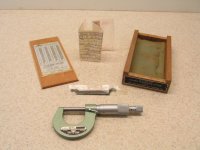
Here is an example of a Japanese caliper from the 1960s having a stylized logo but only having a label on the tool itself, since a simple label is compliant with US trade laws. Were the label to fall off or be removed, there would be no ID marks on the tool at all. Note too that the calibration wrench has no need of a marking itself because it's included in the marked set.
 

Attachments

  • IMG_4701.jpg
    IMG_4701.jpg
    146.8 KB · Views: 33
  • IMG_4708.jpg
    IMG_4708.jpg
    148.3 KB · Views: 24
OP
P

Private Lugnutz

Well-known member
Joined
Mar 30, 2012
Messages
30,574
Location
The Authentic Jersey Shore
Thanks, ARFLY. I agree. Even thought the particular marking on my model no. 126 inside micrometer is not shown, it bears enough similarities to make a slightly less than definitive identification to TALW arsenal, for the time being. That also confirms my original estimation on timeframe, as well. I am a military collector, and the reason I picked it up was because the instrument definitely looked military and wartime to me. Bakelite may have lasted longer than the 40's in other domains, but it's still a good tell in my domain, especially for tools, as far as I know. And the marking looked like insignia. Three Corps, if you will. I will admit I wasn't thinking Japan though. Thanks much for the solid lead.

Shout out to ganymede, post #4. :)
 

DadsTools

Well-known member
Joined
Jul 27, 2017
Messages
1,852
It looks very similar to the markings from Toyada Jido from the WWII time period.
View media item 82798
These bayonet markings are a strong lead for the cross-cornered diamond. I think you're onto something. There was definitely a consensus forming in here that the symbol was of oriental origin.

I was stuck thinking commercial products for the marketplace. This might explain the lack of commercially relevant marks. Plus I keep forgetting that there's access to a lot more older and diverse stuff up Jersey-way than there is in dimpled-chad Florida.

I was poking around a bit on the web following this reveal. The challenge with unraveling this mystery is that all the web info focuses on weapons like guns and bayonets. WWII Jap micrometers don't seem to be on the radar. The interior 'beehive symbol seems to be associated with Toyada Loom Works (from which Toyota Motors emerged) with the added variations of having a triangle either on the top or bottom. According to this pattern, the III inside does not indicate a specific armory but the maker. I could find no info on what the variations stand for.

The relevant bayonets bear two symbols, the beehive/diamond and the 3-circle symbol. This online reference for WWII Jap rifles and bayonets lists the 3-cirkle as the arsenal symbol, in both cases Nagoya (the site claims several authoritative books as references)

http://oldmilitarymarkings.com/japanese_markings.html

The second symbol represents the subcontractor. Yet ARFLY's graphic shows this same 3-circle symbol designated by a couple of different arsenal names. So there's an apparent discrepancy here. I located the source of ARFLY's post here:

http://antiqueoutings.com/japanese-bayonet-markings/

This chart was apparently put together by a collector/dealer Tom Crandall, who states that an authoritative book inspired him to compile it. It seems to me that this chart is then less credible than the first site mentioned. The info on the first site is also more internally consistent, and seems to concern itself more with accurate historical info, while the second site is focused on what to look for of value when buying these bayonets.

In lieu of additional information, the discrepancy between the two sources just about obligates one to choose between the two. I personally think the first site is more historically authoritative, so I'd go with the interpretation that the diamond/beehive is Toyada (a conclusion on which that all references appear to agree) and the 3-circle is Nagoya arsenal. The site is very detailed. For example, I've seen other dealer/collector sites stating some double-symbol bayonets are the marks of two different arsenals, which makes little sense. The first site lists such instances as a mfr mark (sometimes an unknown mfr) under the supervision of a known arsenal.

If we work under the assumption that the first site is correct, that leaves us with a few other details to solve. First is the symbol on the micrometer itself. It does not bear a second arsenal symbol, but only a maker symbol. That means the item was not made "under the supervision" of a particular arsenal. This makes sense to the extent that the tool may not have needed to be standardized to a specific spec like a weapon and its accessories, but only that it satisfied a specific function. If my original assumption was correct that this item was part of a larger set (and I still think the lack of markings on the tube indicate this), then the accessory mic only needed to be compatible for use with the other components in the set.

Next is the meaning of the cross-cornered diamond. Was this always a symbol for Toyada? If so, this might mean that the symbol inside, whether beehive or III might designate different divisions or different types of products. Another possibility is that the diamond + III is a symbol for a different mfr altogether. One would need access to specific records regarding this.

Another question that might be relevant is who assigned the symbols? Were they existing company logo symbols, were they self-assigned during the war, or did the military devise and assign them? This opens a possibility that the symbol may have been used by that mfr on its products as a company logo for non-military contract items also.

The question remains--how did this item find its way into the US? There's a number of possibilities. One of the main goals of post-war reconstruction was to convert Japan to an industrial-based society. measuring instruments like these would have been quite valuable and would likely not have been destroyed simply because it was military issue. This would differ from rifles and bayonets that were prime mementos for GIs and their disposal a welcome aspect of reconstruction.

A commercial channel is a possible solution. From 1945-47, no exports from Japan were allowed. 1947-52, any exports to the US had to be marked Occupied Japan. 1952 the "Occupied" requirement was dropped. Starting in 1952, a number of products were exported to the US having excellent precision and accuracy. From the tool side, a look at these early Allenite tools is a real eye opener. The engineering of the first 1952 Olympic fishing reels was remarkable, cloning the French Mitchell reels so closely that most of the parts were perfectly interchangeable. Based on my study of post-war Japanese fishing reels, this accuracy degraded over the next several years so that by the late 1950s, it was the "Jap-****" we were all familiar with. Apparently such high-grade product did not prove the be the most profitable approach, but it certainly made for a good showing for reputation when they first came out of the gate. Most of this carried logos very reminiscent of the style on this mic, a traditional approach to logos going back a very long time in Japanese culture, especially on their ceramics and pottery.

I know these are some "ifs" but IF the symbol on the tool was issued by the military for its exclusive use, then the tool is probably confined to the war years (for Japan, I think that was 1937-45). However, if it were adopted as a company logo, and lacking any arsenal marking, the micrometer might still be an early 1950s export, which would also explain how it found its way here.
 
Last edited:
OP
P

Private Lugnutz

Well-known member
Joined
Mar 30, 2012
Messages
30,574
Location
The Authentic Jersey Shore
Good luck as you continue to search. Keep us posted on what you find.
Thanks, and will do.

While Toyoda Automatic Loom Works (TALW) was used for rifles and bayonets, I haven't found any mention of the production of measuring instruments on Toyota's excellent and extensive history pages. That doesn't mean it's not TALW. The lack of info and the double-circle around what highly resembles a TALW logo could mean it's not strictly TALW.

When I think of Japanese micrometers, I think of Mitutoyo, and according to them, they were the first maker in Japan, in 1934. Not sure that means anything, yet, but if they were making micrometers in 1934, I am sure they were making them during the war, would've been under government control during the war, and almost certainly would've been part of Occupied or Post-Occupation production. I highly doubt Mitutoyo was exporting micrometers in the late 1930's. I haven't found any old markings for them, though, akin to TALW.

IF the symbol on the tool was issued by the military for its exclusive use, then the tool is probably confined to the war years (for Japan, I think that was 1937-45).
As far as I know, Japanese military equipment bore Japanese characters for make, model, and stock number information. Note again that this micrometer is marked "126" (which I interpret as a model number) and "125-150mm", both markings etched in the Bakelite sleeve. This isn't Japanese military. If that is indeed a Toyoda Jidoshoki Seisakushu (TALW) factory or other similar factory mark on it, it has to be post-war, either Occupation or Post-Occupation. It could've been made in Japan by a TALW-related factory for reconstruction efforts inside the country, to be used by GHQ/SCAP/Far East Commission forces and contractors inside the country. Possibly export.

As for how it got here, it was in a lot of stuff I bought from a house close-out guy that included other wartime era machinist's tools (among them, the Lufkin No 77C radius gage set, which I am showing in a separate thread) as well as other WWII militaria, including a machete and an axe, and the previous owner was a WWII vet. I am wary of making too much of those associations without substantiation, but it's possible he served in Post-War Japan. My aunt did. I will try to find out more about the previous owner if I run into the vendor again.
 
To avoid these ads, REGISTER NOW!
Top Bottom