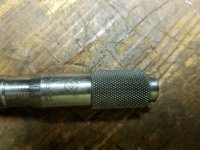
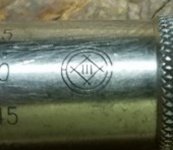
It looks very similar to the markings from Toyada Jido from the WWII time period.
View media item 82798
These bayonet markings are a strong lead for the cross-cornered diamond. I think you're onto something. There was definitely a consensus forming in here that the symbol was of oriental origin.
I was stuck thinking commercial products for the marketplace. This might explain the lack of commercially relevant marks. Plus I keep forgetting that there's access to a lot more older and diverse stuff up Jersey-way than there is in dimpled-chad Florida.
I was poking around a bit on the web following this reveal. The challenge with unraveling this mystery is that all the web info focuses on weapons like guns and bayonets. WWII Jap micrometers don't seem to be on the radar. The interior 'beehive symbol seems to be associated with Toyada Loom Works (from which Toyota Motors emerged) with the added variations of having a triangle either on the top or bottom. According to this pattern, the III inside does not indicate a specific armory but the maker. I could find no info on what the variations stand for.
The relevant bayonets bear two symbols, the beehive/diamond and the 3-circle symbol. This online reference for WWII Jap rifles and bayonets lists the 3-cirkle as the arsenal symbol, in both cases Nagoya (the site claims several authoritative books as references)
http://oldmilitarymarkings.com/japanese_markings.html
The second symbol represents the subcontractor. Yet ARFLY's graphic shows this same 3-circle symbol designated by a couple of different arsenal names. So there's an apparent discrepancy here. I located the source of ARFLY's post here:
http://antiqueoutings.com/japanese-bayonet-markings/
This chart was apparently put together by a collector/dealer Tom Crandall, who states that an authoritative book inspired him to compile it. It seems to me that this chart is then less credible than the first site mentioned. The info on the first site is also more internally consistent, and seems to concern itself more with accurate historical info, while the second site is focused on what to look for of value when buying these bayonets.
In lieu of additional information, the discrepancy between the two sources just about obligates one to choose between the two. I personally think the first site is more historically authoritative, so I'd go with the interpretation that the diamond/beehive is Toyada (a conclusion on which that all references appear to agree) and the 3-circle is Nagoya arsenal. The site is very detailed. For example, I've seen other dealer/collector sites stating some double-symbol bayonets are the marks of two different arsenals, which makes little sense. The first site lists such instances as a mfr mark (sometimes an unknown mfr) under the supervision of a known arsenal.
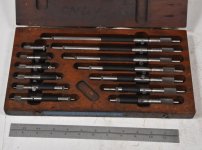
If we work under the assumption that the first site is correct, that leaves us with a few other details to solve. First is the symbol on the micrometer itself. It does not bear a second arsenal symbol, but only a maker symbol. That means the item was not made "under the supervision" of a particular arsenal. This makes sense to the extent that the tool may not have needed to be standardized to a specific spec like a weapon and its accessories, but only that it satisfied a specific function. If my original assumption was correct that this item was part of a larger set (and I still think the lack of markings on the tube indicate this), then the accessory mic only needed to be compatible for use with the other components in the set.
Next is the meaning of the cross-cornered diamond. Was this always a symbol for Toyada? If so, this might mean that the symbol inside, whether beehive or III might designate different divisions or different types of products. Another possibility is that the diamond + III is a symbol for a different mfr altogether. One would need access to specific records regarding this.
Another question that might be relevant is who assigned the symbols? Were they existing company logo symbols, were they self-assigned during the war, or did the military devise and assign them? This opens a possibility that the symbol may have been used by that mfr on its products as a company logo for non-military contract items also.
The question remains--how did this item find its way into the US? There's a number of possibilities. One of the main goals of post-war reconstruction was to convert Japan to an industrial-based society. measuring instruments like these would have been quite valuable and would likely not have been destroyed simply because it was military issue. This would differ from rifles and bayonets that were prime mementos for GIs and their disposal a welcome aspect of reconstruction.
A commercial channel is a possible solution. From 1945-47, no exports from Japan were allowed. 1947-52, any exports to the US had to be marked Occupied Japan. 1952 the "Occupied" requirement was dropped. Starting in 1952, a number of products were exported to the US having excellent precision and accuracy. From the tool side, a look at these early Allenite tools is a real eye opener. The engineering of the first 1952 Olympic fishing reels was remarkable, cloning the French Mitchell reels so closely that most of the parts were perfectly interchangeable. Based on my study of post-war Japanese fishing reels, this accuracy degraded over the next several years so that by the late 1950s, it was the "Jap-****" we were all familiar with. Apparently such high-grade product did not prove the be the most profitable approach, but it certainly made for a good showing for reputation when they first came out of the gate. Most of this carried logos very reminiscent of the style on this mic, a traditional approach to logos going back a very long time in Japanese culture, especially on their ceramics and pottery.
I know these are some "ifs" but IF the symbol on the tool was issued by the military for its exclusive use, then the tool is probably confined to the war years (for Japan, I think that was 1937-45). However, if it were adopted as a company logo, and lacking any arsenal marking, the micrometer might still be an early 1950s export, which would also explain how it found its way here.