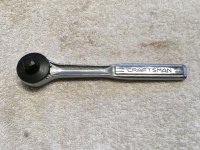
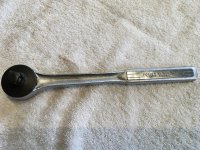
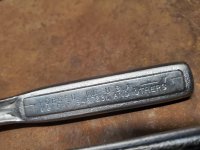
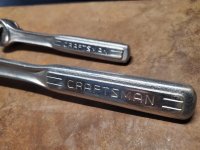
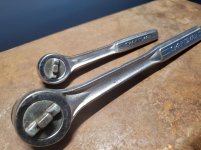
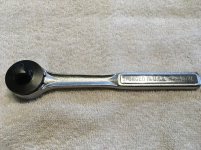
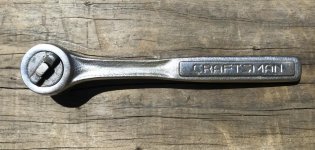
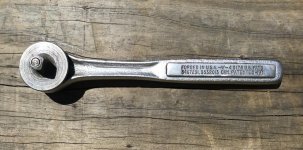
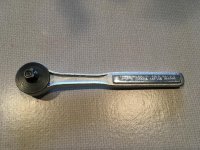
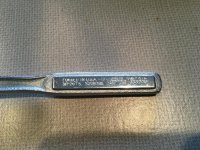
Hey Dad, check this one out. Although the stamps are reversed on the handle, the letter “A” is pointed. I think your “Craftsman Dating Lottery” assessment has a lot of validity. Putting a timeline on these things isn’t easy.
Jim C.
Don't know what the Cman boys were smoking. I don't think it was crack since it wasn't around then, but there was certainly plenty of other things to smoke.
Another member, Lesserstore, recently conducted a case study on Craftsman sockets in which you posted so I know you're familiar with it. He cited the flat-top A as being introduced in the early 70s based on catalogs. But I know from my research for my vintage fishing tackle book that it was not uncommon for companies to continue using photos, descriptions and line art in their catalogs years after that particular iteration of the product was discontinued. Saved time and money when everything was laid out by hand. They reused just about anything they considered 'close enough'. The same is true in the tool industry. So the Sears catalogs can only take you so far.
Since none of us were actually there when they running the Lottery, we can only go by the artifacts and assess them according to what should be normal conventions when compared with other industries (i.e., in the case of Craftsman, PAT PEND before patent numbers, no-item numbers before item numbers, pointy-A before flat-A, etc.). This has always been a path of fuzzy logic with the Craftsman =v= and -v- stuff. Close thumbnails seem to be the best anyone could muster.
However, the patent info on these unique ratchets that also happen to correspond to the fuzzy years of transition to -v-, model numbers and flat-A may supply us with some more distinct info. Well....just maybe.

The first convention we'd have to rely on is that Sears was actually being honest when they marked the tools patent pending--that there was actually a patent application filed during that time, and not just something still on the drawing board they were planning to file. So........if their use of patent pending is to be believed, then the dates of the patent apps and issues on the two numbers in question must give us a clearer reference point than ever before.
We DO know that at some point, the pointy-A was replaced across the line with the flat-A, what year depends on who you ask. But, if my dating assessment is correct of Types 1 through 4 based on the patent markings, your pointed-A example gives us a hard date that at least some switch-over occurred during the Type 1 years of 1968-69. That is the hardest date I've ever seen for this. If they followed marketplace conventions by marking patent pending only AFTER they actually filed the patent app, then this date is 100% good. If that's the case (lots of ifs), then for the first time we can say definitively that the changeover to flat-A began during these years. That would be a first!
I think we can say that the issued patent numbers are good for their particular dates because they really couldn't use them until the patent numbers were actually issued. HOWEVER, we really can't say for sure how long of time it may have been between when the patent(s) were issued and when they started using them in the stamping. Let's
assume for a moment that they wanted to mark these issued patents on the tool asap.
We do see a sort of fudging on Sears part in my Type 3 with the single patent number followed by "and others"--since they stamped ALL the patent numbers on the Type 4, I think it's safe to conclude that at the time of the Type 3, they only had one issued patent. So I think the Type 3 dates are good.
Finally, if we are going to 'type' these based on the markings, your pointy-A example represents another type. Rounding off to the closest practical years, that brings us to:
Type 1 = 1968; =v=, patent pending, no model number, pointy-A
Type 2 = 1969; same as above but with a flat-A
Type 3 = 1969-70; -v-, patent pending, model number, flat-A
Type 4 = 1969-70; -v-, one patent number "and others", no model number, flat-A
Type 5 = 1971; -v-, 3 patent numbers + 1971, model number, flat-A
Type 6 = ????; -v-. no patent info, model number, flat-A
We cannot say for certain about the chronology of Types 3 & 4 because both has features that would make one earlier than the other. But I think it's safe to bracket both in the same years.
As for Type 5 with the 1971 date, this has been by far the most common type I've seen in-person and online, so I suspect it was made for some years. Which leads me to my ???? on Type 6 dating, because I have no idea when Type 5 ended. We can say that Type 6 markings at some point became the standard markings for all -v- Cman RP wrenches and those with different codes that followed down til today.
If Sears was sincere in its patent-related markings on these ratchets, this chronology will represent the end of the 'fuzzy era' with the most precise dating to date of the transitions from pointy-A to flat-A, =v= to -v-, and no-model numbers to model numbers.
Oy!