To avoid these ads, REGISTER NOW!

Treasured Craftsman RHFT ratchets

OP
B

b.well

Well-known member
Joined
May 13, 2020
Messages
391
Location
NY
StillTooManyHobbies. I believe your VK series was made by Danaher after 1996.

Here is a 7 type proposal. No more complete with dates around type 5 and 6. It does cover Jim's 4 patent example. It does cover Post V models (loosely).

Type 1 = 1968; =V=, patent pending, no model number, pointy-A
Type 2 = 1969; same as above but with a flat-A
Type 3 = 1969-70; -V-, patent pending, model number, flat-A
Type 4 = 1969-70; -V-, various patent number(s), maybe "and others", maybe model number, flat-A
Type 5 = 1971; -V-, 3 patent numbers + 1971, model number, flat-A
Type 6 = ????; -V-. no patent info, model number, flat-A
Type 7 = 1986-2008; post V, no patents, no year, flat-A
 
To avoid these ads, REGISTER NOW!
OP
B

b.well

Well-known member
Joined
May 13, 2020
Messages
391
Location
NY
Lesserstore. Thank you for those details. I also emailed someone selling one on ebay and they said "Taiwan in the 80s". Good to see two sources line up. I did not realize Craftsman made any hand tools outside the USA in the 80s. Surely not as early as 82 when the -V- line was still going strong. I did look into EE sockets recently and also found they were mostly Taiwan 82-91. In recent years, the pecking order I believe in terms of hand tool quality is USA, Taiwan, China. Also in recent years, I have seen Dewalt hand tools made in Taiwan. Might be interesting to learn how Taiwan got started in tools; from Stanley? But that's a whole other topic.
 

Lesserstore

Well-known member
Joined
Mar 18, 2020
Messages
864
Location
Texas
"I did look into EE sockets recently and also found they were mostly Taiwan 82-91."

Really? All of the EE sockets I have and seen are US made. Maybe the Canadian Craftsman series?
 

3baygarage

Well-known member
Joined
Sep 1, 2013
Messages
11,941
Location
SW Florida/from Buffalo,NY
These were made in Taiwan by Stanley from 1982-91 but I don't know when the flex stubby was introduced. They were unmarked with a coo too hide that fact. They were made as a cheaper alternative to the quick release ratchets.

Just a fun fact, there are some tri-wing ratchets stamped Taiwan. Not sure where they fall along the timeline. The ones I had were in a black cased socket set.
 
OP
B

b.well

Well-known member
Joined
May 13, 2020
Messages
391
Location
NY
Did some patent digging. Will they clear or muddy the water?

Dated_____ 03/09/65 09/28/65 9/16/69 10/06/70
Filed______ 02/19/63 04/24/64 2/12/68 05/01/68
4 US Patents 3172675 3208318 3467231 3532013
2 US Pats 1971_____________ 3467231 3532013


Ok so two are the same. But what are they for?

3172675 Ball Socket for Impact Tool
3208318 QR for Socket Wrenches
3467231 Pawl reversing mechanism
3532013 QR mechanism for fine tooth ratchet wrenches

Ok... so the two for the type5 1971 make sense
the two for the type4 four us pats...not as much. also interesting they are 4-5 years older than the other two.... thoughts?
 
OP
B

b.well

Well-known member
Joined
May 13, 2020
Messages
391
Location
NY
I messaged about 12 ebay sellers that had RHFT patent ratchets (4pats or 1971) asking what year the ratchet was from. So far doesn't seem any are the original owner. Maybe the original owner never sells these.... One seller quoted me the patent dates and tracked down a "tool talk log" where someone dated the change in the RHFT model numbers. Accuracy is not guaranteed but it's a good place to start and makes sense in the type list. Please know all of these dates are potentially off +/- year(s). It is widely believed there is overlap in Craftsman manufacturing and here is no exception.

I do want to find more evidence for when the "No Ram" models were released. When is their first showing in the sears catalog? If you have access to sears catalogs around 1980 please help!

Type 1 = 1968; =V=, patent pending, no model number, pointy-A
Type 2 = 1969; same as above but with a flat-A
Type 3 = 1969-70; -V-, patent pending, model number(R), flat-A
Type 4 = 1969-70; -V-, patent number(s), maybe "and others", maybe model number(R), flat-A
Type 5 = 1971-80; -V-, 3 patent numbers + 1971, ram model number(R), flat-A
Type 6 = 1980; -V-, patent pending, model number(NR), flat-A
Type 7 = 1980-86; -V-, no patent info, model number(NR), flat-A
Type 8 = 1986-2008; post V, no patent info, no year, model number(NR), flat-A

(R) = Ram; quick release protrudes out the drive tang
(NR) = No Ram; drive tang end is solid

Use the chart below to identify your model number. Model numbers are listed to the right of their respective drive size and under their respective type #.
Type ____ 1-5__ 6-8
Drive____ Ram_ No Ram
1/4" ____ 43178 43187
3/8" ____ 43788 43781
1/2" ____ 44978 44977
3/8" Flex_ 42794 42792
1/2" Flex_ 44973 44983
 
Last edited:

DadsTools

Well-known member
Joined
Jul 27, 2017
Messages
1,852
Do you have this one on the list? It reads: -v-, model #, four US patent #s, flat top A.
Thanks Jim! That's an important find. If we are Typing according to markings, this would definitely represent a different Type.

I cannot read all the patent numbers on the handle. If you could, please post them for us. We need to look at the USPTO issue dates. This will tell us if it pre-dates or post-dates the "1971" type.

Once again, the patent info gives us the ability to rise somewhat above the normal Craftsman dating mud.
 
Last edited:

DadsTools

Well-known member
Joined
Jul 27, 2017
Messages
1,852
I messaged about 12 ebay sellers that had RHFT patent ratchets (4pats or 1971) asking what year the ratchet was from. So far doesn't seem any are the original owner. Maybe the original owner never sells these.... One seller quoted me the patent dates and tracked down a "tool talk log" where someone dated the change in the RHFT model numbers. Accuracy is not guaranteed but it's a good place to start and makes sense in the type list. Please know all of these dates are potentially off +/- year(s). It is widely believed there is overlap in Craftsman manufacturing and here is no exception.

I do want to find more evidence for when the "No Ram" models were released. When is their first showing in the sears catalog? If you have access to sears catalogs around 1980 please help!

Type 1 = 1968; =V=, patent pending, no model number, pointy-A
Type 2 = 1969; same as above but with a flat-A
Type 3 = 1969-70; -V-, patent pending, model number(R), flat-A
Type 4 = 1969-70; -V-, patent number(s), maybe "and others", maybe model number(R), flat-A
Type 5 = 1971-80; -V-, 3 patent numbers + 1971, ram model number(R), flat-A
Type 6 = 1980; -V-, patent pending, model number(NR), flat-A
Type 7 = 1980-86; -V-, no patent info, model number(NR), flat-A
Type 8 = 1986-2008; post V, no patent info, no year, model number(NR), flat-A

(R) = Ram; quick release protrudes out the drive tang
(NR) = No Ram; drive tang end is solid

Type ____ 1-5__ 6-8
Drive____ Ram_ No Ram
1/4" ____ 43178 43187
3/8" ____ 43788 43781
1/2" ____ 44978 44977
3/8" Flex_ 42794 42792
1/2" Flex_ 44973 44983
I don' think we can place a patent pending marked ratchet after a patent number ratchet. So I don't think the Type 6 in this list is correctly placed.

I also think that you might set the ram or no-ram feature aside for a moment. Just my opinion. I would try to get the chronology of the markings down first before it gets too confusing. From my experience in publishing a book on vintage fishing tackle, I found it best to sort by type first, then variations. You have to "pick a lane" and drive in it. I feel the markings are the main lane we should be in. The ram is a variation IMO.

Jim C. 's exampole with the four us patent numbers need the issue dates confirmed so we can see if this is a pre-"1971" or post.
 
Last edited:
OP
B

b.well

Well-known member
Joined
May 13, 2020
Messages
391
Location
NY
Dad
Type 6 is a new model number; and the first of that new model could be patent pending. The No Ram models are different than the Ram models. The model numbers are in the chart below the types sorted by their respective drive size. Take size 3/8" for example. Types 1-5 are model 43788 and types 6-8 are model 43781. Unless one proves otherwise everything I have seen shows the No Ram was introduced with the new part numbers. Prove me otherwise :)

I confirmed the four us patent numbers in my post #45. Please read that post for clarity on the patent information. Two of the four patents match with the 1971 type5. The two extra patents are 4-5 years older.
 
Last edited:
OP
B

b.well

Well-known member
Joined
May 13, 2020
Messages
391
Location
NY
Dad here is the inspiration for type6. Its the patent pending 43781 with No Ram.
 

Attachments

  • RHFT 3.8 -V- 43781 patent pending 01 back.jpg
    RHFT 3.8 -V- 43781 patent pending 01 back.jpg
    35.6 KB · Views: 46
  • RHFT 3.8 -V- 43781 patent pending 01 front.jpg
    RHFT 3.8 -V- 43781 patent pending 01 front.jpg
    40.5 KB · Views: 46
Last edited:
OP
B

b.well

Well-known member
Joined
May 13, 2020
Messages
391
Location
NY
After more digging I found some Craftsman catalogs online. And thanks to JimC for giving me the details from the 1979-80 catalog. Here is what I found.

1978-79 power and hand tool catalog, page 119
Fine-tooth Ratchet Wrenches
1/4" 43178 6oz
3/8" 43788 11oz
1/2" 44978 1lb 7oz

1979-80 power tool and hand tool catalog, page 125
1/4” 43178
3/8” 43788
1/2” 44978

1981 spring catalog of power and hand tools, page 64
Fine-tooth Ratchet
1/4" 43187 4oz
3/8" 43781 9oz
1/2" 44977 1lb 5oz

The RHFT line clearly changed model number in the 1980-81 time frame. It is probably easiest to say RHFT Gen2 started with Type6. Funny Gen2 RHFT is 2oz lighter than it's Gen1 sibling. Did the change in QR make that much of a difference? You be the judge.

This is newest catalog I found. Model numbers are the same as the 1981 catalog.
1994-1995 Craftsman power and hand tools, page 35
1/4" 43187 0.25lb
3/8" 43781 0.50lb
3/8" 42794 0.88lb Flex
1/2" 44977 1.31lbs
1/2" 44983 2lbs Flex
 
Last edited:

Jim C.

Well-known member
Joined
Jan 8, 2010
Messages
2,598
Thanks Jim! That's an important find. If we are Typing according to markings, this would definitely represent a different Type.

I cannot read all the patent numbers on the handle. If you could, please post them for us. We need to look at the USPTO issue dates. This will tell us if it pre-dates or post-dates the "1971" type.

Once again, the patent info gives us the ability to rise somewhat above the normal Craftsman dating mud.

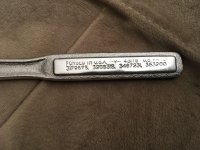
The four patent numbers are: 3172675, 3208318, 3467231, 3532013
 

Attachments

  • D509F5AE-3E87-49FB-B32D-BB938906A06B.jpg
    D509F5AE-3E87-49FB-B32D-BB938906A06B.jpg
    149.8 KB · Views: 52

DadsTools

Well-known member
Joined
Jul 27, 2017
Messages
1,852
The four patent numbers are: 3172675, 3208318, 3467231, 3532013
Thanks! Looks like b.well already caught these. It's strange that they decided on this one variation to put those older patent numbers on this too, the direct relevance to the rhft being a bit fuzzy. Yet another prize drawing in the never-ending saga of The Craftsman Dating Lottery.
 

DadsTools

Well-known member
Joined
Jul 27, 2017
Messages
1,852
b.well and I are collaborating in PMs to refine this Typing. He is VERY CLOSE to tying this down. When it finally gets posted here, I think you'll be impressed.
 

ganymede

Well-known member
Joined
Nov 29, 2012
Messages
2,332
Location
New England
b.well and I are collaborating in PMs to refine this Typing. He is VERY CLOSE to tying this down. When it finally gets posted here, I think you'll be impressed.

I have 6 rhft's that are waiting to learn their birth year (+or - a few years ).
:)
 

Jim C.

Well-known member
Joined
Jan 8, 2010
Messages
2,598
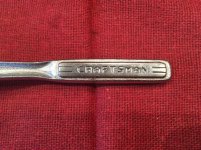
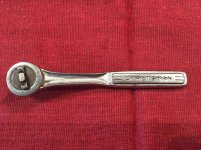
Here’s the earliest version of the Cman 1/4” drive RHFT ratchet. Although the 1/2” and 3/8” versions of this ratchet first appeared in the 1970 catalog, the 1/4” made its debut in the 1971 catalog. Notice it has the pointed letter “A” and “PATENT PENDING” stamps.

Jim C.
 

Attachments

  • C1ABF23C-1D27-4DDC-B050-B8EAE570EBA1.jpg
    C1ABF23C-1D27-4DDC-B050-B8EAE570EBA1.jpg
    150.8 KB · Views: 44
  • 23B3FBAF-62A1-44C9-8BC5-509EEE929DAE.jpg
    23B3FBAF-62A1-44C9-8BC5-509EEE929DAE.jpg
    151.5 KB · Views: 40
  • 892E6CAB-0B3C-4154-9E07-DFEE11FC0C20.jpg
    892E6CAB-0B3C-4154-9E07-DFEE11FC0C20.jpg
    148.8 KB · Views: 42
  • 258EDFF0-D6D1-4F77-9FE3-B3FC90D7CB5A.jpg
    258EDFF0-D6D1-4F77-9FE3-B3FC90D7CB5A.jpg
    149.8 KB · Views: 45
Last edited:
OP
B

b.well

Well-known member
Joined
May 13, 2020
Messages
391
Location
NY
Jim. Very interesting. That squarely falls into type1. Possible its from 1968 as we have all =V= from? We rely on the catalog for alot but also know its not 100% accurate. Great piece!

I am working on collecting that set of =V= RHFTs. I was lucky to find a minty 1/2 model. Thought I only need now to find it's ONE smaller sibling. Thanks for now giving me another to search out :)
 
Last edited:
OP
B

b.well

Well-known member
Joined
May 13, 2020
Messages
391
Location
NY
Grannymeade, have you used my typelist from post 46? Would love to know if it covers all your ratchets accurately! Please post pics of any that dont fall in one of the current types. Thank you :)
 
Last edited:

ganymede

Well-known member
Joined
Nov 29, 2012
Messages
2,332
Location
New England
Grannymeade, have you used my typelist from post 46? Would love to know if it covers all your ratchets accurately! Please post pics of any that dont fall in one of the current types. Thank you :)

All of mine are covered.
They all have flat top A's so no type 1.

Edit: 1 actually has 4 patent #'s.
Flat top a with no bars beside the logo.
View media item 104302
 
Last edited:
OP
B

b.well

Well-known member
Joined
May 13, 2020
Messages
391
Location
NY
Type 4 currently covers your 4 patent example. There are a few variations in that same timeframe that I grouped together. In the updated type list I am working on I did separate the current type 4 into their specific variations with their own type numbers. Unofficially, I expect your new type will still be type 4 :)
 
To avoid these ads, REGISTER NOW!

DadsTools

Well-known member
Joined
Jul 27, 2017
Messages
1,852
I have 6 rhft's that are waiting to learn their birth year (+or - a few years ).
:)
I think b.well and I finally have this all ironed out. You'll have your dates soon! Here again, the patent info on the handles gives us an unprecedented authoritative source external to Sears and the catalogs. Government-issued hard dates that will also help clear up some of the mud with the transition dates from =v= to -v- and from pointed-A to flat-A. I'm actually surprised no one has ever dug into this rhft so deep before. Hat's off to b.well for getting it going!
 

DadsTools

Well-known member
Joined
Jul 27, 2017
Messages
1,852
All of mine are covered.
They all have flat top A's so no type 1.

Edit: 1 actually has 4 patent #'s.
Flat top a with no bars beside the logo.
View media item 104302
We came up with a very interesting line of reasoning to chronologically place this four-patent number version, which I'll expand upon once b.well posts his final findings.
 

Jim C.

Well-known member
Joined
Jan 8, 2010
Messages
2,598
It’s good to see the information coming together. I’m looking forward to reading the type study you guys come up with. When I finished the Cman teardrop ratchet type study, I thought about trying to do another one. The Cman RHFT was on my short list of potential subjects. I sort of started to collect various examples but didn’t get serious about it. I’m glad I can cross it off my list now that you guys got it off the ground! Anyway, I was looking through my pre-type study RHFT notes and found this blurb that I wrote to myself a few years ago.

“The 3/8” drive and ½” drive models appeared in the Sears product line at some point around 1970. The 1/4” model joined the line up in 1971. It appears that all three ratchets were offered through 2008. The ¼”, 3/8” and ½” models had 70, 82, and 90 teeth respectively from 1970 through 1977. In 1978 the tooth count was essentially cut in half to 35, 41 and 45 respectively.”

I don’t know how deep you’re going to dive into the type study, but if tooth count is part of it, here you go.......

Jim C.
 
Last edited:

DadsTools

Well-known member
Joined
Jul 27, 2017
Messages
1,852
It’s good to see the information coming together. I’m looking forward to reading the type study you guys come up with. When I finished the Cman teardrop ratchet type study, I thought about trying to do another one. The Cman RHFT was on my short list of potential subjects. I sort of started to collect various examples but didn’t get serious about it. I’m glad I can cross it off my list now that you guys got it off the ground! Anyway, I was looking through my pre-type study RHFT notes and found this blurb that I wrote to myself a few years ago.

“The 3/8” drive and ½” drive models appeared in the Sears product line at some point around 1970. The 1/4” model joined the line up in 1971. It appears that all three ratchets were offered through 2008. The ¼”, 3/8” and ½” models had 70, 82, and 90 teeth respectively from 1970 through 1977. In 1978 the tooth count was essentially cut in half to 35, 41 and 45 respectively.”

I don’t know how deep you’re going to dive into the type study, but if tooth count is part of it, here you go.......

Jim C.
So far, we have been going entirely on the markings. The only mechanical distinction made so far was in the change from a ram quick release to a no-ram quick release. But its tied to a change in the markings, where once again the patent pending mark was used, but on a ratchet having a model number as well. We don't have a patent application number for this pending. It's quite possible that the patent was never issued because it failed the examiner's test of being sufficiently "novel" and/or "unobvious" to someone skilled in the trade. I'm sure there are a number of past tools that were first marked pat. pend. but never progressed to an actual patent number because the application was rejected.

The type study so far has been limited to visual identification. As you know, there are times in these studies where you have to "pick a lane and drive in it." The lane we picked was visual identification. If there were a visually distinct change on the tool when it switched to a lower tooth count, then a new Type could be created based on that. Otherwise, I think it might have to be designated as a variation, such as TypeX-a or Type X-b.

But this brings up another question: if the tooth count was cut in half in 1978, would that then still be considered a TRUE RHFT, or does the true RHFT end in 1977?
 
OP
B

b.well

Well-known member
Joined
May 13, 2020
Messages
391
Location
NY
This is the first I have heard of the tooth count changing on the RHFT at any time. My understanding is there have always been 35T(1/4), 41T(3/8) and 45T(1/2). The wording I have seen in the sears catalog does not say 90t outright, just that it feels like 90t. The key are the pawls. The dual pawls with 3 teeth per pawl(6 teeth total) is what gives the feel of twice the tooth count, ~4 degree arc swing, and the extra strength. Typical -V- is one pawl 2 teeth.
 

Jim C.

Well-known member
Joined
Jan 8, 2010
Messages
2,598
......... But this brings up another question: if the tooth count was cut in half in 1978, would that then still be considered a TRUE RHFT, or does the true RHFT end in 1977?

Well, I guess that is a question you have to ask. If I was writing this thing using the parameters you just laid out, I’d probably keep going, because your evaluation of each example is pretty much external markings, patent dates, etc. When I put together the Cman Teardrop Type Study, I initially based all of my evaluation criteria on external markings, handle stamps, etc. When I learned of some internal differences, like tooth counts, I noted it where necessary within the type study. My goal was to give people a look at all the ratchets within that family and hopefully enough information to match their ratchet(s) to an approximate period in time. Only after I got that solidified, did I then start looking for more information inside the ratchets. Now when I add to the thread, most of the information deals with the actual guts versus the external features. And a lot of that is really just me picking fly sh*t out of pepper because I like to do that stuff.

If you guys can come away with a type study that allows someone to look at his/her ratchet and match it to a time period, then I’d say mission accomplished. I guess the only stumbling block is if you miss one and then need to do a revision. A lesser, but still sort of important issue, is determining if each type actually was produced in all three drive sizes. Like I said earlier, I’m interested to see what you guys did with this thing. I think you’re on the right track!

Jim C.
 
Last edited:

ganymede

Well-known member
Joined
Nov 29, 2012
Messages
2,332
Location
New England
Guys. Re read the Haznar patents. It talks about the offset pawl arrangement. Two pawls offset. When one is engaged, the other is out. As the pawl that was engaged moves out the idle pawl moves into position.
 
Last edited:

Jim C.

Well-known member
Joined
Jan 8, 2010
Messages
2,598
This is the first I have heard of the tooth count changing on the RHFT at any time. My understanding is there have always been 35T(1/4), 41T(3/8) and 45T(1/2). The wording I have seen in the sears catalog does not say 90t outright, just that it feels like 90t. The key are the pawls. The dual pawls with 3 teeth per pawl(6 teeth total) is what gives the feel of twice the tooth count, ~4 degree arc swing, and the extra strength. Typical -V- is one pawl 2 teeth.


:lol_hitti. So in their 1970-1975 catalogs, Sears used some tricky language....
“..... 3/8-in drive ratchet has 82-tooth action ..... 1/2-in drive has 90-tooth action ......”

In my notes to self, I wrote 90 and 82 tooth blah blah blah. I guess the word “action” has a very defined meaning in this case, and I missed it!

Although, in the 1976, and 1977 catalogs Sears lists “number of teeth” not “tooth action” and goes on to list them at “70, 82, 90.” Very misleading and confusing.

In the 1978 catalog, Sears lists each ratchet’s respective “tooth count”, those being 35, 41 and 45. That’s a little more straightforward and half the “number of teeth” listed in its previous two catalogs. Now I see how I came up with my numbers. Anyway......

New note to self: “Tooth action” and “tooth count” do NOT mean the same thing!

Jim C. (Who stands corrected)
 
Last edited:

DadsTools

Well-known member
Joined
Jul 27, 2017
Messages
1,852
:lol_hitti. So in their 1970-1975 catalogs, Sears used some tricky language....

“..... 3/8-in drive ratchet has 82-tooth action ..... 1/2-in drive has 90-tooth action ......”

In my notes to self, I wrote 90 and 82 tooth blah blah blah. I guess the word “action” has a very defined meaning in his case, and I missed it!

Although, in the 1976, and 1977 catalogs Sears lists “number of teeth” not “tooth action” and goes on to list them at “70, 82, 90.” Very misleading and confusing.

In the 1978 catalog, Sears lists each ratchet’s respective “tooth count”, those being 35, 41 and 45. That’s a little more straightforward and half the “number of teeth” listed in its previous two catalogs. Now I see how I came up with my numbers. Anyway......

New note to self: “Tooth action” and “tooth count” do NOT mean the same thing!

Jim C. (Who stands corrected)
Thanks for checking this out. Once again, the catalogs can prove to be a snag.

I think b.well is going to be able to post his final Type list later today (Sunday). We've got it tied down really well, and have solved two of the final minor glitches.
 
Last edited:
OP
B

b.well

Well-known member
Joined
May 13, 2020
Messages
391
Location
NY
And just when we think we've got it "tied down". In comes a couple new finds. Always seems to be the case with Craftsman. Especially around patent years!
 

Jim C.

Well-known member
Joined
Jan 8, 2010
Messages
2,598
And just when we think we've got it "tied down". In comes a couple new finds. Always seems to be the case with Craftsman. Especially around patent years!

I feel your pain! Hang in there, keep plugging away.

Jim C.
 

DadsTools

Well-known member
Joined
Jul 27, 2017
Messages
1,852
I feel your pain! Hang in there, keep plugging away.

Jim C.
Jim, I haven't taken the time to say how impressive your type study is with the TD ratchets. It's quite an inspiration, and quite an undertaking. My hat's off to you.

The RHFT is proving to be nowhere near as complex, but in some places, just as mysterious. I believe the critical key puzzles have been solved.

b.well and I believe we now have everything we need to finally publish a sound, comprehensive study. It's now a matter of putting it all together in an easy-to-follow comprehensive way that will also lend itself to updating if needed.
 

Jim C.

Well-known member
Joined
Jan 8, 2010
Messages
2,598
Hey Dad,

Wow, many thanks for the kind words!! Totally unnecessary, but greatly appreciated. I’m pulling for you guys! Doing a type study on such a well known series of ratchets is not as easy as some might think. A lot of research goes into it. I still think one of the hardest parts of the whole project is identifying all the iterations within the series. Just take your time and keep plugging away at it. I’m a big fan of the thread and look forward to reading your finished product. And again, many thanks for your compliment.

Jim C.
 

Downwindtracker 2

Well-known member
Joined
Jun 13, 2019
Messages
1,715
Location
BC
A thank you for all the work you guys have put in. I have a type #3 1/4" I purchased new and type#5 3/8" fleamarket find.
 

DadsTools

Well-known member
Joined
Jul 27, 2017
Messages
1,852
Hey Dad,

Wow, many thanks for the kind words!! Totally unnecessary, but greatly appreciated. I’m pulling for you guys! Doing a type study on such a well known series of ratchets is not as easy as some might think. A lot of research goes into it. I still think one of the hardest parts of the whole project is identifying all the iterations within the series. Just take your time and keep plugging away at it. I’m a big fan of the thread and look forward to reading your finished product. And again, many thanks for your compliment.

Jim C.
You deserve the accolades!

We now have all the necessary information. We are in the process of assembling it in a comprehensive, informative and useful way. I am finding that a list with a bunch of data is not what is needed here. There's a lot of backstory as well. I believe a section needs to be devoted to our objective, approach, the reasoning behind certain choices, and our sources. Another section needs to have a brief summary for each Type explaining the underlying details and reckoning. b.well has completed the list. I've completed the Approach section. It's too big to message! So I'm waiting for an email address to send it to him for review. This will be more like an essay when it's completed.
 
OP
B

b.well

Well-known member
Joined
May 13, 2020
Messages
391
Location
NY
Yes, I believe, a great accomplishment. Thanks for all the help along the way!
 

rbryantaz

Member
Joined
Feb 9, 2024
Messages
11
Location
phoenix, AZ
Great thread.

it is too bad that they never made a 1/4 or 3/8 stubby flex head.

I found posts in the craftsman tool collectors threads on facebook where tri-wing 94378 stubby handle can be attached to make what is in my opinion a better ratchet.

I had a cheap pittsburgh round head flex ratchet laying around and found that the handle from that also fits the 3/8 eastco head very well so that is now one of my go to ratchets. I did shim the handle with a wave washer to really tighten it up but it wasn't really necessary.

I had the gearwrench 90 stubby 3/8 for a little while and just didn't like the feel of it. The pittsburgh felt better in my hand and now the hybrid stubby RHFT is pretty nice.

For a stubby I prefer the round head with a thumb wheel even over my hybrid gearwrench 3/8" that is in a 1/4" body. The pear head just seems awkward off center and unbalanced in a small stubby ratchet. The 3/8" in 1/4" body modified gearwrench is better than the stubby 3/8" that gearwrench sells but it still isn't as nice as the RHFT stubby!

The long handle on the RHFT just seems like overkill. IMO the locking gearwrench 84/90/120xp are better for a long handle flex head ratchet...

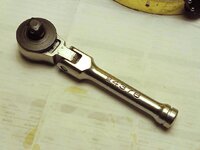
The hybrid 94378 from Facebook craftsman tool collectors:

FB_IMG_1753665214325.jpgFB_IMG_1753665206229.jpg

My economy blasphemy Pittsburg handle version...
20250727_174702.jpg20250727_174646.jpg
 
Last edited:
To avoid these ads, REGISTER NOW!
Top Bottom