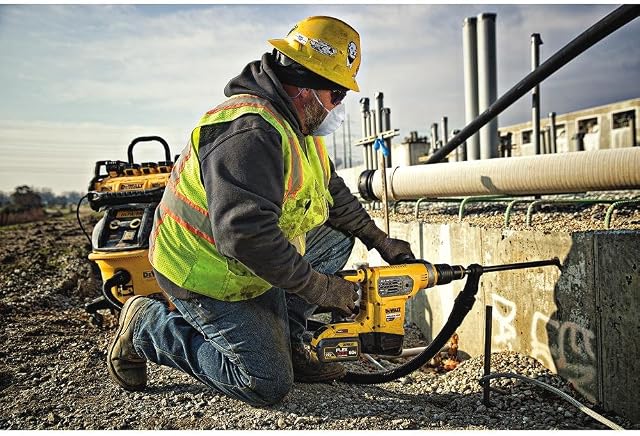
As others have alluded to, this type of tool is difficult to translate to a battery (or more broadly, electrically) operated version. To get any sort of real performance, given the current technology available the tool needs to essentially do internally what the air compressor would be doing anyway, so it is going to end up heavier/bulkier, more expensive, and probably lower performing. Other types of tools (impacts, drills, etc.) are mostly converting pneumatic energy into rotary motion- something that is straightforward to do with electrical energy as well. A tool like this hammer- requiring strong, rapid, back and forth movement- is a little different. It might be theoretically possible to do something with electromagnetism I suppose, but that's not out there yet. Many of the rapid advances in cordless tools recently have revolved around the development of extremely powerful (for a given size) brushless motors running off of high voltage, energy-dense batteries. Once those components are developed, it's just a matter of figuring out how to adapt them to all sorts of different tools. High energy reciprocating hammer-type tools are one where it is not just a simple matter of packaging and powertrain design to make it work.
Pneumatics have some operating characteristics that are hard to beat for certain applications. One is hand-held tools for continuous, relatively high speed operations, especially when the nature of the job is such that you frequently bog the tool down. Think of a Dremel vs. a pneumatic die grinder- that's a tool where air power shines. Another is rapid release of large amounts of energy in quick succession, like an air hammer. The "explosive," energy-dense nature of compressed gas just suits the operation extremely well. For a somewhat similar application, look at "cordless" nailers. Yes, there are nailers that operate exclusively on battery power (DeWalt) but, other than convenience, my impression is that they are OK at best- a case of trying to fit the square peg of battery power into the round hole of using a sharp blow to drive a nail. The more successful compressor free nailers are those like the Paslode which are essentially internal combustion engines, using fuel to ignite and create the pulse of energy that you would otherwise get from compressed air.