To avoid these ads, REGISTER NOW!

Welding on an air compressor

reznunt

Well-known member
Joined
Dec 13, 2009
Messages
273
Location
Socal
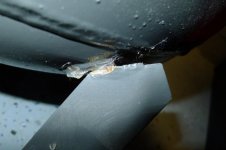
I have a two year-old vertical air compressor that stands on two wheels on one side, and a U-shaped bracket with rubber feet on the other. The factory (very crappily) welded the bracket to the outer tank at two points. One of these welds has broken off. When it broke off, the bracket left all of the filler material behind on the tank surface. I would like to repair it with my trusty HF flux core welder loaded with Lincoln wire.

Before starting this repair, is there anything I should be aware of, or is this a straightforward job that I think it will be? I just want to observe a bit of extra caution around things like pressure vessels. TIA!
 

Attachments

  • P1000685.jpg
    P1000685.jpg
    40.6 KB · Views: 174
  • P1000684.jpg
    P1000684.jpg
    41.8 KB · Views: 225
Last edited:
To avoid these ads, REGISTER NOW!

ForceFed70

Well-known member
Joined
Apr 27, 2010
Messages
3,441
Location
BC, Canada
Should be fine. Try not to add more heat than absolutely required. And of course: Open the valve to the tank before welding.
 

djjsr

Well-known member
Joined
Sep 4, 2006
Messages
4,796
Location
In the cornfields
Take it to a pro. It won't cost much to have it done and a faulty pressure tank can be a disaster waiting to happen. JMO.
 

MoonRise

Well-known member
Joined
Nov 5, 2010
Messages
4,028
Location
NJ
Weld on the actual exterior of the tank surface?

No - No - No - No - No

And also, NO!

Clear enough.

You do NOT weld on a pressure vessel unless you are certified/approved to do so with certified/approved materials and procedures, including the specified inspections afterward. Period.

No matter how bad the OEM weld was, you do NOT weld on a pressure vesssel unless you KNOW exactly what you are doing.

And have the certifications and paperwork and liability insurance 'proving' you know what you are doing.

And the bracket welded to the outside of the pressure vessel is still considered welding on a pressure vessel.

And btw, I don't think you would EVER find Lincoln listing their 'typical' small welder NR211-MP FCAW wire as approved for pressure vessel welding. And that is about the only kind/class of small spool and small diameter FCAW wire that will run on the small 'home' FCAW/GMAW machines. It is NOT rated for impact or fatigue conditions, both of which are DarnImportant for a pressure vessel.
 

ForceFed70

Well-known member
Joined
Apr 27, 2010
Messages
3,441
Location
BC, Canada
Yeesh. You'd think he's welding on an oxygen tank or something.

Let's be honest here folks. These tanks arn't rated or tested, they are not hardened metal. The majority are manufactured in China with no quality control.

Even if the metal is weakened, it's not going to explode or anything like that. Air compressor tanks rust through all the time... when's the last time you heard of one exploding due to the weakened metal? Or one exploding at all for any reason?

My brother works up north and is certified to weld high pressure gas lines, etc. I asked him when it was time to weld a bung into my air tank. I said "what do I need to do to make this safe" his reply "Wear your hood".
 
Last edited:

KrisKustomPaint

Well-known member
Joined
Sep 8, 2010
Messages
99
I wouldn't use flux core, but i wouldn't have a problem welding on an air compressor tank, the factory welds aren't all that great anyway. Its only 150 psi or so its not like its going to shoot through the wall if your weld fails. its just going to rip the side of the tank and blow all the pressure out, the noise will be scarier then damage caused.
 

MoonRise

Well-known member
Joined
Nov 5, 2010
Messages
4,028
Location
NJ
Actually, the compressed air tanks (and their design and construction) ARE rated and tested. At least at some point in the design cycle.

And different locales may have slightly different certification on the design and construction and repair of air compressor tanks. In my locale, ASME Pressure Vessel Codes apply.

And although it is not -as- dangerous as welding on a high-pressure cylinder ...

[DISCLAIMER - - - Do NOT-NOT-NOT-NOT Ever weld or strike an arc on a high-pressure gas cylinder!!!!! ]

If not abused, and given even a little bit of care, a 'typical' high-pressure gas cylinder can have a service life around 100 YEARS!

Strike an arc on such a cylinder and it is pretty much condemned.

Yes, it -IS- a big deal to weld on a pressure vessel.

Back to the air compressor cylinder/tank.

Do -NOT- weld on it. Even just a little bit.

Do

NOT

Weld

It !!!

Crappy or broken OEM weld or not, you do NOT weld on a pressure vessel unless you KNOW what you are donig.

No "This should be OK."

No "I think this will be fine."

No "It looks OK now."

No.

No.

No.

And yes, air tanks and pressure vessel can and do fail. And even a 'little' air tank at a 'low' pressure of 100-150 pounds or so can destroy things (and people) if it fails catastrophically.

If a steel air compressor tank fails by rusting through, that -usually- just means the air will leak out.

If that same air tank fails because you welded on it and made the metal brittle or hard or set up any other material condition (such as due to the HAZ or the filler metallurgy or such) that leads to a brittle failure (as opposed to a ductile failure) then things can get RealBad-RealQuick. As in shrapnel.

Do NOT weld on a pressure vessel.

If you have to ask, you don't KNOW what you are doing.
 

ZRX61

Well-known member
Joined
Aug 15, 2006
Messages
28,716
Location
Solar Blight Valley, SoCal
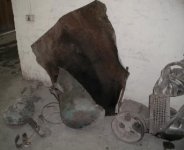
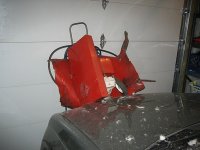
Yeah, what could possibly go wrong?

DSC_5075.JPG
 

djd99

Well-known member
Joined
May 4, 2009
Messages
1,006
Location
Owosso,Michigan
I have a two year-old vertical air compressor that stands on two wheels on one side, and a U-shaped bracket with rubber feet on the other. The factory (very crappily) welded the bracket to the outer tank at two points. One of these welds has broken off. When it broke off, the bracket left all of the filler material behind on the tank surface. I would like to repair it with my trusty HF flux core welder loaded with Lincoln wire.

Before starting this repair, is there anything I should be aware of, or is this a straightforward job that I think it will be? I just want to observe a bit of extra caution around things like pressure vessels. TIA!

Once again this topic comes up!!!:lol_hitti And once again There will always be members that will tell you not to do this but in reality it's done all the time and even members here that have welded there tanks with no problems.
Hell if you listen to the members here I wouldn't have my homemade sandblaster because they would tell you it's too dangerous. Once again I've been using this tank for over 15 years with no problem with pressures up to 170 pounds. OMG I should be dead. LMAO
Maybe if you have to ask this question you shouldn't be doing such a repair. All you need to do is empty the tank, grind down the factory welds and reweld the bracket back on. I could have it fixed by the time this reply was done. Flame on don't care I'll continue to use my broken down remanufactured(by me) tools.
 
Last edited:

ForceFed70

Well-known member
Joined
Apr 27, 2010
Messages
3,441
Location
BC, Canada
Yeah, what could possibly go wrong?

DSC_5075.JPG

Classic example of a rusted out tank letting go. Do you know what happened? Pressure limit switch failure or just a tank failure?

Regardless, looking at that pic... the roof shingles it was sitting on wern't even disturbed. The damage to the one shingle seems to be from the leg of the tank and not the failure itself. I'm sure it make a loud noise when it let go, but that's about it.
 

Theloniousmonk

Well-known member
Joined
Sep 10, 2010
Messages
1,814
Location
Where the tall corn grows!
Classic example of a rusted out tank letting go. Do you know what happened? Pressure limit switch failure or just a tank failure?

Regardless, looking at that pic... the roof shingles it was sitting on wern't even disturbed. The damage to the one shingle seems to be from the leg of the tank and not the failure itself. I'm sure it make a loud noise when it let go, but that's about it.

Funny, that tank used to be in the garage.

These things are not to be triffled with... I don't care if guys slag on em all the time... you run the risk.

Oh, and most any tank, afaik, larger than 20gal. is US made, check your build tag on the tank. They ARE tested and rated.

PS: That pic is also a good example of why you should drain your tank once in a while.
 

djjsr

Well-known member
Joined
Sep 4, 2006
Messages
4,796
Location
In the cornfields
I can't believe a couple of you guys are recommending this guy do his own repair without knowing his welding skills.
 
OP
R

reznunt

Well-known member
Joined
Dec 13, 2009
Messages
273
Location
Socal
I can't believe a couple of you guys are recommending this guy do his own repair without knowing his welding skills.

i'm not a professional, but i'm not a beginner either. i haven't gone beyond mig/flux core. my last project i completed was a nice little welding cart.
 
OP
R

reznunt

Well-known member
Joined
Dec 13, 2009
Messages
273
Location
Socal
i added pics if that helps at all. it's weird that the vote is split when i thought all GJ members were geniuses. :confused:

still waiting to do this repair... all i have gotten so far is FUD. no rush though since it still stands on the one leg.
 

Screamin' Metal

New member
Joined
Sep 30, 2010
Messages
2
Since we're not talking about a .25 wall thickness tank wall....hopefully that will be a single stage, and one of those cheap robotic mig welds where they're worried about production and not longevity
That being said....if your a good welder, a qualified welder to do those type of repair....(me, I've done hot taps on 36" cross country pipelines before, but I weld for a living, too)....get yourself a good 220 welder, 175 is good. Wires size needs to be .023 to .030, 75/25 argon/co2. Straight co2 runs too hot, don't need innershield or gasless. Better to got less deep than too deep.....
Clean off the paint with a 4 1/2 flap wheel, don't remove any metal, just remove the paint. Go get your self a piece of 10 ga. sheetmetal and pratice running a good bead on it. If you flip the sheetmetal over and you start to see a bead appear.....since your not a pro, your going too deep. Either speed up your hand some or back off on your wire speed if you don't have a true variable voltage tap on the machine.
Then, weld your bracket on. Barely apply the air pressure, about 25 psi, apply a water / soap mix to be sure no pinholes, air her up 1/2 way, check it again, then full and check it agian. If all is good,do not just throw air pressure to this type of repair, slowly turn it on, you should be OK.....
 
Last edited:

rwhite692

Well-known member
Joined
Mar 4, 2008
Messages
1,850
Location
Central Valley, CA
If any of you think that the guy at the compressor manufacturer, whose job it was to weld little brackets to the outside surface of the tank for wheels/handles and such, was a pro welder, you are dreaming.

Compressor manufacturers almost universally, buy the tank from a supplier; that tank is welded and certified to ASME specs, etc. Any additional doodads like wheel brackets are up to the manufacturer to take care of.
 
Last edited:
OP
R

reznunt

Well-known member
Joined
Dec 13, 2009
Messages
273
Location
Socal
Once again this topic comes up!!!:lol_hitti

i think the other topic (regarding the propane tank) was more about combustible gases or traces thereof. i'm more concerned with the integrity of a pressurized tank after welding.
 

Screamin' Metal

New member
Joined
Sep 30, 2010
Messages
2
Classic example of a rusted out tank letting go. Do you know what happened? Pressure limit switch failure or just a tank failure?

Regardless, looking at that pic... the roof shingles it was sitting on wern't even disturbed. The damage to the one shingle seems to be from the leg of the tank and not the failure itself. I'm sure it make a loud noise when it let go, but that's about it.

Dawm, I want some of that stuff that roof is made out of!!!!
 
To avoid these ads, REGISTER NOW!

bdkruger1

Banned
Joined
Sep 14, 2010
Messages
349
Location
Constant Disbelief
My GOD some of you guys on this board that think you know welding are just plain out in LA LA land.

1.- Unplug the compressor.

2.- drain all air from compressor, and leave the valve OPEN.

3.- LIGHTLY sand the paint from the leg, and the weld remaining on the tank. LEAVE the weld remaining on the tank to REMAIN.

4.- Position the broken leg back in place with where the weld broke.

5.- WELD the leg bracket back onto the remaining weld on the tank.

6.- Allow the tank bracket repair area to cool until its cold to the touch.

7.- Re-Fill the tank slowly to it's max capacity and let it sit for an hour or so.

8.- Did it hold?, OK all is good. Prime the repair and have a nice day!
 

Ben Iv

Well-known member
Joined
Jul 23, 2010
Messages
212
Location
Oklahoma
Weld on the actual exterior of the tank surface?

No - No - No - No - No

And also, NO!

Clear enough.

You do NOT weld on a pressure vessel unless you are certified/approved to do so with certified/approved materials and procedures, including the specified inspections afterward. Period.

No matter how bad the OEM weld was, you do NOT weld on a pressure vesssel unless you KNOW exactly what you are doing.

And have the certifications and paperwork and liability insurance 'proving' you know what you are doing.

And the bracket welded to the outside of the pressure vessel is still considered welding on a pressure vessel.

And btw, I don't think you would EVER find Lincoln listing their 'typical' small welder NR211-MP FCAW wire as approved for pressure vessel welding. And that is about the only kind/class of small spool and small diameter FCAW wire that will run on the small 'home' FCAW/GMAW machines. It is NOT rated for impact or fatigue conditions, both of which are DarnImportant for a pressure vessel.

Do you really think the guy in china or mexico who welded that bracket on had any sort of certification? Its a bracket just weld the damn thing on. You should see some of the **** from mexico that we fix in our shop that companies are too cheap to have bult in america in the first place.
 

gorilla

Well-known member
Joined
Dec 13, 2007
Messages
1,650
If you feel that you are capable of welding your air tank do it. The most important thing to do is to have the tank hydro tested after you weld it. Pressure vessels are tested with high pressure water never with air. YOU ARE RISKING YOUR LIFE WHEN YOU TEST A PRESSURE VESSEL WITH HIGH PRESSURE AIR!!!!!
 

79firebird

Well-known member
Joined
Aug 19, 2008
Messages
385
Location
Victoria bc
There are some things i will do and some i will not. One thing i will not do is weld on a compressor. Why you ask years ago i welded a leg like that had it aired up in a back shead was fine for months turned the compressor on i hear a hissing. I went out back to see it had blown a hole where it was welded and a peace was in the wall what if it was in the open with someone next to it. Im not a exbert welder but i do know what im doing. I work in autobody so im allways welding new panles on repairing frames on new and old stuff. Would i weld on a compressor agane NO i would not
 

e-tek

Well-known member
Joined
Dec 19, 2007
Messages
10,690
Location
Saskatoon, SK
Every once in a while we get the legal-eagle type that comes on and wags his finger, with "disclaimers" and "No-No's" and Don't-Don'ts"..... This is a forum where people DO things....safely yes, but come-on, it's a compressor leg, NOT the filler bung on an O2 cyclinder!! :shocking:

I'd weld that leg on in a heart beat. It's not the same as trying to weld up a cracked or rusted tank.....
 

KrisKustomPaint

Well-known member
Joined
Sep 8, 2010
Messages
99
Every once in a while we get the legal-eagle type that comes on and wags his finger, with "disclaimers" and "No-No's" and Don't-Don'ts"..... This is a forum where people DO things....safely yes, but come-on, it's a compressor leg, NOT the filler bung on an O2 cyclinder!! :shocking:

I'd weld that leg on in a heart beat. It's not the same as trying to weld up a cracked or rusted tank.....


Hell yeah!

Nay sayers are everywhere. There are those that don't hear the words "you can't do that". These are the people that set records at Bonneville, invent cool things, and are immortalized in history. The flip side is a lot of people die doing stupid things, but welding a leg on a compressor isn't one of them.
 

danski0224

Well-known member
Joined
Jan 29, 2005
Messages
13,370
Location
Near Naperville, IL
Classic example of a rusted out tank letting go. Do you know what happened? Pressure limit switch failure or just a tank failure?

Regardless, looking at that pic... the roof shingles it was sitting on wern't even disturbed. The damage to the one shingle seems to be from the leg of the tank and not the failure itself. I'm sure it make a loud noise when it let go, but that's about it.

I would be more interested in the roof next door.

Unless that compressor was installed outside or it is a staged photo, it went though a roof to get there.
 

danski0224

Well-known member
Joined
Jan 29, 2005
Messages
13,370
Location
Near Naperville, IL
I have a two year-old vertical air compressor that stands on two wheels on one side, and a U-shaped bracket with rubber feet on the other. The factory (very crappily) welded the bracket to the outer tank at two points. One of these welds has broken off. When it broke off, the bracket left all of the filler material behind on the tank surface. I would like to repair it with my trusty HF flux core welder loaded with Lincoln wire.

Before starting this repair, is there anything I should be aware of, or is this a straightforward job that I think it will be? I just want to observe a bit of extra caution around things like pressure vessels. TIA!

Probably the only good thing about that HF welder is that it won't get hot enough to have good penetration on the tank or bracket.

How big is your tank? Do you know how to figure out the surface area of it?

Take your shutoff pressure and multiply it by the area in square inches.

That is the potential stored energy of your air tank.
 

NASTYZEN

Well-known member
Joined
Jun 11, 2010
Messages
2,823
Location
St-Colomban,Que. Canada
Go ahead weld it!Get some advice from that other guy who welds on propane tanks.:thumbup::thumbup::thumbup:
Glad your not my neighbor!:lol_hitti **** DOES happen.
 

Attachments

  • 0.jpg
    0.jpg
    12.6 KB · Views: 252
  • 05ca010c.jpg
    05ca010c.jpg
    13.5 KB · Views: 271
  • 05ca010d.jpg
    05ca010d.jpg
    12.1 KB · Views: 268
  • 366125531_kyiia-S.jpg
    366125531_kyiia-S.jpg
    33.7 KB · Views: 262

Test Tech

Well-known member
Joined
Oct 28, 2010
Messages
245
Location
Automation Alley
For my money I've repaired two compressor tanks. One for me and one for my uncle. Mine has been in use for 3-4 years and my uncle's for around one year. No problems yet. Just for the record I used a miller 210 loaded with .030" crown ER70S on mine, and a similar sized welder from fronius on my uncles. I'm unsure about the wire in the fronius welder, although I know it was solid wire not flux core.
 

rwhite692

Well-known member
Joined
Mar 4, 2008
Messages
1,850
Location
Central Valley, CA
Every once in a while we get the legal-eagle type that comes on and wags his finger, with "disclaimers" and "No-No's" and Don't-Don'ts"..... This is a forum where people DO things....safely yes, but come-on, it's a compressor leg, NOT the filler bung on an O2 cyclinder!! :shocking:

I'd weld that leg on in a heart beat. It's not the same as trying to weld up a cracked or rusted tank.....


Exactly! :thumbup:
 

djd99

Well-known member
Joined
May 4, 2009
Messages
1,006
Location
Owosso,Michigan
Yea,
Thats one hell of a roof to show no damage with a 1000 lb compressor flying through the air and hardly damaging a shingle. It should have gone right through the roof!

It's called Photoshop.....It's unbelievable that so many people are against welding a tiny bracket. That's why were a throw away society I'll take your trash any day put a inch of weld on it and use it for the next 20 years.
 

rsanter

Well-known member
Joined
Dec 22, 2007
Messages
18,494
Location
visalia ca
welding on a pressure vessel can be dangerious.
with that said, these tanks have large safety margins built into the design.

are you a good welder? are are you a bird pooper?
if you are not a good welder then stop there

someone said weld it and becarefull to not overheat it....good advice
when you weld it, weld such that you will effect the base metalurgy a minimum amount

someone else said dont use flux core....good advice
use an actual MIG process or even a TIG process

bob
 

RbrtAWhyt

Well-known member
Joined
Aug 25, 2008
Messages
5,154
Location
North East Georgia
No - No - No - No - No

And also, NO!

Clear enough.

You do NOT weld

No matter how bad the OEM weld was, you do NOT weld on a pressure vesssel unless you KNOW exactly what you are doing.


[DISCLAIMER - - - Do NOT-NOT-NOT-NOT Ever weld or strike an arc on a high-pressure gas cylinder!!!!! ]


Do -NOT- weld on it. Even just a little bit.

Do

NOT

Weld

It !!!

you do NOT weld on a pressure vessel unless you KNOW what you are donig.

No "This should be OK."

No "I think this will be fine."

No "It looks OK now."

No.

No.

No.


Do NOT weld on a pressure vessel.


Just to be clear, it's OK for the OP to weld his broken compressor bracket since it's on the outside of the tank?:headscrat


As for the below pic...I'd pay $10 to hear the explosion and see that comp get launched like that...AWESOME!


Yeah, what could possibly go wrong?

DSC_5075.JPG
 

Dale B

Well-known member
Joined
Jan 5, 2009
Messages
875
Location
Rowland Hts , SoCal
And all those exploded compressors just had their saftey valves and pressure cut off switches tested the day before , I'm sure.....I just repaired a pinhole in my compressor tank 2 mo's ago. I expect it will develop another in the future , and I'll perform the repair again in that spot, it's just gonna hiss like the first one ......
 

vesselman

New member
Joined
Dec 22, 2010
Messages
2
here is the risks and legal of it.

all pressure tanks are asme section VIII div 1 certified with a U stamp by ASME national Board. They are all registered with the nation board as well. All have been either air tested or hydro tested. All material has MTR certs and all welding procedures, wire, and welders have certifications including having their welds 100% xray examined. technically if you strike an arc on a pressure boundary without first notifying the national board and getting approval you are breaking the law and become 100% liable for any damage or injuries that occur for the life of that tank. If an exploded tank has been welded on without following the correct procedures any insurance claims will be 100% denied whether the weld caused it or not. If a tank is welded on it has to have a repair stamp applied to it and that repair has to registered with the national board as well. No company just "welds stuff" to a pressure tank as they want.
 

vesselman

New member
Joined
Dec 22, 2010
Messages
2
Dale B...... Please be aware that a pin hole in a pressure tank is a clear sign that the corrosion allowance has far bee exceeded on that tank. You may get away with it for a while as ASME tanks are built with a 2.5 safety factor. However if it ever goes from being a pin hole failure to a linear failure like a crack or line hole then you are on the verge of explosion. You really need to T-mic that tank to check the thickness in these areas to know how big your problems are.
 
To avoid these ads, REGISTER NOW!
Top Bottom