To avoid these ads, REGISTER NOW!

Cool OLD electric hand drill

Lump

Well-known member
Joined
Mar 16, 2009
Messages
3,405
Location
Jamestown, Ohio
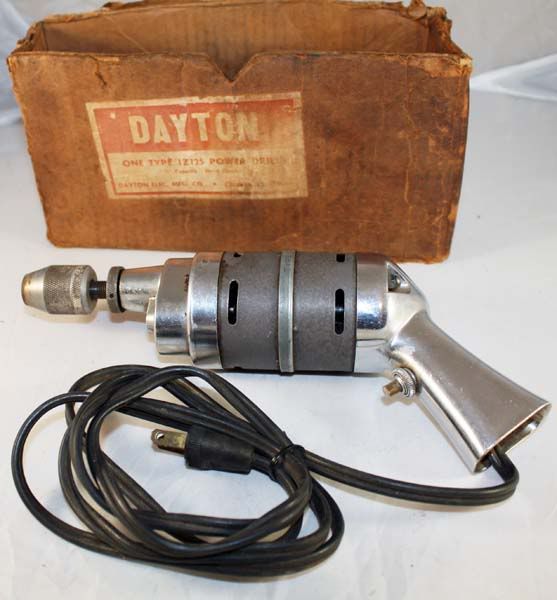
Some of you may have seen my threads earlier this year when I bought lots and lots of cool old USA-made tools. Today while I'm waiting for the Super Bowl to begin, I'm sorting through them and putting a few online for sale. But this really old small Dayton brand electric drill is neat enough that I thought some of you might enjoy seeing it just for fun in THIS forum.
DrillDayton1.jpg

Note that it has a "keyless chuck"! I found it with the original box, though the box is pretty rough.
DrillDayton2.jpg

This single-speed drill does work, although you can clearly see sparks at the brushes on the commutator. It is small and very lightweight. Really different!
DrillDayton3.jpg

The number on the drill body matches the number on the box it came with. That's got to be uncommon, eh? :thumbup:

I'm going to list it in the classified section, but again, I thought some folks just might enjoy seeing it here for nostalgic interest. Thanks.
 
To avoid these ads, REGISTER NOW!

jwitt

Well-known member
Joined
Jun 7, 2009
Messages
527
Location
Pensacola, FL
I have one real close to that. Looks like something Buck Rogers might use.
100_0472.jpg

100_0473.jpg


Also an in the box, never used Skilsaw SkilDrill drill.
100_0126.jpg

100_0128.jpg

100_0127.jpg


Too bad that there is not more interest in vintage electric tools, maybe some day.

Jim
 
Last edited:

Bull

Super Moderator
Joined
Dec 12, 2005
Messages
16,189
Location
MA
Is it possible to rewire these so they are grounded and safe to use? I'm guessing it's fairly simple, right? Or am I incorrect?
 
OP
L

Lump

Well-known member
Joined
Mar 16, 2009
Messages
3,405
Location
Jamestown, Ohio
Cool old drills, guys! Bull, I dunno about rewiring and grounding.

Say, Bull...I have some old tools that you might want. Shall I PM you...or will that get lost in the masses of mail you get re GJ?
 

Packard V8

Well-known member
Joined
Mar 16, 2009
Messages
7,380
Location
Spokane, WA
Is it possible to rewire these so they are grounded and safe to use? I'm guessing it's fairly simple, right? Or am I incorrect?

Yes, it is simple.

No, I'd never bother. Been using two-prong plug metal case drills in sewers, in showers, in rainstorms and worse for fifty years.

Maybe, your perceptions and results may vary. I'd put the danger of using one of those drills on the job at the bottom of my worry list; at the top are the risks incurred in driving to the job site. Every year, 40,000 are killed and a million injured in traffic accidents, but we get in the commute every morning. When was the last fatality from an ungrounded 110V drill?

jack vines
 

air

Well-known member
Joined
Oct 13, 2010
Messages
184
When was the last fatality from an ungrounded 110V drill?

I dunno, but my Grandfather told me recently he was working next to a fella back in the day that was killed by a drill. This was probably 50 or 60 years ago. Then again he said it was on a wet cement floor also. Operator error I guess.
 

Bull

Super Moderator
Joined
Dec 12, 2005
Messages
16,189
Location
MA
I have 476 stored messages out of 500 allowed at the moment, my good man. Plenty of room for you to sneak one in if you act quickly :lol_hitti

Say, Bull...I have some old tools that you might want. Shall I PM you...or will that get lost in the masses of mail you get re GJ?
 
OP
L

Lump

Well-known member
Joined
Mar 16, 2009
Messages
3,405
Location
Jamestown, Ohio
Thanks, Woody. It was one of those "bonuses" which came with a large old tool box I bought at one time or another.
 
To avoid these ads, REGISTER NOW!

trexdoink

Well-known member
Joined
Dec 28, 2010
Messages
259
Location
Iowa
Maybe that's why they use to call them drill motors, That thing is all motor! Cool stuff!
 

Amitygravel

Well-known member
Joined
Mar 26, 2010
Messages
1,188
Location
Claremont Illinois
Thanks for those photos Lump and jwitt. Neat stuff , it is too bad there isn't more interest in the older electric tools. I'm sure some neat stuff has gone to the scrap heap.
 

PassnThru

Well-known member
Joined
Jan 5, 2010
Messages
6,511
Location
Bowling Green KY
Yes, it is simple.

No, I'd never bother. Been using two-prong plug metal case drills in sewers, in showers, in rainstorms and worse for fifty years.

Maybe, your perceptions and results may vary. I'd put the danger of using one of those drills on the job at the bottom of my worry list; at the top are the risks incurred in driving to the job site. Every year, 40,000 are killed and a million injured in traffic accidents, but we get in the commute every morning. When was the last fatality from an ungrounded 110V drill?

jack vines

I remember my Dad had an old drill with a metal case - definitely not double insulated. He probably still has it - I'll have to ask next time I see him. I remember using that thing when I was young and it would almost always 'bite' me at least once while using it. I thought that was just the way it was? Or was there actually something wrong with the drill?
BTW - not trying to hijack the thread. The rewiring question came up and you seem to know about the older drills.
 

Kirbot

Well-known member
Joined
Sep 25, 2010
Messages
11,001
Location
New Jersey
Is it possible to rewire these so they are grounded and safe to use? I'm guessing it's fairly simple, right? Or am I incorrect?

Very simple indeed.
I do it with all my old metal power tools. (I have about 19 or 20)

Most times the cords are deteriorated badly and need to be replaced anyway.
All you have to do, is attach the ground wire to the metal case somewhere.

As a matter of fact, I have an old Black & Decker sander thats been waiting for a new cord for a while, maybe I'll write up a little tutorial about it.


Here's a few of my drills.


3/4" Craftsman


1/2" Black & Decker


1/2" Thor


Another 1/2" Thor


-PassnThru
There was definitely something wrong with your dad's drill.
Probably a nothing a new cord, preferably with a ground, wouldn't fix.

-Lump
Very nice drill
You don't find original boxes very often
 

larry_g

Well-known member
Joined
Apr 28, 2007
Messages
16,889
Location
oregon
One thing to consider on the grounding issue is if you have GFCI in the garage circuits then you should be protected, if I understand the workings of a GFCI.
I'm going to post this question over on the electrical forum, so look for it there and comment there if you please.
lg
no neat sig line
 
Last edited:

Packard V8

Well-known member
Joined
Mar 16, 2009
Messages
7,380
Location
Spokane, WA
Very simple indeed.
Most times the cords are deteriorated badly and need to be replaced anyway.
All you have to do, is attach the ground wire to the metal case somewhere.

Agreed, if I'm going to replace the power cord anyway, I go ahead and install a ground. When I come across a totally defunct power tool, I disassemble it and save the power cords and strain relief. Then, when an older tool needs a new cord, I have a complete newer one ready to bolt in. The green ground wire usually even has a ring terminal on it, ready to go under an convenient screw.

If it doesn't need a new cord, I just use it in the original two prong form. FWIW, I've been "grabbed aholt of", as we say in the south, by 110v dozens of times. It does get your attention, but is not often fatal. More than you wanted to know:

110V AC Kills!

"According to the United States Consumer Safety Report published in 1995 based on statistics provided by NCHS (National Center for Health Safety) on electrocutions by consumer products, the home is truly a dangerous place for the unaware. According to the 1995 statistics, the latest statistics available, there were 550 electrocutions in and around the home because of consumer products. Out of a total of 560 electrocutions in the United States, 230 electrocutions or 41 percent were related to consumer products.
· Installed household wiring accounted for 23 percent, or 53 deaths caused by household electrocutions. You need to know what’s inside that wall you’re cutting into with your Saws All.
· Another 17 percent, or 40 deaths, resulted from defective or improperly used small appliances.
· Another 14 percent, or 33 deaths, resulted from defective or improperly installed major appliances
· Another 10 percent, or 24 deaths, resulted from improperly installed television antennas.
· Another 9 percent, or 20 deaths, result from defective or improperly installed or used lighting equipment
· Another 7 percent, or 15 deaths resulted from people coming into contact with electrical wires while working on ladders
· Another 6 percent, or 13 deaths, resulted from using defective or improperly wired power tolls
· Another 6 percent, or 14 deaths resulted from defective or improperly used farm and garden equipment
· The remaining 8 percent or 18 deaths resulted miscellaneous causes of electrocution."

http://factoidz.com/the-home-handy-p...-can-kill-you/


"Voltage is not a reliable indication of danger because the body's resistance varies so widely it is impossible to predict how much current will be made to flow through the body by a given voltage.
AC is more dangerous than DC, and 60-cycle current is more dangerous than high-frequency current. Skin resistance decreases when the skin is wet or when the skin area in contact with a voltage source increases. It also decreases rapidly with continued exposure to electric current.
Offhand, it would seem that a shock of 10,000 volts would be more deadly than 100 volts. That is not necessarily so! Individuals have been electrocuted by appliances using ordinary house supplies of 110 volts and by electrical apparatus in industry using as little as 42 volts direct current. The real measure of a shock's intensity lies in the amount of current (amperes) forced through the body, and not the voltage. Any electrical device used on a house wiring circuit can, under certain conditions, transmit a fatal current."

http://www.spgs-ground.com/information/shock-hazard

"According to the U.S. Consumer Product Safety Commission (CPSC), approximately 400 individuals are killed in the U.S. each year as a result of electrical shocks and electrocution accidents in the home. The National Fire Protection Association estimates that on average, 53,000 residential electrical fires occur yearly, leading to more than 450 deaths, 1,400 injuries, and at least $1.4 billion in property damage.
Many accidents result from misuse of electrical outlets, with almost 4,000 injuries reported yearly. One-third of these injuries occur when young children insert objects such as keys, safety pins, or hairpins into wall outlets. Electrical shocks can cause severe muscular contractions, nerve damage, cardiac arrest, severe burns, and even death from electrocution."

http://www.consumerwatch.com/safety/electrical-safety

Having read all the above, I'll continue to use my ungrounded power tools:

Cause of Death Lifetime Odds

Heart Disease 1-in-5

Cancer 1-in-7

Stroke 1-in-23

Accidental Injury 1-in-36

Motor Vehicle Accident 1-in-100

Intentional Self-harm (suicide) 1-in-121

Falling Down 1-in-246

Assault by Firearm 1-in-325

Fire or Smoke 1-in-1,116

Natural Forces (heat, cold, storms, quakes, etc.) 1-in-3,357

Electrocution 1-in-5,000

http://www.livescience.com/environme..._of_dying.html

jack vines
 
OP
L

Lump

Well-known member
Joined
Mar 16, 2009
Messages
3,405
Location
Jamestown, Ohio
I agree, Jack. A really important thing about household electricity is to be sure you haven't cheated a circuit by using a much-oversized breaker or fuse. I have known people who have a circuit in their homes which keeps kicking off breakers, so they installed breakers with more and still more amp ratings.
 
To avoid these ads, REGISTER NOW!
Top Bottom