To avoid these ads, REGISTER NOW!

1/2" black iron pipe length?

dwasifar

Well-known member
Joined
May 28, 2017
Messages
2,097
I'm about to install a gas line for an outdoor grill. There are two options for where and how to join it to the central gas line, and I'm looking for advice on which is better.

The gas line enters the building at one corner, runs along the closest floor joist until it reaches the middle of the main building, then does this:

gaspipes.jpg


My original plan was just to take apart the 1/2" line to the kitchen and replace an elbow with a tee further along, but that turns out not to be possible because of clearance with the electrical panel.

So option 1 is to cut out the ****** in that picture, replace the bottom elbow with a tee (or better, a side outlet elbow), and run 1/2" line to the service point. This would be about a 35' run to the grill connection. This is a shorter run than my other option, but it requires me to put a union where that ****** is now, and I'm not sure that's a good idea; it looks like that union would be stressed.

Option 2: About 2/3 of the way down that central line, there is a capped reducing tee, 1" to 1/2". There's a clearance problem with an HVAC duct but I'm pretty sure I can move that out of the way. No unions necessary, just uncap it and start piping, but it will be a significantly longer run that way, about 48' all told.

What would you do? Stick a union in the main line as in option 1, to keep the new run shorter? Or just hook up to the existing tee?
 
Last edited:
To avoid these ads, REGISTER NOW!

D45

Well-known member
Joined
Mar 21, 2014
Messages
4,836
Location
NW INDIANA
I tied into an outside line and installed a T, even before it entered the house..........then used a steel riser and some yellow poly
 

Miss the Pontiacs

Well-known member
Joined
Nov 7, 2016
Messages
16,505
Location
Saskatchewan Canada
If we did a DIY like this where I lived you would get strung up. We can DIY electrical as long as it has nothing to do with the feed cable or the meter. No way you can get a DIY permit for gas unless you are certified for gas.
 

brewchief

Well-known member
Joined
Sep 20, 2008
Messages
2,370
Location
Michigan
Two short ******* and a union may be longer then that ****** that is in there now. I would probably cut the 1"line marked central and shorten it up enough to add a tee and union.
 
OP
D

dwasifar

Well-known member
Joined
May 28, 2017
Messages
2,097
Two short ******* and a union may be longer then that ****** that is in there now. I would probably cut the 1"line marked central and shorten it up enough to add a tee and union.

I don't really have the capacity to do that. It's about a 20' long piece of 1" pipe, and I don't have the tools to thread it. That's why I was going to take out the ****** instead.

In the absence of any advice to the contrary, I think I'll just go from the more distant capped tee.
 

DC73

Well-known member
Joined
Dec 27, 2014
Messages
1,627
Location
Lubbock TX
Could you replace the elbow below the ****** with a tee? The main line would stay in the approximate same location and then you could tap off the bottom of the tee for the new line. Might have to disassemble part of the main line to do this which requires finding a good spot to begin disassembly.

DC
 

eddieK

Well-known member
Joined
Mar 2, 2017
Messages
695
Location
Nampa Idaho
not really answering your question, but, fwiw, my grill was plumbed with flexible copper off the main line , much easier install than using black pipe. might be an option for you

Flexible copper? If it's natural gas, the additive to create a smell will eat it up. Copper is okay with Propane, but not natural gas.
 
OP
D

dwasifar

Well-known member
Joined
May 28, 2017
Messages
2,097
Could you replace the elbow below the ****** with a tee? The main line would stay in the approximate same location and then you could tap off the bottom of the tee for the new line. Might have to disassemble part of the main line to do this which requires finding a good spot to begin disassembly.

DC

That is actually Option 1 in my original post. I'd have to put a union in though.
 

eddieK

Well-known member
Joined
Mar 2, 2017
Messages
695
Location
Nampa Idaho
copper is used all the time here above ground. it is only underground that it's an issue

It's still the additive that breaks down the copper, nothing to do with buried or not.

NFPA 54 article 5.6.2.3 Copper and Brass. Copper and brass shall not be used if the gas contains more than the average of 0.3 grains of hydrogen sulfide per 100 scf of gas (0.7mg/100L).
 
Last edited:
To avoid these ads, REGISTER NOW!

mm08822

Well-known member
Joined
Jan 13, 2012
Messages
6,009
Location
NJ
A sketch with existing pipe sizes, distances, all loads(BTUH), meter/regulator size, location and basement perimeter with proposed grill location is needed.
Also what is the grill input (BTUH)?

That info will determine where a tap can be made ...or not.
 

mm08822

Well-known member
Joined
Jan 13, 2012
Messages
6,009
Location
NJ
It's still the additive that breaks down the copper, nothing to do with buried or not.

NFPA 54 article 5.6.2.3 Copper and Brass. Copper and brass shall not be used if the gas contains more than the average of 0.3 grains of hydrogen sulfide per 100 scf of gas (0.7mg/100L).

That is IF
 

D45

Well-known member
Joined
Mar 21, 2014
Messages
4,836
Location
NW INDIANA
I guess the OP needs to state if the line is going to be buried or not..........if the line will be exposed to moisture, ran inside, ran outside, etc
 
OP
D

dwasifar

Well-known member
Joined
May 28, 2017
Messages
2,097
I guess the OP needs to state if the line is going to be buried or not..........if the line will be exposed to moisture, ran inside, ran outside, etc

Mostly indoors. All but the last foot or two of the run will be indoors, in the basement. It will emerge from the outside wall underneath a deck, and take an immediate 90 elbow upward to meet a gas outlet box with shutoff and quick-disconnect mounted to the outside wall of the house.

This will leave a short amount of pipe exposed outside, and I was just planning to paint it so it won't rust, unless you guys have a better idea.
 

Matt Matt

Well-known member
Joined
May 11, 2017
Messages
523
Location
Ontario
I'll give it two options

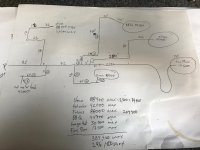
give a full drawing all the lengths lines, Diameter of pipe , 90°, 45°, 22 1/2° And the max BTU of each appliance or

You need to take off from the 1 inch pipe, anywhere but I need to know the max BTUs of the outdoor grill. Half-inch pipe just might not be big enough.

Realistically, you should do the full drawing as a load calculation needs to be done. In most cases, there is less five psi in the gas pipe. If the pipe is not big enough or not taking off from the right place it could cripple another appliance, which requires the fuel.

From a 1 inch line you roughly have 300,000 BTU total. But a stove, a furnace and a hot water tank will pull just over 200,000 BTU.

This particular system is considered just about over loaded.
 

Attachments

  • IMG_6925.jpg
    IMG_6925.jpg
    135.9 KB · Views: 21
Last edited:

ljhhontx

Well-known member
Joined
Dec 27, 2010
Messages
104
Location
San Antonio Tx Area
Odorant is methyl mercaptan, hydrogen sulfide is a naturally occuring part of a lot of the natural gas that is sold, it eats the pipe from the inside and leaves black flakes which stop up valves and orifices. Tin lined copper when available is ok for natural gas but I don't know where you would find it anymore.
 

Matt Matt

Well-known member
Joined
May 11, 2017
Messages
523
Location
Ontario
Odorant is methyl mercaptan, hydrogen sulfide is a naturally occuring part of a lot of the natural gas that is sold, it eats the pipe from the inside and leaves black flakes which stop up valves and orifices. Tin lined copper when available is ok for natural gas but I don't know where you would find it anymore.

There is still certified NG copper piping. But it is hard to obtain by DIY'ers. Most new flex pipe is now stainless steel. And the certified NG stainless steel is also hard to purchase by DYI'ers. I guess they don't want DYI'ers doing a job that they're not certified for.

In some parts of Canada now, every ball valve, off the main has to have a certification installer ticket number and tag for insurance purposes. It's gone this way after a few houses have blown up and taken out A half dozen houses in neighbourhoods. Bricks fly miles. Some insurance claims have made major upsets in the insurance industry.

Just imagine your car being hit (by a house that blew up a mile away) by half a brick. Now just imagine what your own home insurance company is going to start implementing.
 
Last edited:

DC73

Well-known member
Joined
Dec 27, 2014
Messages
1,627
Location
Lubbock TX
That is actually Option 1 in my original post. I'd have to put a union in though.

Actually, I was suggesting an alternative to Option 1. Leave the ****** and attach the tee directly to it. This will require disassembly of the 1" main line but if it could be done, would eliminate the need for a union and would allow you to use your existing pipes without cutting. Basically, deconstruct the system the way it was built and then reconstruct using a tee in place of the elbow.

DC
 
To avoid these ads, REGISTER NOW!
Top Bottom