KeyserSoze
Member
- Joined
- Apr 15, 2011
- Messages
- 16
I'm building a workbench. My workshop isn't very big so I'd like to be able to slide my welding table under the workbench when I'm not using it, and then roll it out to the middle of the room for welding or to use as an additional workbench when I do need it.
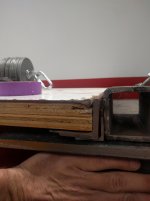
What do you think of using 1 3/4" angle, with 1/4" web thickness, to support the top? The top will be doubled up 0.75" plywood with 1.5" total thickness, so it'll nestle right in to the shelf made by the angle. Is that strong enough to avoid sagging across a 59" (the width of my toolbox) span? And is the 1.5" ledge of the angle enough support for the doubled-up plywood? I'm not planning to put anything super heavy on the workbench, but I don't want it flimsy either.
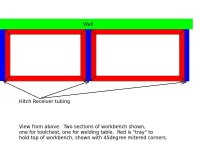
For legs, I'm planning on 2x2" 11g square tubing because I've got 20' of it left over. I'm planning to use hitch receiver tubing for the horizontal members going front to back, so I can plug attachments in for my vise, grinder, tube notcher, tubing bender, etc., in to the bench. I'll build it such that the top of the hitch receiver tubing is flush with the top of the angle, and flush with the top of the doubled-up plywood, segmenting the wooden top every where there's a leg. I'll weld angle to the sides of the hitch receiver too, so each section of top is supported on all 4 sides. I'll lag bolt the bench to wall studs so it doesn't shift around. Finally, I'll top it off with 1/8" steel sheet, bent down in front to cover the front lip and bent up in back for a backsplash. Should I build legs in the back next to the wall, or only have legs in front and let the studs I lag bolt to support the back? My walls are 2x6 studs 12" OC, and I've got a bunch of 3/8" lag bolts 3" long sitting in a box. Drywall is 5/8", and I'd rather not cut it if I can avoid it.
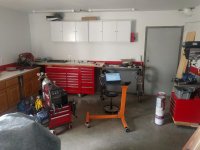
If the pic worked, you can see where my toolbox and welding table are now. That wall is 12' long up to the doorway, and I'd like one continuous workbench there, with the toolbox and welding table under it. The toolbox never needs to move for day-to-day use, but it's the perfect height with casters under it, and I'm planning to leave the casters on so I can roll the box out to store a set of tires in the corner. The workbench will extend along the adjacent wall 6 or 8', and the top will all be the same height.
Thanks in advance for your advice!
What do you think of using 1 3/4" angle, with 1/4" web thickness, to support the top? The top will be doubled up 0.75" plywood with 1.5" total thickness, so it'll nestle right in to the shelf made by the angle. Is that strong enough to avoid sagging across a 59" (the width of my toolbox) span? And is the 1.5" ledge of the angle enough support for the doubled-up plywood? I'm not planning to put anything super heavy on the workbench, but I don't want it flimsy either.
For legs, I'm planning on 2x2" 11g square tubing because I've got 20' of it left over. I'm planning to use hitch receiver tubing for the horizontal members going front to back, so I can plug attachments in for my vise, grinder, tube notcher, tubing bender, etc., in to the bench. I'll build it such that the top of the hitch receiver tubing is flush with the top of the angle, and flush with the top of the doubled-up plywood, segmenting the wooden top every where there's a leg. I'll weld angle to the sides of the hitch receiver too, so each section of top is supported on all 4 sides. I'll lag bolt the bench to wall studs so it doesn't shift around. Finally, I'll top it off with 1/8" steel sheet, bent down in front to cover the front lip and bent up in back for a backsplash. Should I build legs in the back next to the wall, or only have legs in front and let the studs I lag bolt to support the back? My walls are 2x6 studs 12" OC, and I've got a bunch of 3/8" lag bolts 3" long sitting in a box. Drywall is 5/8", and I'd rather not cut it if I can avoid it.
If the pic worked, you can see where my toolbox and welding table are now. That wall is 12' long up to the doorway, and I'd like one continuous workbench there, with the toolbox and welding table under it. The toolbox never needs to move for day-to-day use, but it's the perfect height with casters under it, and I'm planning to leave the casters on so I can roll the box out to store a set of tires in the corner. The workbench will extend along the adjacent wall 6 or 8', and the top will all be the same height.
Thanks in advance for your advice!