To avoid these ads, REGISTER NOW!

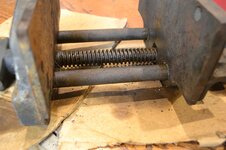
10" Craftsman woodworking vise. Fire damage.

Movin/on

Well-known member
Joined
May 9, 2014
Messages
247
Location
Brookings, Oregon
A friend dropped this off for free, he found it while cleaning out a burned garage for a fellow here in town.
The Acme screw is bent (not too much) about 1/4 way from the back from the fire.
I'm wondering if it's forged or cast. It starts getting to be stiff to turn about 2/3 from closed. If it's forged I can heat it with an Oxy Acel. torch and straighten it in a press. If it's cast the I will have to take a different approach.
Your thoughts?
Movin/on
 

Attachments

  • Craftsman Woodworking vise-2.jpg
    Craftsman Woodworking vise-2.jpg
    277 KB · Views: 45
  • Craftsman Woodworking vise-3.jpg
    Craftsman Woodworking vise-3.jpg
    231 KB · Views: 43
  • Craftsman Woodworking vise-4.jpg
    Craftsman Woodworking vise-4.jpg
    212.3 KB · Views: 43
  • Craftsman Woodworking vise-5.jpg
    Craftsman Woodworking vise-5.jpg
    268.8 KB · Views: 44
  • Craftsman Woodworking vise-6.jpg
    Craftsman Woodworking vise-6.jpg
    247.4 KB · Views: 44
To avoid these ads, REGISTER NOW!

The Cobbler

Super Moderator
Staff member
Joined
Oct 24, 2013
Messages
25,949
Location
Niagara Region, Ontario, Canada
the acme screw won't be forged or cast, it will be some form of steel,machined , probably with a harden & temper to it . if you heat it you'll screw that up, but since it's been in a fire already , I guess it's already compromised.
you can look online for heat treating & tempering steel and re do it. probably bring it to a cherry red and oil quench it to harden, then 500° and slow cool to temper it .
 

gleman

Well-known member
Joined
Jun 24, 2019
Messages
3,057
Location
Michigan And Florida too!
I'd leave it alone if it's not too obnoxious to use.

Heating, bending, quenching then cooling down in sand or kitty litter seems like a fun challenge too.

I have a antique 10" vise thats way more handy than I ever thought it would be.
 

neophyte

Well-known member
Joined
Apr 23, 2012
Messages
9,746
Location
Pennsylvannia
Vise screws are either made by roll threading, or by just machining the threads into rod.
Better modern vises screws are almost always roll threaded, because it produces a stronger thread.
For what was likely a high volume item, a Craftsman vise provably would have used a rolled thread, especially on a USA made vise.

Unlike a steel bench vise, a woodworking vise likely doesn’t need as strong a thread.
In many cases, woodworking vises simply have the front handles pinned in place, and the front jaws are regular grey iron.
Heating the threads and bending then back would probably be fine.
 
To avoid these ads, REGISTER NOW!

dogdog

Well-known member
Joined
Nov 15, 2011
Messages
12,711
take screw out and heat straighten it, add some paint and put it back to use. Don’t think too much about it. It’s just a wood bench wise. You are not claiming 5,000,000 lbs of force torture or bust some nuts with it.
 

MoonRise

Well-known member
Joined
Nov 5, 2010
Messages
4,031
Location
NJ
A 'regular' Acme screw thread is often just mild steel and probably machined, sometimes of the free-machining alloy type. See McMaster or Grainger for some replacement options. A woodworking vise screw is not likely to be cast or forged IMNSHO.

Unless the screw is REALLY bent/warped, if you can remove the screw from the vise (complete teardown, which you might want to do to check everything else out and make it easier to clean things up and at least slightly polish the two guide rods and their respective holes) you can check more closely as to how much the screw is bent and then apply force as needed to straighten it out. Heat is probably not needed.

The heat from the fire might have warped the actual thread profile on either the male thread on the rod or the female thread in the nut. In which case you might need to chase the threads with a tap, die, or both (I have had to chase some Acme rods that were a little bit 'off' from the machine shop). In which case the fixing got more expensive unless you just happen to have the correct tap and/or die available.

Another option could be to replace the Acme threaded rod (McMaster, Grainger, others).

Your call as to just how deep you want to get into this rebuild. The (cast?) jaws and/or the guide rods might also be heat warped. Check everything out before you get to deep.
 

BlackVersa2

Well-known member
Joined
May 9, 2023
Messages
73
This is a $50 vise on a good day...I wouldn't advise spending any money on it. But you do you
 

exmaxima1

Well-known member
Joined
Jun 25, 2011
Messages
6,343
Location
Midwest
This is a $50 vise on a good day...I wouldn't advise spending any money on it. But you do you
Those Japan-made vises were machined very well yet fetch significantly less than their USA versions. You can spend many hours restoring it but $50-$75 would buy the same vise in excellent condition.
 

seber

Well-known member
Joined
May 31, 2016
Messages
4,203
Location
Deep East Tx.
In a woodworking vise there is almost zero chance that threaded rod is heat treated. Just pull it out and straighten it. No heat needed. A press would be the best tool for the purpose, but if you don't have one, just put it on a hard surface and support two locations equidistant from the bend with wood pads and hit it with a soft hammer.
 
OP
M

Movin/on

Well-known member
Joined
May 9, 2014
Messages
247
Location
Brookings, Oregon
Leaflessshadetree: Thanks !!
I read the Michael Parrish vise rescue and found out more about the vise. I've got disassembled and removed the screw head (drilled the rivet) and pounded it out. In this way I was able to roll the acme screw on my Cast Iron table saw and found it was bent about 1/4" at the end. I found where the bend started and put the screw in a vise used a cheater pipe and bent it back to close to straight. Reassembled the vise and I can now run it in and out. Next step will be cabinet blasting all the parts that will be visible (not the shafts or screw) paint and reassemble.
Thanks to all who have helped with my understanding of this vise.
Richard >>> Movin/on
 

MoonRise

Well-known member
Joined
Nov 5, 2010
Messages
4,031
Location
NJ
Glad that you seem to have it working now. :thumbup:

I'd at least clean up the guide rods with some non-woven abrasive pads (aka Scotchbrite).

Post some pics of the progress as you clean up and the vise. We like pics. :)
 
To avoid these ads, REGISTER NOW!
Top Bottom