I don't blame you!
"when the GFCI is off" ... "doesn't work when the breaker is off".
I understand a circuit not working when the breaker is off. But I don't understand what you mean by "when the GFCI is off". Do you mean when you've unhooked the GFCI and taken it out of the circuit?
Let me recap what I understand ...
1. Remove the GFCI from the circuit, wire the line hot & neutral to the load hot & neutral wires, respectively, (effectively "jumping" the GFCI) the downstream outlets work. Correct?
2. Put the GFCI back into the circuit with the line hot & neutral wires hooked to the line lugs and the load hot & neutral wires hooked to the load lugs and ... (a) you can't reset the GFCI to get the little green light to come on and (b) the downstream outlets obviously don't work.
When you're in situation #2 above, have you tried the GFCI outlet tester? Does anything light up? I presume that nothing would light up. Let us know what happens.
I wonder if the line and load wires have been transposed; i.e. you're hooking the incoming line wires (that are hot from the breaker) to the line side. When you're in stuation #2 above, what happens when you use the DMM to check the voltage? Check the voltage both on the line lugs and the load lugs. If you get 120 volts on the load lugs, the GFCI is wired backwards.
Being a regular guy and not an electrician, I don't know what impact having the line and load hots hooked up right on the GFCI and the neutrals transposed.
With the GFCI out of the circuit and bare wires hanging there, you can put the breaker on confirm which hot is the line (using either a test light or the DMM).
Please expound on "nothing is burnt is fried, but T=this one confused the **** out of me ... ". I'm having trouble visualizing what you were presented with when you pulled the things apart.
Doing that obviously would NOT be code. One option you have to replace all the outlets with GFCI outlets. Hook both the line and load wires to the line lugs only, disregard the load lugs. Each outlet then is responsible for protecting itself independent of the other outlets. This way you can have one outlet trip its GFCI, and it won't kill anything other outlet on the same circuit. I hope this is code and correct, I've done it in my house (two bathrooms and the garage on the same GFCI, now three GFCI's independent of each other). If this is wrong, I'm sure the properly trained electricians will gently let know how wrong I am.
Keep plugging away.

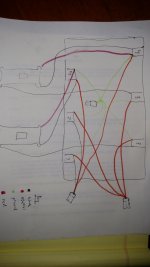


 ) and see what you get.
 when he tested hot to ground.