To avoid these ads, REGISTER NOW!

110v door jam switch

LSU

Well-known member
Joined
Dec 4, 2011
Messages
701
I need to replace the overhead lights in my clothes‘ closet.

I‘m going to install some 48” LED lights.

My old (30+ years) overhead lights are the old style - 4 tube 48” fluorescent lights. This old fixture had an old fashion pull cord switch. (And no - I do not want to take the ballast out and rewire the lights. - I want a new fixture).

On my new model I’d like to install a door jamb switch that will activate the light when the door is opened. I don’t want to use a motion detector switch.

The door frame is wooden and painted. On the inside of the closet I’m going to remove the door casing trim to access the wooden (door jam part - the thing in which the door hinges are screwed) and I’m looking for a switch to mount.

ideally a small push button type. Maybe something I could drill a 1” hole.

I‘m trying to remove as little wood as possible And bust up as little pain as possible.

Any suggestions or comments would be appreciated.

Thank you.
 
To avoid these ads, REGISTER NOW!

Gozo

Well-known member
Joined
Oct 10, 2013
Messages
249
Location
Central VA
The thought of running 115ac through a door jam switch frightens me.
I did do something similar. Take my experience and do what you may with it.
I used a lever action microswitch powered by a doorbell transformer to activate a solid state switch/optocoupler and that would switch the 115. The coupler is 100% isolated input and output. More parts, but much better safety.
Could also use a relay similarly. I didn’t want the “clicking” with on and off.
 
OP
L

LSU

Well-known member
Joined
Dec 4, 2011
Messages
701
The thought of running 115ac through a door jam switch frightens me.
I did do something similar. Take my experience and do what you may with it.
I used a lever action microswitch powered by a doorbell transformer to activate a solid state switch/optocoupler and that would switch the 115. The coupler is 100% isolated input and output. More parts, but much better safety.
Could also use a relay similarly. I didn’t want the “clicking” with on and off.
Thanks but I didn’t take shop in high school and you’ve lost me.

Would you please explain a bit more. Thanks.
 

Gozo

Well-known member
Joined
Oct 10, 2013
Messages
249
Location
Central VA
How’d you finish high school without taking shop. That was the most practical course. And you got to play with tools.
Basically, the low voltage from the transformer gets switched by the door jamb switch, turning on the input side of a solid state relay. All the line voltage stuff is isolated on the output side.
Like I said, just my musings of a way to get it done without AC line voltage loose in a door jamb.
 

bonneyman

Well-known member
Joined
Apr 22, 2010
Messages
8,757
Location
Desert SW
It shouldn't be too hard to rig up a push button style switch shielded from any wood. Like something on a garage door opener that brings the light on when the door opens.
 
  • Like
Reactions: LSU

wyliesdiesels

Well-known member
Joined
Aug 14, 2012
Messages
19,983
Location
Modesto, CA
The thought of running 115ac through a door jam switch frightens me.
I did do something similar. Take my experience and do what you may with it.
I used a lever action microswitch powered by a doorbell transformer to activate a solid state switch/optocoupler and that would switch the 115. The coupler is 100% isolated input and output. More parts, but much better safety.
Could also use a relay similarly. I didn’t want the “clicking” with on and off.
Yeah thats what i would do too
 

mogandave

Well-known member
Joined
Nov 4, 2021
Messages
3,052
Location
Bangkok
Assuming it swings out, I would just screw a block to the inside, middle, top of the jamb and use one of these:
Switch.jpg

I would not mess with drilling any big holes in the jamb or what-not.

Run some stick-on plastic trunking from the light to the switch for the wire and be done with it in 30 minutes.
 
  • Like
Reactions: LSU
To avoid these ads, REGISTER NOW!

rharman

Well-known member
Joined
Apr 22, 2012
Messages
8,734
Location
SoCal
Tell me you don't read threads without telling me you don't read threads.

Post #16 just above yours suggested the same switch.
Yeah, we crossed over. I'd had that tab open for a bit and his post wasn't showing.

Not the end of the world.... Chill.
 

larry4406

Well-known member
Joined
Jan 27, 2006
Messages
18,994
Location
Northern Virginia
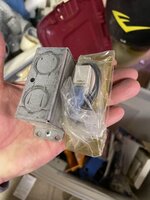
I used these jamb switches at my first house eons ago. Real PIA to mortise the stud and casing to fit the metal back box and brass trim.

This switch is easily 30 years old and still in box unused. I think I have 2. 10C00E78-8507-470F-B2EC-9594A5D5220B.jpegFD9DCA7E-A140-4E33-8B87-EAA7FDCCCD5F.jpeg9C2D828A-852B-46C9-A33A-133D10E3209F.jpeg9851097D-E22A-45F8-AE2C-878CE4AA2E2F.jpegE899207D-17A0-4D57-85E9-9D5CE5302B6C.jpeg
 
  • Like
Reactions: LSU

Zeke

Well-known member
Joined
Aug 13, 2009
Messages
17,176
Location
Long Beach CA, the sewer by the sea.
As a carpenter and a door hanger/installer I can tell you that using one of those line voltage switches in a box is going to involve cutting the jamb, mortising the trimmer and doing quite a bit of drywall/plaster work. I think you said, "I‘m trying to remove as little wood as possible And bust up as little pain as possible."

That switch won't meet your desires. Go with the LV idea.
 

Innovate1

Well-known member
Joined
Jul 28, 2014
Messages
4,272
Location
Illinois near St. Louis, Missouri
I have seen a number of hotel closets in foreign countries where they just hang a microswitch above the door on the door frame with the line voltage wires exposed. Not recommending that though...

I put a jamb switch in the front closet when we built this house. Readily available and meets code. But a lot of work to retrofit as others have pointed out.
 
  • Like
Reactions: LSU

Norcal

Well-known member
Joined
Mar 16, 2008
Messages
13,752
I have seen a number of hotel closets in foreign countries where they just hang a microswitch above the door on the door frame with the line voltage wires exposed. Not recommending that though...

I put a jamb switch in the front closet when we built this house. Readily available and meets code. But a lot of work to retrofit as others have pointed out.
Can always use a limit switch, all industrial control manufacturers offer them but will not be much in the looks dept.

4149512.jpg
 

Sumboodie

Well-known member
Joined
Mar 20, 2021
Messages
10,656
Location
AK
How’d you finish high school without taking shop. That was the most practical course. And you got to play with tools.
Basically, the low voltage from the transformer gets switched by the door jamb switch, turning on the input side of a solid state relay. All the line voltage stuff is isolated on the output side.
Like I said, just my musings of a way to get it done without AC line voltage loose in a door jamb.
We weren’t allowed to take shop. That was for the "slow" group and certainly not the "advanced" group.

My brother, who is a few years younger had to petition to the school board to allow it. They pretty well were convinced he'd fail at life.
 

nadogail

Well-known member
Joined
Jan 23, 2009
Messages
31,904
Location
Coronado, CA
Shop classes died when our culture decided that Everyone Needs To Go To College.

I did not begin my studies for my BS in Adult Vocational Education until I was 47, I got the BS, with honors, from SIU Carbondale in 2.5 years.

I was also working full time.
 

adrenalinejeeper

Well-known member
Joined
Jan 30, 2018
Messages
191
Location
Ventura County, CA
Here is what I learned in shop:
  1. Install a magnetic sensor on the door, which sends a signal to a microcontroller when the door is opened.
  2. Connect the microcontroller to a relay that controls the flow of electricity to the lightbulb.
  3. Power the microcontroller using a battery or power supply.
  4. Program the microcontroller to listen for the signal from the magnetic sensor.
  5. When the microcontroller receives the signal from the magnetic sensor, it activates a timer function.
  6. The timer function waits for a specific amount of time, say 30 seconds.
  7. After the timer function has elapsed, the microcontroller triggers a solenoid valve that releases a small amount of water into a tube filled with salt.
  8. The saltwater solution creates a chemical reaction that generates a small electrical charge, which is picked up by a piezoelectric sensor.
  9. The piezoelectric sensor generates a small amount of electricity, which is stored in a capacitor.
  10. The capacitor discharges through a high-voltage transformer, creating a spark that ignites a small amount of thermite powder.
  11. The thermite powder produces a burst of intense heat, which melts a thin wire holding a small weight.
  12. The weight falls, pulling on a string that releases a small ball bearing.
  13. The ball bearing rolls down a ramp and strikes a small switch, completing the circuit and turning on the light.
A simpler solution would be to use a basic magnetic sensor and relay setup to turn on the light when the door is opened, without the need for any additional components or complicated chemical reactions.
 

jdm5

Well-known member
Joined
Jan 1, 2012
Messages
281
Location
CT
  • Like
Reactions: LSU

infinkc

Well-known member
Joined
Jan 19, 2012
Messages
862
Here is what I learned in shop:
  1. Install a magnetic sensor on the door, which sends a signal to a microcontroller when the door is opened.
  2. Connect the microcontroller to a relay that controls the flow of electricity to the lightbulb.
  3. Power the microcontroller using a battery or power supply.
  4. Program the microcontroller to listen for the signal from the magnetic sensor.
  5. When the microcontroller receives the signal from the magnetic sensor, it activates a timer function.
  6. The timer function waits for a specific amount of time, say 30 seconds.
  7. After the timer function has elapsed, the microcontroller triggers a solenoid valve that releases a small amount of water into a tube filled with salt.
  8. The saltwater solution creates a chemical reaction that generates a small electrical charge, which is picked up by a piezoelectric sensor.
  9. The piezoelectric sensor generates a small amount of electricity, which is stored in a capacitor.
  10. The capacitor discharges through a high-voltage transformer, creating a spark that ignites a small amount of thermite powder.
  11. The thermite powder produces a burst of intense heat, which melts a thin wire holding a small weight.
  12. The weight falls, pulling on a string that releases a small ball bearing.
  13. The ball bearing rolls down a ramp and strikes a small switch, completing the circuit and turning on the light.
A simpler solution would be to use a basic magnetic sensor and relay setup to turn on the light when the door is opened, without the need for any additional components or complicated chemical reactions.
Pretty much what I posted above that they sell
 

kinglake

Well-known member
Joined
Dec 12, 2011
Messages
96
Just get a motion activated LED bulb. I have them in all my closets. Exact same end result that is accomplished by screwing in a bulb.
 

alfredeneuman

Well-known member
Joined
Mar 3, 2011
Messages
4,580
Location
Fullerton, CA
I have them in all my closets. Exact same end result that is accomplished by screwing in a bulb.
410.16 Luminaires in Clothes Closets.
(A) Luminaire Types Permitted. Only luminaires of the following types shall be permitted in a closet:
(1) Surface-mounted or recessed incandescent or LED luminaires with completely enclosed light sources

A motion sensor bulb usually won't sense the motion with a completely enclosed fixture
 
To avoid these ads, REGISTER NOW!
Top Bottom