To avoid these ads, REGISTER NOW!

12 ft tall wall sheathing

dkaskie

Member
Joined
Dec 1, 2018
Messages
7
Location
Indiana
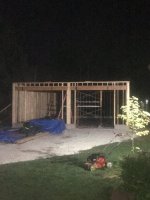
I am building a 32 wide x 48 deep 2 bay tandem garage. I have the walls framed (2x6) but am getting some mixed advice and having mixed thoughts on sheathing. Doors are 10'x10'


I was planning to install sheathing in a vertical orientation for added shear strength, but I am wondering if the full 8 foot vertical sheet should be toward the top or bottom of the 12 ft wall. I was planning to do a line of wall blocking to break the sheathing.


My thought was to put the full 8 ft piece toward the top of the wall to tie the top plate to the rest of the wall since my hurricane ties for my trusses will be fastened to the top plates.


Your thoughts?
 

Attachments

  • IMG_1559.jpg
    IMG_1559.jpg
    147 KB · Views: 133
  • IMG_1590.jpg
    IMG_1590.jpg
    91.9 KB · Views: 121
Last edited:
To avoid these ads, REGISTER NOW!

Samh

Well-known member
Joined
Aug 16, 2006
Messages
482
Location
Canton GA
Mine was a little different, as I framed a loft, but I ran the first two rows horizontal, and the last row vertical so it would tie the first floor walls, the second floor and 2nd floor walls together
 

ItsNemo

Well-known member
Joined
Mar 5, 2016
Messages
4,805
Location
Canada
I would think staggered sheets all horizontally would be stronger? Ties more studs together with each sheet.

Vertical means each sheet only hits 4 studs...horizontal you hit 7 studs per sheet.
 

Kaizen

Well-known member
Joined
Jan 9, 2015
Messages
6,946
Location
New England
All horizontal stagger seams four feet. Block and nail at each four and eight feet. I did all but not needed by code here. As said if you have a second floor I’d have full sheets up there


Sent from my iPhone using Tapatalk
 

redneckcharlie

Well-known member
Joined
Dec 26, 2009
Messages
125
If you are having it inspected check with your local building department. Here it’s full sheets from the sill plate up. If it’s not done in that manner here and being inspected the building inspectors will require blocking in the joints. Most will require blocking at the 8’ level as well, some won’t. If I’m doing sheathing like you describe and I’m not having it inspected I’d go perpendicular across from the sill plate and top with verticle sheets. It’s easier considering the height. I highly doubt there is any strength difference between the two. It’s in that same realm of an electrical inspector failing a box with a screw threw it to square it up by claiming it affects the fire rating. All perimeter sheathing has to be stapled at 3” intervals here as well. That’s all vertical corners and the sill and top plate as well.
 
Last edited:

egdede

ALLIANCE MEMBER
Joined
Dec 20, 2009
Messages
2,063
Buy 12' sheets, install vertically with a sistered stud at every 48" (so all edges are covered with their own full stud).
 

jbwilkins

Well-known member
Joined
Mar 16, 2016
Messages
310
Location
Nashville Tn
To realize any shear value at all the sheet has to be continuous and (typically per the manufacturer) it's designed to be installed vertically....Since 12' sheathing is 'hard to come by' you can block the hormonal joints with 2x material to make the sheet continuous.......

Make sure you're capturing the very top and bottom plates with the sheathing......

BTW in certain jurisdictions the inspector will look for this, in others they don't have a clue......I've even seen them count the nails and check the spacing to make sure the shear meets the engineers design.......
 

maxpat82

Well-known member
Joined
Dec 9, 2012
Messages
275
I have blocking at 4' and 8' in my 12' walls. (staggered seams)
and sheating is horinzontal (7/16 OSB)
 

RocketScott

Well-known member
Joined
Jul 20, 2016
Messages
262
Location
Lexington, KY
12' sheets aren't common, they would be ridiculously expensive if you could find them

Horizontal or vertical orientation does not matter for strength as long as all the panel edges are nailed. Running the sheets vertically means less block lines (less things for the electrician to drill through, less thermal bridging, less work to install, less material)

Speaking as a professional framer, I would run the first course of sheets horizontal, put a line of blocks at 4', then run the upper sheets vertically
 

ddawg16

Well-known member
Joined
Jul 11, 2008
Messages
21,005
Location
S. California
Unless ALL of your studs are exactly 16" OC with each section EXACTLY 4' OC, you are going to have issues with the sheets lining up. You find out REAL QUICK what happens of you are off even 3/4".

I was **** about getting all my studs 16" OC.....and I still had some mis-alignment.

I'm assuming you used 2x6's? Hope so....2x4's have trouble staying straight over 8'.

You can get 4x10 and 4x12 sheets.

If it was me, I'd use 2x8's sheet horz with the ends staggered. In other words, lay your first row using a full sheet. For you next row, cut it in half or what ever the stud location comes out to. That way your vert seams are not on the same stud. This will give you the maximum shear strength....assuming you edge and field nailing is per spec.
 

kbs2244

Well-known member
Joined
Nov 11, 2006
Messages
14,065
Unless code calls for otherwise.
I would go with ddawg's advice for the reasons he gives.

If the stud spacing comes out wrong, do not be afraid to slip in an extra.
They are cheap.
 

RocketScott

Well-known member
Joined
Jul 20, 2016
Messages
262
Location
Lexington, KY
I would think staggered sheets all horizontally would be stronger? Ties more studs together with each sheet.

Vertical means each sheet only hits 4 studs...horizontal you hit 7 studs per sheet.

All horizontal stagger seams four feet. Block and nail at each four and eight feet. I did all but not needed by code here. As said if you have a second floor I’d have full sheets up there

If it was me, I'd use 2x8's sheet horz with the ends staggered. In other words, lay your first row using a full sheet. For you next row, cut it in half or what ever the stud location comes out to. That way your vert seams are not on the same stud. This will give you the maximum shear strength....assuming you edge and field nailing is per spec.

All of this is false or misleading information and needs to stop

I get tired of this issue coming up on a regular basis and these ideas being kicked around like it's still up for debate

There needs to be a tacked thread on how to install wall sheeting. I've explained it numerous times
 

Kaizen

Well-known member
Joined
Jan 9, 2015
Messages
6,946
Location
New England
All of this is false or misleading information and needs to stop


I get tired of this issue coming up on a regular basis and these ideas being kicked around like it's still up for debate


There needs to be a tacked thread on how to install wall sheeting. I've explained it numerous times


You said the same damn thing as me?!?! With the exception of the top vertical sheet. Which you say doesn’t matter so ??


Sent from my iPhone using Tapatalk
 

RocketScott

Well-known member
Joined
Jul 20, 2016
Messages
262
Location
Lexington, KY
You said the same damn thing as me?!?! With the exception of the top vertical sheet. Which you say doesn’t matter so ??


Sent from my iPhone using Tapatalk

You and the other guys are giving the impression that running the sheets horizontally is stronger, which is flat out not true

You're the least guilty in those statements, which is why I threw in 'misleading'. Thank you for not claiming that it's somehow stronger or better
 

ItsNemo

Well-known member
Joined
Mar 5, 2016
Messages
4,805
Location
Canada
You and the other guys are giving the impression that running the sheets horizontally is stronger, which is flat out not true

You're the least guilty in those statements, which is why I threw in 'misleading'. Thank you for not claiming that it's somehow stronger or better
Can you please back up your claims? Otherwise, you're just as full of **** as the rest of us :)
 

RocketScott

Well-known member
Joined
Jul 20, 2016
Messages
262
Location
Lexington, KY
Can you please back up your claims? Otherwise, you're just as full of **** as the rest of us :)


Yea, I’m full of it

This was the last house I framed:
62e2e233b927353752c09af4b61e56b3.jpg


Sent from my iPhone using Tapatalk
 

Attachments

  • 62e2e233b927353752c09af4b61e56b3.jpg
    62e2e233b927353752c09af4b61e56b3.jpg
    950.3 KB · Views: 9

Kaizen

Well-known member
Joined
Jan 9, 2015
Messages
6,946
Location
New England
You and the other guys are giving the impression that running the sheets horizontally is stronger, which is flat out not true

You're the least guilty in those statements, which is why I threw in 'misleading'. Thank you for not claiming that it's somehow stronger or better


Oh no I do not make that claim. I lay them horizontal as I do it alone and easier to get it up and hold it there with only four feet above your head. Also easier to keep square for a hack as it has eight feet of contact.


Sent from my iPhone using Tapatalk
 
To avoid these ads, REGISTER NOW!

RocketScott

Well-known member
Joined
Jul 20, 2016
Messages
262
Location
Lexington, KY
Here’s a garage I built before that:

f0530507a14e02d96ce1cf39360dece3.jpg


Sent from my iPhone using Tapatalk
 

RocketScott

Well-known member
Joined
Jul 20, 2016
Messages
262
Location
Lexington, KY
Oh no I do not make that claim. I lay them horizontal as I do it alone and easier to get it up and hold it there with only four feet above your head. Also easier to keep square for a hack as it has eight feet of contact.


Sent from my iPhone using Tapatalk

That's why I recommended putting the horizontal course on first. It gives an edge to rest the upper sheets on

I understand about making accommodations for working by yourself. I did everything in the pictures above by myself (with a boom truck)

Your good, it's just that if someone else reads what you posted on it's own they might think that that's the 'best' way to do it. I don't like the false impression that continues to go around here that it's somehow stronger for sheets to be horizontal
 

ItsNemo

Well-known member
Joined
Mar 5, 2016
Messages
4,805
Location
Canada
Yea, I’m full of it

This was the last house I framed:

Sent from my iPhone using Tapatalk


Good for you...are you an engineer too? Have you done analysis on sheer strength? Have you done scientific testing?

Just because you can pull the trigger on a nail gun and put some wood together, doesn't make you an authoritative answer.
 

RocketScott

Well-known member
Joined
Jul 20, 2016
Messages
262
Location
Lexington, KY
Good for you...are you an engineer too? Have you done analysis on sheer strength? Have you done scientific testing?

Just because you can pull the trigger on a nail gun and put some wood together, doesn't make you an authoritative answer.

To build the structures in the pictures I posted took more than just pulling a trigger on a nail gun

After framing for over 20 years and looking at plans from an untold number of engineers I can unequivocally say that running sheets horizontally is not stronger than running them vertically. No question. It's not like some say to do it one way and some say to do it the other way. They all have the same rules to follow, and I follow their rules

So. I don't just make this stuff up. I see it on plan after plan after plan

How many houses have you built?

Can you prove me wrong?
 

ItsNemo

Well-known member
Joined
Mar 5, 2016
Messages
4,805
Location
Canada
To build the structures in the pictures I posted took more than just pulling a trigger on a nail gun

After framing for over 20 years and looking at plans from an untold number of engineers I can unequivocally say that running sheets horizontally is not stronger than running them vertically. No question. It's not like some say to do it one way and some say to do it the other way. They all have the same rules to follow, and I follow their rules

So. I don't just make this stuff up. I see it on plan after plan after plan

How many houses have you built?

Can you prove me wrong?
Good for you...and why do you think the plans are showing the best way to do it? I would be willing to bet that vertically ends up being cheaper to do (no need for blocking for instance) and that's why "plan after plan after plan" has said vertical.

I am not trying to swing my credentials here (I have none) but I'm not going to just buy your anecdotal evidence. The number of contractors who have "always done things this way" which end up being completely wrong is well documented on this forum and everywhere out there. Like I said, you can be as full of **** as the rest of us.

That said, I'll let the AWC cover it:

https://www.awc.org/pdf/codes-standards/publications/sdpws/AWC-SDPWS2015-ViewOnly-1411.pdf

Seems both are acceptable from a cursory reading but perpendicular (ie. horizontal) sure looks better from a load perspective (see table 3.2.1). Shear on the other hand seems indifferent so long as it's installed with the right nailing schedule.

(See how I provided real scientific evidence, that's how it's done)
 

RocketScott

Well-known member
Joined
Jul 20, 2016
Messages
262
Location
Lexington, KY
Good for you...and why do you think the plans are showing the best way to do it? I would be willing to bet that vertically ends up being cheaper to do (no need for blocking for instance) and that's why "plan after plan after plan" has said vertical.

The engineers don't specify vertical or horizontal. Because it doesn't matter for most practical purposes. They also don't really care what the cost of materials are or how long it takes me to frame it (at least for the projects I frame). They just do the calcs and specify a bunch of stuff

There's only been a handful of times where I've called the engineer and said "Hey, this looks overly complicated. Can I do it this way in stead?" Usually it's not because it's way easier for me, I just see all the other trades coming through and having an issue with a beam right where they need to run a duct or pipe, or I see the big picture in stead of all the calcs that the engineer is doing and realize there's a bearing point right next to where he wants me to add one. I'm framing houses where just the labor is over $50k, if something takes an extra hour or two I don't really care. I'm not a production framer

I am not trying to swing my credentials here (I have none) but I'm not going to just buy your anecdotal evidence. The number of contractors who have "always done things this way" which end up being completely wrong is well documented on this forum and everywhere out there. Like I said, you can be as full of **** as the rest of us.

Fair enough. I don't really care what you think of me though (and you should go look at the definition of anecdotal). That's one thing on this forum that bugs me, there's no way to tell who has been doing this for most of their life, in an earthquake zone, with some of the most stringent engineering in the country, that gets inspected for every facet of work performed, from those that just pull up a chart to feel superior

Speaking of which:

That said, I'll let the AWC cover it:

https://www.awc.org/pdf/codes-standards/publications/sdpws/AWC-SDPWS2015-ViewOnly-1411.pdf

Seems both are acceptable from a cursory reading but perpendicular (ie. horizontal) sure looks better from a load perspective (see table 3.2.1). Shear on the other hand seems indifferent so long as it's installed with the right nailing schedule.

(See how I provided real scientific evidence, that's how it's done)

Can you explain the loading that they are talking about? I mean, we don't want the OPs roof caving in and I'm just a knuckle dragging framer. Even with your lack of credentials I'm sure you can explain it to all of us
 

ddawg16

Well-known member
Joined
Jul 11, 2008
Messages
21,005
Location
S. California
All of this is false or misleading information and needs to stop

I get tired of this issue coming up on a regular basis and these ideas being kicked around like it's still up for debate

There needs to be a tacked thread on how to install wall sheeting. I've explained it numerous times

You and the other guys are giving the impression that running the sheets horizontally is stronger, which is flat out not true

You're the least guilty in those statements, which is why I threw in 'misleading'. Thank you for not claiming that it's somehow stronger or better


Wow.....an expert...."Hack"

Nothing funnier than an 'expert' trashing everyone else when they are a hack. Your last house you built? Wouldn't pass framing inspection here in California....they would have a BIG issue with the non-continuous sheathing between floors.

I never said horz was stronger than vert.....but you felt it necessary to clump me in with your." false or misleading information" without saying why, much less posting a reference as to why.

I prefer links....

Here is one from APA.....are you going to say they are 'false and misleading'?

https://cache5.buildgp.com/wp-content/uploads/2018/11/APA-wall-installation-pdf.pdf


And here is a discussion on vert vs horz.

http://thehtrc.com/2013/common-sense-building-exterior-wall-sheathing

Notice....I provided links? Try it sometime before you call people out....especially when you're a hack.

What it boils down to is how accurate your stud spacing is....and, if you go vert, can you get sheets long enough? For the average DIY guy, he is going to use 4x8 sheets.
 

readhead

Well-known member
Joined
Dec 8, 2012
Messages
6,175
Location
Durango, Co.
The AWC specs are an interesting read. It would appear that horizontal placement is stronger than vertical. However Either orientation can supply the desired loads. The loads required don’t always need to be the maximum.

Having framed in California in the seventies the emphasis was on seismic requirements and not as much wind. We were told that spanning wall and floor systems was essential to holding the building together. Sheets were installed vertical because that was the way it was done. I don’t doubt that that was directed by engineers somewhere and was adequate.

Building practices are regional and can vary quite a bit. I was surprised to see that there was a provision for shear walls that were not blocked at all edges. Again, if it meets the required loads then it should work.

I suppose the take away here is that each structure should be treated as an individual and constructed per the engineers requirements and not put together any such way because “that is the way we always do it “.
 

RocketScott

Well-known member
Joined
Jul 20, 2016
Messages
262
Location
Lexington, KY
Wow.....an expert...."Hack"

Nothing funnier than an 'expert' trashing everyone else when they are a hack. Your last house you built? Wouldn't pass framing inspection here in California....they would have a BIG issue with the non-continuous sheathing between floors.

I never said horz was stronger than vert.....but you felt it necessary to clump me in with your." false or misleading information" without saying why, much less posting a reference as to why.

I prefer links....

Here is one from APA.....are you going to say they are 'false and misleading'?

https://cache5.buildgp.com/wp-content/uploads/2018/11/APA-wall-installation-pdf.pdf


And here is a discussion on vert vs horz.

http://thehtrc.com/2013/common-sense-building-exterior-wall-sheathing

Notice....I provided links? Try it sometime before you call people out....especially when you're a hack.

What it boils down to is how accurate your stud spacing is....and, if you go vert, can you get sheets long enough? For the average DIY guy, he is going to use 4x8 sheets.

Not even worth it

Go back and read what you wrote, it's right there

I hope those scouts in your avatar don't listen to you because you're the last person that needs to be teaching our youth right now
 

RocketScott

Well-known member
Joined
Jul 20, 2016
Messages
262
Location
Lexington, KY
The AWC specs are an interesting read. It would appear that horizontal placement is stronger than vertical. However Either orientation can supply the desired loads. The loads required don’t always need to be the maximum.

Having framed in California in the seventies the emphasis was on seismic requirements and not as much wind. We were told that spanning wall and floor systems was essential to holding the building together. Sheets were installed vertical because that was the way it was done. I don’t doubt that that was directed by engineers somewhere and was adequate.

Building practices are regional and can vary quite a bit. I was surprised to see that there was a provision for shear walls that were not blocked at all edges. Again, if it meets the required loads then it should work.

I suppose the take away here is that each structure should be treated as an individual and constructed per the engineers requirements and not put together any such way because “that is the way we always do it “.

Totally

That's also a good reminder that practices change over time
 

ddawg16

Well-known member
Joined
Jul 11, 2008
Messages
21,005
Location
S. California
Not even worth it

Go back and read what you wrote, it's right there

I hope those scouts in your avatar don't listen to you because you're the last person that needs to be teaching our youth right now

Dude....you need to work on your reading comprehension.....

And how little you know about me.

Just another ******* troll...........
 

Samh

Well-known member
Joined
Aug 16, 2006
Messages
482
Location
Canton GA
I think where horizontal vs vertical matters, is more based on the thickness of plywood, and how many plies run in a specific direction. For instance, 3 ply would be stronger in the direction that has two plies running the same direction. As you get thicker, I believe it becomes a moot point.

And when in doubt, call your inspectors and see what they are expecting, and if you are doing something different, run it by them, or get an engineer to spec it out and stamp it.

All of that being said, I am a big believer in wanting to understand the "why" vs everyone does it this way. Helps when things can't be the way you'd like them to be.
 

RocketScott

Well-known member
Joined
Jul 20, 2016
Messages
262
Location
Lexington, KY
You posted this:

If it was me, I'd use 2x8's sheet horz with the ends staggered. In other words, lay your first row using a full sheet. For you next row, cut it in half or what ever the stud location comes out to. That way your vert seams are not on the same stud. This will give you the maximum shear strength....assuming you edge and field nailing is per spec.

Before you posted this :

I never said horz was stronger than vert.....

Seriously. I'm not trying to start a trollfest poopstorm. There's a lot of misinformation that goes around and I'm trying to stop it

So... Stop. Just. Stop

This question comes up often enough that we need to have a tacked thread for everyone with the same question to look at. I'm not the end all, be all framer. Just someone who has done it long enough in multiple places to know what I'm talking about (legit licensed/bonded/insured framer, not just someone who did something once). What's more important than knowing what I know is knowing what I don't know. I'll freely admit when I don't and help look for the answers. If any of you do the same work I'd gladly debate the finer points

What I do know is that having a bunch of quasi engineers hope on and throw ideas about what they think is stronger is not helpful to the OP. Saying 'This' is the way to do it isn't the correct answer
 

matt_i

Well-known member
Joined
Mar 14, 2008
Messages
10,724
Location
SE Michigan
You know...at the end of the day it all boils down to the number of nails that develop the shear strength...if 4' o.c. horizontal blocking is used then its the same number of nails each way. Typical is 6" o.c. nailing for panel edges and 12" o.c. across the field.
 

jetnow1

Well-known member
Joined
Jun 27, 2016
Messages
511
Location
CT.
You know...at the end of the day it all boils down to the number of nails that develop the shear strength...if 4' o.c. horizontal blocking is used then its the same number of nails each way. Typical is 6" o.c. nailing for panel edges and 12" o.c. across the field.

Would not fly here, inspector would require 4" on edges, 6" in field., due to hurricane wind loads. As mentioned many times in this thread, check with your local inspector, different places have different needs due to local risk factors. It also varies depending in what version of the code they have adopted. I pulled a permit to build an addition in Sept, the foundation was poured under one version of the code, other parts came under the new version.
 

readhead

Well-known member
Joined
Dec 8, 2012
Messages
6,175
Location
Durango, Co.
The AWC report was very informative. I’ve been involved with wood and steel construction for forty eight years and have a pretty good understanding of why things are the way they are. The last twenty years I have been mostly involved with steel and how it integrates with wood and the report answered some of my questions about why we fabricated our wood/steel connections a certain way. In the steel business there is a lot more interaction with engineers and I think I have a very good layman’s understanding of how things work.

RocketScott, I have been a framer and worked with a lot of framers. Like any trade there are good ones and bad ones. I would like to believe that you do good, clean, fast work but you are not helping yourself here. Keep in mind that no matter how good you think you are there is someone behind you that is better and smarter and someone behind them and so on. When someone puffs up their chest and has to tell me how good they are I generally move on to someone that will be easier to work with. Age brings wisdom and I would suggest that you take a breath and start listening instead of talking.
 

ddawg16

Well-known member
Joined
Jul 11, 2008
Messages
21,005
Location
S. California
You posted this:


Before you posted this :


Seriously. I'm not trying to start a trollfest poopstorm. There's a lot of misinformation that goes around and I'm trying to stop it

So... Stop. Just. Stop

This question comes up often enough that we need to have a tacked thread for everyone with the same question to look at. I'm not the end all, be all framer. Just someone who has done it long enough in multiple places to know what I'm talking about (legit licensed/bonded/insured framer, not just someone who did something once). What's more important than knowing what I know is knowing what I don't know. I'll freely admit when I don't and help look for the answers. If any of you do the same work I'd gladly debate the finer points

What I do know is that having a bunch of quasi engineers hope on and throw ideas about what they think is stronger is not helpful to the OP. Saying 'This' is the way to do it isn't the correct answer

I was talking about the staggared sheets....
It's a big no no to lay them horz with the ends lined up.

This is what I meant about reading comprehension.
 

ddawg16

Well-known member
Joined
Jul 11, 2008
Messages
21,005
Location
S. California
No expert, but Logic....to me....would dictate horizontal?

You would be correct.....

Vert is fine 'if' your studs are straight and perfectly aligned AND only a 1A shear panel requirement. But if you start getting into C shear requirements, that 2xX must now be a 3xX....

I have a couple of 2C shear locations in my house.....In one spot I have a 6x8 post....and all lumber on shear panel edges must be 3x
 
To avoid these ads, REGISTER NOW!
Top Bottom