To avoid these ads, REGISTER NOW!

12G or 14G?

D45

Well-known member
Joined
Mar 21, 2014
Messages
4,842
Location
NW INDIANA
I am in the process of connecting some wiring for my pool pump (Hayward MaxFlo 1.5HP 2 Speed)

The previous owners already had the wiring ran from the house to a "stub" in the yard. I installed a junction box and will be installing 4 outdoor rated GCFI outlets (all are 15A). Two outlets at this junction box and two outlets near the pool pump location.

I dug a trench and ran the underground rated flexible PVC conduit approximately 35 feet to the location of where the pool pump will be.

I cannot find the amp draw for the two speed pump...…...Will 14G wire be sufficient or should I get 12G?

I also have a lot of stranded copper wiring...……..could I use this or solid copper wire only?

Thanks for any and all info!
 
Last edited:
To avoid these ads, REGISTER NOW!

Copymutt

Well-known member
Joined
Sep 3, 2016
Messages
3,432
Location
Colorado
Check the existing run. You can’t go to 12 unless that run is 12 or 10. Otherwise for the tiny price diff. go w/ 12 as future desires might need it. Stranded of same gauge is superior conductor, but you need to ck. Code for being buried and in the pvc your using.
 
Last edited:
OP
D

D45

Well-known member
Joined
Mar 21, 2014
Messages
4,842
Location
NW INDIANA
I believe some of the wires are 14G and some are 12G

I guess I should just connect 14G to the preexisting 14G and same for the 12G
 

Stuart in MN

Well-known member
Joined
Sep 8, 2005
Messages
23,343
Location
Minneapolis
What's the voltage of the pump, 120vac or 240vac?

A 1.5hp, 120vac motor has a full load amp rating of about 20 amps, and will require a 25 or 30 amp breaker.

A 1.5hp, 240vac motor has a full load amp rating of about 10 amps, so a 15 amp circuit will be okay. 14 AWG wire will be okay, assuming the distance from the breaker to the pump isn't so far that you need to worry about voltage drop. Either stranded or solid wire is okay as long as it's rated for use in an underground conduit (typically this is THHN/THWN, the wire should have that designation marked on the insulation.)

The receptacles need to be on their own circuit.
 

yeldogt

Well-known member
Joined
Jan 2, 2012
Messages
18,184
My pumps are all on 12g w/ 20 amp breakers ... 1hp and 1.5 hp.
 
OP
D

D45

Well-known member
Joined
Mar 21, 2014
Messages
4,842
Location
NW INDIANA
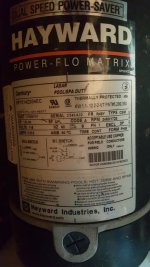
The pump spec sheet says:

115V

1.5 HP - HIGH
0.16 HP - LOW

AMPS:
11.0 - HIGH
2.0 - LOW
 

wyliesdiesels

Well-known member
Joined
Aug 14, 2012
Messages
20,179
Location
Modesto, CA
What's the voltage of the pump, 120vac or 240vac?

A 1.5hp, 120vac motor has a full load amp rating of about 20 amps, and will require a 25 or 30 amp breaker.

A 1.5hp, 240vac motor has a full load amp rating of about 10 amps, so a 15 amp circuit will be okay. 14 AWG wire will be okay, assuming the distance from the breaker to the pump isn't so far that you need to worry about voltage drop. Either stranded or solid wire is okay as long as it's rated for use in an underground conduit (typically this is THHN/THWN, the wire should have that designation marked on the insulation.)

The receptacles need to be on their own circuit.

This is correct except the NEC tables are FLC/full load current not FLA/full load amps, which is what is listed on the nameplate...

The pump spec sheet says:

115V

1.5 HP - HIGH
0.16 HP - LOW

AMPS:
11.0 - HIGH
2.0 - LOW

The FLA on the nameplate is meaningless unless Hp isnt listed. This is because the NEC requires motor circuits to be wired based on nameplate HP and the tables listed in 430.248 or 430.250, instead of nameplate FLA

Stuart provided the correct wire gauges above.
 
Last edited:
OP
D

D45

Well-known member
Joined
Mar 21, 2014
Messages
4,842
Location
NW INDIANA
Thanks

Does this help at all
 

Attachments

  • 20200517_113756.jpg
    20200517_113756.jpg
    74.9 KB · Views: 66
To avoid these ads, REGISTER NOW!

Copymutt

Well-known member
Joined
Sep 3, 2016
Messages
3,432
Location
Colorado
Where did you get this information? There's nothing in the Code that supports any of this.

In this case code does not address common sense. The next homeowner sees 12 and doesn't know its tied to 14, he connects a 20 amp device.
Not good. Illogical practice.
Stranded has some benefits over solid. Flex/ higher current. As long as its properly encased and connections are secure I see no reason to not use it.
 

wyliesdiesels

Well-known member
Joined
Aug 14, 2012
Messages
20,179
Location
Modesto, CA
the benefit you speak of in regards to stranded wire is called the skin effect and is not apparent with smaller gauge wire
 

alfredeneuman

Well-known member
Joined
Mar 3, 2011
Messages
4,596
Location
Fullerton, CA
In this case code does not address common sense. The next homeowner sees 12 and doesn't know its tied to 14, he connects a 20 amp device.

Then the next homeowner has no business doing electrical work if he just adds a receptacle without checking the whole circuit first.
 

sberry

Banned
Joined
Jun 18, 2005
Messages
35,747
Location
Brethren, Michigan
I got a call a while back from the maint man, they had looked in the panel and couldn't understand the mismatch of breakers on the wire sizes. I know the master that was there before, he wasn't a guy that looks for extra work but he is a bona-fide genius and isn't going to leave a box full of wrong ocpd. Whole thing stuffed with tandems and multi wire. If it was followed a little it was obvious, some 12 spliced to 14.
I did find one mw with both on a leg but,,, was to lights, fixxed load, no recepts.
 

CJ7VFR

Well-known member
Joined
Jan 13, 2015
Messages
2,942
Location
Central New Jersey
In this case code does not address common sense. The next homeowner sees 12 and doesn't know its tied to 14, he connects a 20 amp device.
Not good. Illogical practice...

Sort of like someone using heavier gauge wire, like 10 gauge, or even 8 gauge, for a longer run to an out building that is 200 feet away, in order to help eliminate voltage drop, even though the circuit breaker will be 20 amps and all the wiring inside the out building will be 12 guage.

As long as the breaker is sized for the smallest gauge of wire used in the circuit, it is code compliant, as you said.

I agree with alfredeneuman, and his statement. You shouldn't do things for whoever is going to own your house in the future. Do what you need to do now, and as long as it meets the NEC codes at the time you are installing it, don't worry about it. If someone else in the future is not educated enough about wiring codes to do the right thing, and check that what they are doing is correct, there is nothing you can do to stop that unfortunately.

Jim
 
Last edited:

Bert_

Well-known member
Joined
Dec 24, 2016
Messages
9,853
Location
NW Iowa
In this case code does not address common sense. The next homeowner sees 12 and doesn't know its tied to 14, he connects a 20 amp device.
Not good. Illogical practice


Can't plan for those types of people. They will probably just slap a 30a on it no matter what size wire it is. Then they will argue how it's always worked for them before when you try to tell them it's wrong.
 

Terry D

Well-known member
Joined
Mar 25, 2015
Messages
2,202
Location
St. Louis, MO.
Then the next homeowner has no business doing electrical work if he just adds a receptacle without checking the whole circuit first.

Not to start a whole new subject, but when you do a service/panel change and you putting that #12 on that 20 amp breaker, do you actually check the whole circuit to make sure its all #12. It could go through a half a dozen boxes or so, not to mention the ones that could be buried behind a wall
 
Last edited:

alfredeneuman

Well-known member
Joined
Mar 3, 2011
Messages
4,596
Location
Fullerton, CA
Not to start a whole new subject, but when you do a service/panel change and you putting that #12 on that 20 amp breaker, do you actually check the whole circuit to make sure its all #12.

I put the #12 on whatever size breaker that it was on before I did the service change, with very few exceptions :)
 
To avoid these ads, REGISTER NOW!
Top Bottom