

You are using an out of date browser. It may not display this or other websites correctly.
You should upgrade or use an alternative browser.
You should upgrade or use an alternative browser.
12pt vs Spline
- Thread starter BrandonV
- Start date
Proto spline with ASD open ends are my favorite ratcheting wrenches - so in my opinion, NO.
Different companies do spline drive differently. Some seem to have looser tolerances so that the wrenches are "universal" or both "SAE and Metric" combined. Those are garbage. I wonder if that's why some people have an aversion to spline drive.
Proto does it right and I've never had any issues.
Different companies do spline drive differently. Some seem to have looser tolerances so that the wrenches are "universal" or both "SAE and Metric" combined. Those are garbage. I wonder if that's why some people have an aversion to spline drive.
Proto does it right and I've never had any issues.
I have a set of spline ratcheting wrenches. Mountain? They work great. Some here complain that they mark the fastener excessively, but I haven't seen that. And on a modern car, I don't care about a line in the plating on a bolt I may never remove again.
Proto spline with ASD open ends are my favorite ratcheting wrenches - so in my opinion, NO.
Different companies do spline drive differently. Some seem to have looser tolerances so that the wrenches are "universal" or both "SAE and Metric" combined. Those are garbage. I wonder if that's why some people have an aversion to spline drive.
Proto does it right and I've never had any issues.
This is what I wanted to hear. I read something about the "universal" fit elsewhere.
Thanks!
toddmorr
Well-known member
I don't like spline because they tend to really hold the fastener once it's off, then you have to waste time getting the nut unstuck.
LWB
Well-known member
I don't like spline because they tend to really hold the fastener once it's off, then you have to waste time getting the nut unstuck.
This has been my experience too. On the plus side they bite and don't slip.
Jack Ryan
Well-known member
Different companies do spline drive differently. Some seem to have looser tolerances so that the wrenches are "universal" or both "SAE and Metric" combined. Those are garbage. I wonder if that's why some people have an aversion to spline drive.
I would have thought that if you are using a spline drive on any head other than a spline, you are using a universal tool.
I have some sets that are called "universal" meaning that they are designed to fit several head types. They are all metric and do not claim to fit non metric hex or double hex heads.
A spline drive that is not universal will definitely bite (mark) a hex or double hex head.
Not all manufacturers get it right though, you are correct there.
Jack
dnschmidt
Well-known member
Nothing wrong with spline. 100,000 mechanics that own the KABO long flex head ratcheting wrenches can't be wrong.
fatfillup
Well-known member
Spline drive certainly has its place but wouldn't be my choice for my only wrench set
That said, this is GJ, you need spline, 12 point and 6 point wrenches
That said, this is GJ, you need spline, 12 point and 6 point wrenches
shanker
Well-known member
I love my proto spline drive ratcheting wrenches...the one thing I DON'T like though is the color, I got a set of black ones...I would rather have bright chrome to make them easier to see when dropped in dark areas.
Spline drive certainly has its place but wouldn't be my choice for my only wrench set
That said, this is GJ, you need spline, 12 point and 6 point wrenches
Yes, this is the logical conclusion.
Shoreline_
Well-known member
I sold off my spline. I also found they wedged the fastener too. And they beat up soft fasteners.
...and 8 point (double square)Spline drive certainly has its place but wouldn't be my choice for my only wrench set
That said, this is GJ, you need spline, 12 point and 6 point wrenches
Wamsutta
Well-known member
Spline drive is for driving splines.
WWheeler
Well-known member
Spline drive certainly has its place but wouldn't be my choice for my only wrench set
That said, this is GJ, you need spline, 12 point and 6 point wrenches
In stubby, standard length, long pattern, offset, and then all over again once we get to ratcheting versions and you can add flex, reversible versions. lol
cvairwerks
Well-known member
Because there are spline bolts in use out there..... Lots of them in the aircraft world.I’ve never had a 12pt wrench slip on a fastener. I think spline is a solution in search of a problem. Yes, they work! Why bother?
That’s makes perfect sense to me. Thanks.Because there are spline bolts in use out there..... Lots of them in the aircraft world.
roofdweller49
Well-known member
- Joined
- Jan 22, 2023
- Messages
- 196
I was always curious why those are not 12 point. I guess they're fine in actual use?Nothing wrong with spline. 100,000 mechanics that own the KABO long flex head ratcheting wrenches can't be wrong.
cvairwerks
Well-known member
Typically a spline head is used where high strength is needed in a high heat area. Most jet and turbine engines use all spline bolts and nuts.I was always curious why those are not 12 point. I guess they're fine in actual use?
Ilikeike
ALLIANCE MEMBER
We used spline in the USAF working on aircraft, all SnapOn stuff.
I like them, and use them on normal fasteners just fine.
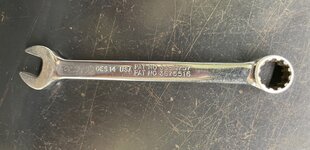
My Protos also

I like them, and use them on normal fasteners just fine.
My Protos also
Last edited:
I’ve never had a 12pt wrench slip on a fastener. I think spline is a solution in search of a problem. Yes, they work! Why bother?
Because they fit 6 point, 12 point, spline, E-torx....
InjectorService
Well-known member
Spline *****. Period. It's a homeowner "one wrench does everything" solution. My Gearwrench 120xp wrenches are really nice, but the spline makes them useless because there is about 10° of slop in them compared to a 12 point.
I won't ever own another spline tool. Ever
I won't ever own another spline tool. Ever
Yeah. I have all those. I’m personally not a fan of the “one wrench to rule them all” approach. I’d only buy them if I had splined fasteners I needed to work on.Because they fit 6 point, 12 point, spline, E-torx....
I’ve worked on aircraft but never jet engines and have never needed a splined wrench.
I agree there is some confusion of "Metric+SAE Universal" type spline drives and mm or inch dedicated spline drive tools (which may still be advertised as "universal" in that they fit various 6, 12 point head styles, but not sizes), with very different performance levels. Properly done, it makes for excellent tools.
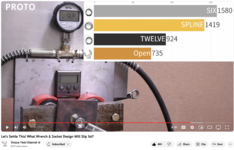
Spline drive (US Patent 3354757, attached, standardized as SAE AS1159 AS1325, MS33787) was originally developed in the 1960s as a high torque wrenching standard, to get smaller heads and thus save weight/volume for aerospace and similar applications. It got adopted in a limited way and is used in some aerospace fasteners. It was also proposed for the American metric standard fasteners as part of the "Optimum Metric Fastener System" to replace hexagonal heads, but didn't catch on.
It was explicitly designed to be backwards compatible with hex and bi-hex fasteners and bi-hex tooling, but of course each wrench profile fits best on its own fastener type... and yes the higher contact pressure may make it so that softer fasteners get some surface deformation.
Torx was developed right around the same time and has had more commercial success, especially as the patents expired. (Perhaps easier for the heading tooling to do 6 big vs 12 small lobes? And probably better for automated assembly with the huge lead-in chamfer on many external Torx.)
For partially rounded hex fastener heads, spline tools gets you almost 6 point performance with much more positional and fastener type flexibility. (For good condition/high spec fasteners, almost any boxed wrench has enough torque to break off the fastener at the shank.)
Spline drive (US Patent 3354757, attached, standardized as SAE AS1159 AS1325, MS33787) was originally developed in the 1960s as a high torque wrenching standard, to get smaller heads and thus save weight/volume for aerospace and similar applications. It got adopted in a limited way and is used in some aerospace fasteners. It was also proposed for the American metric standard fasteners as part of the "Optimum Metric Fastener System" to replace hexagonal heads, but didn't catch on.
It was explicitly designed to be backwards compatible with hex and bi-hex fasteners and bi-hex tooling, but of course each wrench profile fits best on its own fastener type... and yes the higher contact pressure may make it so that softer fasteners get some surface deformation.
Torx was developed right around the same time and has had more commercial success, especially as the patents expired. (Perhaps easier for the heading tooling to do 6 big vs 12 small lobes? And probably better for automated assembly with the huge lead-in chamfer on many external Torx.)
For partially rounded hex fastener heads, spline tools gets you almost 6 point performance with much more positional and fastener type flexibility. (For good condition/high spec fasteners, almost any boxed wrench has enough torque to break off the fastener at the shank.)
Attachments
Last edited:
General Geoff
Well-known member
Allow me to retort: Spline ***** when they're not sized correctly. Tight fitting spline wrenches and sockets are great and work better than standard 12 point.Spline *****. Period.
Ilikeike
ALLIANCE MEMBER
You're doing it wrong.. lolSpline *****. Period. It's a homeowner "one wrench does everything" solution. My Gearwrench 120xp wrenches are really nice, but the spline makes them useless because there is about 10° of slop in them compared to a 12 point.
I won't ever own another spline tool. Ever
Kidding,
it's cool, cause that's what you like.
But just for info,
spline do work just fine, even on the highest end stuff.
But...I've never used cheap ****...so , some may not work well.
Shoreline_
Well-known member
I actually stopped buying a lot of Matco wrenches because it seems they only push their spline wrenches now. The "normal" wrenches are never on sale.
Yeah. I have all those. I’m personally not a fan of the “one wrench to rule them all” approach. I’d only buy them if I had splined fasteners I needed to work on.
I’ve worked on aircraft but never jet engines and have never needed a splined wrench.
I agree. But if you wanted to buy long flex head ratcheting wrenches ~10 years ago, they were mostly spline, because most, or all, were coming from Kabo- and sold by Mountain, EZ Red..... I didn't want spline, but that's what was available at the time I bought. It was years later when Tekton started selling 6 point. I'm sure there are a lot more choices now, but 10 years ago there weren't; at least not in my price range.