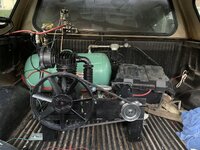
This is a picture of the 12volt air compressor I did not have a chance to get my out so I thought you could use this picture. The problem with most compressors is heat. I was told that the Oasis compressor has to be in the open or it will overheat.



Would you be interested in selling it to me?This is a picture of the 12volt air compressor I did not have a chance to get my out so I thought you could use this picture. The problem with most compressors is heat. I was told that the Oasis compressor has to be in the open or it will overheat.
 www.blocklayer.com
I see the rpms arePlug your pulley sizes into this calculator if you're asking about what the RPMs will go to.
Pulleys and Belts - Inch
Visually calculate pulley size rpm belt length and speed with animated scaled diagrams - Inch
At ten years old I'm wondering if your Viair 444 is just tired. My on-board air system used two Bushranger compressors. It got pulled out when I sold that vehicle. If I was building that system again I would probably splash out on an ARB twin motor high output (6.1 cfm) compressor or two of the other high output Aussie compressors on the market.So I use it for several things. My primary purpose is for air horns. I operate my vehicle as an emergency vehicle sometimes through heavy traffic in a metro area. My 30 gallon tank and viair 444 (over 10 years old now) works great. The only downside is the recovery time is a bit slow. It’s in the 5-7 minute from 80-100 back up to 140. Also I am considering adding a genuine Nathan K5LA for recreational purposes. I also use this to run an occasional air tool or pump up tires.
Thank you for your awesome insights! I am running a HO alternator, along with 2 auxiliary batteries. The current I’m not concerned about. I am wondering what other type of motor would be suited to this project? I haven’t had much luck finding one. I have been able to run the compressor with a 4 inch pulley for 20 mins with no problems continuously. I’m not an engineer so I am just working by trial and error standards. Do you think I should replace the motor?This is where design engineering comes into play. You look at the motor ratings and curves, compressor pump curves, and also figure on losing 10-20% power from the V-belt drive. Also, measuring the external temperature of the motor doesn't tell you how hot the windings are getting internally. When I used to design DC motor drives, we would have the motor manufacturer make us prototype motors with temperature sensing elements bonded to the motor windings. This way we knew how hot we were getting the windings.
Not yet discussed: what effect does drawing 150A or so for several minutes have on the vehicle's electrical system? I can see the alternator and battery not taking kindly to this kind of load.
Remember, there is no free lunch! Somebody's got to pay for the sandwich.
Does is still function after you let the smoke out of it? Without knowing the specifications and ratings on your existing motor, it is difficult to answer your question. That fact that it ran for 20 minutes really doesn't mean much, as you could have (and I am guessing did) overheat the windings internally. You can get away with that for awhile, until you have a failure of the winding insulation at which point the motor is toast (not economically viable to rebuild such a motor in most cases, when comparing to the cost to buy another one). You may find that a DC motor rated for your compressor pump load, for continuous operation is many times larger (and commensurately more expensive) than the one that you have now.Thank you for your awesome insights! I am running a HO alternator, along with 2 auxiliary batteries. The current I’m not concerned about. I am wondering what other type of motor would be suited to this project? I haven’t had much luck finding one. I have been able to run the compressor with a 4 inch pulley for 20 mins with no problems continuously. I’m not an engineer so I am just working by trial and error standards. Do you think I should replace the motor?
Thank you so much. I will check. The motor has been running ok until the smoking started which was prompted by removing a 4 inch pulley for a 6 in an attempt to speed up the motor. I am using a winch motor running 2hp at 1800 rpm. It pulls around 100 amps at 0 psi and 145 at 120 psi. I did add some small holes at the rear of the motor and attach a fan on a timer. The fan runs on startup and continues for 10 mins after the compressor stops running. I will check around for a new motor.Does is still function after you let the smoke out of it? Without knowing the specifications and ratings on your existing motor, it is difficult to answer your question. That fact that it ran for 20 minutes really doesn't mean much, as you could have (and I am guessing did) overheat the windings internally. You can get away with that for awhile, until you have a failure of the winding insulation at which point the motor is toast (not economically viable to rebuild such a motor in most cases, when comparing to the cost to buy another one). You may find that a DC motor rated for your compressor pump load, for continuous operation is many times larger (and commensurately more expensive) than the one that you have now.
When you are dealing with a motor, welder, solenoid or similar electrical devices that have windings, the key thing is not to overheat the windings internally. You have a very long insulated copper wire, which conducts heat very well through the wire, but not very well through the insulation. Now you tightly wrap this wire around and around a core (either in a motor or transformer) hundreds of times. The section of wire buried in the middle of the windings has no effective way to get the heat out, other than to transfer it to the wires around it, which are equally hot. So the whole mess heats up, with the inside getting the hottest, as only the outside of the winding assembly can conduct and radiate the heat out to whatever it is contacting. The manufacturer will run tests to see how long under various conditions that the motor can run without exceeding the safe internal winding temperature, in order to provide the specifications for the motor so the designers using the motor can determine if it is suitable for a particular use.
This is why items like motors and transformers have duty cycles. Take a consumer-grade welder for example. Read what the duty cycle is in the instructions. It's probably 10-20%. So 2 minutes of welding, followed by 10 minutes of cooling down so the windings don't overheat. Now take an industrial-duty welder that has a 100% duty cycle. It costs 5 times as much, and weighs much more as well. Why? It has much larger windings and other design features (bigger fans, more airflow around the windings, etc.) to help it dissipate the heat.
So this is why I say that there is no free lunch. The motor you are currently using may only be rated for the load you are applying to it for say 5 minutes, followed by 20 minutes of no use for cooling the windings (this is just a guess for illustrative purposes). Will it run for longer? Sure, but the windings won't like it and their life will suffer.
I used to specify DC electric motors for a major lift manufacturer (scissor and boom lifts). We dealt directly with the DC motor manufacturer who in most cases custom-designed motors for our application. There are several companies that manufacture such motors, such as Advanced DC Motors, D&D Motor Systems, and others. I would suggest looking at their existing offerings to see if they have an off-the-shelf solution which might work for you. Here is a link to an EV supplier which lists various DC motor manufacturers:
Got both of these in my JK. Great optionsAfter 35 years of 4 wheeling and airing up tires, in my opinion, hands down, the two BEST options for on board air are:
1. A York compressor. This is belt driven.
2. ARB dual compressor. 12v.