To avoid these ads, REGISTER NOW!

12V winch wiring

driftpin

Well-known member
Joined
Dec 22, 2016
Messages
11,210
Location
Miami-Dade/Broward Co. Florida
I have an older Sears winch. I tried finding the manual for it on the Sears site, no luck. I suspect it's probably a simple wiring, where the negative should go to somewhere on the winch bracket when the winch is mounted to the vehicle, or wherever it's going to be placed. Then the two copper threaded studs are used for power-in and power-out, providing 12V + to one or the other of the threaded studs.

My concern is, I don't want to short things out, because I have this wrong. Input, please, and thank-you.

After I get this squared-away for proper placement of the wires, I'll buy a switch and power cord, and a relay. My intended use is to pull things into my pick up, or onto a ~4' X 8' open, flat-bed trailer.

One other thing, there's a nylon machine screw in what I assume is the gear case, I suspect this is for adding some type of gear oil/grease? There is another threaded hole opposite where the nylon machine screw is (3 o'clock/9 o'clock, on the third picture), I don't know if that's also supposed to have another nylon screw.

My, how Sears has fallen. You used to be able to find owner's manuals for nearly anything through their online parts site, but it's not that way in this case.
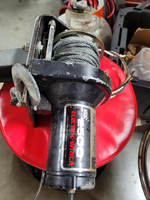
winch electric.01.pngwinch electric.02.pngwinch electric.03.png
 
Last edited:
To avoid these ads, REGISTER NOW!

CADPoint

Well-known member
Joined
Jan 31, 2011
Messages
155
Location
WSW of **** City
Well first you didn't qualify what you're putting this on!
Now I'm not an active wrencher but I do know I had to buy a special cord for my 2008 silverado just to
add a new stereo. Granted this was due to their wiring BS, but I'm just saying. So just taping off the ignition power might
like the old days would not be a good thing!
Second, everything I see on wiring diagrams presents the use of a solenoid to be between a switch and the unit.

The terms solenoid and relay can often be used interchangeably; however, in the Automotive market, the term solenoid generally refers to a "metal can" type, whereas a relay typically refers to the standard "cube" style relay. The contactor is the relay to use when a circuit must support a heavy current load.

Lastly, you'll have to determine which you want the use: a toggle switch or a rocker switch almost the same, a toggle is on when applied
and a rocket is sometimes/most times a momentary switch meaning you have to keep pressure on it, more desirable when winching.

If you have an ohm meter, one terminal will ring out to the chassis that is your common, the other terminal should not ring, that's your hot.
There seems to be enough road maps on the internet to figure out how to wire this.
Good Luck.
 

htmdude57

Well-known member
Joined
Apr 28, 2014
Messages
173
Location
Hudson Valley, New York
I would think that ground DOES NOT go to the chassis. The motor would need to be isolated from the metal case. The motor would need +12 on one terminal, ground on other terminal, to drive one way, then complete opposite wiring when going in reverse direction. If you have no control for this winch, you need to build your own, using 4 relays like the ones made for a garden tractor starter, and 2 push buttons for forward and reverse.
 

CADPoint

Well-known member
Joined
Jan 31, 2011
Messages
155
Location
WSW of **** City
I would think that ground DOES NOT go to the chassis.
You're right the solenoid would be in control for the desired direction , IE both terminals are the motors wiring.
The exposed nut is the common terminal. (I've seemed to have missed that)
 

fitter30

Well-known member
Joined
Jun 23, 2019
Messages
2,967
Location
Peace Valley,mo
Harbor freight has a badland has a 2500 that looks almost the same. Measure resistance from each stud to case ground both should be the same. There using case ground for the common each stud either cable out or in.
 
OP
D

driftpin

Well-known member
Joined
Dec 22, 2016
Messages
11,210
Location
Miami-Dade/Broward Co. Florida
As suggested, each circuit stud is insulated from the case, so trying to read from the one stud (or the other) to the winch case gives an 'open' circuit, both ways.

Taking a leap of faith, I jumped from a well-charged battery, to each of the winch copper studs. Eureka! One way 'cable-out,' reverse the leads on the winch, and I have 'cable-in.' It works.

Thanks for the responses, each of you. htmdude57, looking for relays and momentary contact spring-loaded switches last night on the internet, I saw that same relay/contactor. I'll probably just make things easy, and buy the suggested 'frequently bought together' wireless remote, and spring-loaded switch with it.

CADpoint, there are two bare-nutted terminals. As to tapping for a source of power, I think I'll look for a high-amp rated secondary fuse panel. I see the relay/contactor is rated at 250 amps. Something in that range would seem appropriate. I'm thinking 10 ga. stranded copper wire should be sufficient from the vehicle battery to the aux. fuse panel.

It's a boat winch, though I'm not using it for that, just to load things onto a trailer or into a pick up bed. The winch is mounted on a male receiver, square I-beam girder section. I have a couple of steel rings welded into the front of the bed and I'm considering a tube which would run across the front floor to which the winch would be attached, maybe not using the previously-mentioned square I-beam girder section. Having it removable but able to be locked somehow would appeal to me as I don't need the duty it would perform frequently. The wireless remote would eliminate running some wires, unless I wanted a manual switch too.

The switch in post #7 appears to be a simple on-off switch, but it needs to be a center-off spring-loaded double-position switch, reversing polarity when it moves up or down. I'm not an E.E. so I don't know the abbreviation. DPDT, maybe?
 
Last edited:

htmdude57

Well-known member
Joined
Apr 28, 2014
Messages
173
Location
Hudson Valley, New York
Driftpin, the switch shown in the photo is a SPDT, which means Single Pole Double Throw. You could buy one to test (mock up) your system, but if you buy a wireless remote it (the wireless remote) works in the place of the switch.
 
To avoid these ads, REGISTER NOW!

PoorUB

Well-known member
Joined
Mar 29, 2021
Messages
11,622
Location
Fargo, ND
I have an older Sears winch. I tried finding the manual for it on the Sears site, no luck. I suspect it's probably a simple wiring, where the negative should go to somewhere on the winch bracket when the winch is mounted to the vehicle, or wherever it's going to be placed. Then the two copper threaded studs are used for power-in and power-out, providing 12V + to one or the other of the threaded studs.
I have a similar winch and i was going to get it prepared for use, then I ran across this,
HF Winch
And i had to wonder if dealing with a 35 year old winch that I would have to cobble up a remote was worth it.
$80, all ready to go with a wireless remote. Pretty sweet deal.
 
OP
D

driftpin

Well-known member
Joined
Dec 22, 2016
Messages
11,210
Location
Miami-Dade/Broward Co. Florida
I have no qualms about HFT stuff, I have one of their heavy-duty hoisting winches (h-d being for consumer shop/home garage use, not industrial use). However, I think that this one may be of stronger stuff than what HFT is selling.

I could always just advertise it as a working winch, and sell it, as I really don't have a burning need for it.
 

no704

Well-known member
Joined
Apr 27, 2016
Messages
5,209
Just use 4 old school ford starter solinoids. Or 2 with really big diodes.
 

Sumboodie

Well-known member
Joined
Mar 20, 2021
Messages
10,668
Location
AK
Well first you didn't qualify what you're putting this on!
Now I'm not an active wrencher but I do know I had to buy a special cord for my 2008 silverado just to
add a new stereo. Granted this was due to their wiring BS, but I'm just saying. So just taping off the ignition power might
like the old days would not be a good thing!
Second, everything I see on wiring diagrams presents the use of a solenoid to be between a switch and the unit.

The terms solenoid and relay can often be used interchangeably; however, in the Automotive market, the term solenoid generally refers to a "metal can" type, whereas a relay typically refers to the standard "cube" style relay. The contactor is the relay to use when a circuit must support a heavy current load.

Lastly, you'll have to determine which you want the use: a toggle switch or a rocker switch almost the same, a toggle is on when applied
and a rocket is sometimes/most times a momentary switch meaning you have to keep pressure on it, more desirable when winching.

If you have an ohm meter, one terminal will ring out to the chassis that is your common, the other terminal should not ring, that's your hot.
There seems to be enough road maps on the internet to figure out how to wire this.
Good Luck.
Solenoid does work, relay doesn't.
 

kerrynzl

Well-known member
Joined
Nov 8, 2013
Messages
5,054
Location
Tauranga, New Zealand
Use a 4 relay setup, and you are not stuck winching if one relay welds itself in the 'on' position.

Or simply use a battery isolator switch instead with the relay in post #7

Driftpin, the switch shown in the photo is a SPDT, which means Single Pole Double Throw. You could buy one to test (mock up) your system, but if you buy a wireless remote it (the wireless remote) works in the place of the switch.

you can use a piece of wire just to test it [a switch isn't needed]
Wireless relays are cheap [here's one with the winch solenoid as one kit]

 
OP
D

driftpin

Well-known member
Joined
Dec 22, 2016
Messages
11,210
Location
Miami-Dade/Broward Co. Florida
Or simply use a battery isolator switch instead with the relay in post #7


you can use a piece of wire just to test it [a switch isn't needed]
Wireless relays are cheap [here's one with the winch solenoid as one kit]

Thank-you for the suggestions.

Yes, I just used two 10 ga wires and a large a-h battery to see if the winch works, and it does.

Looking online, I also saw that solenoid & relay you posted. Now I have to decide about either running a harness from the engine compartment battery, or using a separate battery, which I have. Either way, I'll fuse it and employ plastic split flex conduit.
 

Tbender78

Well-known member
Joined
Feb 23, 2013
Messages
122
Location
Boston area
I have the same winch. The forward reverse switch mounts on the end of the winch. A thumb screw holds the switch in place over the 2 studs. I bought a replacement switch from another winch manufacturer. Can’t remember which one. Relatively cheap if I recall. That way you don’t have to do any relays, just hook the positive and negative to the battery.
 

75gmck25

Well-known member
Joined
Jul 21, 2014
Messages
1,318
Location
Alexandria, VA
If you start looking for solenoids, make sure you get one for continuous operation. Starter solenoids, like the very common one Ford used, are only rated for intermittent use. However, there are also solenoids rated for continous operation, and they are often used in battery isolators or other dual battery setups. For a winch I think you would want one rated for continuous operation.
 
Last edited:

kerrynzl

Well-known member
Joined
Nov 8, 2013
Messages
5,054
Location
Tauranga, New Zealand
Thank-you for the suggestions.

Yes, I just used two 10 ga wires and a large a-h battery to see if the winch works, and it does.

Looking online, I also saw that solenoid & relay you posted. Now I have to decide about either running a harness from the engine compartment battery, or using a separate battery, which I have. Either way, I'll fuse it and employ plastic split flex conduit.

If you run a wireless relay/ remote , use a battery isolator/cut-off switch. [these will drain a battery on standby]
Winches are like starter motors and they perfom better without a fuse [hence also the battery isolator]

I went through this whole exercise on my car hauler trailer, and even with the crazy cost of batterys it was cheaper to mount a battery on the trailer than using cables and anderson plugs cut-off switches , conduit, cushion clamps etc etc

I ended up with a battery mounted under the tilt-deck [on the tongue] with all the cables inside the 2 x 4 tubing.
Then I added a smaller set of wires to a 70a relay [via a 40a auto reset fuse] to a 50a Anderson plug. The relay is activated via the taillights.

On my tow vehicle is another Anderson plug connected to the battery. If I tow with the lights on, it charges the battery.
By using a relay , when I switch the lights off , a flat trailer battery won't drain the tow vehicle battery [when parked]

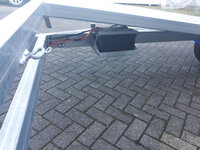
Here is my winch showing the Isolator switch in the center where it can be reach at from both sides. The round circle to it's right is a voltage gauge
All the wiring is hidden inside the tubing
20210724_162748.jpg

Here is the battery box mounted to the tongue [tilt deck] you can see the 40a auto reset fuse which is close to the battery.
I used a Euro car battery for the low height, it fits between 2 crossmembers on the deck
20210724_163112.jpg
 

mdmmfm

Member
Joined
Aug 28, 2014
Messages
5
Hi driftpin,

I wanted to thank you for this post, even though it is old, regarding your winch as I have the Dayton version of this winch and am totally bewildered on how to properly test/set it up. I only have the winch as well and not the factory supplied switch mechanism that it is suppose to have. Since I am visual learner, would you be able to show a pic of how you tested yours? Just like you, I don't want to short anything out, but I just want to see if I can get this thing to power up/move. Also, in just testing it with a meter, what should I be looking for? Any helpf would be greatly appreciated. Thanks in advance for your assistance.
 
To avoid these ads, REGISTER NOW!
Top Bottom