I found a deal on some 2 inch insulation on Craigslist for 8 bucks a 4x9 sheet. They said its r value is 10-12 but they dont know the pressure rating. I'm assuming it's 15psi. I asked my concrete guy and he thought it would be fine. I searched for some threads concerning this subject but being new here I didn't find the info I was looking for. Any input would be useful and appreciated. I'm planning on radiant floor heat in a 34x40 detached garage in Northwest indiana. Thanks.

You are using an out of date browser. It may not display this or other websites correctly.
You should upgrade or use an alternative browser.
You should upgrade or use an alternative browser.
15psi vs. 25psi under slab insulation
- Thread starter Lenny C
- Start date
Highbeam
Well-known member
15 psi is most likely stronger than the earth that you are building on. The concrete slab only weighs 0.5 psi.
The only trouble with the 15 psi is that it is easily damaged during installation, just softer and easier to dent. Since the add says R 10-12 I would guess that you are dealing with XPS and a standard 25 psi rating.
The only trouble with the 15 psi is that it is easily damaged during installation, just softer and easier to dent. Since the add says R 10-12 I would guess that you are dealing with XPS and a standard 25 psi rating.
kj_mustang
Well-known member
What type of insulation is the stuff on Craigslist? XPS and EPS foam can go under the slab but polyiso can not.
kj_mustang
Well-known member
150 will hold water, the 250 is rated for ground installation. If you dig up 150 you can't lift it up it is so heavy with water
If they used a vapor barrier and protected any exposed edges, then there would be no water absorption.
Trey T
Well-known member
concrete floor (reinforced) weighs about 150pcf (lb/cubic-ft).
typical rating for concrete (US) is 3000psi. Concrete strength varies around the world and US' concrete are tested much higher than 3000psi.
typical rating for concrete (US) is 3000psi. Concrete strength varies around the world and US' concrete are tested much higher than 3000psi.
15 psi is most likely stronger than the earth that you are building on. The concrete slab only weighs 0.5 psi.
The only trouble with the 15 psi is that it is easily damaged during installation, just softer and easier to dent. Since the add says R 10-12 I would guess that you are dealing with XPS and a standard 25 psi rating.
Highbeam
Well-known member
concrete floor (reinforced) weighs about 150pcf (lb/cubic-ft).
typical rating for concrete (US) is 3000psi. Concrete strength varies around the world and US' concrete are tested much higher than 3000psi.
The concrete WEIGHS 0.5 psi. Do the math. 150 pcf as you said, 6" thick, you will find less than 0.5 psi exerted on the foam by the concrete. Sure the foam will fail before the concrete will fail in compression but before that, the earth (most of the country) under the foam will yield.
So the 3000 psi compressive strength has nothing to do with the price of turkey.
Concrete is a rigid pavement so you can assume load distribution. My 10,000# fully loaded pickup is 8 feet wide and 20 feet long, that's over 23000 square inches and only 0.43 psi of load.
I would rather work with 25 psi stuff due to density.
I went to look at the stuff this morning. Its called polyplank. Its a closed-cell polyethylene plank. It looks like the same stuff the swimming pool noodle things are made of but a little heavier duty. It looks like it will hold up fine structurally but im concerned about the r value. I cant seem to find any info about the r value of the stuff because it isnt intended for insulation. Its made for packing material.
It seems like water absorbing is a non issue seeing as though the stuff is used as a floatation device. It seems a little softer than the owens corning 25psi stuff at menards so would that equate to less dense? Would less dense offer higher r value?
Trey T
Well-known member
Highbeam: I'm not even sure we're on the same page here. I don't know any civil engineer out there that measure the weight of concrete by pound per square-inch (psi) because no body measure anything in two-dimensional (square-inch).
weight (unit weight) and pressure are two different units and you're using it interchangeably. All I'm saying is that you may confuse others.
weight (unit weight) and pressure are two different units and you're using it interchangeably. All I'm saying is that you may confuse others.
Highbeam
Well-known member
Yes, I'm a civil engineer but most aren't. So the statement that concrete weighs 0.5 psi is a reference to the typical 6" slab thickness as I continued to explain.
Yes, I've mixed up 11000 psi concrete and crushed it in the lab to measure the compressive strength.
Read carefully here.... 6" thick concrete, you will find less than 0.5 psi exerted on the foam by the concrete.
We now spec out 4000 psi concrete for sidewalks. 3000 is pretty weak but easier to work with.
Yes, I've mixed up 11000 psi concrete and crushed it in the lab to measure the compressive strength.
Read carefully here.... 6" thick concrete, you will find less than 0.5 psi exerted on the foam by the concrete.
We now spec out 4000 psi concrete for sidewalks. 3000 is pretty weak but easier to work with.
Highbeam
Well-known member
Highbeam: I'm not even sure we're on the same page here. I don't know any civil engineer out there that measure the weight of concrete by pound per square-inch (psi) because no body measure anything in two-dimensional (square-inch).
You do now. Try and use your imagination and assume a 6" slab. That provides the third dimension that you seem to need to be able to visualize a weight of a material.
Part of engineering is making good assumptions to apply the science to real world situations.
Trey T
Well-known member
Highbeam: Again, obviously we weren't on the same page with the grammar.
I think the better way to say it is: typical concrete (assuming 6") will exerts about 0.5psi.
I think the better way to say it is: typical concrete (assuming 6") will exerts about 0.5psi.
Highbeam
Well-known member
Sounds good Trey. Thought that's what I said.
you could always buy a piece and test its pressure rating yourself.
Cut 3 1"x1" squares place them in a triangle under a dumbbell weight, add weight to 75 lbs. see if it holds up over say 48 hours... Highbeam may be able to suggest a better time frame.
my best advice is if in doubt don't use it. I'm not sure it would pass a compression strength test anyway. Most Polyethylene Foam applications I see involve the foam being able to compress for shock absorption reasons, and that is one of the main purposes that polyplank is marketed for.
Cut 3 1"x1" squares place them in a triangle under a dumbbell weight, add weight to 75 lbs. see if it holds up over say 48 hours... Highbeam may be able to suggest a better time frame.
my best advice is if in doubt don't use it. I'm not sure it would pass a compression strength test anyway. Most Polyethylene Foam applications I see involve the foam being able to compress for shock absorption reasons, and that is one of the main purposes that polyplank is marketed for.
Highbeam
Well-known member
Too risky, your floor is expensive, buy the right stuff. Eps or xps.
Kevin C
Well-known member
Concrete is a rigid pavement so you can assume load distribution.
Being rigid is why you want to understand how its loaded, it will try and distribute a load, but its stress level may be higher than its design rating (a nice way of getting crack in your slab).
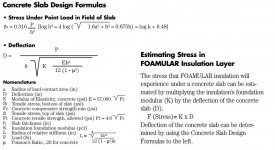
If anyone is interested in the right way to figure out foam strength for under a slab....
http://www.foamular.com/assets/0/144/172/174/4e330789-b09e-4cf0-b2d9-e16ed89ae5c3.pdf
And a thread about it....
http://www.garagejournal.com/forum/showthread.php?p=3110464#post3110464
The modulus of elasticity for the foam and the concrete are dramatically different, you cant accurately calculating loading assuming they are the same.
What happens? As the concrete is loaded, it's stresses go up very quickly (since its more rigid). The foam, tends to give a bit as its loaded and does not see nearly as much loading.
Basically, the give of the foam increases the localized loading of the concrete ( All materials deflect as they are loaded, even the concrete floor).
The foam failing is not the issue, localized loading of the slab is. The foam with the higher PSI rating is also stiffer (increased modulus of elasticity). The increase in foam stiffness provides better support for the concrete, reducing deflection and therefore strain (the foam board starts to behave more like soil, but still has a long way to go.
The main reason to specify stronger foam is that as its strength goes up, it becomes stiffer. That's one reason why DOW recommends calculating using a percentage of the foams rated strength (not its full advertised strength).
Basically, you need a thick enough slab to distribute your load forces to keep the stress in the slab within its design limits. The more your foam gives the thicker your concrete should be.
The thicker the slab, the lower the better it can distribute forces, that reduces localized loading on the foam.
If you ever want to put a lift in, the calculations should be a requirement. For any other usage the worst that happens is your nice floor cracks.
Attachments

Last edited:
AgreedToo risky, your floor is expensive, buy the right stuff. Eps or xps.
BadgerBoilerMN
Well-known member
150 will hold water, the 250 is rated for ground installation. If you dig up 150 you can't lift it up it is so heavy with water
Riiiight.
Dig up a lot of XPS do you?
We just pulled up a 20 year old heated driveway (asphalt) to replace it with a new concrete heated driveway. Our near-record rains here in Minneapolis did not make the old XPS "heavy". Same as always, about 5% max.
150 will work for most residential applications but when installing snow melting or other significant heating jobs we use 250 (25# foamboard) as it will stand up to foot traffic as High astutely suggested.