Alienbaby17
Well-known member
I came upon this listing a week ago while I was doing my nightly “rounds” of the local Craigslist ‘Tools’ section.
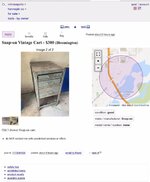
It immediately caught my eye but I initially didn’t think much of it. It was old, which I liked, but it wasn’t much to look at. It lacked the design elegance of a K-60. It lacked the useful size of a KR-300. It was really just kind of odd. But it was OLD and I’d never seen one before. It intrigued me. I flipped past the listing but a moment later I was thinking about it again and went back for another look.
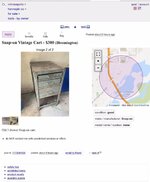
That night I ended up sending the seller a message expressing my interest and offering him what I considered a fair price. I told him it was no problem if he wasn’t interested but to keep my offer in mind if he changed his thinking. The next day we exchanged a few more emails, agreed upon a mutually fair value and that night I scheduled an appointment to go have a look in person.
Naturally the anticipation had me thinking about it all day. I began speculating that the kind of person that had this might have other good stuff as well. I had visions of a family member cleaning out the remains of a deceased relatives old auto repair shop. I dreamt of vintage cabinets and work stations, signs, cool old equipment, manuals and tools. I grabbed a couple hundred extra in cash and headed out full of high hopes.
When I arrived I found the scenes I’d been fantasizing about all afternoon were not to be realized. The seller had acquired the “roller bench” when he had purchased an old house. It had been left behind with tons of trash and he was gradually working his way to finally getting rid of it all. This was all he had of interest to me. However, my disappointment quickly faded when I saw the cart. The seller asked me if it was what I expected and I laughed. I told him I would absolutely buy it for our agreed upon price but that it was a little more “crude” than it had looked in the listing. Still I was very excited to get it and the seller seemed happy it was going to someone that would use, enjoy and appreciate it.
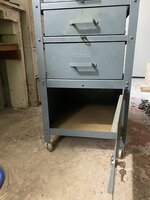
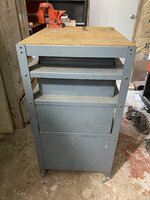
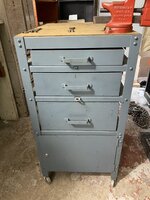
The first thing I had to do was give the old girl a bath. I started hand-scrubbing with an abrasive sponge and mild detergent. It was working but was taking forever. I ended up loading it back up into the car and bringing it to a self-service car wash. I ran it through three high-pressure wash cycles but it wasn’t super effective. In the end I went back to hand scrubbing and eventually got the main skin of dirt and grime off of it. That was when I noticed it wasn’t actually grey as it had originally appeared, but rather a light blue in color. It had clearly been repainted and rather badly. One of the few things I could find about these was that the early versions (K-7) were black and the later versions (K-70) were grey. When I had it tipped over to clean it looked to me like several areas that had been missed during the repaint were a dark red color. Possibly it has seen several paint jobs over the years.
I wanted to start this thread for a couple reasons. First , to show off a little. Secondly, because when I was doing my early research on these I couldn’t find hardly anything about them. There was one post here from ??? years ago, a listing on a EBay, but otherwise that was it save for the amazing collectingsnapon.com catalogs and one thread over there. I wanted to put a little more information out there for anyone trying to learn more about these in the future.


Here’s what I’ve learned.
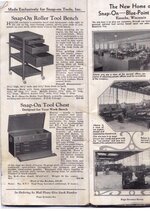
The catalogs refer to these as a “Roller Tool Bench”. It looks like they first appeared starting in 1931. At that point the model was a K-7. The K-7 model number was shown in the catalogs through 1935. In 1936 the K-7 was replaced with a K-70. The K-70 was made until 1939. After that they disappear from the books.
From what I have been able to tell the only real difference between the two is that the K-7 was black and the K-70 was grey.
Another difference between the two models may have come in the form of accessories. Both models look to include a, “...handy, removable valve shelf which hangs on either side of bench.” However the K-70 models also offer a K-70-H Metal Tray (.90 option in 1936) which also hangs on the side for small parts. The K-70 also shows an option for a locking door and side panel kit ($4.30 in 1936) for the lower shelf area. Although the options are only shown for the K-70 models I’d guess they could also work with the K-7 models since virtually everything else about them seems identical.
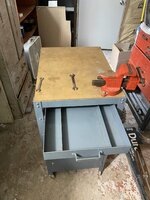
Another interesting feature has to do with the drawers. I had read that the drawers all fit inside one another. It is indeed true. The top drawer fits inside the middle drawer and the middle drawer fits inside the bottom drawer. It’s actually pretty clever. I’d guess it was to make shipping more convenient. Although it’s only mentioned starting with the K-70s I believe these were both probably shipped, “knocked-down and ready for assembling by purchaser.”

Overall, for an old piece of shop equipment I think I’m going to get lots of use out of it. It’s a good height to conveniently set things on top of. The narrow size makes it easy to roll around a crowded shop. I can see why they eventually discontinued it as it was basically just a couple sheet metal sides away from being a narrow tool box. As larger rolling cabinets became more common I imagine they seemed a bit nicer than these service carts.

Sent from my iPad using The Garage Journal mobile app
It immediately caught my eye but I initially didn’t think much of it. It was old, which I liked, but it wasn’t much to look at. It lacked the design elegance of a K-60. It lacked the useful size of a KR-300. It was really just kind of odd. But it was OLD and I’d never seen one before. It intrigued me. I flipped past the listing but a moment later I was thinking about it again and went back for another look.
That night I ended up sending the seller a message expressing my interest and offering him what I considered a fair price. I told him it was no problem if he wasn’t interested but to keep my offer in mind if he changed his thinking. The next day we exchanged a few more emails, agreed upon a mutually fair value and that night I scheduled an appointment to go have a look in person.
Naturally the anticipation had me thinking about it all day. I began speculating that the kind of person that had this might have other good stuff as well. I had visions of a family member cleaning out the remains of a deceased relatives old auto repair shop. I dreamt of vintage cabinets and work stations, signs, cool old equipment, manuals and tools. I grabbed a couple hundred extra in cash and headed out full of high hopes.
When I arrived I found the scenes I’d been fantasizing about all afternoon were not to be realized. The seller had acquired the “roller bench” when he had purchased an old house. It had been left behind with tons of trash and he was gradually working his way to finally getting rid of it all. This was all he had of interest to me. However, my disappointment quickly faded when I saw the cart. The seller asked me if it was what I expected and I laughed. I told him I would absolutely buy it for our agreed upon price but that it was a little more “crude” than it had looked in the listing. Still I was very excited to get it and the seller seemed happy it was going to someone that would use, enjoy and appreciate it.
The first thing I had to do was give the old girl a bath. I started hand-scrubbing with an abrasive sponge and mild detergent. It was working but was taking forever. I ended up loading it back up into the car and bringing it to a self-service car wash. I ran it through three high-pressure wash cycles but it wasn’t super effective. In the end I went back to hand scrubbing and eventually got the main skin of dirt and grime off of it. That was when I noticed it wasn’t actually grey as it had originally appeared, but rather a light blue in color. It had clearly been repainted and rather badly. One of the few things I could find about these was that the early versions (K-7) were black and the later versions (K-70) were grey. When I had it tipped over to clean it looked to me like several areas that had been missed during the repaint were a dark red color. Possibly it has seen several paint jobs over the years.
I wanted to start this thread for a couple reasons. First , to show off a little. Secondly, because when I was doing my early research on these I couldn’t find hardly anything about them. There was one post here from ??? years ago, a listing on a EBay, but otherwise that was it save for the amazing collectingsnapon.com catalogs and one thread over there. I wanted to put a little more information out there for anyone trying to learn more about these in the future.
Here’s what I’ve learned.
The catalogs refer to these as a “Roller Tool Bench”. It looks like they first appeared starting in 1931. At that point the model was a K-7. The K-7 model number was shown in the catalogs through 1935. In 1936 the K-7 was replaced with a K-70. The K-70 was made until 1939. After that they disappear from the books.
From what I have been able to tell the only real difference between the two is that the K-7 was black and the K-70 was grey.
Another difference between the two models may have come in the form of accessories. Both models look to include a, “...handy, removable valve shelf which hangs on either side of bench.” However the K-70 models also offer a K-70-H Metal Tray (.90 option in 1936) which also hangs on the side for small parts. The K-70 also shows an option for a locking door and side panel kit ($4.30 in 1936) for the lower shelf area. Although the options are only shown for the K-70 models I’d guess they could also work with the K-7 models since virtually everything else about them seems identical.
Another interesting feature has to do with the drawers. I had read that the drawers all fit inside one another. It is indeed true. The top drawer fits inside the middle drawer and the middle drawer fits inside the bottom drawer. It’s actually pretty clever. I’d guess it was to make shipping more convenient. Although it’s only mentioned starting with the K-70s I believe these were both probably shipped, “knocked-down and ready for assembling by purchaser.”
Overall, for an old piece of shop equipment I think I’m going to get lots of use out of it. It’s a good height to conveniently set things on top of. The narrow size makes it easy to roll around a crowded shop. I can see why they eventually discontinued it as it was basically just a couple sheet metal sides away from being a narrow tool box. As larger rolling cabinets became more common I imagine they seemed a bit nicer than these service carts.
Sent from my iPad using The Garage Journal mobile app
Attachments
-
 6c69f55cae87bd0e21c8321944ecbe67.jpg263.3 KB · Views: 15
 -
 5273589faa948aa3025b840a87949ab2.jpg234.2 KB · Views: 8
 -
 2301aacc42afc613cc76b41e513837c3.jpg416.8 KB · Views: 5
 -
 1ec78d2b13979a3bac93ba38920655da.jpg425.7 KB · Views: 8
 -
 c10196d9801b36fe8eb7def63349f1e6.jpg416.4 KB · Views: 8
 -
 08df965aedbd0f2a687c534c01bd2136.jpg139.9 KB · Views: 13
Last edited: