

You are using an out of date browser. It may not display this or other websites correctly.
You should upgrade or use an alternative browser.
You should upgrade or use an alternative browser.
1938 Scaife Air Compressor (?!?)
- Thread starter RaysnCayne
- Start date
Murphy4570
Well-known member
That tank can probably be welded up around that frame. I dunno if I would though. Depends on how ballsy I feel that day LOL.
If that thing held 225psi in that condition, it must be seriously thick steel.
If that thing held 225psi in that condition, it must be seriously thick steel.
OP
RaysnCayne
Well-known member
That's an awesome compressor John! You should do a dedicated thread about its restoration.
My dilemma is that I absolutely cannot afford to have a horizontal tank in my garage. Just don't have the space at all. It has to be a vertical unit. So if I wanted to use this compressor, this tank, I'd have to convert all these ports to a more vertical-friendly orientation. (Thus I'm quite jealous of that nice port arrangement on the top of your Gulf machine, John.)
I think I'm gonna weld it up and put it all back together and see if I can measure its performance against my current IR T20. If it can push more air than my IR (or at least the same amount quieter and more efficiently), I'll tear it back down and totally reconfigure the whole thing. Not relishing the idea of that at all, but that's the only way I can see me being able to use this ol' girl.
And yes Murphy, it's real thick steel. That's the only reason I'm continuing to fiddle with it. That, and I'm a glutton for punishment!
My dilemma is that I absolutely cannot afford to have a horizontal tank in my garage. Just don't have the space at all. It has to be a vertical unit. So if I wanted to use this compressor, this tank, I'd have to convert all these ports to a more vertical-friendly orientation. (Thus I'm quite jealous of that nice port arrangement on the top of your Gulf machine, John.)
I think I'm gonna weld it up and put it all back together and see if I can measure its performance against my current IR T20. If it can push more air than my IR (or at least the same amount quieter and more efficiently), I'll tear it back down and totally reconfigure the whole thing. Not relishing the idea of that at all, but that's the only way I can see me being able to use this ol' girl.
And yes Murphy, it's real thick steel. That's the only reason I'm continuing to fiddle with it. That, and I'm a glutton for punishment!
64Trvlr
Well-known member
I think I'm gonna weld it up and put it all back together and see if I can measure its performance against my current IR T20. If it can push more air than my IR (or at least the same amount quieter and more efficiently), I'll tear it back down and totally reconfigure the whole thing. Not relishing the idea of that at all, but that's the only way I can see me being able to use this ol' girl.
And yes Murphy, it's real thick steel. That's the only reason I'm continuing to fiddle with it. That, and I'm a glutton for punishment!
I'd weld it up if it was mine. Vee the crack out, drill the ends of it, then a root pass, cap pass and pressure test it.
The tank on my old Wayne is 5/8" steel.

With minor leaks at 225 psi, sure looks like you can save that tank and weld it.
If you're short on floor space, how about McGyver solution and mount the tank up on rack by ceiling?? That would actually be a good solution for you to keep an eye on those welds.
I'm thinking of a custom bench with 4x4 legs in corner that go all the way up to ceiling that has unistrut frame or box frame that you'd weld up that holds tank up there. Then the compressor and motor could be under the bench.
Love to see you save the old machine. You might have Oldest Running Compressor on entire GJ if you restore to it's full potential !! Go for it!
If you're short on floor space, how about McGyver solution and mount the tank up on rack by ceiling?? That would actually be a good solution for you to keep an eye on those welds.
I'm thinking of a custom bench with 4x4 legs in corner that go all the way up to ceiling that has unistrut frame or box frame that you'd weld up that holds tank up there. Then the compressor and motor could be under the bench.
Love to see you save the old machine. You might have Oldest Running Compressor on entire GJ if you restore to it's full potential !! Go for it!
Last edited:
mayday0017
Well-known member
Just to throw it out there regulations require a new tank to pass 2.5x working pressure. So if the intended pressure is 100psi it must be hydro tested to 250psi and hold with out leaks for X amount of time (most likely only 10 min).
So with that said if you are looking for standard requirements for hydro testing now you have an idea of where you stand at passing a true safety inspection.
So with that said if you are looking for standard requirements for hydro testing now you have an idea of where you stand at passing a true safety inspection.
Engineer61
Well-known member
The 1725 rpm is the motor rpm, to find the compressor rpm you need to measure the pulleys. Then divide the motor pulley measurement by the compressor pulley measurement and multiply the result by the 1725 motor rpm to get the compressor rpm. The reason the old compressors turn slower than most modern compressors is they used small motor pulleys and big compressor pulleys and large displacement compressors that didn't need to turn fast to pump a lot of air.
OP
RaysnCayne
Well-known member
It's been awhile, but I finally made some progress on the compressor this weekend.
The big delay is I've never done much welding up to this point. I've always wanted to, but could never justify the expense of a decent machine to do it with. I finally saved my pennies and bought a decent, used Miller about a month ago. But was only just able to get the helmet this past week. So I was finally able to start back up on this project. But, it turns out welding air-tight joints ain't as easy as the seasoned pros on all the reality TV car-build shows make it look.
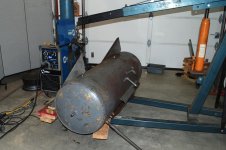
I spent about half of this past Saturday trying to weld that crack around the leg in. No matter how many times I tried, I couldn't get it air tight. (I'll not be showing you my globby welds!) Since my goal was simply to get it all back together to try out the new motor and see how the Quincy compressor performed, I decided to just let it leak and get her back together.
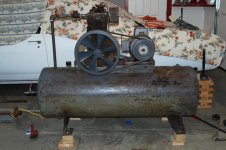
I spent Sunday afternoon piecing her all back together.
I think I'm ready to fire her up, but I'm not sure about my wiring. Can someone tell me if I can run it like this or will I blow it up with it wired this way?
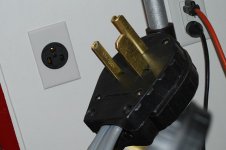
For temporary power, I've got a laundry cable with an RV plug that will plug into my 40A welder outlet. I'm running that into the pressure switch. Then taking two wires from there to the motor. (The motor had these extra, numbered white wires that had to be run in certain pairs to make the motor spin the way I wanted.) The red wire-nutted wire is a ground that was in the laundry cable. I just ran it over to the motor plate base and screwed it to that. Do I even need that?
Yes, this is a total spaghetti mess of wires, but I just want to fire her up and see how she runs. I won't be running it this way for more than an hour or two. Will this make the motor run? Or do I have my wires crossed and will blow the thing to bits when I flip the breaker on?
The big delay is I've never done much welding up to this point. I've always wanted to, but could never justify the expense of a decent machine to do it with. I finally saved my pennies and bought a decent, used Miller about a month ago. But was only just able to get the helmet this past week. So I was finally able to start back up on this project. But, it turns out welding air-tight joints ain't as easy as the seasoned pros on all the reality TV car-build shows make it look.
I spent about half of this past Saturday trying to weld that crack around the leg in. No matter how many times I tried, I couldn't get it air tight. (I'll not be showing you my globby welds!) Since my goal was simply to get it all back together to try out the new motor and see how the Quincy compressor performed, I decided to just let it leak and get her back together.
I spent Sunday afternoon piecing her all back together.
I think I'm ready to fire her up, but I'm not sure about my wiring. Can someone tell me if I can run it like this or will I blow it up with it wired this way?
For temporary power, I've got a laundry cable with an RV plug that will plug into my 40A welder outlet. I'm running that into the pressure switch. Then taking two wires from there to the motor. (The motor had these extra, numbered white wires that had to be run in certain pairs to make the motor spin the way I wanted.) The red wire-nutted wire is a ground that was in the laundry cable. I just ran it over to the motor plate base and screwed it to that. Do I even need that?
Yes, this is a total spaghetti mess of wires, but I just want to fire her up and see how she runs. I won't be running it this way for more than an hour or two. Will this make the motor run? Or do I have my wires crossed and will blow the thing to bits when I flip the breaker on?
Attachments



Fixnair
Well-known member
You have your wires crossed and you will ignite the atmosphere and destroy the world!
All kidding aside you do have a direct short the way you have wired. If you look at your pressure switch closely you will see the contacts are at opposite ends of the shiny bars where you have your wires connected. Your power is going to flow from one supply wire down the shiny bar to the points on the other end. From one point to the other point and back to the other supply wire. Direct short!
What you want is to split the supply wires up between the two sides of the switch. One on the right side and one on the left side. Same with your motor leads. One on the right and one on the left.
And yes you should ground it for your safety.
All kidding aside you do have a direct short the way you have wired. If you look at your pressure switch closely you will see the contacts are at opposite ends of the shiny bars where you have your wires connected. Your power is going to flow from one supply wire down the shiny bar to the points on the other end. From one point to the other point and back to the other supply wire. Direct short!
What you want is to split the supply wires up between the two sides of the switch. One on the right side and one on the left side. Same with your motor leads. One on the right and one on the left.
And yes you should ground it for your safety.
Last edited:
G_P
Well-known member
It appears the pressure switch is wired wrong. Each pair of terminals on either side of the big screw will be connected when the switch closes. Right now it would short both hot legs together. You need to wire it with power-motor(screw)power-motor not motor-motor(screw)power-power.
The ground is ok but there should be a ground screw on the metal housing of the pressure switch somewhere that you can connect the ground to and then run an wire from there to the motor to ground it.
Edit: Fixnair beat me to it by a minute!
The ground is ok but there should be a ground screw on the metal housing of the pressure switch somewhere that you can connect the ground to and then run an wire from there to the motor to ground it.
Edit: Fixnair beat me to it by a minute!
OP
RaysnCayne
Well-known member
Thanks guys.
Well that's pretty easy, L = incoming power line and M = motor, right? That's the way my current IR compressor is wired so that makes sense. Despite what I saw on my current compressor, I wired it this way b/c that's how I found the box originally wired (the M&L on the left side both went through some MC conduit out to the original motor). Maybe that's a 3 phase thing?
Also noticed on my IR compressor that there's a nice spot for a ground inside the Square D pressure switch box. I looked high and low inside there, but there's no provision whatsoever for a ground in this old Penn switch box. Guess I could jerry-rig one up in the long term, but the way I have it grounded now, it's okay for a couple test runs, right?
Well that's pretty easy, L = incoming power line and M = motor, right? That's the way my current IR compressor is wired so that makes sense. Despite what I saw on my current compressor, I wired it this way b/c that's how I found the box originally wired (the M&L on the left side both went through some MC conduit out to the original motor). Maybe that's a 3 phase thing?
Also noticed on my IR compressor that there's a nice spot for a ground inside the Square D pressure switch box. I looked high and low inside there, but there's no provision whatsoever for a ground in this old Penn switch box. Guess I could jerry-rig one up in the long term, but the way I have it grounded now, it's okay for a couple test runs, right?
OP
RaysnCayne
Well-known member
Well... hmmm...
Got her wired right. Closed my eyes and flipped the switch. She rolled right on and made a nice, vintage pump popping hum. Things seemed to be working just fine. It takes my IR compressor about 13-14 mins to fill up the 60 gallon tank. I didn't have a stop watch, but it seemed to take about 11 mins for the ol' Quincy to fill up this 80 gallon tank.
Problem #1:
I'm not sure why the compressor shop didn't tell me about the giant hole in the neck of the cooling tube?!?!? Grr!! Once she kicked off at just north of 150psi, all I could hear was the sound of a big air leak. I traced it to the neck of the finned cooling tube.
What's in that tube? Oil, right? If I pull the wheel (sheave?) off and remove the tube, am I going to dump oil everywhere? Do I need to drain it first? Or does the oil drain back to the bottom?
Any chance this is a fairly common, replaceable Quincy part that might be shared with the 325's more common 335 brother? Or, might I be able to solder the holes and get back to business?
Problem #2
I let it bleed down to see what happens when she kicks back on. Right about 120, the old Baldor tried to turn her over, but couldn't find enough torque to accomplish that. I heard a locked-up buzzing sort of sound. After about 6-8 seconds of that, the breaker popped.
I tried turning it over with my hands and nothing doin'. I could turn it over a little bit, but not enough to get over the hump.
So, does that mean I need some massive 7.5hp motor to overcome the "compression resistance" (my made-up term) on the pump? I can't imagine I'd need something that massive for this small of a compressor.
Give me some guidance here guys.
Got her wired right. Closed my eyes and flipped the switch. She rolled right on and made a nice, vintage pump popping hum. Things seemed to be working just fine. It takes my IR compressor about 13-14 mins to fill up the 60 gallon tank. I didn't have a stop watch, but it seemed to take about 11 mins for the ol' Quincy to fill up this 80 gallon tank.
Problem #1:
I'm not sure why the compressor shop didn't tell me about the giant hole in the neck of the cooling tube?!?!? Grr!! Once she kicked off at just north of 150psi, all I could hear was the sound of a big air leak. I traced it to the neck of the finned cooling tube.
What's in that tube? Oil, right? If I pull the wheel (sheave?) off and remove the tube, am I going to dump oil everywhere? Do I need to drain it first? Or does the oil drain back to the bottom?
Any chance this is a fairly common, replaceable Quincy part that might be shared with the 325's more common 335 brother? Or, might I be able to solder the holes and get back to business?
Problem #2
I let it bleed down to see what happens when she kicks back on. Right about 120, the old Baldor tried to turn her over, but couldn't find enough torque to accomplish that. I heard a locked-up buzzing sort of sound. After about 6-8 seconds of that, the breaker popped.
I tried turning it over with my hands and nothing doin'. I could turn it over a little bit, but not enough to get over the hump.
So, does that mean I need some massive 7.5hp motor to overcome the "compression resistance" (my made-up term) on the pump? I can't imagine I'd need something that massive for this small of a compressor.
Give me some guidance here guys.
OP
RaysnCayne
Well-known member
You need to brush up on your skimming skills bran1har. I have taken it. And so far I've spent $225 (on top of the $50) trying to save it! I'm well beyond getting my money back if I scrap it.
I have taken it. And so far I've spent $225 (on top of the $50) trying to save it! I'm well beyond getting my money back if I scrap it.Well... hmmm...
Got her wired right. Closed my eyes and flipped the switch. She rolled right on and made a nice, vintage pump popping hum. Things seemed to be working just fine. It takes my IR compressor about 13-14 mins to fill up the 60 gallon tank. I didn't have a stop watch, but it seemed to take about 11 mins for the ol' Quincy to fill up this 80 gallon tank.
Problem #1:
I'm not sure why the compressor shop didn't tell me about the giant hole in the neck of the cooling tube?!?!? Grr!! Once she kicked off at just north of 150psi, all I could hear was the sound of a big air leak. I traced it to the neck of the finned cooling tube.
What's in that tube? Oil, right? If I pull the wheel (sheave?) off and remove the tube, am I going to dump oil everywhere? Do I need to drain it first? Or does the oil drain back to the bottom?
Any chance this is a fairly common, replaceable Quincy part that might be shared with the 325's more common 335 brother? Or, might I be able to solder the holes and get back to business?
Problem #2
I let it bleed down to see what happens when she kicks back on. Right about 120, the old Baldor tried to turn her over, but couldn't find enough torque to accomplish that. I heard a locked-up buzzing sort of sound. After about 6-8 seconds of that, the breaker popped.
I tried turning it over with my hands and nothing doin'. I could turn it over a little bit, but not enough to get over the hump.
So, does that mean I need some massive 7.5hp motor to overcome the "compression resistance" (my made-up term) on the pump? I can't imagine I'd need something that massive for this small of a compressor.
Give me some guidance here guys.
Solution #2
You need an unloader valve or the one you have is not working
OP
RaysnCayne
Well-known member
Copy that ratman. I just discussed this with my brother-in-law and he suggested I try tinkering with my unloader first before shopping for a new one. After 20+ years of sitting, it might be a gummed up and just needs some WD-40. (I can only hope!) I'll see if I can get a new diaphragm though.
I've got the intercooler (is that what the finned copper pipe is called?) pulled off. I'll clean it off and see if it can be repaired. Can't imagine it'll be any cheaper than $100 for a new one.
Off I go...
I've got the intercooler (is that what the finned copper pipe is called?) pulled off. I'll clean it off and see if it can be repaired. Can't imagine it'll be any cheaper than $100 for a new one.
Off I go...
G_P
Well-known member
How did that pipe get a hole in it? You talked about soldering it so I am assuming its copper with cooling fins on it.
Solder should hold but if you can you should replace the pipe.
Solder should hold but if you can you should replace the pipe.
OP
RaysnCayne
Well-known member
Took a lot of wire-brushing and sanding, but I finally got to the crack. It looks like a fatigue crack. It goes around 75% of the circumference of the neck. I figure that means it's probably toast, right?
I've called my local compressor shop and they don't have the part. Quincy does have it, but it'll cost me waaay more than I'm comfortable with.
Anyone know of any good online sources for such a part? Or an aftermarket solution?
I've called my local compressor shop and they don't have the part. Quincy does have it, but it'll cost me waaay more than I'm comfortable with.
Anyone know of any good online sources for such a part? Or an aftermarket solution?
Attachments

EOC_Jason
Well-known member
#1 - I would think that crack could be brazed, how do you think the copper pipe is held in the end piece in the first place?
#2 - Sounds like your unloader valve isn't working, but also would be a good time to check the check valve.
Also, you said you really want a vertical tank, you do realize too the tank doesn't have to be located with the pump & motor. I've seen a few people with just a pump/motor setup in one place, and the tank sitting somewhere else.
#2 - Sounds like your unloader valve isn't working, but also would be a good time to check the check valve.
Also, you said you really want a vertical tank, you do realize too the tank doesn't have to be located with the pump & motor. I've seen a few people with just a pump/motor setup in one place, and the tank sitting somewhere else.
mayday0017
Well-known member
Agree, find a friend who does AC work and bring him the tube, he should be able to get that fixed up for you in a matter of minutes!
Also agree with unloader valve being the issue, clean it up and see what happens....
Also agree with unloader valve being the issue, clean it up and see what happens....
trbomax
Well-known member
With minor leaks at 225 psi, sure looks like you can save that tank and weld it.
If you're short on floor space, how about McGyver solution and mount the tank up on rack by ceiling?? That would actually be a good solution for you to keep an eye on those welds.
I'm thinking of a custom bench with 4x4 legs in corner that go all the way up to ceiling that has unistrut frame or box frame that you'd weld up that holds tank up there. Then the compressor and motor could be under the bench.
Love to see you save the old machine. You might have Oldest Running Compressor on entire GJ if you restore to it's full potential !! Go for it!
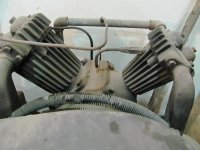
Nope,I'm running a 1937 IR T-30 that I can document the pump and tank as 1937. Note the vertical cooling fins on the cylinders.Nobody I have talked to has ever seen one of those.
Attachments


OP
RaysnCayne
Well-known member
Oldie but a goodie there Trbomax. BTW, my tank is dated "1936" so I may have you by a year.
Well, I might've jumped the gun on my "fix" for this intercooler. Went and JB-Welded it last night. Probably not my brightest moment. But I figured with a crack that big, it toast anyway so what have I got to lose? And a new one surely won't cost more than $75-100. (Wrong!)
I'll let that set up for a day or two and then fire her up again. If it doesn't hold, and I'm doubtful it will, then I'll scrape it off and see if it can be brazed.
I just got me a new unloader diaphragm. The old one was so hard and brittle it broke to pieces as I tried to remove it. Maybe I'll get lucky and find it was just the diaphragm. I checked the check valve and the piston thingy in the unloader. They both seem to be moving fine. Nothing frozen up anyways.
I'll get it all back together in the next night or two and give her another whirl.
Well, I might've jumped the gun on my "fix" for this intercooler. Went and JB-Welded it last night. Probably not my brightest moment. But I figured with a crack that big, it toast anyway so what have I got to lose? And a new one surely won't cost more than $75-100. (Wrong!)
I'll let that set up for a day or two and then fire her up again. If it doesn't hold, and I'm doubtful it will, then I'll scrape it off and see if it can be brazed.
I just got me a new unloader diaphragm. The old one was so hard and brittle it broke to pieces as I tried to remove it. Maybe I'll get lucky and find it was just the diaphragm. I checked the check valve and the piston thingy in the unloader. They both seem to be moving fine. Nothing frozen up anyways.
I'll get it all back together in the next night or two and give her another whirl.
Fixnair
Well-known member
I wouldn't try to get the unloader going. I think you would be better off getting a check valve with a bleeder port and a new pressure switch with an unloader valve on it. That way when the switch opens and shuts the motor off it will also open the unloader valve which will bleed off the air trapped in the head and discharge pipe. Allowing the motor to start unloaded.
The reason you cannot rotate the compressor when it is shut off is the check valve is leaking pressure back on the high pressure piston.
FYI. The inter cooler tube which is broken can be silver soldered successfully by someone who knows what they are doing. I would take it to a refrigeration shop. Also, in normal operation the inter cooler should only see less than 40 PSI. If it is hi or low you have valve problems.
The reason you cannot rotate the compressor when it is shut off is the check valve is leaking pressure back on the high pressure piston.
FYI. The inter cooler tube which is broken can be silver soldered successfully by someone who knows what they are doing. I would take it to a refrigeration shop. Also, in normal operation the inter cooler should only see less than 40 PSI. If it is hi or low you have valve problems.
OP
RaysnCayne
Well-known member
Well, she seems to be working. Again.
I have serious doubts about the longevity of my JB Weld fix, but it didn't flinch when I put her all back together and fired her up this evening. I was gonna let it dry another 24-48 hours but I just couldn't wait that long. I'm gonna leave it at that and start shopping for a decent used tube from here on out. I expect the heating and cooling cycles will eventually take its toll and the JB Weld will loosen up.
The ol' codger at the compressor shop told me the tube will generally see about 60psi at 175. I'll set this to be around 155 so I figure that might be somewhere around 50psi. Still a fair amount of pressure for a jerry-rig fix. Oh well.
It would appear my $8 diaphragm did the trick! She got up to pressure and when the switch kicked it off, the unloader let out a nice burst of air. I could free-wheel the compressor sheave at that point. And it started back up just fine on its own when the pressure dropped.
I've got to get a new fitting for one end of the unloader line. (Chasing leaks like crazy!) Once I do that, I'll run a couple comparison tests and if the ol' 320 performs as well as or slightly better than my IR, I'll keep her.
Oh, one new concern: on start-up there seems to be some sort of a mild screech/grind sound for about 10-20 seconds or so. Once the pump's up and running it's nice and quiet. Don't think I heard that the first start up. I'm sure that's not good, but is that fatal, or just something old compressors do?
I have serious doubts about the longevity of my JB Weld fix, but it didn't flinch when I put her all back together and fired her up this evening. I was gonna let it dry another 24-48 hours but I just couldn't wait that long. I'm gonna leave it at that and start shopping for a decent used tube from here on out. I expect the heating and cooling cycles will eventually take its toll and the JB Weld will loosen up.
The ol' codger at the compressor shop told me the tube will generally see about 60psi at 175. I'll set this to be around 155 so I figure that might be somewhere around 50psi. Still a fair amount of pressure for a jerry-rig fix. Oh well.
It would appear my $8 diaphragm did the trick! She got up to pressure and when the switch kicked it off, the unloader let out a nice burst of air. I could free-wheel the compressor sheave at that point. And it started back up just fine on its own when the pressure dropped.
I've got to get a new fitting for one end of the unloader line. (Chasing leaks like crazy!) Once I do that, I'll run a couple comparison tests and if the ol' 320 performs as well as or slightly better than my IR, I'll keep her.
Oh, one new concern: on start-up there seems to be some sort of a mild screech/grind sound for about 10-20 seconds or so. Once the pump's up and running it's nice and quiet. Don't think I heard that the first start up. I'm sure that's not good, but is that fatal, or just something old compressors do?
EOC_Jason
Well-known member
Oh, one new concern: on start-up there seems to be some sort of a mild screech/grind sound for about 10-20 seconds or so. Once the pump's up and running it's nice and quiet. Don't think I heard that the first start up. I'm sure that's not good, but is that fatal, or just something old compressors do?
That is pretty vague... I had a friend's compressor that started making a loud screeching sound. Turned out the connecting rod bearings wore down and ground the snot out of the crank...
OP
RaysnCayne
Well-known member
I agree it is rather vague Jason. But I felt it was worth mentioning just in case someone here might be familiar with the description.
I'm gonna see if I can get some footage of it and post it. I'm gonna run it a few more times and see if it's consistent before I freak out too much. It just seems odd that I didn't hear this sound the first time I started it up but now that the unloader seems to be fixed, I do.
I'm gonna see if I can get some footage of it and post it. I'm gonna run it a few more times and see if it's consistent before I freak out too much. It just seems odd that I didn't hear this sound the first time I started it up but now that the unloader seems to be fixed, I do.
OP
RaysnCayne
Well-known member
Got some shaky, poor-sound-quality video on my Flip camera this evening. Gonna try to embed it here to see if anyone can tell me what might be going on on the start-up with this ol' girl.
[Okay, I'm too dumb to figure out how to embed a video. You'll just have to make the jump to YouTube.]
This is the initial start-up:
You hear the screech/grind sound til about the 33-34 second mark, then it quiets down and sounds pretty normal.
This is how it sounds starting after the pressure has dropped in the tank (about 10 mins after I made the first video):
You hear the screech/grind sound for the first 9-10 seconds.
[Okay, I'm too dumb to figure out how to embed a video. You'll just have to make the jump to YouTube.]
This is the initial start-up:
You hear the screech/grind sound til about the 33-34 second mark, then it quiets down and sounds pretty normal.
This is how it sounds starting after the pressure has dropped in the tank (about 10 mins after I made the first video):
You hear the screech/grind sound for the first 9-10 seconds.
Last edited:
G_P
Well-known member
My compressor has a small pug that pushes into a port over the crank where the crank comes out and the pulley goes on.
When got the compressor the grease inside was mostly hard and nasty as hell. It squealed like a stuck pig when I first fired it up. Cleaning out the old grease and refilling it with new grease made the squeal stop.
COuld also be the motor. Some have oil ports or oil cups on each end. For the oil cup style with the flip up lid I use non detergent 30w oil. FOr the ones with just a hole and felt around the bushng to hold the oil I use thinner oil.
When got the compressor the grease inside was mostly hard and nasty as hell. It squealed like a stuck pig when I first fired it up. Cleaning out the old grease and refilling it with new grease made the squeal stop.
COuld also be the motor. Some have oil ports or oil cups on each end. For the oil cup style with the flip up lid I use non detergent 30w oil. FOr the ones with just a hole and felt around the bushng to hold the oil I use thinner oil.
OP
RaysnCayne
Well-known member
Are you referring to this cover G P?
I looked at that a few times when I had the sheave off and fiddling with the intercooler. I was curious but some how not enough to open it up. (Derr...)
I opened it up and there doesn't seem to be anything in it. I can't see down to the bottom without taking the sheave (and possibly the intercooler) off. Should it be full of grease under normal circumstances?
The motor has a grease fitting on each end. I just pumped a bunch of grease into them. (No idea why I didn't do this before.) I ran it and it still has the screech/knock sound. So it's probably the compressor, right?
I looked at that a few times when I had the sheave off and fiddling with the intercooler. I was curious but some how not enough to open it up. (Derr...)
I opened it up and there doesn't seem to be anything in it. I can't see down to the bottom without taking the sheave (and possibly the intercooler) off. Should it be full of grease under normal circumstances?
The motor has a grease fitting on each end. I just pumped a bunch of grease into them. (No idea why I didn't do this before.) I ran it and it still has the screech/knock sound. So it's probably the compressor, right?
Attachments
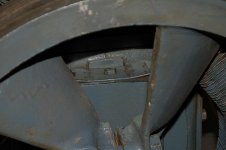

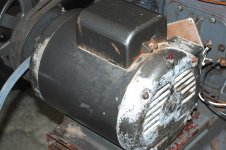
When I can't tell where a sound is coming from, I'll usually put a piece of rubber hose to my ear and move it towards each moving part until I can localize the sound.
A mechanics stethoscope would come in handy as well. I use them for isolating bad bearings when I'm working on cars. They're handy things to have in general.
http://www.harborfreight.com/mechanics-stethoscope-41966.html
A mechanics stethoscope would come in handy as well. I use them for isolating bad bearings when I'm working on cars. They're handy things to have in general.
http://www.harborfreight.com/mechanics-stethoscope-41966.html
OP
RaysnCayne
Well-known member
Near as I can figure, it's coming from the compressor and not the motor. The motor has good oil and a good oil level.
I'm kinda at a stand-still on this now. Any thoughts/suggestions on what that sound might be caused by?
I'm kinda at a stand-still on this now. Any thoughts/suggestions on what that sound might be caused by?
EOC_Jason
Well-known member
Did you ever trace down the source of the noise? Was it doing it before you fiddled with the unloader?
OP
RaysnCayne
Well-known member
No. No progress lately. I'm at the end of my knowledge bank on this thing. (Heck, I was at that before I even moved it into the garage.) I've fired it up a couple more times. It still screeches/knocks the first 20-30 seconds on a cold start-up and then acts just fine.
You know, I don't know if it was making any of these noises before the unloader diaphragm replacement. (That's all I did to the unloader. Can't imagine a little piece of rubber that fixed the unloader would cause all this racket in the compressor.) I only ran it once and all the sounds were new to me at that point. So I wasn't listening too keenly.
I'd like to keep it and make her run nice again. But at the same time, I can't keep throwing $$ I don't have at it.
You know, I don't know if it was making any of these noises before the unloader diaphragm replacement. (That's all I did to the unloader. Can't imagine a little piece of rubber that fixed the unloader would cause all this racket in the compressor.) I only ran it once and all the sounds were new to me at that point. So I wasn't listening too keenly.
I'd like to keep it and make her run nice again. But at the same time, I can't keep throwing $$ I don't have at it.
You've got $275 or so into a unit that would cost a few grand to replace. I'd say keep plugging away at it. All the expensive stuff functions, fortunately. When it's running the way it should you'll not only have a great machine, you'll know every part of it and how it should function.