Placeholder17
Well-known member
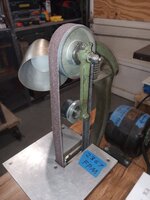
I wasn't even looking for a 1 inch sander when I saw this randomly browsing Facebook Marketplace. I'd never anything before other than the typical sheet metal combined 1 in belt / 6 in disc sander, but this sucker was all cast-iron, so I ran and bought it the same night.
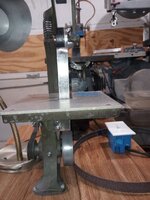
According to Vintage Machinery, this was the first 1 in belt sander, and only a decade later the manufacturer moved from cast iron to sheet metal. Actually, it may be very early on in their business/quality control efforts because the base isn't even flat; they never ground down the casting mold joint ridges. It was easily shimmed though. You can also see how this was a first concept in that the slot for the belt is behind the platen, not to the side like a modern sander, which makes it annoying to change a stiff coarse grit belt that doesn't want to to turn the corner.
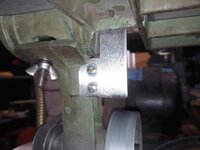
Otherwise, it works great. The top arm is spring loaded and has has no guard....you just press down and slide off the belt, then slide on the next one and let go. I can change a flexible fine grit belt in under 5 seconds, and a stiff coarse grit belt that has to be babied around the slot takes around 10 seconds.
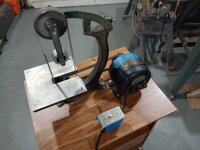
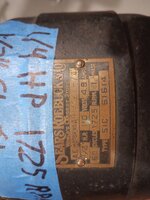
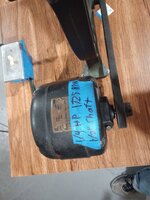
The original platen was aluminum, well-worn, and uneven, so I made a new one from bed frame steel (after a lot of sanding smooth). Originally, It was mounted to a piece of particleboard countertop with a 1/3 HP motor to be "portable", but that motor was overkill. I moved it to a wheeled card from the local thrift store, added a light, and decided to use the oldest motor I had laying around, a Sears 1/4" motor that I think is 1920's.
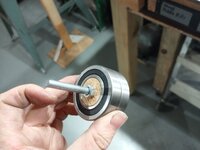
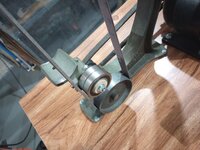
All bearings are ball bearing and shielded on only one side, with grease ports through the castings for access. It was very easy to take them out, clean, and repack. The exception is the bearing immediately behind the drive pulley. It has no shields at all and uses the oversized pulley bore to cover it up.
It's louder than a modern sander because the arm hinge pins aren't tight in their bores and arm doesn't have a means to clamp rigidly, so there is more vibration.
According to Vintage Machinery, this was the first 1 in belt sander, and only a decade later the manufacturer moved from cast iron to sheet metal. Actually, it may be very early on in their business/quality control efforts because the base isn't even flat; they never ground down the casting mold joint ridges. It was easily shimmed though. You can also see how this was a first concept in that the slot for the belt is behind the platen, not to the side like a modern sander, which makes it annoying to change a stiff coarse grit belt that doesn't want to to turn the corner.
Otherwise, it works great. The top arm is spring loaded and has has no guard....you just press down and slide off the belt, then slide on the next one and let go. I can change a flexible fine grit belt in under 5 seconds, and a stiff coarse grit belt that has to be babied around the slot takes around 10 seconds.
The original platen was aluminum, well-worn, and uneven, so I made a new one from bed frame steel (after a lot of sanding smooth). Originally, It was mounted to a piece of particleboard countertop with a 1/3 HP motor to be "portable", but that motor was overkill. I moved it to a wheeled card from the local thrift store, added a light, and decided to use the oldest motor I had laying around, a Sears 1/4" motor that I think is 1920's.
All bearings are ball bearing and shielded on only one side, with grease ports through the castings for access. It was very easy to take them out, clean, and repack. The exception is the bearing immediately behind the drive pulley. It has no shields at all and uses the oversized pulley bore to cover it up.
It's louder than a modern sander because the arm hinge pins aren't tight in their bores and arm doesn't have a means to clamp rigidly, so there is more vibration.
Attachments
-
 IMG_20241117_160931518.jpg803 KB · Views: 55
 -
 IMG_20241116_161945755.jpg484.7 KB · Views: 47
 -
 IMG_20241117_160922672_HDR.jpg646.9 KB · Views: 41
 -
 IMG_20241117_160931518.jpg803 KB · Views: 48
 -
 IMG_20241115_183345116.jpg727.4 KB · Views: 47
 -
 IMG_20250926_101519990.jpg668.3 KB · Views: 42
 -
 IMG_20250926_101637611.jpg682.3 KB · Views: 37
 -
 IMG_20250926_101502013.jpg884.3 KB · Views: 38
 -
 IMG_20241117_160952139.jpg898.9 KB · Views: 36
 -
 IMG_20241117_160944682.jpg770.7 KB · Views: 36